 x/health ·
Published: October 5, 2026 | Reading Time: ~7 minutes | Topic: Nutrition & Everyday Metabolic Health
Picture this: it's 12:45 PM, your lunch break is a warzone, and you demolish your salad-and-sandwich combo in seven flat minutes at your desk. You feel fine. Then 1:15 PM hits and suddenly you're stuffed, foggy, and weirdly raid-hungry again by 3. Sound familiar? Here's the plot twist — your stomach actually did text your brain. Your brain just took its sweet time reading the message.¹
Today we're talking about the 20-minute fullness lag, the Ozempic-era hormone your own gut has been quietly making all along, and the gloriously unglamorous habit — eating slower — that science keeps linking to better metabolic health. No syringes, no willpower theatrics. Just a fork, a timer, and maybe putting your phone face-down. Let's go. 🚀
Here's the strange, wonderful plumbing of a meal. When food hits your stomach, the muscles around it stretch, and stretch-sensors fire messages up to your brain. At the same time, your gut starts releasing fullness hormones like leptin and cholecystokinin (CCK). The catch? It takes a while for those hormone and insulin levels to rise high enough for your brain to detect them. "It's not a super speedy process," as Cleveland Clinic psychologist Susan Albers, PsyD puts it — she compares the stomach-to-brain connection to old-school dial-up speed rather than instantaneous WiFi.¹
How long is the lag? The popular science answer is about 20 minutes from your first bite until fullness fully registers — and Dr. Albers notes it can be up to 30 minutes for some people.¹
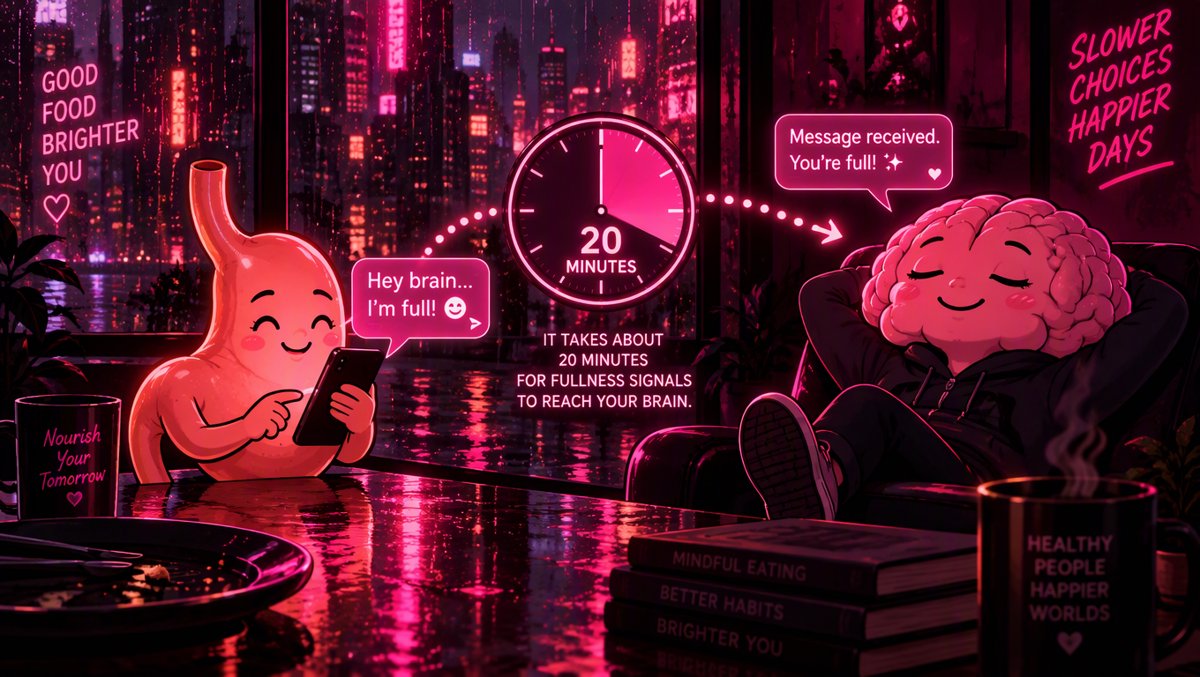 Which means a fast eater can blow straight past "satisfied" and land at "uncomfortably stuffed" before the signal ever arrives. Cleveland Clinic even has a fun tool for this: a hunger/fullness scale from 1 (starving) to 10 (absolutely stuffed), with the sweet spot being staying between 4 and 7 — eating when you're genuinely hungry, stopping at satiated, not stuffed.¹
Try this:
🔑 Key takeaway: Your stomach sends the "I'm good" text almost immediately — but your brain reads it roughly 20 (some say up to 30) minutes later. Fast eaters keep typing after the message lands.¹
Okay, GLP-1. You've heard the name a thousand times this decade — it's the hormone behind the blockbuster weight-loss injections. But here's what the marketing doesn't mention: your body already makes GLP-1. It's a satiety hormone your gut releases during meals; it helps you feel full, slows stomach emptying, and blunts blood-sugar spikes.² That's the very mechanism drug companies figured out how to amplify — the original version has been bundled with your biology since birth.
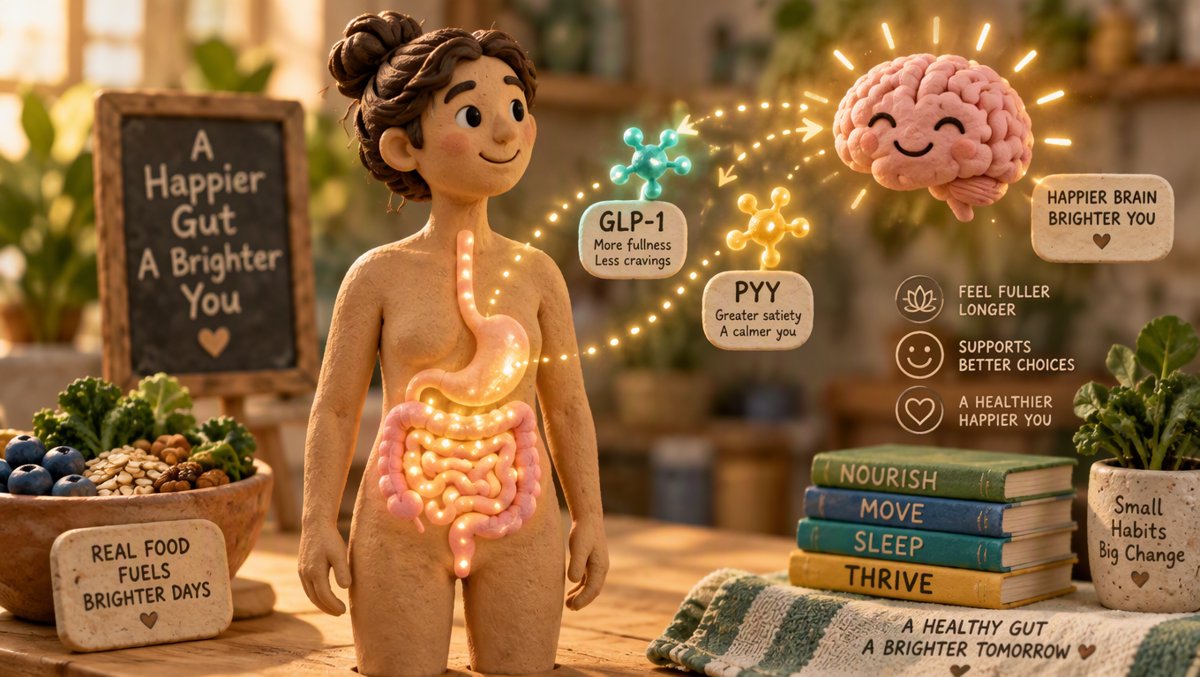
And eating speed? It directly tunes that system. In a neat clinical experiment, researchers gave healthy volunteers the same dessert on two occasions — once in 5 minutes, once in 30 — and measured their gut hormones. Slow eating produced a bigger release of peptide YY (PYY) and GLP-1, the two hormones that tell your brain "we're fed."³ Meanwhile, a study in people with type 2 diabetes found that slow, spaced eating increased GLP-1 and PYY responses along with feelings of fullness.⁴ And remember: GLP-1's natural job includes slowing how fast food leaves your stomach — one reason fuller-hormone meals keep you satisfied longer and steady out your glucose curve.²
Translation: when you inhale lunch, you outrun your own pharmacy. When you eat at a human pace, you give your gut's hormone system time to actually switch on.
Try this:
🔑 Key takeaway: You don't need a prescription to touch the GLP-1 system — your gut makes it, and eating slowly is how you let it clock in.³⁻⁴
Maybe you're thinking, "I eat fast and I'm fine — this is a weight thing, I'll pass." Fair, but the research story is bigger than the bathroom scale. A large Japanese cohort study found that eating speed was associated with the incidence of metabolic syndrome — the cluster of high blood pressure, high blood sugar, abnormal cholesterol, and belly fat that raises risk for heart disease and diabetes — with the authors concluding that eating slowly may be an important lifestyle factor.⁵ A 2021 systematic review and meta-analysis pooled the global evidence and echoed the association between fast eating and metabolic syndrome.⁶
And your liver has opinions too. A 2024 meta-analysis of five studies found that frequent fast eating was linked to about a 22% higher risk of MASLD — metabolic dysfunction-associated steatotic liver disease, the fatty-liver condition now estimated to affect roughly 1 in 3 adults.⁷
Now, the honest fine print (we always bring the fine print): these are observational studies. They show fast eating is linked to these conditions — fast eaters may also be eating bigger portions, more ultra-processed food, or carrying other risk factors. But here's the thing — slowing down costs you nothing and carries zero side effects. Even if half the association melted away under better-controlled studies, you'd still be left with a free habit that helps you notice fullness, enjoy food more, and probably chew better. That's a bet even the most skeptical scientist would take.
Try this:
🔑 Key takeaway: Eating speed keeps showing up in studies of metabolic syndrome and fatty liver — the evidence says linked, not proven cause, but slowing down is the rare zero-risk upgrade.⁵⁻⁷
Raise your hand if your last meal came with a side of scroll. 🙋 (Both of my hands are up.) Here's what attention has to do with it: in a study of young adults, people who ate while using their smartphones consumed about 15% more total calories than those who ate without a device.⁸ And it's not just phones — a systematic review of 24 studies found that eating while distracted moderately increases how much you eat at that meal, and — sneakier still — distracted eaters eat even more at the next meal, as if the brain never properly logged the first one.⁹ Harvard Health summarizes the research the same way: distracted eating may add to weight gain, while paying attention to what you're eating helps you consume less.¹⁰
The mechanism is delightfully obvious once you see it: your brain's food-recording system needs attention to write the memory. Scrolling through the soup means the memo never gets filed, so 90 minutes later your brain asks, "Wait, did we even eat?"

Try this:
🔑 Key takeaway: Multitasking meals is a stealth calorie multiplier — about 15% more at the distracted meal, and extra at the next one too. The fix is embarrassingly simple: look at your food while you eat it.⁸⁻¹⁰
Let's end with the least sexy, most underrated lever in the whole operation: chewing. In a classic clinical trial, researchers had people eat the same meal while chewing each bite 40 times instead of 15 — and they ate about 12% fewer calories at that meal, simply because the slower processing let fullness signals catch up.¹¹ Related research found obese participants took fewer chews per gram of food than lean participants, and that coaching them to chew more cut their intake at a meal.¹² A review of chewing experiments also found that increasing chews per bite raised relevant gut hormones in several studies, with mixed-but-promising effects on self-reported fullness.¹³
Are we saying count to 40 on every bite like some masticating metronome? No — and honestly, that depends on the food (40 chews of yogurt is its own mental health crisis). The spirit of the research is: give each bite more work, more time, and more attention.
Try this:
🔑 Key takeaway: Chewing is the manual override for the 20-minute lag — more chews per bite let your gut hormones and your brain get their signals straight.¹¹⁻¹³
All claims fact-checked against Gold-tier (CDC/NIH/WHO/PubMed/Nature/The Lancet) and Silver-tier (Mayo Clinic/Harvard Health/Cleveland Clinic) authoritative sources. Last verified: October 5, 2026.
Here's to slower lunches and smarter stomachs — tonight, give your dinner a fighting chance to be felt. 🌙