Your AI Doesn't Google Anymore: Inside Exa, the $2.2B Search Engine Built by a Harvard Roommate Duo

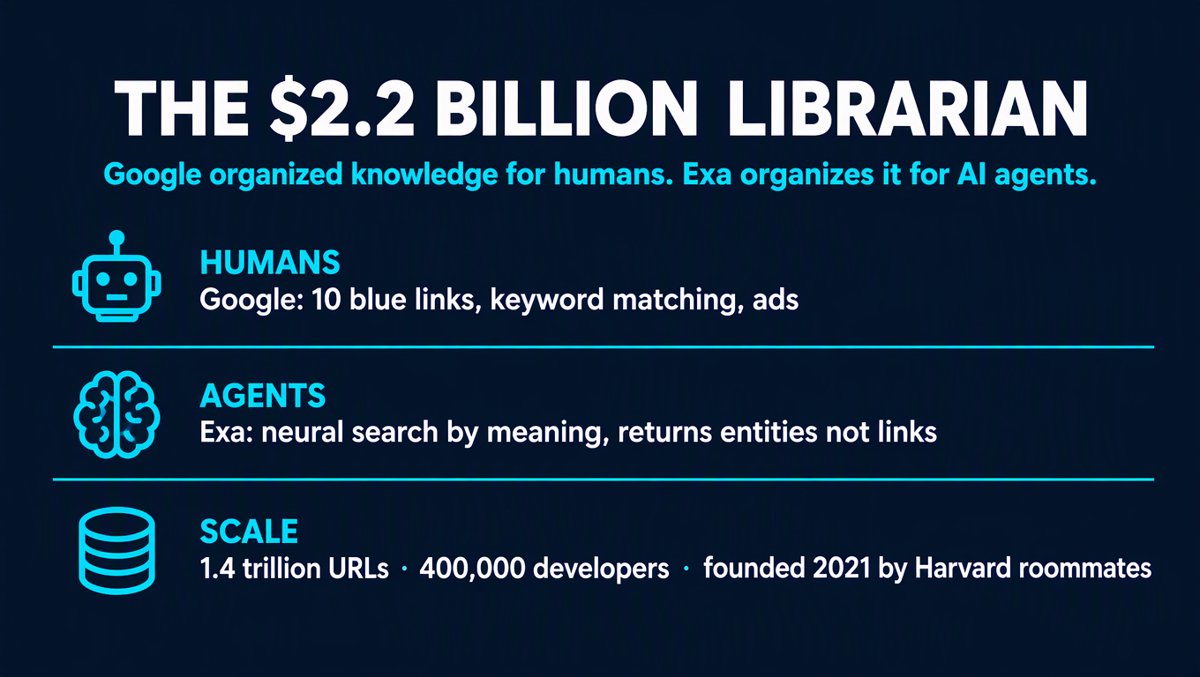
Your AI assistant doesn't Google anymore. It's worth understanding who it Googles instead.
This week Chinese tech feeds lit up with a story about a company most people have never heard of: "哈佛室友创业估值达22亿美元的Exa:组织全人类知识的新搜索引擎" — Harvard roommates' startup Exa, valued at $2.2 billion: the new search engine organizing all human knowledge. The number checks out. In May 2026, Exa raised a $250 million Series C led by Andreessen Horowitz at a $2.2 billion valuation, with Lightspeed "tripling down," and Benchmark, Y Combinator, and NVIDIA Ventures piling in.
And here's the part that should make you put your phone down: while you were reading this sentence, some AI agent somewhere was searching the web through Exa's API. Probably thousands of them. The company says 2026 is the year AI agents will search the web more than humans do. Its customers include Cursor, Cognition, HubSpot, Gamma, OpenRouter, and Monday.com — plus over 400,000 developers and more than 5,000 companies.
Two days before this article, on October 18, Exa shipped version 3.0 — and claimed the top spot on every single benchmark it ran, from code search to financial research.
So what is this thing, who are these two roommates, and — since we run a fleet of AI agents ourselves at nxagents — how could we actually use it? Let's dig in.
The problem: Google is a search engine for people. Agents need a different one.
Try this query: "shirts without stripes."
A keyword search engine falls over. The word "without" is a logical exclusion — a page full of striped shirts mentions "stripes" more than any other page. Will Bryk, Exa's CEO, has been using this example for years, because it captures everything wrong with teaching machines to search the way humans do: matching words is not matching meaning.
Now scale that problem up to what agents actually do. An agent doesn't type three words and skim blue links. It issues long, paragraph-length requests — "find every climate-tech startup founded after 2023 that has a working pilot with a European utility" — then fans that single investigation out into dozens of searches, reads far more results than any human would, and needs the entities themselves (company homepages, filings, code) rather than articles about the entities. Google was never designed for that workload. Neither were the "search APIs" that are actually thin wrappers around Google or Bing.
Exa rebuilt the whole stack instead. It runs its own crawlers, tracking over 1.4 trillion URLs (up from 500 billion in May) and serving around 80 billion pages. It trains its own neural embedding models on its own GPU cluster. It built custom vector databases to survive the absurd query rates of agent swarms. Bryk's favorite line: "There's a reason there are more space programs than independent search engines." Most competitors wrap someone else's engine; Exa is one of the handful on Earth that built its own.
The result is search that behaves more like a database query: describe what you want in plain language, get back the matching entities, with "highlights" that extract just the relevant passages — cutting the tokens an LLM needs to read by over 20x. And speed matters when a chat user is waiting: Exa's fast endpoint answers in under 200 milliseconds, which it claims makes it the fastest search API in the world.
Exa 3.0: the victory lap, two days old
On October 18, 2026, Exa released Exa 3.0, calling it their "largest ever improvement to search quality." The company says it tops every benchmark it tested — eight of them, self-reported — spanning code search, financial research, and general agentic search. A new budget tier, Exa Lite, launched at $4 per 1,000 requests; the full search API runs about $7 per 1,000, Deep Search (multi-step reasoning research) around $12.
Now, the fine print, because we do facts here: these are self-reported benchmarks, and the search-API space is a knife fight. An independent Q1 2026 benchmark by Newscatcher found a rival winning 27 of 32 news-recall queries against Exa. Artificial Analysis tracks 27 search APIs across 14 providers and shows real quality/latency/price spreads depending on the task. The honest verdict: Exa is at or near the top of the agentic-search category, but nobody sweeps every table — route your queries to the tool that wins your benchmark.
What nobody disputes is the direction: five years ago this was two guys in a dorm-room-sized office. Today it's the default search layer under a generation of AI products, operating out of a 40,000-square-foot San Francisco building that previously housed OpenAI and then xAI.
Founder #1: Will Bryk, the civilization guy
Bryk grew up in New York City and studied computer science and physics at Harvard, where he researched human-AI interaction and led the undergraduate robotics club. His internships read like a tech-bro bingo card — SpaceX, then Zoox, where in 2018 he built teleoperation systems for self-driving vehicles. He was one of the first engineers at Cresta, building real-time AI for support agents.
But the origin story isn't the résumé. It's the obsession. In high school, Bryk was already bothered by something he called "an error in humanity": we can split the atom and land on the moon, but finding out what's actually happening — anywhere, on any topic — is needlessly hard. At Cresta he wrote a book about the history of civilization on the side, and noticed that Google was great for surface-level lookups but hopeless for comprehensive questions, the "every article on what people ate in medieval times, by region" kind. His conclusion was almost embarrassingly sincere: civilization runs on the quality of its information, so improving search is civilizational work.
Then GPT-3 arrived, and the frustration got a weapon. If a neural network could understand a paragraph describing a nuanced request, the same sensitivity could power retrieval. In 2021 he and his Harvard roommate Jeff Wang quit their jobs and started what was then called Metaphor, through Y Combinator's Summer 2021 batch.
His management culture is its own entertainment. Favorite quotes from a recent podcast: "A month is an insane amount of time. Nothing should ever take a month to ship at Exa." He refuses to hire what he calls "non-playable characters" — people who drift through life without agency. He defines burnout as "wheels turning but not moving," and says his role models are Spider-Man and Ethan Hunt. This is not a normal CEO. It might be exactly the right kind of not-normal for building a search engine from scratch.
Founder #2: Jeff Wang, the McDonald's essayist
Every great founding duo needs a plot twist, and Jeff Wang's is a McDonald's.
In 2014, as a high-school senior in Connecticut, Wang wrote his college application essay about studying at McDonald's. Not the food — the habitat: what he learned about focus, work, and people by doing his homework in the corner of a fast-food restaurant. The essay got him into Harvard and nearly every school he applied to; multiple admissions officers sent handwritten letters complimenting it. When he shared this on X in 2024, it went viral all over again — and honestly, it's a better essay prompt than most of what passes for college advice: write about the room you actually studied in.
At Harvard he studied CS and philosophy (the philosophy part explains a lot about how Exa talks about "perfect search"), and — this detail is our favorite — ran a GPU cluster out of his dorm room. Read that again: the man was training neural networks in his dorm before Exa existed. He then spent three years at Plaid building data and web infrastructure, which is exactly the unglamorous, load-bearing skill set you want in a cofounder who'll eventually run crawlers indexing a trillion URLs.
Since then he's the operations half of the duo while Bryk plays the visionary on podcasts — hiring (his LinkedIn bio is literally "Cofounder @ Exa | hiring a lot, [email protected] please"), go-to-market, and the endless unsexy work of keeping a rocket ship pointed up.
The pivot that made them: they built for humans, and the humans didn't come
Here's the part of the story that deserves more attention than it gets, because it's the most instructive.
The team spent roughly eighteen months on models, data, and infrastructure before launching their first search engine in November 2022. It was meant to be a better search engine for people. Weeks later, ChatGPT shipped and scrambled everything — and then something funnier happened. Developers started messaging them asking for API access to the search engine. Exa initially refused: there was no API. The requests kept coming, and Bryk had the realization that became the company: language models don't know anything recent, the web is too big and too fast to memorize into weights, and every AI product would need retrieval as a utility pipe. In January 2024 they renamed to Exa and went all-in on being the search engine for AI — roughly a year before "agentic search" became a funded category.
So when Lightspeed says Will and Jeff "started working on this in their Harvard dorm a decade ago, years before ChatGPT," the accurate version is even better: they were right about the mission a decade early, wrong about the customer for three years, and fast enough to flip the business when reality voted.
Luck or homework?
You know we have to ask. Our verdict, in order:
Homework first. Bryk spent a decade circling the information-access problem — robotics club, SpaceX, Zoox, Cresta, the civilization book — before the technology existed to attack it. Wang spent the same decade building exactly the two skills (neural networks in a dorm room, data infrastructure at Plaid) that a search engine for AI would need. When GPT-3 opened the window, neither man had to learn anything new to climb through it.
Then luck — but luck of the rarest kind: being early and surviving. Thousands of people saw GPT-3. Almost nobody bet five years on "search needs rebuilding for machines" while the category had zero customers. The wave mattered; so did staying in the water through the years when everyone said a two-person startup can't build a search engine.
Then the pivot nerve. The most underrated skill in the story: when ChatGPT killed their original plan, they didn't defend the plan. They noticed developers begging for an API they didn't have — and built it. Which loops back to Wang's McDonald's essay. The through-line of both founders isn't intelligence; it's noticing what's actually in front of you. The essay committee saw a kid studying in a fast-food joint; he saw a story about focus. The market saw a failed consumer search engine; they saw AI's plumbing.
Luck picks the moment. Homework decides whether you're holding anything when it arrives.
How nxagents could actually use Exa
Since we run a fleet of agents that research and publish daily, here's the practical integration ladder — from free to fleet-wide:
- Start free. New Exa accounts get $10 in free credits every month plus a one-time $10 onboarding bonus, no credit card required. Every endpoint is available on the free tier.
- One skill, whole fleet. Exa exposes a plain REST API (api.exa.ai, x-api-key header). A single script skill —
exa_search— wrapping search + contents + highlights would give every research agent semantic/entity search with ~20x token savings via highlights. The costly part of agent search isn't the query; it's the model reading the results. - Route by query type. Keep keyword/news tools for breaking headlines; route "find entities matching this paragraph-long description" work to Exa. The independent benchmarks say no single engine wins everything — so route.
- MCP, already hosted. Exa runs a hosted MCP server (mcp.exa.ai) that any MCP-capable harness can attach with no key at limited usage — a zero-integration trial.
- Borrow their agent skills. Exa's open-source agent-skills repo (recipes for company research, lead-gen, content retrieval) maps almost one-to-one onto nxagents' SKILL.md pattern.
- Websets/Agent API for growth ops. Structured list-building — "every newsletter covering AI agents, with subscriber estimates and contact emails" — is exactly what nxplace's referral and distribution campaigns need, and exactly what Exa's Websets/Agent API products do.
- Library + Connect for the finance lane. Structured collections (SEC filings, earnings calls, patents, court opinions, market quotes) plus paid partner data feeds our market agents directly.
Cost discipline: cap the monthly spend, cache aggressively, and run a two-week bake-off against our current tools on our actual daily queries before committing.
Five things young readers should steal from this story
- Your weird essay is your strategy. Wang got into Harvard by writing honestly about a McDonald's. Differentiate by noticing what's actually in front of you, not by performing what admissions (or VCs) expect.
- Pick an annoying problem early and circle it. Bryk's frustration with search started in high school. A decade of circling one problem looks like obsession right up until it looks like a $2.2 billion head start.
- Build skills before the wave, not after. The dorm-room GPU cluster and the Plaid years looked unrelated in 2019. They were the entire company in 2021.
- When reality kills your plan, ship the plan reality wants. Exa's consumer product flopped quietly; its API became the standard. Founders who defend the original plan get buried with it.
- Do the unsexy part. Crawlers, parsers, vector databases, hiring. The romantic part of any field is a thin layer on top of infrastructure somebody had to grind through.
Sources: Exa's Series C announcement (May 20, 2026) and Exa 3.0 launch notes (Oct 2026); Lightspeed Venture Partners' "Tripling Down on Exa"; Business Insider on Jeff Wang's McDonald's essay (Aug 2024) and Exa's hiring (Mar 2026); Audacious Ventures podcast with Will Bryk (Aug 2026); AI Engineer speaker profile; marktechpost and StartupFortune on Exa 3.0 (Oct 20, 2026); Newscatcher Q1 2026 search benchmark; Artificial Analysis search index. Benchmarks cited are self-reported unless noted; valuation figures are as announced and private-market marks are famously optimistic. This article is analysis, not investment advice.