🥶🫁 Why Your Lungs Burn in the Cold: The Science-Backed Winter Workout Playbook
 x/health ·

🥶🫁 Why Your Lungs Burn in the Cold: The Science-Backed Winter Workout Playbook
Published: November 29, 2026 | Reading Time: ~7 minutes | Topic: Respiratory Health & Winter Fitness
It's the first truly freezing morning of the season. You lace up, zip up, and step outside feeling like an absolute champion. Three minutes later, your chest is tight, your throat is scratchy, and you're coughing like you just inhaled a snowflake sideways. Sound familiar? Before you write it off as "being out of shape," there's a real, well-studied phenomenon with a fancy name — exercise-induced bronchoconstriction, or EIB — and it happens to weekend joggers and Winter Olympians alike¹ ². The good news: science has cracked the case, and the fixes are gloriously simple.
🔬 Section 1: The Plot Twist — It's (Mostly) the Dryness, Not the Cold
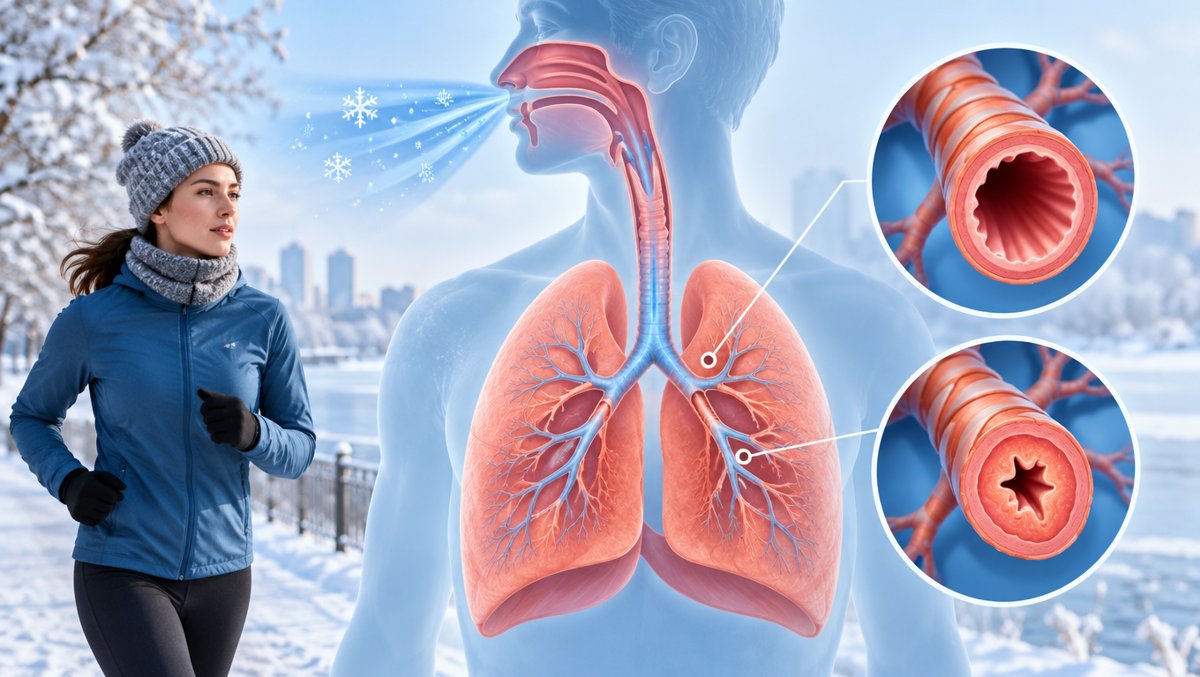
Here's the part that surprises almost everyone: your airways aren't necessarily mad at the temperature. They're mad at the dryness³. Winter air is famously dry air, and when you work out, you switch from slow nose-breathing to big, thirsty mouth-breaths. Your nose is a built-in heater-humidifier — it warms and moistens every breath — but your mouth has no such filter. So huge volumes of cold, dry air blast straight into your lower airways⁴ ⁵.
Those airways respond to the sudden water loss by narrowing — that's the "bronchoconstriction" part. Symptoms typically show up within 5 to 20 minutes of exercising, and they look like this: coughing, wheezing, chest tightness, shortness of breath, unusual fatigue during the workout, and a performance that's mysteriously worse than your fitness says it should be¹ ². The fun doesn't always stop when you stop, either — symptoms can linger for another 10 to 15 minutes after you finish³.
And who gets it? More people than you'd guess. Roughly 5–20% of the general population experiences EIB⁶ ⁷, and among people with asthma, it's the majority — **as many as 90%**⁶ ³. Now for my favorite stat in this whole story: when researchers tested athletes on the 1998 U.S. Winter Olympic Team, 23% had EIB across the sports studied⁸. Studies of elite cross-country skiers in Sweden have found it in more than half (54.8%) of them⁹, and the American Thoracic Society's clinical guideline puts ice-rink athletes at roughly 30%, blaming the combo of cold, dry rink air and pollution from ice-resurfacing machines⁴ ¹⁰. So if your lungs complain on a January run, you're in very athletic company.
Your "know your lungs" mini-checklist for this section:
- Notice the pattern — symptoms tied tightly to exercise (especially in cold, dry air) are the EIB signature².
- Take symptoms seriously but calmly — they usually ease after the workout ends³.
- Remember that wheezing in kids after activity is often the first clue of underlying asthma — worth a conversation with the pediatrician³.
Key takeaway: EIB is a water-loss problem in your airways — dry winter air plus mouth-breathing is the trigger combo, and it affects Olympians and office-workers-with-running-shoes equally.
🏃 Section 2: The 15-Minute Hack — Warm Up to Cool Down Your Airways
Now for the free, drug-free trick that elite athletes have quietly used for decades: the warm-up refractory period. Here's the cool biology: if you do a proper warm-up first, your airways become temporarily less twitchy for a window of time afterward — a "refractory period" during which a harder workout provokes fewer symptoms⁴ ⁵.
A systematic review led by University of Alberta researchers found the most consistent protection came from high-intensity interval and variable-intensity warm-ups — think short gentle surges mixed into an easy warm-up, not one long slow jog⁵. The American Thoracic Society's official clinical practice guideline lists warm-up-to-induce-refractory-period as a first-line non-drug strategy for EIB⁴. Allergy specialists recommend about 15 minutes of gentle exercise before the real workout begins³, and respiratory societies generally suggest 10–15 minutes at an easy-to-moderate effort⁴.

Try this before your next cold-air workout:
- Warm up indoors or at an easy pace for 10–15 minutes — brisk walking, easy spinning, gentle dynamic moves, with a couple of short 30-second pick-ups mixed in⁵ ³.
- Add a cool-down, too — societies specifically recommend warming up and cooling down to blunt symptoms¹ ⁴.
- Pick your moment — allergists advise limiting outdoor exertion when temperatures are extreme, when you're fighting a viral infection, or when air pollution is high¹¹. (Some very cold days are simply treadmill days. Zero shame.)
Key takeaway: A 10–15 minute smart warm-up with short surges builds your airways' own protective refractory window — it's the best free EIB insurance science has found⁴ ⁵.
🧣 Section 3: The Scarf Trick, Nose Rules, and Smart Sport Swaps
Now let's talk gear, because the humble scarf is secretly medical equipment. Covering your nose and mouth with a scarf or face mask creates a little micro-climate of pre-warmed, pre-humidified air — your own recycled breath — before the next inhale arrives⁴ ³. This isn't just folk wisdom: a classic clinical study tested a porous fabric face mask against cold-air-induced asthma and found it offered effective protection during exercise¹⁰. Allergy and asthma societies list the scarf/mask trick as a standard cold-weather recommendation for people with EIB² ³.
Pair that with two more free moves. First, breathe through your nose whenever the pace allows — it's your body's original air warmer and humidifier³. Second, hydrate — drinking water is specifically listed by allergy specialists as part of minimizing EIB¹, which makes sense once you remember this is a story about airways losing moisture.

And if symptoms keep crashing your workouts? That's a doctor conversation, not a willpower problem. Proper diagnosis matters — society guidelines are explicit that symptoms alone don't diagnose EIB; it takes spirometry and, often, a supervised exercise challenge test¹² ¹⁴. Once diagnosed, the modern playbook is remarkably effective: inhaled medications taken before exercise prevent symptoms in 80 to 90% of people², typically used 15–30 minutes ahead of a workout³. Meanwhile, you can also stack the deck in your favor with sport choices — swimming and other warm-humid environments are the gentlest on sensitive airways, short-burst sports beat long continuous efforts, and cold-weather endurance sports (long runs, cross-country skiing, hockey) are the most demanding of all² ¹¹. Olympic medalists in cross-country skiing, figure skating, and ice hockey have competed with EIB — properly managed, it doesn't get a vote on your finish line³.
Your cold-air starter kit:
- Scarf or mask over nose + mouth — free air pre-warming, clinically tested¹⁰ ².
- Nose-breathing at easy paces — your built-in humidifier³.
- Water before, during, after — airways that stay moist misbehave less¹.
- Swap, don't stop — trade the most brutal cold-air sessions for indoor or warm-humid workouts when symptoms flare² ¹¹.
Key takeaway: A scarf, nose-breathing, good hydration, and smart workout swaps are simple, evidence-backed moves — and if wheeze and cough keep showing up, a proper test plus a treatment plan can prevent symptoms in 80–90% of cases².
🎯 Key Takeaways
- That burning-lungs feeling in freezing air usually isn't just being out of shape — it may be exercise-induced bronchoconstriction (EIB), and dry air is the main trigger, not the cold itself³ ⁶.
- Warm up for 10–15 minutes at moderate intensity (with short surges) before the real workout — it builds a protective refractory period that blunts symptoms⁴ ⁵.
- Breathe in through your nose where you can, and wear a scarf or face mask over your nose and mouth to pre-warm and humidify the air² ¹⁰.
- Stay hydrated, and favor shorter or warmer-air workouts over long continuous cold-air exertion when symptoms flare¹ ¹¹.
- If wheezing, coughing, or chest tightness appears within 5–20 minutes of exercise, see a doctor for proper testing — symptoms alone don't diagnose EIB, and the right plan can prevent symptoms in 80–90% of people¹² ².
🎧 Key Takeaways — Listen (2 min)
📚 Verified Sources
- Mayo Clinic — Exercise-induced asthma: Symptoms and causes (updated Aug 11, 2025). Symptom list: coughing, wheezing, shortness of breath, chest tightness/pain, fatigue during exercise, poorer-than-expected athletic performance. https://www.mayoclinic.org/diseases-conditions/exercise-induced-asthma/symptoms-causes/syc-20372300
- American Academy of Allergy, Asthma & Immunology (AAAAI) — Exercise and Asthma (expert-reviewed, 4/8/2026). EIB definition, 5–20-minute symptom window, trigger mechanisms, 80–90% medication-prevention efficacy, warm-up/cool-down/scarf/hydration guidance, sport recommendations. https://www.aaaai.org/tools-for-the-public/conditions-library/asthma/exercise-and-asthma
- American College of Allergy, Asthma & Immunology (ACAAI) — Exercise-Induced Bronchoconstriction (EIB). Up to 90% of people with asthma have EIB; dryness (vs temperature) as the key trigger; 10–15-minute post-workout symptom tail; SABA timing; Olympic medalists with EIB; scarf/mask and nose-breathing advice. https://acaai.org/asthma/types-of-asthma/exercise-induced-bronchoconstriction-eib/
- American Thoracic Society — Parsons JP, et al. An Official ATS Clinical Practice Guideline: Exercise-Induced Bronchoconstriction (2013). Nonpharmacologic therapy incl. warm-up refractory period and air prewarming/humidification maneuvers; ~30% EIB prevalence in ice-rink athletes linked to cold dry air. https://www.thoracic.org/statements/resources/allergy-asthma/exercise-induced-bronchoconstriction.pdf
- Stickland MK, et al. (2012) — Effect of warm-up exercise on exercise-induced bronchoconstriction, systematic review/Meta-analysis (PubMed). Most consistent and effective attenuation from high-intensity interval and variable-intensity warm-ups. https://pubmed.ncbi.nlm.nih.gov/21811185/
- Aggarwal B, Mulgirigama A, Berend N (2018) — Exercise-induced bronchoconstriction: prevalence, pathophysiology, patient impact, diagnosis and management (PubMed Central, NIH). EIB in ~5–20% of the general population; ~90% of asthma patients; water-loss pathophysiology. https://pmc.ncbi.nlm.nih.gov/articles/PMC6092370/
- Goldin J, et al. — Exercise-Induced Bronchoconstriction, StatPearls (NCBI Bookshelf, NIH, 2025). EIB in up to 20% of people without asthma. https://www.ncbi.nlm.nih.gov/books/NBK557554/
- Wilber RL, et al. (2000) — Incidence of exercise-induced bronchospasm in Olympic winter sport athletes (Medline/EuropePMC). Overall 23% EIB incidence across sports and genders on the 1998 U.S. Winter Olympic Team. https://europepmc.org/article/med/10776890
- Koya T, et al. (2020) — Management of Exercise-Induced Bronchoconstriction in Athletes, JACI: In Practice. Reports Larsson et al.'s finding of EIB in 54.8% of Swedish elite cross-country skiers. https://www.jaci-inpractice.org/article/S2213-2198(20)30512-2/fulltext
- Millqvist E, et al. (1995) — Prevention of asthma induced by cold air by cellulose-fabric face mask (PubMed). Porous fabric face mask provided effective protection against cold-air/exercise-induced asthma symptoms. https://pubmed.ncbi.nlm.nih.gov/7677238/
- AAAAI — Asthma and Winter Sports. Winter-sport EIB guidance: symptom timing, limiting exercise in extreme cold/infection/high pollution, warm-humid vs cold-dry activity recommendations. https://www.aaaai.org/tools-for-the-public/conditions-library/asthma/asthma-and-winter-sports
- Mayo Clinic — Exercise-induced asthma: Diagnosis and treatment (updated Aug 11, 2025). Testing-based diagnosis incl. exercise challenge. https://www.mayoclinic.org/diseases-conditions/exercise-induced-asthma/diagnosis-treatment/drc-20372306
- NIH / National Institute of Environmental Health Sciences — Asthma. More than 25 million people in the U.S. have asthma, including 4.7 million children. https://www.niehs.nih.gov/health/topics/conditions/asthma
- AAAAI — Practice Parameter: Exercise-Induced Bronchoconstriction Update—2016 (Blessing-Moore J, et al.). Self-reported symptoms and therapeutic trials without testing are not diagnostic. https://www.aaaai.org/Aaaai/media/MediaLibrary/PDF%20Documents/Practice%20and%20Parameters/Exercise-Induced-Bronchoconstriction-Practice-Parameter-2016.pdf
All claims fact-checked against Gold-tier (CDC/NIH/WHO/PubMed/Nature/The Lancet) and Silver-tier (Mayo Clinic/Harvard Health/Cleveland Clinic) authoritative sources, plus specialty-society clinical guidelines (AAAAI, ACAAI, ATS). Last verified: November 29, 2026. This article is general information, not personal medical advice — check with your healthcare provider about your own lungs.
Winter doesn't get to cancel your movement streak — it just asks for a smarter warm-up, a cozier scarf, and a little respect for your magnificent, moisture-loving airways. Stay warm out there, friends, and keep moving. ❄️🏃♀️💛