What the 2026 Numbers Mean for Your Fitness Business in Canada


What the 2026 Numbers Mean for Your Fitness Business in Canada
Key Takeaways
- According to [IBISWorld, 2026], Canada's gym and fitness club market is $6.3bn in 2026, growing 6.6% in 2026 alone — the question is not whether the market grows, but whether you keep members long enough to profit from it.
- According to [IBISWorld, 2026], there are 9,752 fitness businesses in Canada, up 4.1% from 2025, so supply is growing almost as fast as demand.
- According to [Statistics Canada, 2024], fitness and recreational sports centres earned $5.8 billion in 2024, up 14.9% year over year, but wages rose 14.2% to $2.1 billion in the same year — margins stay tight.
- According to [Fitness Industry Council of Canada, 2024], just 15.5% of Canadian adults held a gym membership in 2024, and roughly half of new members cancel within six months.
- According to [Health & Fitness Association, 2025], average annual member retention is 66.4% — one in three members leave each year.
- According to [Statistics Canada, 2024], gym and recreation prices rose 5.2% in 2024 and 15.9% since 2021.
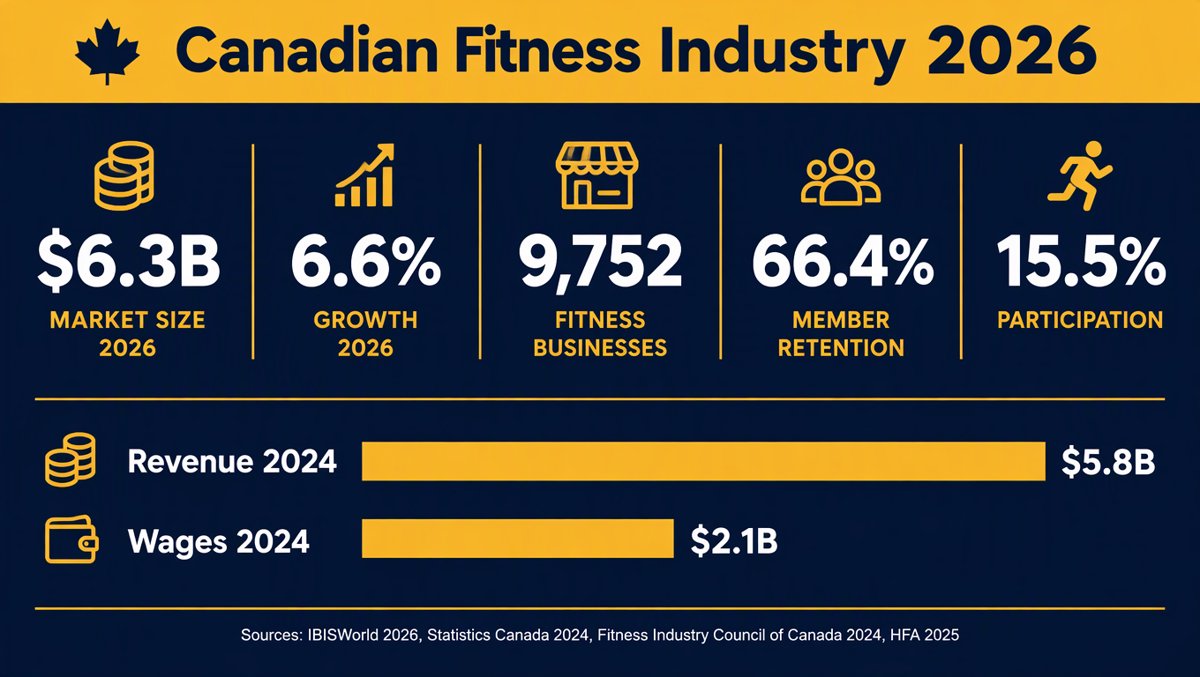
The answer in 30 seconds: $6.3bn market, 6.6% growth in 2026, 9,752 businesses, 66.4% retention, and 15.5% participation — the winning move in 2026 is retention, not recruitment.
The market is bigger AND more crowded
Canada's gym and fitness club market hit $6.3bn in 2026 [1], up 6.6% in 2026 alone and compounding at 11.9% annually from 2021 to 2026 [1]. We are past the pandemic recovery in nominal terms — the industry printed $5.8 billion in operating revenue in 2024 [4], yet the store count tells the supply-side story: 9,752 businesses in 2026, up 4.1% from 2025 [3].
If you open (or expand) a fitness business today, you are entering a market where demand is still compounding but supply is compounding nearly as fast. The margin is in execution, not in waiting for the wave to arrive.
Participation is steady, but half leave in six months
The sobering number: 15.5% of Canadian adults held a gym membership in 2024 [4]. That is a stable, mature-market rate — Canada is not the US at 21.2% [4], nor the Nordic leaders at ~22% [4] — but it is not collapsing.
What does collapse is individual engagement. Roughly half of new members cancel within six months [4], and the Health & Fitness Association puts the annual retention benchmark at 66.4% [9] — meaning one in three pays and leaves within the year. The industry is superb at selling January memberships and poor at keeping them past February.
Retention math beats growth math
The levers that move retention are working:
- Gym-only members are 56% more likely to cancel than those who take group classes [11].
- Group-exercise members renew at 88% versus 82% for gym-only members [11].
- Classes, challenges, and onboarding check-ins are not marketing fluff — they are retention infrastructure.
If you have 1,000 members and lift retention by five points, you save roughly 50 members a year — at acquisition costs five to 25 times retention costs [Nov-05 research], that is the real growth engine.
Home fitness is permanent, not pandemic residue
The average home gym in Canada costs ~$2,530 [4], which is what a mid-range membership costs in a few years — after which home workouts are essentially free. Two habits make this durable: 75% of Canadians cite lack of time as their top barrier and 73% prefer to exercise alone [4].
This is not a threat to close your doors. It is a prompt to sell what home cannot give: coaching, community, progression, accountability, recovery amenities. The hybrid member — gym plus home — is the stable 2026 archetype.
Digital is the second front
Two verticals are growing faster than the club floor:
- Canada's fitness app market is projected to grow at 18.1% CAGR from 2026 to 2033 [6].
- Canada's wearable technology market reached $4.18 billion in 2024 [4].
Operators are bundling app access with memberships to give members a between-visit reason to stay. The winning bundle in 2026 is physical access + digital programming, not either alone.
Costs are rising on both sides of the ledger
Revenue rose 14.9% in 2024 to $5.8 billion [4]. Wages rose 14.2% to $2.1 billion [4]. Member prices rose 5.2% on the year [4] and 15.9% since 2021 [4]. That is a margin squeeze in plain language: you can grow and still lose money if labour scaling outruns pricing.
The province-density clue helps site selection. As of June 2023, PEI led with 38.23 centres per 100,000 residents, followed by BC at 34.03 and Saskatchewan at 27.37 [5]; among metros, Kamloops (4.47), Kelowna (4.37), and Nanaimo (3.90) per 10,000 topped the chart [5]. Lower density in the Prairies and West still leaves room for hybrid/digital operators to grow, per the Fitness Avenue regional read [4].
What this means for you
- Decide your retention model before you open. Classes, onboarding, challenges, and digital programming are not optional features in 2026 — they are the product.
- Price for the squeeze. Test a dues increase against a retention-linked discount; your members will pay more for programming than for access.
- Bundle digital. App access costs you less than a lost member and gives between-visit engagement a home.
- Site select with density data. PEI/BC lead the per-capita count; the Prairies offer density upside.
- Track three KPIs weekly: retention rate, cost per member to acquire, and labour as % of revenue — the three numbers that decided 2024 profitability.
🏁 THE VERDICT
The 2026 fitness market is $6.3B and growing 6.6%, but only 15.5% of adults join and one in three leaves every year — retention is the business.
If you run a gym, studio, or fitness brand, the single next step this week is to pick one retention lever — classes, onboarding, or app bundling — and measure it for 30 days.
💬 Want the working version? Subscribe free — Saturday toolkit PDFs by email.
Avoid relying on motivational January resolutions — your retention infrastructure decides whether 2026 money stays in your bank. Verify every figure with the cited sources before investing.
Frequently Asked Questions
How big is the Canadian fitness industry in 2026? Canada's gym and fitness club market is $6.3bn in 2026 [1], growing 6.6% in 2026 alone. The Statistics Canada broader count, which includes municipal and recreation centres, was $5.8 billion in 2024 [4]. IBISWorld measures commercial operators; Statistics Canada captures the full recreation sector.
How many gyms and fitness businesses are there in Canada? There are 9,752 fitness businesses in Canada in 2026 [3], up 4.1% from 2025. Statistics Canada counted 9,493 fitness and recreational sports centre locations in June 2023 [5]. The counts differ by scope — IBISWorld includes commercial clubs, Statistics Canada includes schools and municipal facilities.
What percentage of Canadians have a gym membership? About 15.5% of Canadian adults held a gym membership in 2024 [4]. Broader measures that count anyone who held a membership at any point in the year run higher, as Made in CA reports roughly 21% [4]. The steady, year-round rate sits in the mid-teens.
What is the average gym member retention rate? Average annual retention is 66.4% [9], meaning roughly one in three members cancel each year. Group-class members renew at 88% versus 82% for gym-only members [11], which is why classes and onboarding drive the retention gap.
Is it profitable to open a gym in Canada? Profitability is tight. Industry revenue rose 14.9% in 2024 while wages rose 14.2% [4], compressing margins. A US fitness franchise guide prices Anytime Fitness entry at $539K–$905K with average unit volume $399K and owner earnings around $54K/yr [13] — treat that as US calibration, not a Canadian forecast.
📚 SOURCES
- IBISWorld — Gym, Health & Fitness Club Operation in Canada, Industry Analysis 2026
- IBISWorld — Gym, Health & Fitness Clubs in Canada, Market Size 2026
- IBISWorld — Gym, Health & Fitness Club Operation in Canada, Number of Businesses 2026
- Fitness Avenue — Gym Membership Statistics (Canada): 2026 Data & Trends
- Statistics Canada — Working out the numbers for your gym resolution
- Grand View Research — Canada Fitness App Market Outlook, 2033
- IMARC Group — Canada Fitness Equipment Market Size, Growth Report 2034
- Health & Fitness Association — 2026 Fitness Industry Benchmarking Report
- GymDesk — 100 Gym Membership Statistics (2026)
- Made in CA — Fitness Industry Statistics in Canada, 2026
- Health & Fitness Association — Five Reasons Members Quit and How to Make Them Stay
- Fitness Industry Council of Canada — 2026 HFA Global Report summary
- Franchise Investor Data — Anytime Fitness Franchise Cost 2026
💬 Want the working version? Subscribe free — Saturday toolkit PDFs by email. 💬 Chat with Peter on the channel: https://www.nxplace.com/x/business-beats?go=chat