What the 2026 Fitness Numbers Mean for Your Gym Business in Canada


What the 2026 Fitness Numbers Mean for Your Gym Business in Canada
Key Takeaways
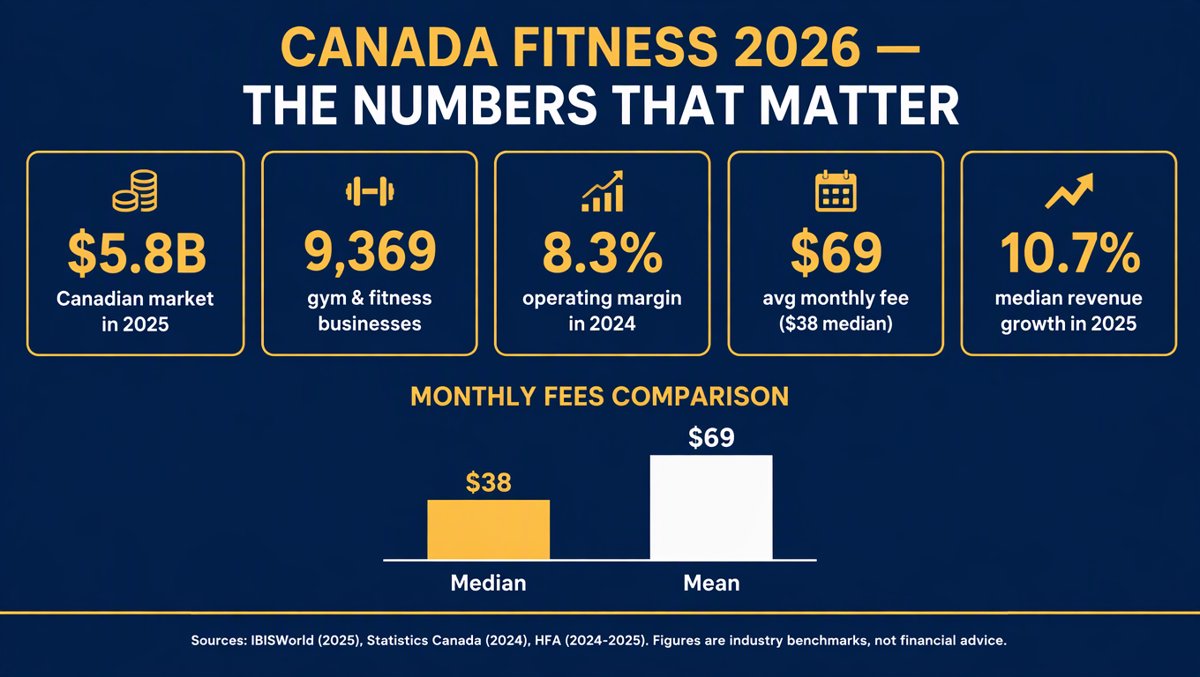
- According to IBISWorld (2025), Canada's gym, health & fitness clubs market was $5.8 billion in 2025 — the anchor number for every decision below.[1]
- According to Statistics Canada (2024), fitness and recreational sports centres earned $5.8 billion in operating revenue in 2024, up 14.9% year over year, with operating profit margins of 8.3% (up from 5.8% in 2023).[3]
- According to HFA (2024), the average monthly gym membership fee was $69, while the median was only $38 — most clubs price for the median, not the mean.[6]
- According to the Fitness Industry Council of Canada (2024) and Made in CA (2025), gym membership penetration is 15.5% to 21% of Canadian adults, depending on how "member" is defined.[2][3]
- According to HFA (2026), surveyed operators reported 10.7% median revenue growth in 2025 and a 22.1% median EBITDA margin — the market is growing, and the best-run operators are earning well above the sector average.[4]
The answer in 30 seconds: A $5.8B market, ~9,400 businesses, an 8.3% operating margin, and a $38 median monthly price — that combination tells you exactly how to play it. The money is in recurring revenue (median revenue growth 10.7% in 2025), the ceiling is set by what the middle of the market actually pays ($38), and the winners layer non-dues income on top of dues. Price for the median, sell the hybrid, benchmark against the operator data, and ignore anything that costs you per acquisition.
The market you're entering — or defending
Canada's gym, health & fitness clubs were worth $5.8 billion in 2025, per IBISWorld, up 3.8% in 2025 alone after a rough post-pandemic climb from $5.5 billion in 2024. [1][2] Broader counts that include recreational sports centres push the 2026 total toward $6.3 billion. [3] Either way, the direction is clear: the market is back past pre-pandemic levels and growing again.
There are roughly 9,400 businesses in the space — about 9,369 gym and fitness club businesses in 2025 (IBISWorld), and 9,493 fitness and recreational sports centre locations as of June 2023 (Statistics Canada). [1][3] The difference is definitional: one counts dedicated clubs, the other counts every fitness and recreation centre. On a per-capita basis, the leaders are not the biggest provinces — Prince Edward Island (38.23 centres per 100,000 residents) and British Columbia (34.03) lead, while Ontario ranks fifth at 26.20 despite holding the most locations. [3]
The demand side has a hard ceiling. Between 15.5% and 21% of Canadian adults hold a gym membership, depending on the survey and how membership is defined — the Fitness Industry Council of Canada puts it at 15.5% (2024), Made in CA at roughly 21% (2025). [2][3] And the population behind those members is not getting uniformly more active: 46% of Canadian adults meet the 150-minute weekly activity guideline, while youth aged 12–17 sit at just 21% (Statistics Canada, 2025). [3] Long-term demand is not automatic. It has to be earned, member by member.
The biggest player is GoodLife Fitness — 255 locations and more than one million members — while boutique studios, Pilates, and HYROX-style training cluster in major urban centres and the industry stays fragmented below the chains. [2][3] The average small-to-medium fitness enterprise in Canada brings in about $377,200 in revenue, and 71.4% of these businesses operate profitably (ISED). [3] That is your comparison point if you are running an SMB: the benchmark is not the chain. It is the profitable independents.
The price problem: you are competing with a $38 median
Gym prices in Canada rose 15.9% between 2021 and 2024, including a 5.2% jump in 2024 alone (Statistics Canada). [3] That is not a trivia point — it is the single biggest pressure on the model. Every price increase pushes a slice of members toward the home-gym math: the average home setup costs about $2,530, which pays itself off against a membership in a few years. [2]
Here's where the numbers get useful. According to HFA (2024), the average monthly fee was $69, but the median was only $38. [6] The mean is pulled up by premium clubs — Equinox charges $235 per month in Canada, while Planet Fitness starts at $10 per month. [2] Most of the market lives near the median. If your pricing plan assumes the average, you are pricing for a market that does not exist.
The operator data tells the same story from the other side. HFA's 2026 Global Report — covering 244 operators and nearly 27,000 facilities across 33 countries — found 10.7% median revenue growth in 2025, 6.1% median net membership growth, and a 22.1% median EBITDA margin. [4] And HFA's Benchmarking soundbite is blunt: 63% of fitness businesses increased profitability last year, and higher-profit operators generated about 21% more revenue per employee than lower-profit ones. [5] Growth and efficiency are both winners' games.
The model that wins: recurring, hybrid, non-dues on top
The HFA numbers point to a structure, not a slogan: revenue per member is the number that matters, and dues are only part of it. The HFA estimate is roughly $517 in average annual revenue per member — and nearly 30% of U.S. club revenue now comes from non-dues sources like personal training, retail, and wellness services (HFA 2025 Benchmarking). [6][7] In Canada, that layering is reinforced by hybrid memberships — in-person floor time plus on-demand app content — because 77% of Canadians prefer the convenience of exercising from home and the digital fitness market already reached roughly US$11.9 billion in 2024. [2][3]
The trend list for 2026 is unusually consistent across the sources: active aging and longevity training, functional training, hybrid memberships, recovery and mental-health services, Pilates, and HYROX-style competitive events — with wearables and connected training now mainstream. [3] Operators are building toward that list on purpose: two-thirds expect technology spending to rise, 60.7% expect marketing spending to rise, and 92.3% expect revenue to grow in 2026. [4]
For profitability, keep the two numbers separate. Statistics Canada puts the sector operating margin at 8.3% (2024) for fitness and recreational sports centres — that's the all-in average, including independents and public-adjacent operators. [3] Operator-level guides put typical net margins at 10–15%, with top performers at 25–30%+ (VantaInsights, Member Solutions, Vagaro — global/U.S. guides, so treat as directional rather than Canadian benchmarks). [8] The gap between the sector average and the top of the guides is exactly where retention, staffing, and non-dues income live.
What to benchmark yourself against
| Benchmark | The number | Your move |
|---|---|---|
| Market size (Canada, 2025) | $5.8B, +3.8% YoY | Anchor your revenue targets to a growing market — no excuse for flat-line growth |
| Business count | ~9,400 operators | Fragmented market: your competition is the independent next door, not just GoodLife |
| Sector operating margin (2024) | 8.3%, up from 5.8% | Below 8% means you are running worse than the average — audit payroll and occupancy cost first |
| Monthly fee | $38 median / $69 mean (HFA) | Price your core tier near the median; earn the mean through PT, classes, and retail |
| Revenue per member | ~$517/yr (HFA estimate) | Track it monthly; if it is flat, your non-dues engine is stalled |
| Retention | 66.4% annual average (HFA) | Below that, every growth dollar leaks — fix onboarding before buying ads |
| Operator growth (2025) | +10.7% median revenue | Growing slower than the median while prices rise 3%+ means share loss, not market drag |
| Non-dues share | ~30% of club revenue (U.S. benchmark) | Build toward it; dues-only clubs are the most exposed to the home-gym math |
What the numbers mean for your exact decision
- If you're setting price: start at the $38 median, not the $69 mean. The mean is a premium-club number. Earn the premium with services — every point of non-dues share added is a point of margin you do not have to win at the dues level.
- If you're picking a format: the growth segments are boutique, functional, hybrid, and recovery-oriented — and the per-capita data says Atlantic Canada and BC are better served relative to population than Ontario. [3] Format and geography are linked: smaller dedicated memberships in underserved markets beat a big-box fight in Toronto.
- If you're deciding whether to enter at all: the sector's 8.3% operating margin is real but thin. The operator median EBITDA margin of 22.1% proves the mechanism works — for operators who manage retention and cost per square foot. The 71.4% of small and medium fitness enterprises operating profitably (ISED) says entry is viable for a disciplined independent, not for a copy-paste chain model. [3][4]
🏁 THE VERDICT
The 2026 numbers say: price for the $38 median, earn the $69 mean through services and hybrid content, and benchmark against the 8.3% sector margin — because the operators growing 10.7% are the ones who retain, layer non-dues income, and staff to the curve.
Who should act: gym owners and independent operators setting 2026 pricing, and anyone deciding format or market before signing a lease. The single next step: pull your revenue per member and retention this week; if either is below $517/year or 66.4%, fix that before spending another dollar on acquisition.

💬 Want the working version? Subscribe free — Saturday toolkit PDFs by email. Ask me anything about this playbook: Chat with Peter.
Informational content only. Figures are cited benchmarks and industry estimates, not financial advice — verify against your own books, your lease, and your accountant before acting.
Frequently Asked Questions
How big is the fitness industry in Canada in 2026? IBISWorld puts Canada's gym, health & fitness clubs at $5.8 billion in 2025, with broader counts including recreational sports centres approaching $6.3 billion in 2026. Statistics Canada separately reports $5.8 billion in operating revenue for fitness and recreational sports centres in 2024, up 14.9% year over year. [1][3]
What is the average gym membership price in Canada? According to HFA (2024), the average monthly gym membership fee was $69, while the median was only $38 — the mean is pulled up by premium clubs. In Canada, chains range from $10 per month (Planet Fitness) to $235 per month (Equinox). [2][6]
What are healthy profit margins for a gym in Canada? Statistics Canada puts the sector's operating margin at 8.3% in 2024 (up from 5.8% in 2023). Operator-level guides put typical net margins at 10–15%, with top performers at 25–30%+, while HFA's operator median EBITDA margin was 22.1% in 2025. These are different measures — compare like with like. [3][4][8]
How many gyms are there in Canada? About 9,400 businesses: 9,369 gym and fitness club businesses in 2025 (IBISWorld) and 9,493 fitness and recreational sports centre locations as of June 2023 (Statistics Canada). The counts differ because they include different facility types. Prince Edward Island and British Columbia have the most centres per capita. [1][3]
Is it profitable to open a gym in Canada? The ISED database indicates the average small-to-medium fitness enterprise earns about $377,200 in revenue, with 71.4% operating profitably. Membership penetration is 15.5% to 21% of adults, and the sector operating margin is 8.3% — viable for a lean, retention-focused independent; much harder for a high-overhead copy of a big-box model. [3]
📚 SOURCES
[1] IBISWorld, Gym, Health & Fitness Clubs in Canada (1655) — $5.8bn in 2025; 9,369 businesses in 2025, +3.8% from 2024 — https://www.ibisworld.com/canada/industry/gym-health-fitness-clubs/1655/ [2] Made in CA, Fitness Industry Statistics in Canada (Jan 25, 2026) — $5.8B 2025; membership ~21% 2025; GoodLife 255 locations/1M+ members; Equinox $235/mo; Planet Fitness from $10/mo; digital fitness ~US$11.9B 2024; home gym ~$2,530 — https://madeinca.ca/fitness-industry-canada-statistics/ [3] Fitness Avenue, Fitness Industry Statistics Canada: Trends and Report for 2026 (Aug 19, 2026) — StatCan $5.8B 2024 revenue +14.9%, 8.3% operating margin; prices +15.9% 2021–2024; 46% adult activity guideline; ISED $377,200 avg revenue, 71.4% profitable; per-capita facilities by province; $37.2B GDP contribution — https://www.fitnessavenue.ca/blogs/post/fitness-industry-statistics-canada [4] HFA, The 2026 HFA Global Report (Sep 14, 2026) — 10.7% median revenue growth 2025; 6.1% median net membership growth; 22.1% median EBITDA margin; 244 operators / ~27,000 facilities; 92.3% expect 2026 revenue growth — https://www.healthandfitness.org/the-2026-hfa-global-report-shows-the-fitness-industry-delivered-a-landmark-2025-with-double-digit-operator-revenue-growth/ [5] HFA, 2026 Fitness Industry Benchmarking Report (Oct 7, 2026) — 244 operators, ~27,000 facilities, 40 countries, based on 2025 results; 63% of fitness businesses increased profitability; higher-profit operators ~21% more revenue per employee — https://www.healthandfitness.org/2026-fitness-industry-benchmarking-report/ [6] HFA membership economics (2024 data) via GymDesk 2026, BizMetricsHQ, Athletech News — $69 mean / $38 median monthly fee; ~$517 average annual revenue per member; 66.4% annual retention — https://gymdesk.com/blog/gym-membership-statistics [7] HFA 2025 Fitness Industry Benchmarking Report via Huzzard (Oct 29, 2025) — nearly 30% of U.S. club revenue from non-dues sources — https://huzzard.com/retail-revenue-in-fitness-clubs/ [8] Gym profit margins 2026 benchmarks (global/U.S. guides, labeled) — VantaInsights avg net 10–15%; Member Solutions avg 10–15%, top 25–30%+; Vagaro typical 10–20%, top 25–30%+ — https://vantainsights.com/insights/gym-profit-margins [9] Statistics Canada, Canadian Health Measures Survey (2025) via Fitness Avenue — 46% of adults meet 150-minute weekly guideline; youth 12–17 at 21%; adults average 9.3 hours/day sedentary — https://www150.statcan.gc.ca/n1/daily-quotidien/251017/dq251017b-eng.htm [10] Fitness Industry Council of Canada — 15.5% adult gym-membership penetration (2024), cited via Fitness Avenue (2026) — https://www.fitnessavenue.ca/blogs/post/fitness-industry-statistics-canada