Want to Open a Retail Business in Canada? Start Here


Want to Open a Retail Business in Canada? Start Here (2026)
Key Takeaways
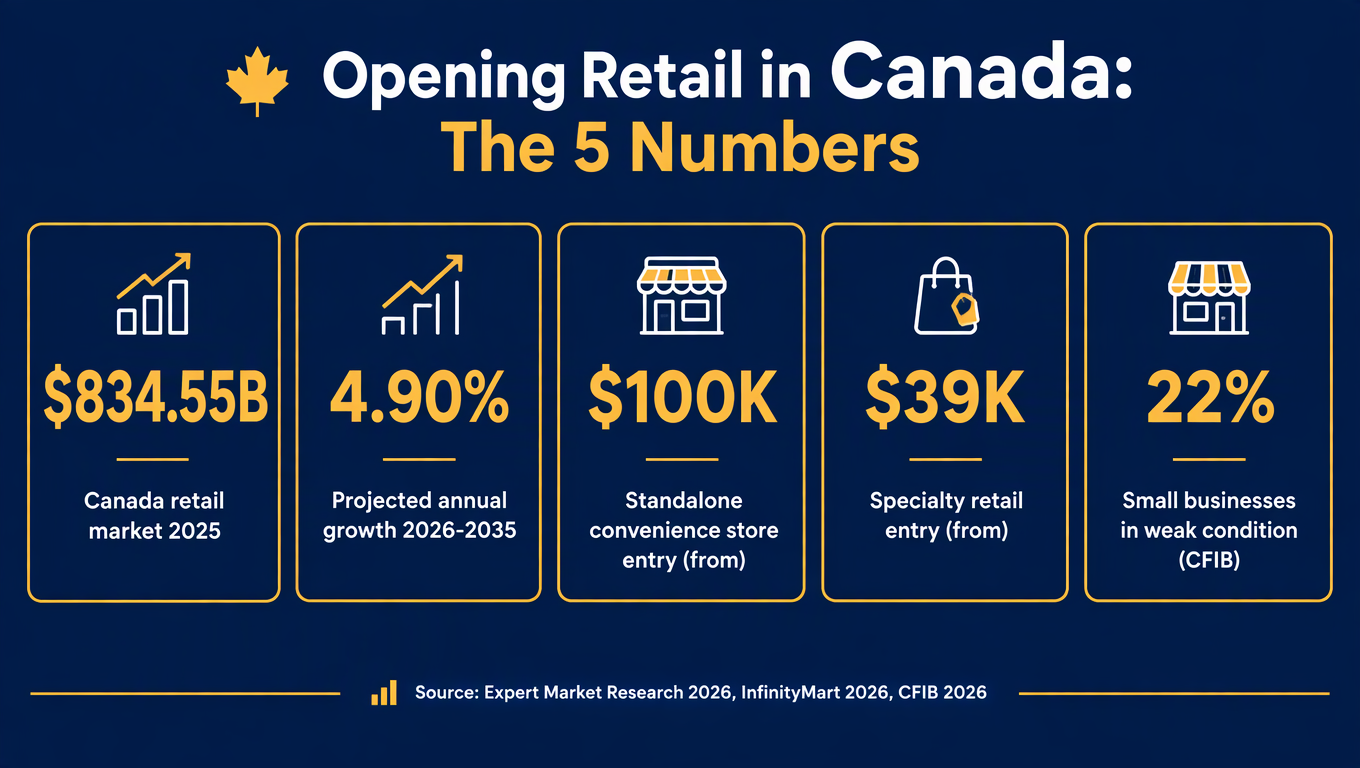
- According to Expert Market Research (2026), Canada's retail market reached US$834.55 billion in 2025 and is projected to grow at about 4.90% per year through 2035 — the tailwind behind every decision in this playbook.[1]
- According to Statistics Canada (2026), Canadian retail sales rose 0.7% month over month in September 2026 after a 0.7% decline to $73.7 billion in July 2026 — choppy, not collapsing.[2]
- According to InfinityMart's 2026 Canada guide, retail franchise entry bands run from about $39,000 for specialty vape retail to $225,000–$850,000+ for gas-station combos — the format you pick decides the budget.[3]
- According to CBRE's Canada Retail Rent Survey (H1 2026), rents rose in 28 of 131 retail formats tracked, fell in only 8, and no format fell everywhere — prime space is scarce, not cheap.[4]
- According to the Canadian Federation of Independent Business (2026), 22% of Canadian small businesses are in weak or critical condition — the real cost of getting site, format, or budget wrong.[5]
The answer in 30 seconds: Retail in Canada is an US$834.55B market growing ~4.90% a year, monthly sales are holding around the $73–74B range, and the openings data shows the money moving to grocery, value/dollar, and necessity formats — not apparel or toy chains. The 2026 playbook is one line: pick a necessity format, budget for the franchise fee PLUS build-out, inventory and 3–6 months of working capital, and lock a suburban or grocery-anchored site before the landlords' market prices you out.
The market you're entering — momentum with churn
Canada's retail market hit US$834.55 billion in 2025 per Expert Market Research, and the same source projects roughly 4.90% annual growth from 2026 to 2035. [1] That is the headline. The fine print is monthly volatility: Statistics Canada recorded a 0.7% decline to $73.7 billion in July 2026 (down in eight of nine subsectors), a 1.2% rise in August (TD Economics), and +0.7% in September. [2] Read those together: the market is not in a boom and not in a bust — it is flat-to-up, and flat markets reward operators who pick the right format.
The 2026 store tracker from Coresight Research shows exactly where the footprint is moving — and it is a two-sided story. Loblaw and Dollarama are opening stores, and discount/value formats like MINISO, Daiso and TJX brands are expanding. In the other direction, 7-Eleven is closing stores (Couche-Tard's Circle K is the one expanding into that space), and Toys"R"Us, Claire's and GameStop are shrinking their Canadian footprints. [6] If you are opening in 2026, you want to be on the Loblaw side of that ledger: necessity, value, and everyday purchases — not discretionary categories fighting for a shrinking basket.
One more piece of context for the brave: the CFIB reports 22% of Canadian small businesses are in weak or critical condition as of October 2026. [5] That is not a reason to stay out of retail — it is a reason to be deliberate about the three things that kill new stores: the wrong site, an under-budgeted build-out, and no working capital. All three are within your control before you sign.
Franchise or independent? — the first decision
The single biggest fork in the road is whether you buy an established brand or build your own. A franchise gives you the brand, the supplier relationships, the POS and marketing systems, and training — but you pay a franchise fee and ongoing royalties, and you follow their playbook. An independent store gives you full control over brand, products and pricing, but you build everything from zero: awareness, suppliers, systems, marketing. [3]
For first-time owners, the structure of a franchise usually de-risks the open — but only if you read the Franchise Disclosure Document (FDD) before you fall in love with the brand. Six provinces — Ontario, Alberta, BC, Manitoba, PEI and New Brunswick — have franchise disclosure laws that force franchisors to hand over the fees, obligations and financial picture before you sign. Use them. [3] Ask for the FDD early, run it past a franchise lawyer, and talk to existing franchisees about what they wish they'd known before signing. No franchisor will hand you a disappointing unit-economics story in the pitch — the FDD is where it lives.
What it actually costs — the three bands
Retail franchise costs in Canada do not come as one number. They come as bands, and the format picks the band. Note the source discipline here: the following bands are one franchisor's published 2026 guide (InfinityMart), not a market-wide survey — treat them as a realistic entry price for those formats, and always verify against the FDD of whatever concept you shortlist. [3]
| Format | Published entry band (CAD) | What that tells you |
|---|---|---|
| Specialty vape retail (e.g., Infinity Vape) | ~$39,000–$50,000 + inventory | The cheapest shelf in franchised retail — a narrow category, small footprint, fast to open |
| Standalone convenience store (e.g., Infinity Mart) | starting ~$100,000 | Daily-needs demand, full storefront, site selection matters most here |
| Gas-station combo | $225,000–$850,000+ | Fuel traffic + retail basket; the scale play for operators ready to run a bigger P&L |
| Major QSR chains | $500,000–$2,000,000+ | Out of reach for most first-time buyers — know it exists, don't stretch for it |
Whatever the band, the total investment is never just the fee. Budget these line items on top: leasehold improvements and fixtures, signage, tech/POS, opening inventory, and working capital for the first 3–6 months — payroll, rent, marketing, inventory replenishment, utilities. [3] The mistake the InfinityMart guide flags most often is the one operators make everywhere: underestimating the working capital runway. Opening day is the easy part. Month four is the wall.
If you go independent instead, the same line items apply — you just also carry the cost of building the brand and supplier relationships from nothing, which is the part franchises quietly sell you inside the fee.
The site is the business — read the rent market before you lease
CBRE's H1 2026 rent survey is the best piece of news and bad news in this article, in one. The good news: vacancy is tight across grocery-anchored centres and suburban corridors, demand is shifting toward service and necessity uses (grocery, pharmacy, medical, pet, wellness, convenience), and necessity operators are moving early to secure sites because quality locations are running out. [4] The bad news: the same report counts rent increases in 28 of 131 format/area combinations versus only 8 decreases, and every single format type saw at least one increase somewhere in Canada — Toronto and Winnipeg recorded the most. [4]
Translate that into site strategy:
- Suburban and grocery-anchored wins. CBRE calls suburban fundamentals the strongest in the country; Calgary's South, Southeast and North Central corridors are described as effectively full. [4]
- Downtown is a tenant's market with a caveat. Return-to-office is lifting downtown cores, Toronto leading, but recovery elsewhere is tied to revitalization efforts — underwrite the daytime population, don't assume it. [4]
- Act like the good spots won't wait. If the necessity format is right, the lease negotiation happens on the landlord's clock, not yours. The operators winning the good corridors in 2026 are the ones who signed early.
And one protected upside: when a consumer buys from a small Canadian retailer, 66 cents of every dollar stays in the local provincial economy (CFIB) — local loyalty is a real, measurable moat an independent can actually claim in its marketing. [5]
What to benchmark before you sign
| Benchmark | The number | Your move |
|---|---|---|
| Market size (Canada, 2025) | US$834.55B, ~4.90%/yr projected | Enter for the long cycle, not the quarter — the growth is structural, not a spike |
| Monthly sales momentum | ~$73.7B/mo at July trough; +0.7% Sep 2026 | Flat-to-up market: format choice beats timing |
| Where doors are opening | Loblaw, Dollarama, MINISO, Daiso, TJX expanding (Coresight 2026) | Follow the grocery/value/neccessity money, not the shrinking categories |
| Franchise entry bands | ~$39K specialty / ~$100K c-store / $225K–$850K+ combo (one franchisor's guide, verify via FDD) | Pick the band your capital actually covers with working capital intact |
| Rent direction | 28 formats up vs 8 down; no format down everywhere (CBRE H1 2026) | Budget rent in for renewal; negotiate term and options at signing |
| Small-biz distress | 22% in weak/critical condition (CFIB 2026) | Your stress test: can the store survive 3–6 months of slow ramp? If not, don't open yet |
🏁 THE VERDICT
The 2026 playbook: open a necessity format (c-store, value retail, pharmacy-adjacent), buy the proven system if it's your first store, budget the fee plus build-out, inventory and 3–6 months of working capital — and lock a grocery-anchored or suburban site while prime space still exists.
Who should act: first-time owners with $40K–$250K of real capital and a clean FDD in hand, and independent operators upgrading from a kiosk to a storefront. The single next step: shortlist two concepts — one franchise, one independent — and run both through the same site and working-capital stress test before you sign anything.
💬 Want the working version? Subscribe free — Saturday toolkit PDFs by email. Ask me anything about this playbook: Chat with Peter.
Informational content only — not financial, legal, or franchise advice. Franchise bands above are one franchisor's published guide; verify costs in the Franchise Disclosure Document and confirm any lease terms with your lawyer and accountant.
Frequently Asked Questions
How much does it cost to open a retail business in Canada in 2026? Entry bands vary sharply by format: specialty vape retail starts around $39,000–$50,000 plus inventory, a standalone convenience store around $100,000, and a gas-station combo $225,000–$850,000+ (InfinityMart's 2026 guide, one franchisor's published ranges). Total cost always adds build-out, inventory, and 3–6 months of working capital on top of any franchise fee. [3]
Is it profitable to open a retail store in Canada? Profitability depends on format, site, and management — and the risk is real: CFIB reports 22% of Canadian small businesses in weak or critical condition (2026). But the market is growing at ~4.90% per year toward US$834.55B+ (Expert Market Research), and necessity formats with disciplined working capital hold up far better than discretionary ones. [1][5]
What are the best retail franchises in Canada for a first-time owner? There is no single best — match the band to your capital and skills. Proven-system formats with accessible entry include convenience retail starting ~$100,000 and specialty retail from ~$39,000 (InfinityMart guide), always verified against the FDD. Six provinces (ON, AB, BC, MB, PEI, NB) require franchise disclosure before signing — use that leverage. [3]
What are the biggest mistakes when opening a retail business? The five most common: underestimating working capital (budget 3–6 months of runway), skipping the FDD legal review, choosing the brand over the business model, accepting a weak site for a strong brand, and no growth plan for a second location. [3]
Where is the best place to open a retail store in Canada in 2026? CBRE's H1 2026 survey says suburban and grocery-anchored centres have the strongest fundamentals, with vacancy effectively at capacity in high-growth corridors; rents rose across 28 of 131 formats. Necessity operators are signing early because quality locations are scarce — the site decision matters more than the city name. [4]
📚 SOURCES
[1] Expert Market Research, Canada retail market via FranNet (Aug 12, 2026) — US$834.55B in 2025; ~4.90% CAGR 2026–2035 — https://frannet.com/resources/canadian-franchises/retail-franchises-in-canada-facts-trends/ [2] Statistics Canada (2026) — July 2026 retail sales $73.7B, −0.7% m/m; September +0.7% m/m (via Trading Economics, Oct 23, 2026) — https://www150.statcan.gc.ca/n1/daily-quotidien/260924/dq260924a-eng.htm [3] InfinityMart, Best Franchises for Small Investors in Canada (2026) — entry bands $39K/$100K/$225K–$850K+; FDD; disclosure-law provinces; 5 common mistakes — https://infinitymart.co/best-franchises-for-small-investors-in-canada/ [4] CBRE Canada, Retail Rent Survey H1 2026 (Sep 10, 2026) — 28 formats up vs 8 down; suburban strength; necessity leasing — https://www.cbre.ca/insights/reports/canada-retail-rent-survey-h1-2026 [5] Canadian Federation of Independent Business (2026; Oct 2023) — 22% of small businesses in weak/critical condition; 66 cents of every small-retail dollar stays local — https://www.cfib-fcei.ca/en/research-economic-analysis/small-retailers-local-contributions [6] Coresight Research, Canada Store Openings and Closures Tracker 2026 (Oct 23, 2026) — Loblaw/Dollarama/MINISO/Daiso/TJX expanding; 7-Eleven/Toys"R"Us/Claire's/GameStop retreating — https://coresight.com/research/canada-store-openings-and-closures-tracker-2026-loblaw-expands-as-7-eleven-closes-stores/