Want to Open a Convenience Store in Canada? (2026 Playbook)


Want to Open a Convenience Store in Canada? (2026 Playbook)
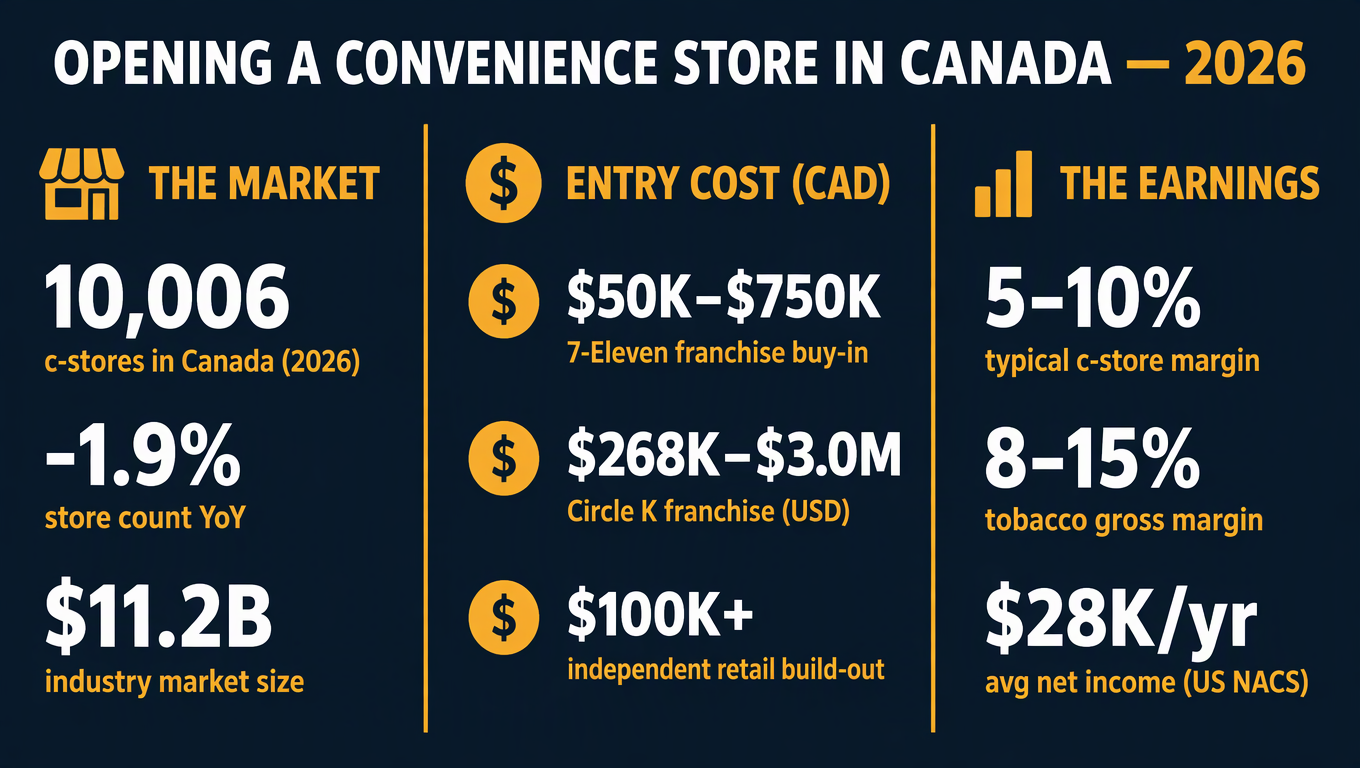
Budget $50,000–$750,000 CAD for a franchise buy-in, or six figures for an independent build-out — but know first that Canada's convenience market is shrinking: 10,006 stores as of 2026, down 1.9% year over year (IBISWorld). This playbook breaks down what opening a convenience store in Canada actually costs across three lanes — independent, franchise, and buying existing — plus the margins and licenses that decide whether the store pays you back.
The market snapshot: 10,006 stores and counting down
The convenience channel in Canada is consolidating, not growing. Here's the 2026 picture:
| Metric | Figure | Source |
|---|---|---|
| C-store businesses (2026) | 10,006, down 1.9% YoY | IBISWorld |
| Industry market size (2026) | $11.2bn | IBISWorld |
| Retail sales (2023) | nearly $9.0 billion | Statistics Canada |
| C-store dollar sales trend (2026) | fell 2.2% (rest of market +2%) | NACS/NIQ Q2 2026 |
| Gas stations with c-stores (2026) | 5,439, up 0.7% | IBISWorld |
| US stores, for contrast | 152,255 | NACS TDLinx |
Two signals matter if you're deciding where to open a convenience store in Canada. First, standalone stores are losing count (-1.9%) while fuel-attached stores are gaining (+0.7% to 5,439) — traffic is consolidating around destinations people already drive to. Second, dollar sales fell 2.2% in the latest NACS/NIQ quarter while the broader retail market grew 2%: the convenience premium is under pressure from dollar stores and delivery.
The dollar-store squeeze is real. Dollarama's Canadian segment did $6.8 billion in fiscal 2026 across 1,691 stores (now 1,734, with 65–75 more planned) and comparable sales rose +4.2%. Every Dollarama that opens near a corner store is a direct hit on your impulse-purchase basket.
The three lanes to owning a store
| Lane | Entry cost (CAD) | What you get | Watch out for |
|---|---|---|---|
| Independent build-out | ~$150K–$180K reported by operators; $100K+ for retail with premises (QC guide) | Full margin control, no royalties | You build traffic from zero |
| Franchise (7-Eleven) | $50K–$750K one-time buy-in range | Brand, systems, traffic | Profit split with franchisor |
| Buy existing | Deal-by-deal (listings actively traded) | Day-one revenue, proven location | Due diligence on books + licenses |
Lane 1: independent
Canadian operators on record report setup costs around $150K–$180K CAD for a store — treat that as an anecdotal midpoint, not a quote. Québec's official startup-budget guide pegs retail-with-premises at $100,000+, and warns working capital should cover 3+ months of operations (lancemententreprise.quebec). For calibration, US industry guides put a mid-size non-fuel store at $50,000–$300,000 USD — the low end is a kiosk, the high end is full refrigeration and coolers (NRS Plus, US). Notably, Québec franchising analysts state plainly that no public average exists for dépanneur startup costs — anyone quoting you one precise number is guessing.
Lane 2: franchise — the 7-Eleven land grab
This is the story of 2026: 7-Eleven Canada is converting ~550 corporate stores to franchises and targets 2,600 franchised stores by 2030 (Elite Franchise). The brand is actively recruiting owner-operators in Ontario and BC, where its corporate network is concentrated. Canadian legal and franchise guides put the buy-in at $50,000–$750,000 CAD (Lexpert) and $50K–$500K CAD with a $25K fee (FundBizPro) — the US program's official FAQ shows a $25,000 franchise fee plus a $20,000–$40,000 inventory down payment as the fee skeleton. Read both ranges as one truth: the entry cheque depends entirely on the store package you're offered.
Circle K is the other door. TMC Franchise Canada Inc. (part of Alimentation Couche-Tard) franchises Circle K in Canada from a 14,000+ store global system. Its published investment range is $268,500–$3,029,500 USD for an existing-store franchise — new construction runs to $4.8M — per the most recent FDD reviews. The parent is growing: 80 new Couche-Tard stores opened since the start of fiscal 2026 on $757.2M of Q3 net earnings. The system has run 2,200+ Canadian stores since it opened franchising in 2018.
Lane 3: buy existing
Canada's c-stores trade actively on business-for-sale marketplaces, and buying skips the leasehold build entirely. But you inherit everything: stale inventory, expiring leases, and the license file. In Canada, stores selling tobacco, alcohol, or lottery tickets need the Tobacco Retail Dealer Permit, lottery retailer registration, and provincial alcohol licenses transferred or re-issued in your name (Legal500 Canada) — a failed transfer can leave you with a store that can't sell its two best categories.
The earnings reality check
Convenience stores run on thin, structural margins. US industry data (closest comparable channel) puts a typical c-store margin at 5–10% (Parts Town), with tobacco — usually the biggest seller — at just 8–15% gross because cigarette pricing is regulated and competitive (PBA Connect). NACS benchmarks show the average US store clearing about $2,300/month (~$28,000/year) in net operating income on roughly $2.25M of in-store sales — meaning the owner's salary is embedded in that $28K, not on top of it.
What actually pays in a c-store: prepared food and coffee (high margin, defensible), lottery commissions (traffic, not profit), and being the only option within a 5-minute walk. The winning stores in a shrinking channel are the ones converting location scarcity into daily habit.
Your licensing checklist (Canada)
- Provincial business registration + municipal license
- Tobacco Retail Dealer Permit (provincial)
- Lottery retailer registration (provincial lottery corp)
- Alcohol license if selling beer/wine (provincial; rules vary ON vs QC vs AB)
- Food handling / health inspection if preparing food
- Lease assignment or transfer clauses — if buying existing
- Verify with your accountant and provincial registry before signing anything
🏁 The Verdict
The store is a real business with a shrinking moat — pick the lane that matches your capital and your tolerance for a profit split. With $50K–$500K CAD and a desire for day-one traffic, the 7-Eleven Canada conversion program is the most credible franchise on-ramp in the country right now. With more capital and total-control instincts, an independent store only makes sense on a location competitors can't touch. One next step: before any cheque, pull the last 12 months of category-level sales for the exact store (or the exact block) and divide tobacco out — what remains is your real business.
Cost and finance figures are informational, compiled from cited sources; verify current numbers with your accountant, lawyer, and the franchisor's disclosure documents before acting.
📚 Sources
- IBISWorld — Convenience Stores in Canada, Number of Businesses 2026 — 10,006 stores, -1.9%
- IBISWorld — Convenience Stores Canada Market Size 2026 — $11.2bn
- IBISWorld — Gas Stations with Convenience Stores 2026 — 5,439, +0.7%
- Statistics Canada — Sales up in 2023 at convenience stores — ~$9.0B 2023
- NACS/NIQ Global Convenience Store Industry Report Q2 2026 — Canada -2.2%
- NACS — 2026 US store count — 152,255 US
- Elite Franchise Canada — 7-Eleven franchise conversion programme — 2,600 stores by 2030
- L'express Franchise — 7-Eleven Canada expansion — ~550 corporate stores, ON/BC
- Lexpert — Legal aspects of a 7-Eleven franchise in Canada — $50K–$750K CAD
- FundBizPro — 7-Eleven Franchise Cost in Canada 2026 — $50K–$500K CAD, $25K fee
- 7-Eleven Franchise official FAQ — $25K fee, $20K–$40K inventory (US program)
- Circle K Canada Franchise — TMC Franchise Canada — 14,000+ store system
- Circle K — How It Works — $268,500–$3,029,500 USD (FDD)
- VetMyFranchise — TMC Franchise Corp FDD review — $25K fee, $327.5K–$2.87M USD
- CSP Daily News — Couche-Tard fiscal 2026 — 80 new stores, $757.2M Q3
- Couche-Tard corporate — Circle K franchising launch — 2,200+ CA stores
- Dollarama Annual Information Form FY2026 — $6.8B, 1,691 stores
- Dollarama Q2 Fiscal 2027 results — +17.6% quarter, 1,734 stores
- Dollarama Q4/FY2026 results — comp +4.2%
- NRS Plus — 2026 c-store startup guide (US) — $50K–$300K USD
- Lancement entreprise Québec — startup budget guide — $100K+ retail, 3-months working capital
- L'express Franchise FR — ouvrir une épicerie/dépanneur — no public average exists (QC)
- Parts Town — most profitable c-store items — 5–10% margin
- PBA Connect — c-store margins by category — tobacco 8–15%
- Petrosoft — lottery economics (NACS benchmark) — ~$2,300/mo net
- Paytronix — c-store revenue data — ~$2.25M in-store sales
- Legal500 — buying/selling a c-store in Canada — permit requirements
- Grow with Gosai (Instagram) — Canadian operator anecdote — $150K–$180K setup cost (anecdotal, social media, not load-bearing)
💬 Want the working version? Subscribe free — Saturday toolkit PDFs by email.
💬 Chat with Peter — got a c-store question? Ask it directly.