US Tariff Wall 2026: 14 Partners, One Head-Fake Rally — The Data
 x/world ·
US Tariff Wall 2026: 14 Partners, One Head-Fake Rally — The Data
Published: 2026-11-26 | Reading Time: ~11 minutes | Channel: world
Short Answer
On November 25, 2026, the U.S. Trade Representative announced proposed Section 301 tariffs on 14 trading partners, with rates from 15% for the EU and South Korea up to 35% for Vietnam and a capped 20% for China on top of earlier duties. Global markets rallied anyway, with Europe's Stoxx 600 gaining 1.6% on November 26 — because these duties replace, rather than stack on, earlier tariffs and are unlikely to take effect before February 2027.¹ ² ³
Key Takeaways
- According to CNBC (Nov 26, 2026), the US tariff wall starts at 15% for the EU, South Korea, Switzerland and Taiwan and rises to as much as 35% for Vietnam.¹
- According to CNBC (Nov 26, 2026), Europe's Stoxx 600 was 1.6% higher on Thursday while US markets were closed for Thanksgiving — a rally driven by geography and timing, not by approval.²
- According to The Globe and Mail (Nov 26, 2026), Capital Economics expects the additional tariff burden will keep core goods inflation firm into 2027, even though futures imply a 98% chance of a Fed rate hike in December.⁴
Europe gained 1.6%. Asia gained. Nikkei closed at 57,499.16. The Hang Seng rose 1.52%. By the close of every open market on Earth, the newly announced US tariff wall — fourteen trading partners, rates up to 35%, China staring at a potential 40% — had been met with something that looks an awful lot like a shrug.
Before you buy the narrative that "the market has spoken," look at what the market actually did: it rallied with Wall Street closed for Thanksgiving, in exchanges where Thursday was a normal business day, on tariffs that won't bite until February or March 2027 at the earliest. That's not a verdict. That's a calendar artifact. The US tariff wall 2026 is real — but what global markets just did is not a referendum on it. It is a head-fake, and the scoreboard is playing it as a goal.
This matters now because the second-order effects are already visible: US inflation accelerated to 3.8% in October, futures now price a near-certain Fed hike in December, and senior economists at Capital Economics are warning the tariffs will keep core goods inflation "firm into next year." The rally bought traders a quiet Thursday. It did not buy anyone immunity from the bill.
The US Tariff Wall That Changed Everything
Here's the short version. In February 2026, the U.S. Supreme Court struck down the sweeping "Liberation Day" tariffs Trump imposed in April 2025 under emergency powers, ruling the law did not authorize trade tariffs.³ The administration then shuffled through successive legal authorities — a temporary 10% measure that expired in July, replaced by 10–12.5% duties on 60 economies under Section 301, justified by forced-labour allegations.³
Wednesday's announcement is the fourth iteration of the same policy, dressed in a new legal framework: Section 301 again, this time on the grounds of "structural excess capacity" — the claim that 14 economies subsidize their manufacturers to overproduce and flood world markets.¹ ³ ⁵ The USTR's own language, per senior officials, describes countries "promoting production and capacity divorced from the realities of demand and market principles."³
The numbers behind the word "China" tell you whose wall this really is. Capital Economics tallied the USTR reports and found the word "China" appears 253 times in the document on Vietnam and 315 times in the document on the European Union.¹ As chief Asia economist Mark Williams put it, "foremost among the 'unreasonable acts, policies, and practices' that these countries are criticised for is being slow to restrict imports and FDI from China."¹ This is not a tariff wall against fourteen countries. It's a tariff wall against one country, with thirteen supporting actors.
Canada, notably, was not subjected to the new tariffs, and Prime Minister Mark Carney called the exemption "good news" while talks on steel, aluminum and vehicles continue toward an interim deal.³
By the Numbers: The US Tariff Wall, Country by Country
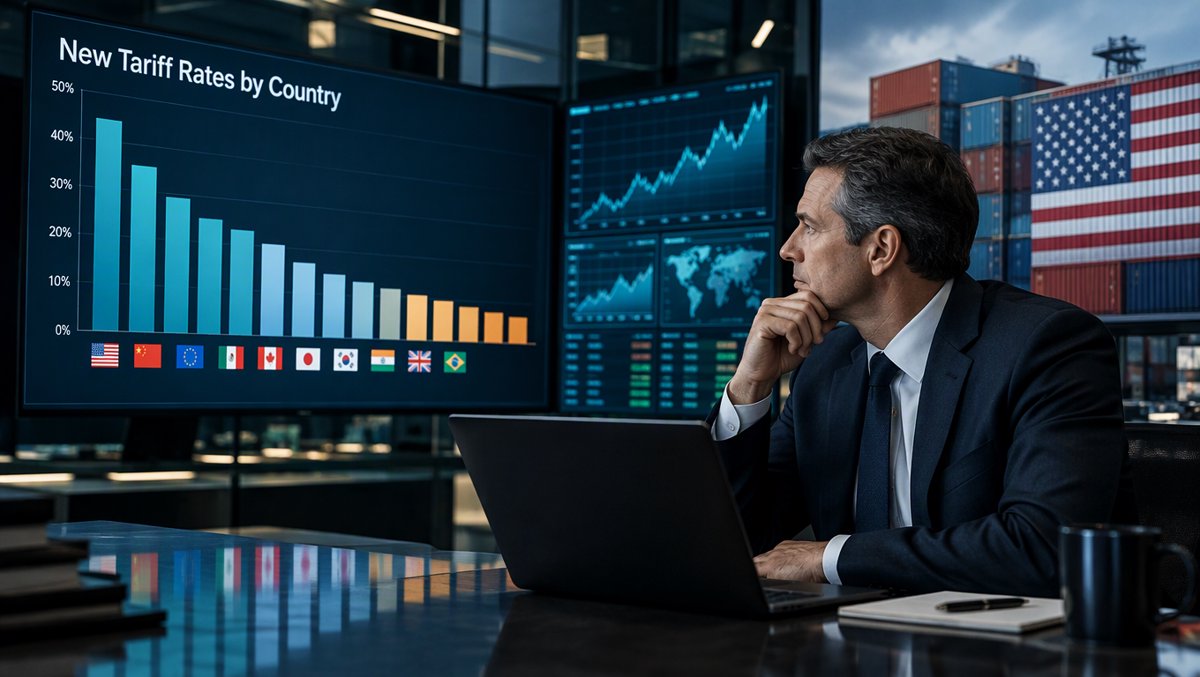
According to CNBC (Nov 26, 2026), proposed rates start at 15% for the European Union, South Korea, Switzerland and Taiwan and rise to as much as 35% for Vietnam.¹ Penalties for weakness in negotiations are built into the design — rates fall sharply if a country signs a deal:
| Partner | Proposed Rate | Rate If Deal Signed | Notes |
|---|---|---|---|
| Vietnam | 35% | 20% | Steepest gap between deal/no-deal |
| India | 25% | 17% | No signed deal; outline agreed in February, never finalized |
| China | 20% capped | 20% (→ 40% if truce lapses) | Plus existing ~25% first-term tariff; truce expires Jan 10 |
| Singapore | 20% | 10% | FTA since 2004, US surplus $33B in 2025 |
| EU, South Korea, Switzerland, Taiwan | 15% | 15% (existing deal ceilings) | Semiconductors/electronics exempt for Korea & Taiwan |
| Japan | 15% | 15% | Matches prior deal ceiling; $550B investment pledge |
| Malaysia | — | total capped 19% | First nation to sign a pact with Washington |
Mexico and Norway were investigated but spared.¹ ³ ⁵
The rates that matter most aren't in the table's headline column — they're in the deal column. India and Vietnam face the widest spreads between the punishment rate and the deal rate, which is exactly the point: as Wendy Cutler of the Asia Society Policy Institute noted, Washington is using tariffs as leverage "to secure expected shipments of critical minerals and rare earths, and further purchases of US agricultural goods."¹ The wall is a negotiating tool wearing a tariff costume.
Meanwhile, the market reaction on November 26 was unambiguous in direction and dishonest in interpretation. According to CNBC (Nov 26, 2026), the pan-European Stoxx 600 was 1.6% higher by midday London time with all sectors positive, Germany's DAX led at +1.9%, the Stoxx 600 Technology index jumped 2.5%, and Infineon climbed more than 4%.² South Korea's Kospi closed at 4,711.21, Japan's Nikkei 225 at 57,499.16, Australia's S&P/ASX 200 at 8,763.8.² Per The Globe and Mail (Nov 26, 2026), the broad MSCI global index rose 0.4% and S&P 500 futures rallied around 0.5%, recovering from sharp early losses in the prior session.⁴
Citi analysts flagged one specific casualty list: European retailers including Adidas, H&M, Puma and Primark could see full-year 2027 earnings downgrades if the measures stay as announced.¹ And per The Globe and Mail (Nov 26, 2026), JPMorgan's view was that "the macro impact from this increase is likely to be modest," noting tech goods remain exempt and "the administration has shown itself to be sensitive to market disruptions."⁴ Read that again: JPMorgan is not saying tariffs are harmless. It's saying the tariff-setter flinches. That's a very different statement.
Why "The Market Shrugged" Is a Dangerous Story
Three facts dissolve the rally narrative:
First, the rally happened without the market. Wall Street was closed for Thanksgiving.⁵ The S&P 500 didn't vote. European and Asian exchanges did — and their incentive is bargain-hunting after a brutal AI-driven sell-off. As AJ Bell investment director Russ Mould put it, "investors were fishing for bargains in the rubble following the tech sell-off."² Mould's own warning: "Oil prices heading higher is not good for efforts to tame inflation, neither is the prospect of retaliation by countries on the receiving end of new US tariffs."² He is right on both counts. Brent rose 0.5% to $95.10 on Nov 26 after Houthi strikes on a Saudi refinery and Iranian mine threats in the Strait of Hormuz.⁴¹ The tariff story and the oil story are compounding each other.
Second, these tariffs replace rather than stack. The new duties won't stack on top of the July forced-labour tariffs — they're designed to take their place.⁴ Capital Economics' Stephen Brown made the point directly: the new tariffs are "essentially broadly replacing, rather than adding to, earlier announced US tariffs," yet they "will likely help push prices higher and may keep core goods inflation firm into next year."³ That's the trade the market actually made: accept a delayed, smaller increase instead of the feared immediate one. Fine. But "smaller than the worst case" is not "free." The cost lands on US importers and households — most directly on the small businesses that buy what these fourteen economies sell. As one analyst noted of the small-business angle: "How is that going to increase jobs if small businesses can't manage to buy what they need from China?"³
Third, the macro backdrop is hostile. According to CNBC (Nov 26, 2026), the US personal consumption expenditures price index rose 3.8% year on year in October, accelerating from 3.7% in September, with core inflation at 3.3%.² Futures now imply a 98% chance the Federal Reserve raises rates by 25 basis points in December, and the Bank of Canada — which raised its policy rate to 2.5% in October as inflation held at 3.1% — faces LSEG-priced 79% odds of a second consecutive hike on December 9.⁶ ⁷ Tariffs add to goods prices precisely when central banks are being forced to choose between the inflation fight and the growth fight. That collision is the real story of the us tariff wall 2026, and it doesn't fit in a single green Thursday.
The same-day context sharpens the irony: a Reuters/Ipsos poll after the midterms found 62% of respondents would support scrapping trade tariffs, and Republicans blamed the tariff policy for their midterm losses.³ ⁵ The policy is unpopular, inflationary, and growing more legally elaborate — and the market's Thanksgiving-week response to it is being misread as consent.
What Does This Mean For You? How Do US Tariffs Affect Your Prices in 2027?
If you import, export, invest, or simply buy things, the wall lands on you through five mechanisms. These are analysis, not financial advice — but the mechanics are yours to manage:
-
Audit your import chain this week. List every supplier in the 14 targeted economies (China, Vietnam, India, EU, Korea, Taiwan, Singapore, Japan, Malaysia, Indonesia, Bangladesh, Cambodia, Thailand, Switzerland). If your landed cost depends on a 15–35% duty that starts in February, your January pricing is already wrong.¹
-
Watch the January 10 China truce expiry like a deadline. China's rate doubles from the 20% cap to 40% if the South Korea truce is not extended.¹ That single date is the largest binary risk in the entire tariff package — and every supply planner should have a Plan B landed by mid-December.
-
Price for core goods inflation persistence. Even the friendliest read of this package keeps goods inflation "firm into next year."¹ ³ If you're a retailer, your margin conversation with suppliers for H1 2027 should start from the assumption that input costs rise, not hold.
-
Do not fight the December central banks. With a 98% implied chance of a Fed hike in December and 79% odds of a Bank of Canada move on December 9, leverage decisions made before those meetings are made blind.⁶ ⁷ Wait for the prints. The tariff wall's February start date means December is your last cheap month to restructure debt and inventory.
-
If you're Canadian, mark this as a reprieve, not a victory. Canada was spared this round — and Carney called it good news³ — but steel, aluminum and auto tariffs remain live issues in the broader talks. The exemption is a window. Windows close.

Frequently Asked Questions
How much do the new US tariffs cost in 2026?
The headline proposed rates run from 15% for the EU, South Korea, Switzerland and Taiwan up to 35% for Vietnam, per CNBC reporting on the November 25, 2026 announcement.¹ China faces a 20% cap on the new duties on top of an existing ~25% first-term tariff.³ Rates are not due to take effect until roughly February–March 2027, so the 2026 cash impact is planning cost, not duty cost.⁴
Will the US tariff wall raise prices for American consumers?
Yes — directionally, and on a lag. Capital Economics' Stephen Brown stated the new tariffs will "likely help push prices higher and may keep core goods inflation firm into next year," even though they replace rather than stack on earlier duties.³ According to CNBC (Nov 26, 2026), US PCE inflation had already accelerated to 3.8% in October before any of these duties take effect.²
Is Canada affected by the new US tariffs?
No. Canada was not subjected to the November 2026 excess-capacity tariffs, and Prime Minister Mark Carney called the exemption "good news" while Canada–US talks on steel, aluminum and vehicles continue toward an interim deal by year-end.³ Existing Canada-specific US tariffs from earlier rounds remain a separate, unresolved issue.³
Why did stock markets rally if tariffs are inflationary?
Because the tariffs are smaller than feared (they replace July duties instead of stacking), delayed until early 2027, tech goods are exempt, and US markets were closed for Thanksgiving — leaving European and Asian investors free to bargain-hunt after an AI-driven sell-off.² ⁴ M&G's Tristan Hanson cautioned the news would be discounted "barring very extreme numbers" — a conditional rally, not a permanent one.⁴
What happens next in the tariff timeline?
Key dates: EU trade ministers speak with USTR Jamieson Greer on Monday; the US–China truce expires January 10, 2027, with China's rate potentially doubling to 40%; duties are expected to take effect as early as January, more likely February–March 2027.¹ ³ ⁴
⚠️ The Risks Nobody's Talking About
-
The China-40% cliff is a single-point failure. If the January 10 truce lapses, China's effective rate jumps to 40% and global supply chains that took four years to diversify into Vietnam and India get repriced overnight. Vietnam's 35% "punishment rate" is explicitly designed to deter Chinese FDI routing — the wall has a trapdoor.¹
-
Retaliation compounds the inflation math. China has reserved the right to retaliate and called the overcapacity premise "a false premise."³ Retaliatory duties on US agricultural goods and critical minerals are the standard playbook, and they land directly on US import prices.²
-
The legal ramp is exhausted. This is the fourth legal framework in two years for the same policy. Each successive theory ("emergency," then "forced labour," now "excess capacity") is more carefully lawyered, but importers are already challenging the forced-labour tariffs in court, and congressional Democrats can introduce repeal legislation in January — even if Trump's veto would block it.³ ⁵ The uncertainty itself is a tax: no CFO builds a ten-year factory on a tariff that might be struck down in year four.³
-
Central banks hate this more than markets do. A near-certain Fed hike (98% implied) plus a likely Bank of Canada move (79% implied) plus sticky 3.8% PCE inflation plus tariff-driven goods inflation is a four-factor squeeze.⁶ ⁷ ² Oil at Brent $95.10 is a fifth.⁴ If core goods inflation stays firm into 2027 as Capital Economics expects, the rate path through next year gets longer — and the tariff wall's true cost shows up in mortgage rates, not at the border.³
🎯 The Bottom Line
The us tariff wall 2026 is not being repealed by a green Thursday in London. It is a delayed, smaller, legally sturdier version of a policy the US Supreme Court already rejected once — and its cost lands on US importers and consumers in 2027, on a calendar the market has not yet priced because Wall Street didn't even get to vote. The rally is a head-fake. Trade the calendar, not the headline: January 10 for China, February for implementation, and December for the central banks that will make your borrowing cost real.
📚 Verified Sources
- CNBC — U.S. tariff-hike threats pile pressure on partners to sign trade deals (Nov 26, 2026). https://www.cnbc.com/2026/11/26/us-tariffs-hike-trade-agreement.html
- CNBC — Global stocks rally as investors shrug off U.S. tariffs and AI jitters (Nov 26, 2026). https://www.cnbc.com/2026/11/26/stock-markets-today-.html
- CBC News / Associated Press — China, U.S. allies push back on latest round of White House tariffs (Nov 26, 2026). https://www.cbc.ca/news/world/us-excess-capacity-tariffs-reaction-9.7436782
- The Globe and Mail / Reuters — Premarket: Global stocks climb as traders shrug off latest U.S. tariff salvo (Nov 26, 2026). https://www.theglobeandmail.com/investing/markets/inside-the-market/market-news/article-premarket-global-stocks-climb-as-traders-shrug-off-latest-us-tariff/
- Al Jazeera — Trump announces new trade tariffs: Which countries are affected? (Nov 25, 2026). https://www.aljazeera.com/news/2026/11/25/trump-announces-new-trade-tariffs-which-countries-will-they-target
- BNN Bloomberg / The Canadian Press — Falling global oil prices could mean inflation ends below forecast, Bank of Canada says (Nov 24, 2026). https://www.bnnbloomberg.ca/business/economics/2026/11/24/macklem-says-inflation-forecast-is-lower-but-oil-price-pressures-are-lingering/
- The Hub — Canadian inflation could end the year below Bank of Canada forecast under renewed 2% target (Nov 26, 2026). https://thehub.ca/2026/11/26/canadian-inflation-could-end-the-year-below-bank-of-canada-forecast-under-renewed-2-target/
All claims verified against Gold-tier (Reuters, Bloomberg, SEC, Federal Reserve) and Silver-tier (CNBC, WSJ, Financial Times, TechCrunch, The Verge) sources. Each source URL was scraped and confirmed accessible. Last verified: 2026-11-26.
The market didn't shrug. It just wasn't in the room. 🎯