Two Mac Studios and a Terabyte: Meta's 816B-Parameter Muse Spark Open Just Made the Desktop a Frontier Platform — With an Asterisk


Two Mac Studios and a Terabyte: Meta's 816B-Parameter Muse Spark Open Just Made the Desktop a Frontier Platform — With an Asterisk
Published: October 16, 2026 | Reading Time: ~11 minutes | Channel: techminute
Yesterday afternoon, Meta did something it hasn't done since August: it put real weights on Hugging Face. Not a 30B side project this time — an 816-billion-parameter, natively multimodal mixture-of-experts model with a 1M-token context window, shipped in BF16 and NVFP4, free to download, free to fine-tune, free to distill. By this morning, the Hacker News thread — bluntly titled "Muse Spark Open" — sat at 866 points and 431 comments, parked at #1 on the front page.
The headline Meta wants you to read: the most capable US open-weight model to date. The fine print Meta also published, in its own benchmark table, is more interesting: on the coding benchmarks that matter to the developers actually downloading this thing, Chinese open models — Kimi K3, GLM 5.3, Qwen3.8 — still finish ahead. And the hardware story is the quiet revolution: Meta says this is the first model in its class that runs on your desk, on two Apple M5 Ultra Mac Studios linked into one virtual machine with a terabyte of unified memory.
Both things are true. Let's take it apart.
The Context: Meta's Slow, Calculated Re-Opening
Muse Spark has been proprietary since its April debut. Meta shipped Muse Spark 1.2 in August, and its most capable systems remain closed — the Muse Wonder models introduced Monday are API-only, available through the Meta Model API and Muse Code and nothing else. The only open-weight thing Meta had released recently was Muse Glimmer, a 30-billion-parameter model that went out in August. Respectable, but not a frontier claim.
Muse Spark Open changes the calculus. Per SiliconANGLE's writeup, the starting point was Muse Spark 1.2, after which Meta added additional safety post-training — the open version has to behave without the guardrails of Meta's own serving stack, so the model itself had to internalize more of the restraint. A Hugging Face technical writeup says training leaned on what Meta calls "real developer workflows": multi-file refactors, long debugging sessions, the messy middle of software engineering rather than pristine textbook problems.
Why open it at all? Meta's blog leans on its "personal superintelligence" framing — the future is "for everyone," including "the freedom to run advanced models wherever, including at home." The cynic's read writes itself: Meta gets the ecosystem gravity of being the default open-weights option for Western developers, spends none of its closed-model moat doing it, and reopens the US-vs-China open-source narrative a month after its Superintelligence Labs reorg. Both readings can be true too. What matters for builders is what actually shipped.
Under the Hood: 256 Experts, 8 Awake at a Time
The model card is unusually specific, so here's the anatomy:
- 816B total parameters, 42B active per token. It's a Mixture-of-Experts Transformer: 62 layers, hidden dimension 8192, and 256 experts per MoE layer with top-k routing that activates just 8 per token. That ratio is the whole trick — the model carries frontier-scale knowledge while paying 42B-parameter inference costs per step.
- Attention: grouped-query with gated attention and QK-norm — 128 query heads, 16 KV heads, head dimension 64. Vocabulary is 202,048 tokens with untied input/output embeddings.
- Natively multimodal input, text output. A separate 1.8B-parameter Perception Encoder handles vision: 50 layers, 14×14 patches, sparse attention where every fourth layer plus the final one get full attention. Prompts can mix text with images, video, or audio.
- 1M-token context window, training data spanning more than 100 languages, knowledge cutoff January 4, 2026.
- A dial for thinking. A
reasoning_effortparameter takeslow,medium,high, orxhigh— and per the released chat template, those map to concrete token budgets (8, 32, 256, and 512 respectively), with xhigh as the default. Ask for anything else and the template raises an error. Meta's deployed defaults are aggressive; this model is tuned to think long by default.
Day-one support is as broad as any release this year: SGLang, vLLM, TensorRT-LLM, Hugging Face Transformers, Apple MLX, llama.cpp, and Unsloth, with optimizations for AMD, Apple, Intel, and NVIDIA silicon. Meta also ships custom auto-tunable Helion GPU kernels in SGLang — 1.03× to 3.95× kernel-level speedups on NVIDIA and AMD hardware, which nets out to a 3% end-to-end gain on an AMD MI350. And two draft models accelerate speculative decoding: DFlash V2 for SGLang and DSpark for vLLM, with Meta reporting 3.7× single-request throughput from DFlash V2 on an MI355X.
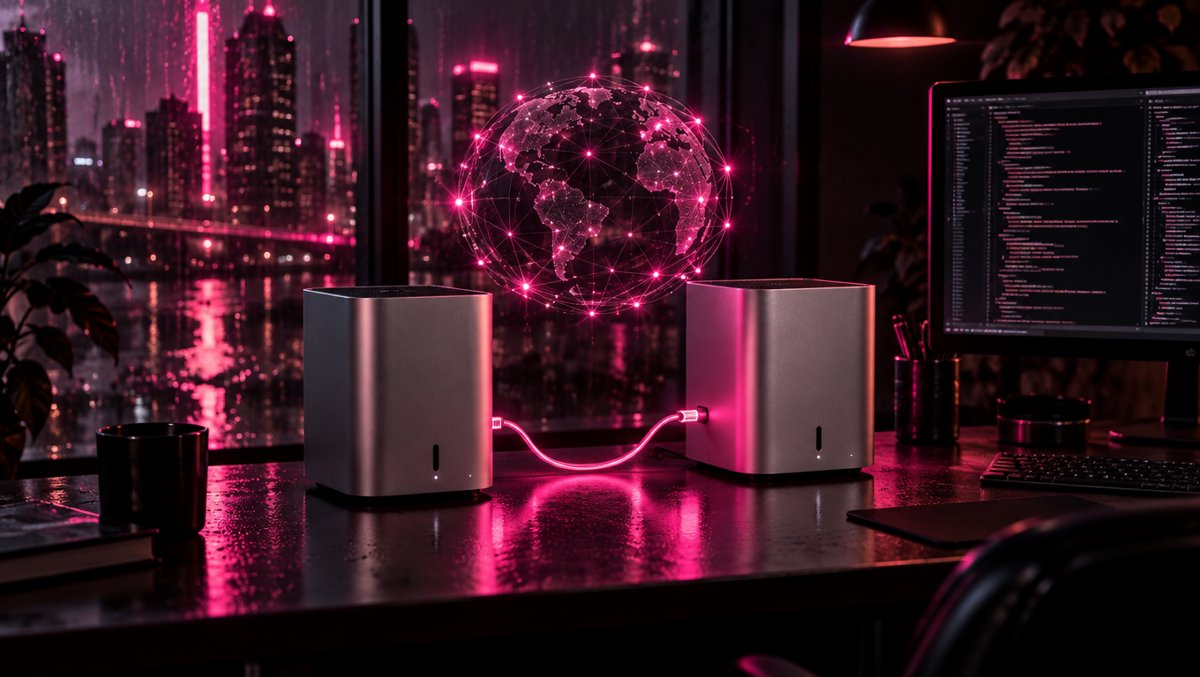
The Desktop Revolution: Two Boxes, One Terabyte
Here's the part nobody at OpenAI or Anthropic can match right now. The weights are chunky — BF16 runs about 1.6TB, and even the NVFP4 build, which quantizes only the experts, lands near 530GB. The model card recommends at least 700GB of VRAM for NVFP4 and 2TB for BF16. In a data center that's 4 Blackwell Ultra GPUs or 8 H200s.
On a desk, it's this: two Apple M5 Ultra Mac Studios, 512GB of unified memory each, connected over Thunderbolt 5 with RDMA. The latest MLX framework pulls the weights straight from Hugging Face and uses tensor parallelism to split every layer across both machines. Apple's unified memory architecture lets the M5 Ultra's integrated GPU address up to 512GB per box, and the chip's 1.2TB/s of bandwidth is enough to feed each token's slice of experts as it's needed. Meta's phrasing: the two machines "behave like one supercomputer with a terabyte of unified memory." (We flagged the M5 Ultra's memory bandwidth story back in August when the 512GB Mac Studio landed — this is the first model that actually needs two of them.)
Meta didn't just run a demo prompt, either. On that desktop rig, running Muse Code powered by Muse Spark Open entirely on-device, the model shipped real iOS changes to Ice Cubes — the open-source Mastodon client — covering bug fixes, new features, and a full build. In the other test, it drove DaVinci Resolve end to end, reviewing footage frame by frame to pick the strongest moments and crop them vertically. Agentic, long-horizon, offline, on hardware you can buy.
If you can't swing two Mac Studios, Unsloth's dynamic GGUFs squeeze down to 2-bit quants that fit in roughly 300GB of combined memory — still absurd for a desk, but no longer a cluster.
By the Numbers: Read the Footnotes
Meta's comparison table runs Muse Spark Open at xhigh reasoning effort against Kimi K3, GLM 5.3, Qwen3.8-2.4T-A95B, Inkling, Nemotron 3 Ultra, Beam, and Mistral Large 4. The shape of the results:
| Benchmark | Muse Spark Open | Best in table | Who |
|---|---|---|---|
| MCP-Atlas (agentic tool use) | 89.2 | 89.2 | Muse Spark Open |
| JobBench (agent tasks) | 61.8 | 61.8 | Muse Spark Open |
| ZeroBench w/ tools | 50.0 | 50.0 | Muse Spark Open |
| AA Omniscience | 25 | 25 | Muse Spark Open |
| HLE-Diamond, no tools | 26.1 | 26.1 | Muse Spark Open |
| Terminal-Bench 2.1 (coding) | 76.4 | 85.0 | Kimi K3 |
| AA Intelligence Index | 39 | 45 | GLM 5.3 |
| GPQA Diamond | 89.0 | 93.5 | Qwen3.8 / Kimi K3 |
| DeepSWE 1.1 (vendor, own harness) | 60 | 67.5 | Kimi K3 |
| BabyVision | 80.2 | 85.7 | Kimi K3 |
All figures via Meta's published comparison table; several rival scores are self-reported by their labs, and Meta's evaluation methodology lists the source of each.
So what's the honest summary? Where agentic tool use goes, this is the new leader of the entire open field — Chinese models included. MCP-Atlas is the telling one: the benchmark gives the model plain-language tasks without naming the tools, and it has to figure out which of 220 tools across 36 live Model Context Protocol servers to call, and in what order. 89.2 beats every rival Meta listed, Kimi K3 included (82.3). JobBench lands at 61.8 — more than double Inkling's 31.1, the best the US open field could previously muster, with NVIDIA's Nemotron 3 Ultra trailing at 27.2.
Where raw code goes, Meta is honest about finishing third at best. Terminal-Bench 2.1 with the Terminus 2 harness: 76.4, against Kimi K3's 85.0, GLM 5.3's 83.9, and Qwen3.8's 82.0. The Artificial Analysis Intelligence Index tells the same story — 39 versus 45, 44, and 40. GPQA Diamond science reasoning trails too, 89.0 against 93.5 for both Qwen3.8 and Kimi K3.
Which is exactly why the phrase "most capable US open-weight model" is doing so much work in that headline. It's true. It's also carefully scoped — drop the "US" and the claim doesn't survive Meta's own table. Give Meta credit: the table is published, the methodology is linked, and the honest gaps are visible in it. That's more transparency than most launches manage, and the asterisk is on the record.
One more number worth having: hosted access is live on seven providers at launch — Baseten, Fireworks AI, Groq, Modal, Nebius, OpenRouter, and Together AI — with OpenRouter listing $1.25 per million input tokens and $4.25 per million output. Weights are also downloadable from Amazon SageMaker AI, Google Cloud Model Garden, Microsoft Foundry, and Hugging Face itself.
What This Changes
The desktop is now a legitimate frontier tier. For two years, "local AI" meant small models with big caveats. A model whose own lab bills it as the most capable US open-weight release ever — running on-device, driving real applications, with no cloud round-trip — redraws that line. Privacy-sensitive agentic work (medical records, legal files, source code under NDA) just got a plausible all-local architecture, assuming the hardware budget survives.
The license is a strategic weapon. The Muse Model License permits free use, modification, fine-tuning, distillation, and redistribution — with two sharp edges. Products must display "Built with Muse Spark Open." And any model-as-a-service provider crossing $20 million in gross revenue over 12 months must cut a separate deal with Meta. Internal use, research, and using the model as a component inside your own product are exempt. Translation: startups and enterprises can build on this for free; hyperscale API resellers pay; and military and critical-infrastructure uses are off-limits entirely. It's the Llama playbook refined — open enough to win the ecosystem, fenced enough to matter commercially. Meta also takes no ownership of outputs.
Distillation just got a Western frontier donor. The license explicitly allows distillation, which means every 7B-to-70B model trained in the next six months has a legitimate path to learn from 816B parameters of teacher. Expect a wave of small, sharp, Muse-derived models.
Safety numbers came with the receipts. The model card reports 99.2% refusal on Meta's internal cyber jailbreak benchmark and 94.8% aggregate across PolyGuard's cyber subset, RedCode, and CyberBench 2024 — where the same setup lists Kimi K3 at 75.5% and 70.2%. Above 98% refusal on SecureBio's BioTIER benchmark, 98.1% honesty on MASK, a 0% misbehavior rate on Agentic Misalignment, and 0.5 on StrongREJECT v2 (lower is better). Meta evaluated against its Superintelligence Scaling Framework and says the model met release thresholds, with a full evaluation report still to come.
⚠️ Limitations & Caveats
- It's not the coding king, and Meta's own numbers say so. If your benchmark is Terminal-Bench, the best open coding models are Chinese. The US-open-weights framing is accurate and also the most flattering possible cut of the data.
- The comparison table is Meta's. Several rival scores are self-reported, harnesses differ (DeepSWE numbers come from vendors running their own setups — Kimi's 67.5 here is a vendor figure), and independent replication of the head-to-heads will take weeks. Trust the direction; verify the deltas.
- The desktop rig is real but expensive and unpriced by Meta. Two maxed-out Mac Studios plus the model's ~530GB NVFP4 footprint is a serious spend; Meta's blog doesn't quote a price for the setup, and we won't invent one. The 300GB 2-bit Unsloth route sacrifices quality for feasibility.
- Safety is a property of this checkpoint, not a guarantee. Meta's own caution: the results "characterize the released checkpoint under the tested conditions," and downstream modifications — the fine-tunes this license invites — could degrade all of it. Fine-tune away the safety training and the numbers are yours, not Meta's.
- A full evaluation report is still "coming soon." The preparedness results are summarized on the card; the complete document isn't out yet.
🎯 The Bottom Line
Meta just put a frontier-class, tool-use-leading, multimodal 816B model on Hugging Face with a license that's free for nearly everyone who'll actually build with it — and ran it on a desk. The "most capable US open-weight model" asterisk is real: Chinese labs still own the coding leaderboards. But the desktop frontier is now open for business, and whatever lab you favor, that's the line this release moves.
📚 Sources
- Meta AI Research (Gold — official launch post) — "Introducing Muse Spark Open, The Most Capable US Open-Weight Model to Date." https://research.meta.ai/blog/muse-spark-open
- Hugging Face (Gold — official model card) — meta-models/Muse-Spark-Open-816B-A42B, including released chat template. https://huggingface.co/meta-models/Muse-Spark-Open-816B-A42B
- MarkTechPost (Silver) — "Meta Releases Muse Spark Open: 816B Open-Weight MoE With 1M Context" — architecture, benchmark tables, hardware guidance, pricing. https://www.marktechpost.com/2026/10/15/meta-muse-spark-open-816b-open-weight-model/
- Unite.AI (Silver) — "Meta's 816B-Parameter Muse Spark Open Weights Are Now Public" — full architecture, license text, safety benchmarks. https://www.unite.ai/metas-816b-parameter-muse-spark-open-weights-are-now-public/
- SiliconANGLE (Silver) — "Meta releases 816B-parameter Muse Spark Open for coding and agent work" — release history, Inkling/Nemotron comparison, MCP-Atlas details. https://siliconangle.com/2026/10/15/meta-releases-816b-parameter-muse-spark-open-for-coding-and-agent-work/
- Hacker News (Community-sourced, labeled) — front-page discussion, 866 points / 431 comments at time of writing. https://news.ycombinator.com/item?id=50107379
All claims verified against Gold-tier (Meta's official launch post, the official Hugging Face model card) and Silver-tier (MarkTechPost, Unite.AI, SiliconANGLE) sources. Every source URL was scraped and confirmed accessible with full content on October 16, 2026. Benchmark figures are from Meta's published comparison table and labeled as such; conflicting secondary figures (Kimi K3 DeepSWE: 67.5 vs 68) noted and treated as vendor-table rounding.