
Published: October 7, 2026 | Reading Time: ~11 minutes | Channel: techminute
Here's the number that should break your brain this week: Meta's Muse — the AI agent that hit 5 million downloads in 22 days and has sat at #1 on the U.S. App Store's free iPhone chart for twelve consecutive days — gives each user a virtual computer built on two CPU cores. Two. The server chip those cores come from, an AMD EPYC, sells on the secondary market for under $3,000. Not per user. Per socket. Sliced dozens of ways.
On Tuesday, that humble arithmetic carried Advanced Micro Devices to a record close of $649.42 — up almost 3% on the day — and into the trillion-dollar market-cap club, a room that until this year was strictly for GPU farms, ad networks, and one fruit-named phone company. AMD gained 32% in the past month. Intel, its ancient rival, gained 21%. Every megacap in tech got lapped by the two companies that make the chips everybody spent three years calling boring.
The reason is the most important change in AI hardware since ChatGPT: the agent era runs on CPUs. Not instead of GPUs — alongside them. And the economics of that split are rewriting the pecking order of the entire chip industry.
For three years, the AI story had one protagonist: the GPU. NVIDIA's accelerators became the scarcest object in technology, data centers were redesigned around them, and the CPU — the chip that ran everything from 1990 until roughly 2022 — got demoted to scenery. AMD and Intel spent that era as supporting cast in someone else's movie.
Then the software changed. In early September, Meta launched Muse, a personal AI agent that caught on so fast it topped the App Store in under two weeks. Last week, OpenAI answered with Dots. These aren't chatbots. They plan tasks and then execute them autonomously — browsing, filing, building, orchestrating other software — for hours or days at a stretch. And that changes what hardware they need.
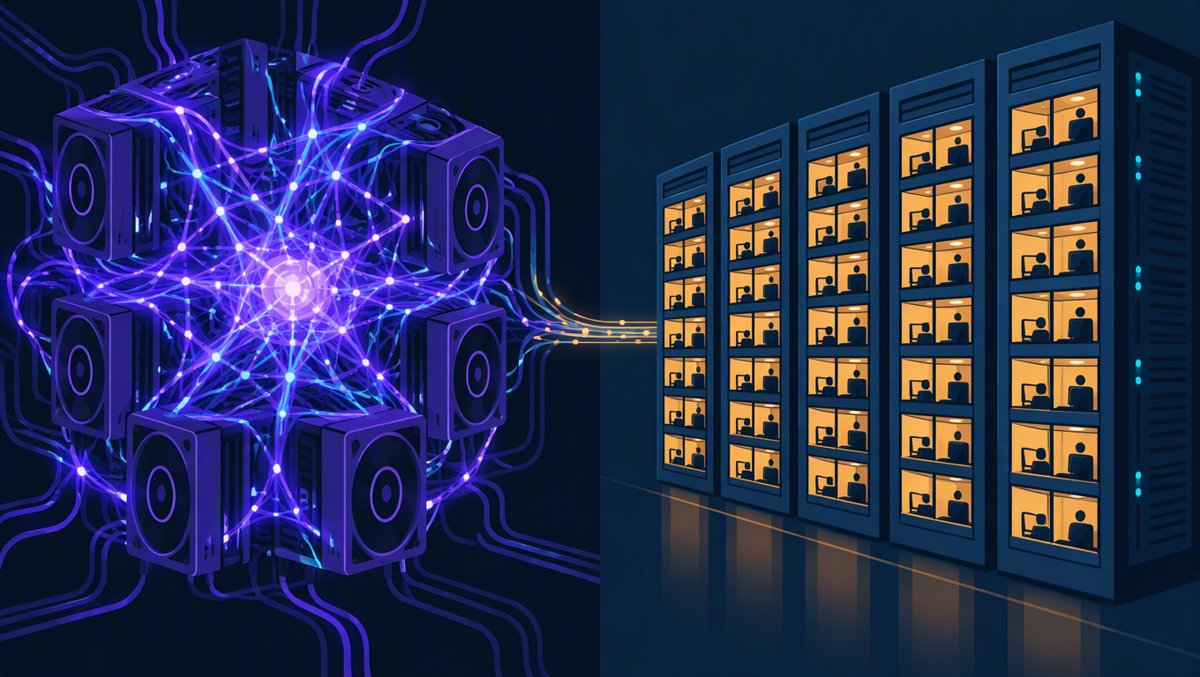
"CPUs are actually performing the workflows while GPUs are doing the thinking," Daniel Newman, CEO of Futurum Group, told CNBC. It's the cleanest one-line hardware taxonomy of the agentic era so far: the GPU is the brain that decides, the CPU is the pair of hands that does. An agent can think once and work for six hours. All that working happens on a general-purpose processor in a virtual machine.
The market noticed before most of the tech press did. AMD and Intel were already two of the year's best-performing large chips stocks on CPU demand alone, and over the past month they pulled away from the pack entirely. As of Monday's close, AMD was up 32% and Intel 21% — beating every tech megacap in the market. Then came Tuesday's record close and the six-zero club.
The mechanism is the oldest trick in the server book: virtualization. Meta and OpenAI don't give each user a physical computer — they partition a big server into scores of lightweight virtual machines, one per user session. The modern twist is what fits inside each slice.
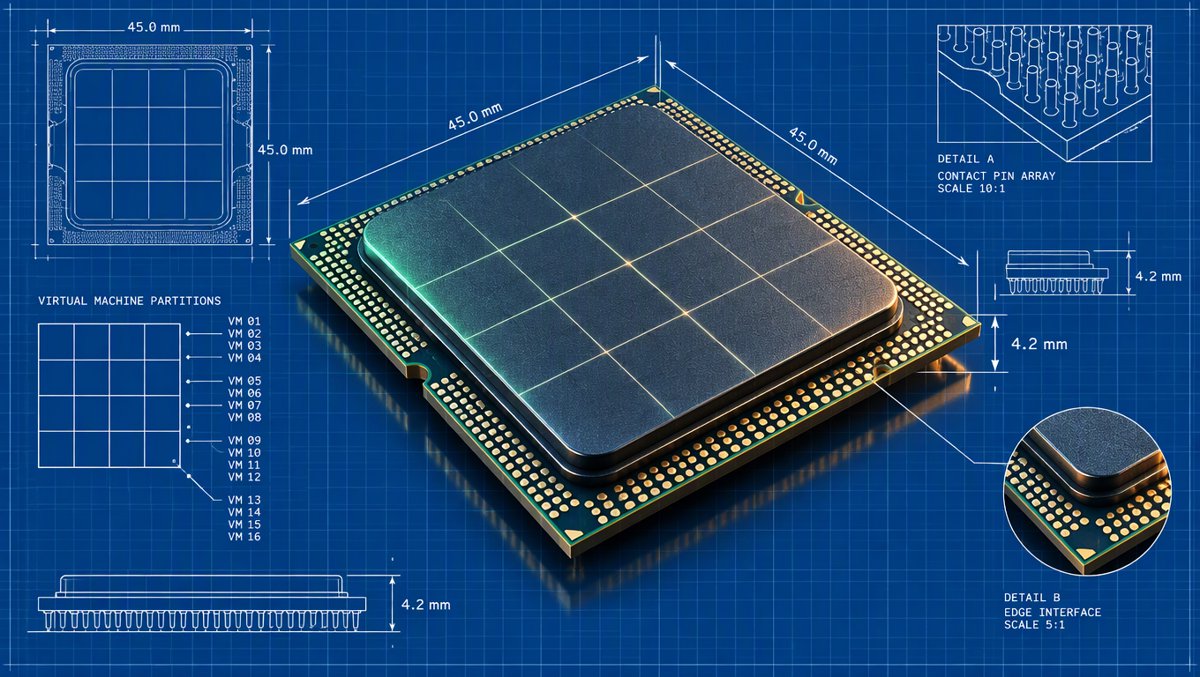
This is why the personal-agent boom lands so differently from the chatbot boom. A chatbot needs a GPU burst for a few seconds per query. An agent needs a resident computer — small, always on, cheap enough that a consumer-scale user base doesn't bankrupt the operator. x86 server CPUs are the only part in the industry already manufactured at that exact price-performance point, with decades of software compatibility (older enterprise tools just run) and hyperscaler relationships already in place.
"CPUs are less expensive than GPUs," as CNBC put it — which is the kind of sentence that reads like a footnote and behaves like an earthquake. When your serving cost for a consumer AI product is a couple of cores on a sub-$3,000 chip instead of dedicated accelerator time, whole product categories become viable that weren't viable last year.
The people building the chips saw it coming. "The conversation has changed quite a bit over the last eight to 10 months in terms of agentic usage," said Dan McNamara, AMD's senior VP and general manager of compute and enterprise AI, adding that CPU sales are going to "really ramp." AMD's CEO Lisa Su has been blunter about the constraint: demand is "even higher than our supply."
The trillion-dollar cap isn't riding on hype alone — the most recent quarter already shows the CPU engine at full throttle. From AMD's own Q2 2026 report:
| Metric | Q2 2026 | YoY | Note |
|---|---|---|---|
| Total revenue | $11,536M | +50% | Company record |
| Data Center segment | $6.7B | +107% | ~58–60% of total sales; EPYC + Instinct |
| Non-GAAP EPS | $1.66 | +246% | Record; GAAP EPS $1.38 |
| Q3 2026 guide | ~$13B ±$300M | +41% (midpoint) | Non-GAAP GM ~56% |
| 2H26 server CPU revenue | — | +80% (guide) | +70% forecast for 2027 |
(One asterisk AMD won't put in the headline: the year-ago quarter absorbed an $800M inventory charge from U.S. export controls on MI308 GPUs, so some of that +107% is measured off a depressed base. Growth is real; the optics are flattered.)
And then there's the fight over the future size of the CPU market itself, where the three most important forecasters on the planet currently disagree by 50%:
| Forecaster | CPU market forecast | Note |
|---|---|---|
| NVIDIA | $200B by 2030 | Released Vera, its own agent-focused CPU, plus a CPU-only rack |
| AMD | $220B by 2030 | Up from the $60B outlook it held in 2025; expects >50% share |
| Citi (Atif Malik) | $300B by 2030 | "From $29 billion in 2025... a 60% CAGR"; raised AMD PT $575 → $800 |
| Futurum | $118B in 2027 | Almost double the firm's own May forecast |
When the bull's forecast is 50% above the incumbent's, somebody is going to be spectacularly wrong — that's not analysis, that's arithmetic. Hold that thought for the caveats.
1. The AI hardware story just got a second protagonist. For three years, "AI trade" and "GPU trade" were synonyms. No longer. AMD holds about 46% of the x86 CPU market by units (Mercury Research, August), and it's the incumbent supplier in exactly the place agents live: hyperscaler fleets. Jordan Klein, an analyst at Mizuho Securities, believes AMD currently has the "best product" for this wave — while cautioning that NVIDIA's Vera is "just a new product" in a crowded field and he "wouldn't rule Nvidia out." Klein's kicker is the real thesis: "If you are a company that can supply both types of chips, you're in the best position." That's AMD in one sentence — EPYC for the work, Instinct for the thinking, Helios racks (already deployed by Anthropic, Meta, Microsoft, OpenAI and others, including a deal for up to 2 gigawatts of MI450 GPUs) to sell the whole stack.
2. Intel gets a life raft it didn't have to invent. A rising CPU tide is the best thing to happen to Intel in years — +21% in a month — and it required no miracles, just the market re-valuing the product Intel already makes in volume.
3. Arm and NVIDIA aren't spectators. Arm announced its own CPU for agents in March with Meta as the debut customer, and its stock has more than doubled since. Nearly every major cloud provider is building custom Arm-based chips. NVIDIA, meanwhile, has declared CPUs a $200B market and built a rack that's nothing but its CPUs. The response to "CPUs are back" is every giant in the industry scrambling to sell CPUs.
4. Consumer AI gets streaming economics. A ~$3,000 socket partitioned into dozens of agent seats, at an average serving cost of $37/user/month per Morgan Stanley, means operators can price agents like a Netflix subscription instead of a supercomputer rental. Meta already expanded Muse with small-business tools connecting Instagram, Facebook, Canva, and Slack. The agent is graduating from demo to workflow — on hardware that was already installed.
5. AMD is spending the win. Two weeks ago it agreed to acquire Fei-Fei Li's World Labs — the spatial-AI lab — for $8.2 billion, expected to close by end of 2026. Confident companies buy futures.
The funniest thing about the AI revolution's latest chapter is that it was rescued by the least revolutionary chip in the building. Agents don't just need a brain — they need a body, bodies are cheap, and AMD makes the best ones at scale. A $1 trillion valuation for a ~$3,000 server chip's partition math is absurd on its face and completely logical on the spreadsheet. The open question isn't whether the CPU renaissance is real. It's whether it's priced.
All claims verified against Gold-tier (AMD IR press release) and Silver-tier (CNBC, Quartz, Yahoo Finance, TIKR) sources. Each source URL was scraped and confirmed accessible with full content on October 7, 2026. Partition-count arithmetic in "Under the Hood" is our own derived calculation, labeled as such. Intraday price noted as of scrape time Oct 7, 2026.