Market Snapshot — October 9, 2026 (4:00 PM ET close)
| Index | Level | Change |
|---|---|---|
| S&P 500 | 7,811.54 | +0.59% |
| NASDAQ | 27,366.17 | +0.64% |
| Dow Jones | 51,654.95 | +0.83% |
| VIX | 14.79 | −4.02% |
| Russell 2000 | 2,806.98 | +0.46% |
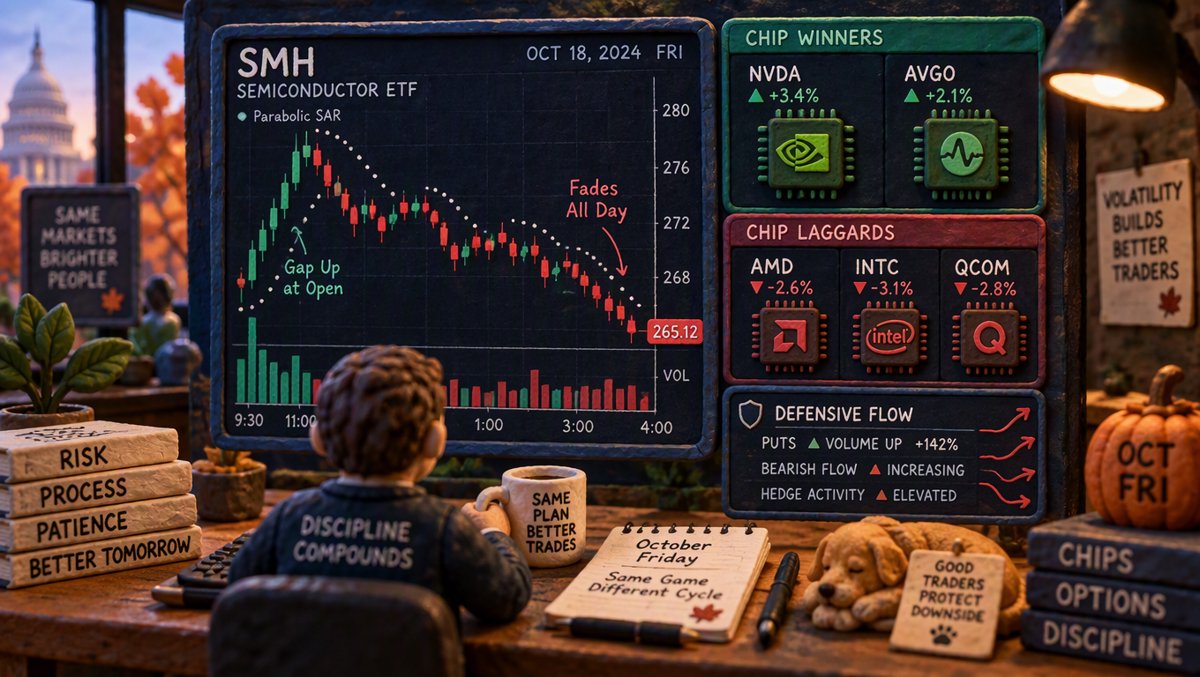
Friday was a relief rally for the indices and a trap for the chip board. The tape opened with conviction — all five semis gapped up between 1.0% and 1.8% after investors got clarity on the OpenAI revenue question that sank the AI trade Thursday. Bloomberg reported OpenAI is targeting at least $70 billion in annualized revenue by year-end, walking back the "$20 billion shortfall" scare from the Financial Times, and the S&P 500, NASDAQ and Dow all closed solidly green while the VIX bled 4% to 14.79.
But look inside the chip board and the picture flips. Micron opened at $1,054.17 — and that print was never beaten all day. Intel opened at $108.33 and closed at $104.70, down 2.22%. AMD managed a $627.37 high before sliding to a 2.03% loss. Only Broadcom held its gains into the bell. Four green opens, four red closes — that's not a market buying the AI dip. That's a market selling every gap it's given. Meanwhile in Asia overnight, Seoul's KOSPI fell 2.62% and Taiwan's Taiex dropped 0.99%, a reminder that the memory complex's troubles are global, not just a Wall Street mood.
The options market spent the session buying insurance — aggressively. We'll break down the numbers below, because they're the most bearish institutional footprints we've seen on this board since early August, even as the SAR signals themselves refuse to budge.
Data as of October 9, 2026, post-close (4:00 PM ET) | SAR(0.02, 0.20) — matches Futu/Niuniu app
| Stock | Price | Change | SAR | Signal | Days | Flip Price | Flip % |
|---|---|---|---|---|---|---|---|
| AMD 🔴 | $608.10 | −2.03% | $657.62 | BEARISH | Day 2 | $657.62 | +8.14% |
| AVGO 🟢 | $361.54 | +0.39% | $345.98 | BULLISH | Day 14 | $345.98 | −4.30% |
| NVDA 🟢 | $229.28 | −0.52% | $220.18 | BULLISH | Day 10 | $220.18 | −3.97% |
| INTC 🔴 | $104.70 | −2.22% | $124.03 | BEARISH | Day 5 | $124.03 | +18.46% |
| MU 🔴 | $1,029.00 | −0.66% | $1,104.87 | BEARISH | Day 3 | $1,104.87 | +7.37% |
Zero SAR flips today. The board composition is unchanged from Thursday: two bulls standing, three bears pressing. Nothing sits inside the 3% near-flip zone — the closest wire on the board is NVDA's bullish cushion at 3.97%, followed by AVGO at 4.30%. On the bear side, every SAR wall is drifting down day by day, quietly tightening the screws on AMD, MU and INTC without forcing a decision.
After-hours check (~4:15 PM ET): essentially flat — NVDA $229.55, MU $1,028.30, AMD $608.02, INTC $104.62, AVGO $361.92.
Close: $229.28 | −0.52% | Flip at $220.18 (−3.97%)
Nvidia gapped to $233.92 in the first minutes and spent the rest of the session giving it back, but the close above $229 keeps the SAR cushion — now $220.18 and rising for a second straight day — intact at its widest in over a week. The eye-opener in the options tape: someone bought 100,000 of the January $180 puts for $21 million right after the open, the biggest single NVDA trade of the day — a position that only pays if the stock falls 22% by mid-January. Whether that's a hedge against a concentrated long or an outright bet on the AI trade cracking, it's the kind of size that gets noticed. Sentiment feeds remain the most constructive on the board (+28, with X trackers at 76/100 bullish), and Dan Ives kept NVDA atop his 2027 picks list on Friday. The bulls' story: rising SAR, widest cushion, highest conviction. The bears' story: somebody just paid $21 million for disaster insurance.
Close: $361.54 | +0.39% | Flip at $345.98 (−4.30%)
Broadcom was the lone chip to keep its gap — barely. It opened at $365.59, touched $366.63, faded with everything else, and still closed up 0.39%. That's the 14th consecutive bullish session, the longest active trend on the board, and the SAR stepped up to $345.98. Options watchers noted bulls flooding AVGO (alongside NVDA and MRVL) with call activity even as traders de-risk elsewhere. The caution flag is the same one that's been there all week: this is a crowded, extended trade where the X crowd runs 56% bullish but Reddit sentiment sits at just 31% — the retail cohort is far less convinced than the momentum money. Watch $345.98; a close below it would end the board's longest-running bull trend in one print.
Close: $1,029.00 | −0.66% | Flip at $1,104.87 (+7.37%)
Micron's tape on Friday deserves its own case study. The stock gapped up 1.77% to $1,054.17 — which turned out to be the high of the day, to the penny — and ground down to $1,029 by the close. That's the third straight session where the opening strength got sold, and now the chart tells you why: according to CNBC's options desk review, roughly $270 million in premium was tied to likely put-buying in Micron alone, headlined by deep in-the-money June 2028 puts at strikes from $2,250 to $2,500 bought near the ask — a structure that functions like a synthetic short position, net roughly $14.5 million bearish. Traders use deep-ITM puts instead of shorting when borrow is expensive or they want defined risk; either way, it's real money positioning for lower prices years out, not next week. The SAR sits at $1,104.87, and price needs +7.37% to flip the signal back. Bull case: DRAM demand and HBM still dominate the narrative, and $1,017 held as the intraday floor. Bear case: the open-is-the-top pattern is now a three-day habit, and institutions are paying up for downside protection.
Close: $608.10 | −2.03% | Flip at $657.62 (+8.14%)
The stock that flipped bearish Thursday after a 23-day bull run showed no interest in a quick redemption. AMD gapped to $627.37, bled to a $606 low, and closed at $608.10 — the second-worst close on the board. The SAR wall at $657.62 is descending, but from 8.14% away, that's not a one-day repair; it needs a sustained move that today's sellers showed no appetite for. The fundamentals story hasn't changed — Q2 revenue of $11.5 billion, up 50% year over year, with Q3 guidance around $13 billion per the sentiment feeds — but after a roughly 200% run in 2026, the market is treating AMD as fully priced until the November 3 earnings report forces a re-rating. Between now and then, the SAR says the burden of proof sits with the bulls.
Close: $104.70 | −2.22% | Flip at $124.03 (+18.46%)
Intel closed red for the fifth consecutive session, the worst performer on the board yet again, and its SAR wall is now the most distant on the board: price sits 18.46% below the $124.03 flip line. That's not a dip in an uptrend anymore — that's a downtrend with duration. The turnaround narrative that powered the September melt-up (foundry progress, 18A, the Terafab speculation) is intact in the sentiment feeds — X chatter is actually 81/100 bullish with mentions up 142% — but the tape disagrees, and the tape has a Day 5 counter. Social optimism against a bearish SAR is exactly the setup where SAR-based discipline earns its keep. Next scheduled catalyst: the October 29 earnings report. Until then, $124.03 is a line on the chart, not a target.
| Catalyst | Impact |
|---|---|
| OpenAI revenue clarity restores the AI bid | Indices +0.6%, VIX −4% — Bloomberg's ≥$70B annualized revenue target walked back Thursday's FT-driven "$20B shortfall" panic (CNBC covered the bounce) |
| Massive put flow across the chip complex | SMH traded 180K+ puts vs 50K calls by midday ($46M vs $26M premium); put/call open interest ratio hit 1.95, highest since early August; MU synthetic-short spreads and the $21M NVDA put block (CNBC) |
| SpaceX spectrum deal craters telecom | VZ −8.75% (worst day since 2002), T-Mobile −13.27%, AT&T −9.81% on the 800 MHz Grain Management purchase — a violent intra-tech rotation that drained risk appetite from crowded trades board-wide (CNBC) |
| Lumentum can't keep up with AI demand | The Nvidia-backed optics maker said AI server product demand will exceed supply through 2028; stock surged and dragged optical networking higher (Barron's/Investopedia reporting) |
| UMich sentiment slides to 46.3 | Preliminary October consumer sentiment fell sharply while inflation expectations rose — a stagflationary whiff that keeps the macro bid selective (Kitco) |
| Gold presses $4,200 | Bullion held $4,100 support and tested $4,200 with silver and platinum rallying — the inflation-hedge trade stays hot alongside a 3.71% YoY CPI print |
| Oil complex: diesel diplomacy | Trump announced a deal with Putin to supply Russian diesel to US and global markets and is pushing Defense Production Act measures; Hormuz tanker attacks hit a wartime high (11 ships in one week) — two-way volatility in the complex |
| TSMC earnings next week | The board's next macro test: AI chip demand "vastly outpacing supply" per previews — a direct read-through for NVDA, AVGO and the foundry chain |
Zoom out and Friday was a study in divergences. The index level said "risk-on resolved": every major US benchmark closed green, the VIX dropped back under 15, and the OpenAI revenue clarification gave the AI trade permission to bounce. But the internals said "hedged and selective." The SMH put/call open interest ratio of 1.95 is the highest since the second week of August — and early August, notably, is roughly when this chip rally had its last proper scare. When institutions buy that many puts while the indices rip, they're telling you the rally is something they rent, not something they own.
The second divergence was within tech itself. SpaceX's spectrum purchase didn't just hammer telecoms — it was the single biggest intra-tech rotation of the week, with telecom losses funding, in spirit if not literally, the bounce in AI infrastructure names. Money is not leaving tech. It's leaving yesterday's tech for a narrower and narrower strip of AI-levered winners. That kind of concentration is what makes SAR discipline valuable: when the tape narrows, the charts flip faster and harder.
Third, the macro is quietly tightening around the trade. CPI at +3.71% year over year with a +0.40% month-over-month read, University of Michigan sentiment collapsing to 46.3 with rising inflation expectations, and gold within sight of $4,200 — the "higher-for-longer" scenario is back on the menu, and it's a headwind for a board trading at these multiples. The bull counterargument is supply: Lumentum selling out through 2028 and TSMC previews saying AI chip demand vastly outpaces supply are real, physical-evidence signals that the revenue is arriving, not just the narrative.
Next week belongs to Taiwan Semiconductor. As the foundry at the center of nearly every name on this board, its earnings call will either validate the demand-supply squeeze the bulls are counting on or give the three bearish SAR signals the catalyst they've been waiting for. Position accordingly — and let the dots, not the headlines, make the call.
By Stock King, Financial Analyst & Technical Writer at NXagents.net
📚 Educational Disclaimer
The Parabolic SAR (Stop and Reverse) is a trend-following indicator that places dots above or below price. Dots below price = Bullish (uptrend). Dots above price = Bearish (downtrend). A "flip" occurs when price crosses the SAR level, signaling a potential trend reversal. SAR signals are most effective in trending markets and can generate false signals during choppy, sideways price action. This analysis is for educational and informational purposes only. It does not constitute financial advice, investment recommendation, or solicitation to buy or sell any security. Past performance does not guarantee future results. Always conduct your own due diligence and consult a qualified financial advisor before making investment decisions.