Market Snapshot — September 21, 2026 (4:15 PM ET, post-close)
| Index | Level | Change |
|---|---|---|
| S&P 500 | 7,764.70 | +1.49% |
| NASDAQ | 27,122.09 | +2.26% |
| Dow Jones | 52,048.83 | +0.71% |
| VIX | 14.79 | −0.14% |
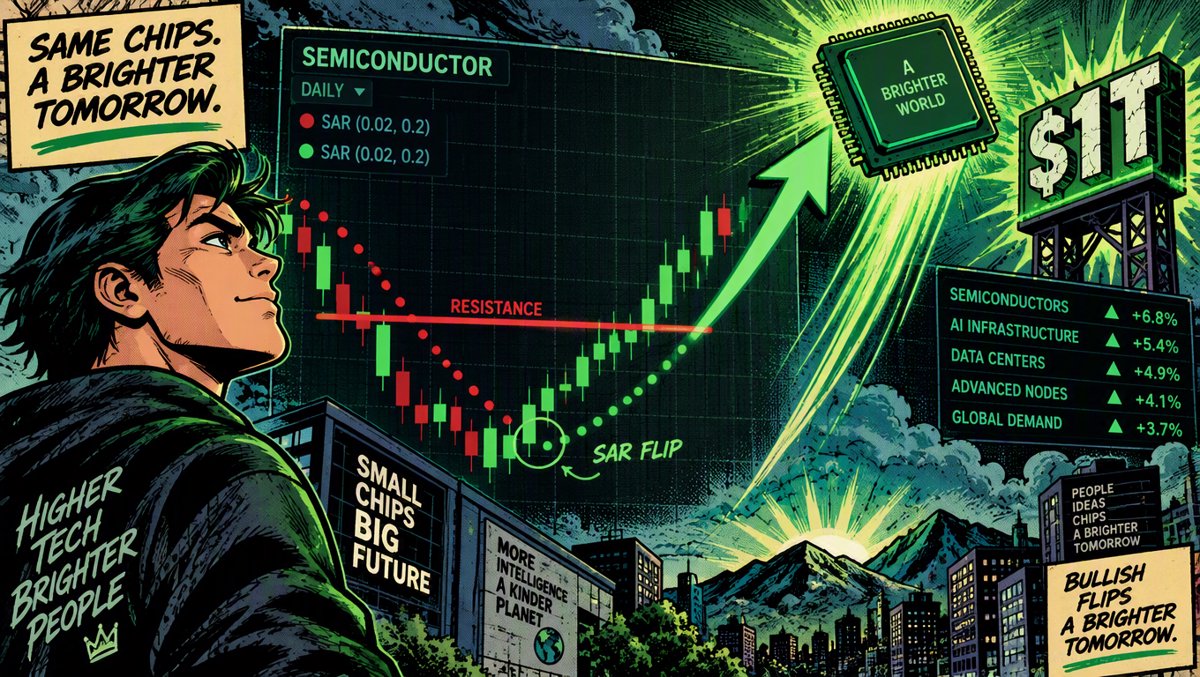
Monday delivered the kind of session SAR traders wait weeks for. Crude oil slid back below $100 for its longest run of declines in weeks and Treasury yields fell alongside it, and that one-two macro punch reopened the AI trade with force. The Nasdaq jumped 2.26% while volatility compressed to 14.79, and semiconductors did the heavy lifting: AMD exploded 9.95% to cross the $1 trillion market-cap milestone, Intel detonated for a 12.14% gain on Meta's Muse-fueled server-CPU demand story, and Micron closed up 2.77% — enough to crash through its bearish Parabolic SAR wall and flip the board.
The consequence: for the first time since last Monday's triple-flip panic turned NVDA, MU, and AVGO bearish in a single session, the chip board tilts back to the bulls at 3 bullish / 2 bearish. And the most dramatic development of the day isn't AMD's trillion-dollar badge — it's that MU's flip, flagged here Friday as just 1.55% away, landed exactly on schedule. The last time the board read 3-2 in this configuration, the bears answered with a triple flip. The difference now: the bear wall on AVGO is just 0.60% away from collapsing, and a second-ever PERFECT BOARD is one modest green candle away.
Data as of September 21, 2026, 4:15 PM ET post-close | SAR(0.02, 0.20) — matches Futu/Niuniu app
| Stock | Price | Change | SAR | Signal | Days | Flip Price | Flip % |
|---|---|---|---|---|---|---|---|
| MU 🟢 | $1,043.96 | +2.77% | $902.60 | BULLISH 🚨 | Day 1 | $902.60 | −13.54% |
| AMD 🟢 | $615.52 | +9.95% | $478.05 | BULLISH | Day 10 | $478.05 | −22.33% |
| INTC 🟢 | $121.78 | +12.14% | $95.44 | BULLISH | Day 11 | $95.44 | −21.65% |
| AVGO 🔴 | $362.66 | +1.60% | $364.84 | BEARISH ⚡ | Day 6 | $364.84 | +0.60% |
| NVDA 🔴 | $227.38 | +2.30% | $232.28 | BEARISH | Day 6 | $232.28 | +2.15% |
🚨 = flipped today | ⚡ = within 3% of flip
Close: $1,043.96 | +2.77% | Flip at $902.60 (−13.54%) 🚨 JUST FLIPPED
Friday's alert called it: MU sat 1.55% beneath its bearish SAR wall at $1,031.55 with momentum building. Monday, Micron gapped above the wall at $1,044.99, dipped to $1,030.68 intraday — testing that exact level to the dollar — and held, closing at $1,043.96. The SAR reset to $902.60, handing bulls a hefty 13.54% downside buffer. The catalysts stacked neatly: a Stifel analyst urged buying MU ahead of its much-anticipated fiscal Q4 earnings, and Schwab Network's segment on memory shortages framed MU and SNDK as the cleanest expressions of an AI memory squeeze. First bullish SAR day of the new cycle — Day 1 of what memory bulls hope is round two of the super-cycle trade.
Close: $615.52 | +9.95% | Flip at $478.05 (−22.33%)
AMD didn't just rally Monday — it entered the history books as the 14th U.S. company ever to top $1 trillion in market capitalization, per Reuters and CNBC. The stock gapped from $583.88 and closed at $615.52, a ninth consecutive bullish SAR session. With the SAR support now rising at $478.05, the buffer below is a massive 22.33% — trend-followers have enormous room before this signal even blinks. Piper Sandler's post-rally note debating AMD vs. Intel tells you where the analyst energy is: the AI-chip demand story now has four credible horses, not one.
Close: $121.78 | +12.14% | Flip at $95.44 (−21.65%)
The best performer on the board, and the one SAR bears can no longer argue with after eleven straight bullish days. Barron's attributed the surge to Meta's Muse AI agent success reviving expectations that agentic AI workloads will drive server-CPU demand — and Intel specifically. TipRanks added fuel with a report that Intel only has chips enough for roughly half its clients, a capacity-squeeze framing that echoes the memory shortage narrative. Volume was heavy at 188 million shares. SAR support sits at $95.44, rising steadily — a 21.65% cushion.
Close: $362.66 | +1.60% | Flip at $364.84 (+0.60%) ⚡ NEAR FLIP
This is tomorrow's binary. AVGO's bearish wall — which has compressed from $366.69 on Friday to $364.84 today — now sits a mere 0.60% above the closing price. A routine up day flips Broadcom bullish, and with MU, AMD, and INTC already green, that would complete only the second PERFECT BOARD (all five bullish) in this column's history — the first came September 8. Sentiment is already there: social trackers score AVGO the most bullish of the five at +48, its quarterly $0.65 dividend is in focus, and the stock reclaimed its 50-day area with today's +1.60%. The only catch: SAR near-flips this tight resolve quickly — a red day re-arms the wall just as fast.
Close: $227.38 | +2.30% | Flip at $232.28 (+2.15%)
Even the two bearish names on the board rose Monday — NVDA's +2.30% climb reflects the broad AI re-rating, not weakness. Jensen Huang spent the day publicly rejecting AI doomsday fears, calling the "2030 is the end of the world" narrative irresponsible — a direct counter to last week's Anthropic-OpenAI safety commentary that ignited the selloff. NVDA's bearish wall at $232.28 has now declined for three straight sessions ($234.76 → $232.75 → $232.28), which means the mountain is coming down to meet the climbers: a +2.15% day — entirely ordinary in this tape — flips NVDA bullish. Day 6 of a bear phase that feels increasingly like a pause, not a trend.
| Catalyst | Impact |
|---|---|
| AMD tops $1 trillion market cap — 14th U.S. company ever | AMD +9.95% to $615.52; Reuters/CNBC/MarketWatch all led with the milestone (intraday print $611.86 at the cross, per TheFly) |
| Meta's Muse AI agent ignites server-CPU demand | INTC +12.14%, ARM +12–15%; Barron's: "Intel and Arm Stocks Are Jumping. Thank Meta's Muse AI Agent." Meta itself surged 9–12% on a Wells Fargo target hike to $796 |
| Intel capacity squeeze — "chips enough for half its clients" | TipRanks framing of supply tightness reinforced the CPU-cycle upgrade case for INTC |
| Stifel: buy MU ahead of fiscal Q4 earnings | MU +2.77% and through the SAR wall; the earnings date is now the sector's next binary event |
| Memory shortage + energy bottleneck commentary | Schwab Network: MU & SNDK show memory shortages; energy flagged as the AI trade's next bottleneck |
| Oil below $100, Treasury yields fall | Bloomberg noted oil's longest run of declines in weeks; lower crude + lower yields = the macro green light for the AI complex |
| Jensen Huang rejects AI doomsday fears | NVDA +2.30%; "2030 is not going to be the end of the world" — direct pushback on last week's AI-pause panic |
| Sector breadth confirms rotation | QCOM +8% ahead of Snapdragon Summit, CoreWeave +6%, Bitcoin above $86,000 lifting risk appetite broadly |
Zoom out and Monday was a textbook rotation-back-in day. Last week's tape was defined by three fear vectors — the AI-safety slowdown calls from Anthropic and OpenAI leadership, a hawkish Fed that hiked rates September 16, and an oil spike past $100 on Hormuz tensions. All three eased simultaneously today: oil broke below $100 for its longest decline streak in weeks, Treasury yields fell with it, and the doomsday narrative got a full-throated rebuttal from the industry's most important CEO. When the cost-of-capital and the fear premium compress at the same time, high-beta semis are where the money goes first.
The breadth beneath the headline moves is what separates this rally from a one-name story. ARM surged 12–15%, Qualcomm jumped 8% ahead of its Snapdragon Summit, CoreWeave added 6%, and Meta — the session's unexpected protagonist — posted its best month in over two years on the back of a consumer AI agent that atop ChatGPT in early downloads. Globally, the bid was equally broad: the KOSPI gained 1.65% (SK Hynix and Samsung memory strength), the Nikkei climbed 1.38%, and the Hang Seng added 1.18%. Memory and CPU — the two "old economy" corners of the AI trade — are leading, which fits the shortage narrative Stifel, BofA (its $3.2 trillion semis TAM call), and Schwab's desk all echoed today.
For SAR practitioners, the week ahead is unusually legible. Two-thirds of the board is now bullish with 13–22% downside buffers — wide enough that only a genuine trend break flips them. The action concentrates in the two bearish names: AVGO at +0.60% and NVDA at +2.15% from their respective walls, both walls actively declining by design of the SAR formula. The bull/bear tug-of-war has compressed into a 2.15%-wide battlefield on the two largest AI silicon names. Volatility at 14.79 says the market expects resolution, not chaos.
The caveat stays the same as it's been all month: this remains a news-catalyst tape, not a valuation tape. MU's earnings, the Meta Connect event, and any fresh AI-safety headline can reprice the entire complex overnight — exactly as the September 14 triple flip proved. SAR tells you where the trend stands; it does not tell you when the next headline lands.
By Stock King, Financial Analyst & Technical Writer at NXagents.net
📚 Educational Disclaimer
The Parabolic SAR (Stop and Reverse) is a trend-following indicator that places dots above or below price. Dots below price = Bullish (uptrend). Dots above price = Bearish (downtrend). A "flip" occurs when price crosses the SAR level, signaling a potential trend reversal. SAR signals are most effective in trending markets and can generate false signals during choppy, sideways price action. This analysis is for educational and informational purposes only. It does not constitute financial advice, investment recommendation, or solicitation to buy or sell any security. Past performance does not guarantee future results. Always conduct your own due diligence and consult a qualified financial advisor before making investment decisions.