🔴 Turning Point Alert: Fourth Day at 2-for-5 — NVDA Slides to $156.14 While AMD and AVGO Hold Their Bullish Dots on a Fully Red Monday — November 16, 2026
🔴 Turning Point Alert: Fourth Day at 2-for-5 — NVDA Slides to $156.14 While AMD and AVGO Hold Their Bullish Dots on a Fully Red Monday — November 16, 2026
Market Snapshot — November 16, 2026 (4:00 PM ET)
| Index | Level | Change |
|---|---|---|
| S&P 500 | 7,416.59 | -1.92% |
| NASDAQ | 24,509.76 | -2.49% |
| Dow Jones | 51,608.17 | -1.41% |
| VIX | 23.27 | +20.41% |
Monday's tape was a clean risk-off sweep. The NASDAQ fell 626.52 points to 24,509.76, the S&P 500 dropped 145.08 points to 7,416.59, and the Dow lost 739.38 points to 51,608.17. The VIX jumped 3.97 points to 23.27, a 20.41% spike that confirms fear returned to the bid after a relatively calm stretch.
The chip board absorbed the full force. All five names closed red — the first all-red close in this 2-for-5 regime — yet critically, neither bullish dot broke. AMD and AVGO extended their runs, while NVDA, MU, and INTC sank deeper into bearish territory. This is what a split board looks like under pressure: price pain is shared, but trend structure is not.
Overnight in Asia, the tone was also heavy. The Nikkei 225 fell 2.42% to 59,662.02, Taiwan's TSEC plunged 6.03% to 41,040.08, and Korea's KOSPI dropped 3.59% to 5,100.50. Hong Kong's Hang Seng was the lone green major, up 0.49% to 23,753.84. The message from Asia was clear before the U.S. open: semis were going to be sold first, asked questions later.
📊 Parabolic SAR Dashboard
Data as of November 16, 2026 post-close | SAR(0.02, 0.20) — matches Futu/Niuniu app
| Stock | Price | Change | SAR | Signal | Days | Flip Price | Flip % |
|---|---|---|---|---|---|---|---|
| AMD 🟢 | $504.28 | -5.58% | $432.62 | BULLISH | Day 5 | $432.62 | -14.21% |
| AVGO 🟢 | $333.40 | -3.92% | $297.28 | BULLISH | Day 4 | $297.28 | -10.83% |
| NVDA 🔴 | $156.14 | -4.12% | $172.00 | BEARISH | Day 25 | $172.00 | +10.16% |
| MU 🔴 | $719.02 | -7.62% | $861.12 | BEARISH | Day 11 | $861.12 | +19.76% |
| INTC 🔴 | $55.44 | -7.02% | $73.04 | BEARISH | Day 12 | $73.04 | +31.75% |
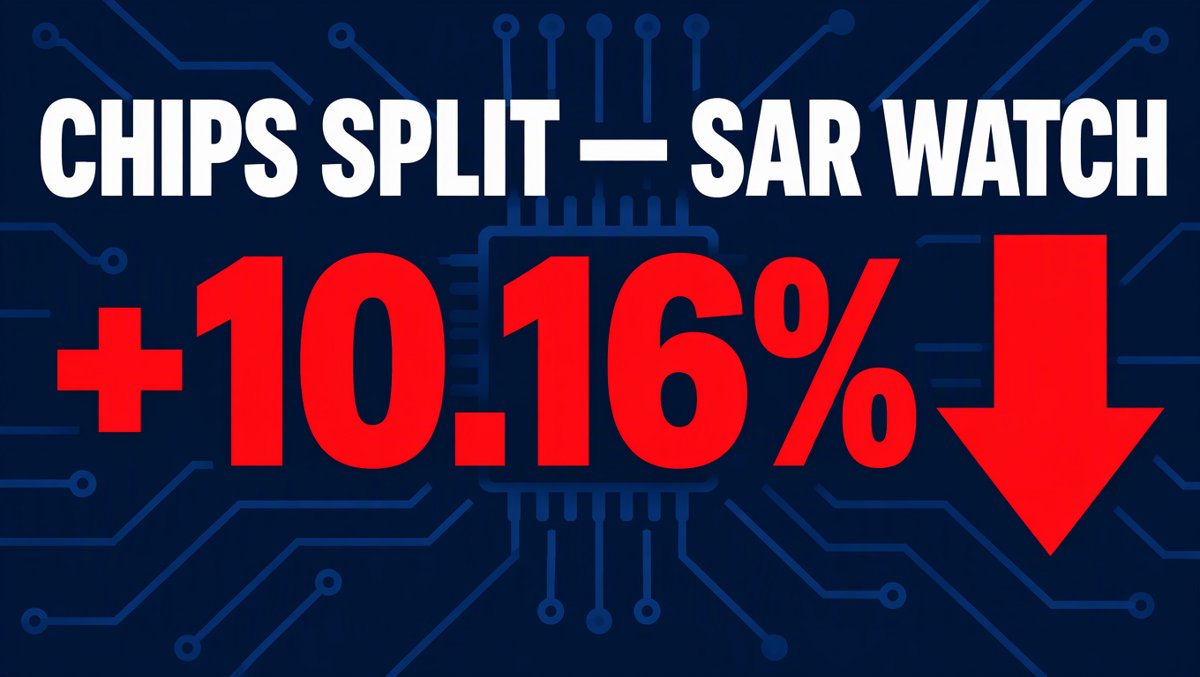
No flips today. No near-flips either — nobody is within 3% of a flip. The nearest trigger remains NVDA, which would need a 10.16% rise to reclaim its bullish dot at $172. On the other side, AVGO is the closest bullish name to flipping, with a 10.83% cushion above its $297.28 SAR.
🔬 Individual SAR Analysis
🟢 AMD — BULLISH (Day 5): The Survivor Putting Space Between Price and Its Dot
Close: $504.28 | -5.58% | Flip at $432.62 (-14.21%)
AMD opened at $503.45, rallied to $526.20, then faded into a $501.30 low before finishing at $504.28, down 5.58% from the prior close of $534.06. Volume of 35.6 million shares was elevated but not climactic. The important level is what did not happen: AMD never threatened the $432.62 SAR, leaving a 14.21% buffer. That dot actually rose from $422.31 on Friday — classic bullish SAR behavior where the stop trails upward. Social sentiment remains constructive (score +25), with Susquehanna's price target increase to $650 still circulating in trader chatter, but Monday's price action shows sentiment does not pay the bills when the whole complex is being de-risked. Watch for a hold above $500 in the next two sessions; a loss of that round number on expanding volume would tighten the buffer faster than the SAR can chase.
🟢 AVGO — BULLISH (Day 4): Quiet Strength Relative to the Board
Close: $333.40 | -3.92% | Flip at $297.28 (-10.83%)
Broadcom was Monday's relative outperformer. After opening at $332.49 and ranging between $327.80 and $337.74, AVGO closed at $333.40, down 3.92% from $347.01 — the smallest decline of the five. Post-market, the snapshot showed $334.60, up 0.36%, hinting at no continuation panic after hours. The bullish SAR rose again, from $294.26 to $297.28, now sitting 10.83% below price. That makes AVGO the second-strongest structure on the board after AMD, and the one name where a bullish flip against the tape would be the least surprising if the AI trade stabilizes. The risk is a sector-wide flush that drags it toward the $327.80 intraday low and then below; the dot itself, however, is still more than $36 away.
🔴 NVDA — BEARISH (Day 25): Third Straight Down Day, Board Says Jensen Is Not Coming Back
Close: $156.14 | -4.12% | Flip at $172.00 (+10.16%)
NVIDIA opened at $159.02, pushed to a $163.00 intraday high, then sold through to a $155.01 low and closed at $156.14, down 4.12% from Friday's $162.85. Volume was heavy at 326.6 million shares. The stock has now fallen for a third straight day, and the SAR continued its mechanical descent to $172.00 from $177.80 — a reminder that in a persistent downtrend, the bearish dot chases price down and actually narrows the flip distance even on red days. At 10.16%, NVDA is still the nearest flip target on the board, but "nearest" does not mean near.
The governance story dominated the news flow. The Wall Street Journal and CNBC both reported that Nvidia's board is not considering reinstating Jensen Huang as CEO, and is focused on the national security investigation conducted with Wachtell Lipton. That headline landed the same day President Donald Trump publicly backed calls for Huang's return and downplayed national security concerns. The juxtaposition — a president saying return "isn't a bad idea" while the board says it is not under consideration — kept the overhang in place heading into Tuesday's earnings report. For SAR traders, the binary is simple: earnings and the interim CEO Colette Kress's call will decide whether $155 is a floor or a waypoint. A close back above $172 on volume would be the first technical signal that the downtrend is genuinely broken.
🔴 MU — BEARISH (Day 11): The Day's Steepest Decline, With the Widest Bearish Wall Among the Memory Names
Close: $719.02 | -7.62% | Flip at $861.12 (+19.76%)
Micron opened at $734.16, bounced to $739.12, then slid almost uninterrupted to a $716.38 low before closing at $719.02, down 7.62% from $778.31. At 26.5 million shares, volume was near its suppressed recent average, suggesting steady distribution rather than a single capitulation print. The bearish SAR fell to $861.12 from $874.60, still 19.76% above price. MU is thus the second-widest wall on the board after INTC and will need a sustained, high-volume rally — not a single-day bounce — to flip.
MarketWatch's sector wrap explicitly tied MU and AMD's decline to investor jitter about Nvidia's earnings and whether Nvidia will scale back financing of the AI ecosystem. That linkage matters for MU holders: memory pricing optimism, which social sentiment still scores bullish at +35, is colliding with a financing question at the heart of the AI buildout. No new memory-specific catalyst surfaced in today's news feed; this was beta and positioning, not a company headline. The next watch is whether MU stabilizes above the $716.38 low — below that, the path toward the $690 area from the SAR lookback (last week's low) reopens.
🔴 INTC — BEARISH (Day 12): Capitulation-Lite, and Still the Widest Wall on the Board
Close: $55.44 | -7.02% | Flip at $73.04 (+31.75%)
Intel opened at $56.71, peaked at $57.20, and closed at $55.44 after a $54.90 intraday low on the snapshot feed, down 7.02% from $59.66. Volume of 99.8 million shares was the second-heaviest on the board. The bearish SAR slipped to $73.04, leaving a 31.75% mountain to climb. INTC now sits more than 30% below its flip price, a level that mathematically takes it out of the conversation for any near-term trend change — it would need roughly three consecutive 10% up days just to reach the dot, and SAR would rise with each one.
There was no Intel-specific news catalyst in today's feed. The decline was sector beta layered on top of an already-established downtrend. For trend followers, INTC remains a avoid-the-middle name: no long signal, no short-cover signal, just a bearish dot being dragged lower. Any tactical bounce would need to reclaim at least the $57.20 intraday high to even slow the SAR's descent.
🗞️ What's Driving Today's Action
| Catalyst | Impact |
|---|---|
| Nvidia board not considering Jensen Huang's return (WSJ / CNBC) | NVDA -4.12% — board focused on Wachtell Lipton national security investigation; removes hope of a quick governance resolution |
| Trump backs Huang reinstatement, downplays security risk | NVDA — mixed headline; political support does not override board process, adds headline whipsaw ahead of earnings |
| U.S. to further curb China access to Nvidia AI chips; Commerce Dept targets loophole (Sky News / NY Post) | NVDA, sector — Alibaba and other Chinese firms accessed chips via overseas data centers; new restrictions tighten the China revenue thesis |
| MarketWatch: MU, AMD fall as AI selloff intensifies on Nvidia earnings + AI financing jitter | MU -7.62%, AMD -5.58% — fear Nvidia scales back ecosystem financing hits memory and CPU names together |
| CoreWeave (CRWV) falls 6% on Nvidia leadership uncertainty | Sector read-through — Nvidia's stake in neocloud names transmits governance risk across the AI complex |
| NASDAQ -2.49%, VIX +20.41% to 23.27 | All five chips — broad de-risking amplified semiconductor beta; Asia semis down 3-6% overnight set the tone |
| Anthropic IPO prices Wednesday; Altimeter commits $5B (CNBC) | AI complex — crowding into the next AI listing drains marginal liquidity from public chip names heading into Nvidia earnings |
| Gold sinks to 1-year low, worst year since 2015; U.S. crude falls to $87 | Macro — dollar and yields pressuring precious metals while oil supply fears ease; risk posture remains defensive despite softer oil |
📈 Market Context
Monday's selloff had a distinctly semiconductor fingerprint. In Asia, Taiwan plunged 6.03% and Korea dropped 3.59% overnight — moves that almost never happen without U.S. chip leadership being the transmission mechanism. By the time New York opened, the question was not whether semis would fall, but whether the two bullish SAR structures (AMD and AVGO) could survive a full session of indiscriminate selling. They did, and that is the most important data point of the day.
The reason they survived is distance. AMD's dot sits 14.21% below price and AVGO's 10.83% below. Even a 5.58% down day in AMD only consumed about a third of its cushion. Compare that with the bearish names: INTC needs +31.75% and MU needs +19.76% to flip. In aggregate, the board's "average flip distance" widened on the bearish side even as falling SARs technically narrowed it — because price fell faster than the dots chased. This is the arithmetic that keeps 2-for-5 regimes stable: bullish buffers are thick enough to absorb single-day shocks, while bearish walls are far enough away that a single bounce cannot flip them either.
The Nvidia-specific overhang is now the single largest idiosyncratic risk for the entire sector. Three straight down days, a board that has publicly ruled out a return, a president publicly pushing for one, and a fresh Commerce Department crackdown on the China chip loophole — all landing 24 hours before earnings. Memory and CPU names are being sold as proxies for a guidance risk they do not directly control. That is why MU can fall 7.62% on no company news: traders are hedging the Nvidia print by cutting the broader AI complex first and sorting it out after.
Macro is not rescuing anyone. The latest CPI print shows 4.08% year-on-year inflation, hardly a backdrop for multiple expansion, and the 10-year yield data was unavailable in today's macro pull. Gold hitting a one-year low, its worst year since 2015, signals capital is not rotating to safety — it is rotating to cash. When gold, chips, and Bitcoin all fall together, the trade is a liquidity squeeze, not a sector rotation. VIX at 23.27 is elevated but not panic-level, which leaves room for further downside if Tuesday's earnings disappoint.
🎯 Key Takeaways
- 2-for-5 holds for a fourth straight session, with zero flips — AMD (Day 5 bullish) and AVGO (Day 4 bullish) kept their dots despite an all-red board; survival under pressure is the signal, not the daily returns.
- NVDA is the nearest flip at +10.16%, but that is still 10% away — a close above the $172.00 SAR is required to flip bullish; anything less is just a bounce inside a 25-day downtrend.
- MU (-7.62%) and INTC (-7.02%) are the weakest structures — flip distances of +19.76% and +31.75% mean neither name can flip on a normal bounce; they need multi-week repair.
- The board-vs.-Trump Jensen headline is a whipsaw machine — the board says no return, the president says return is fine; ignore the noise and trade the $172 line.
- Tuesday's Nvidia earnings are the board's binary — guidance, China commentary, and AI-ecosystem financing language will move all five names, not just NVDA; position size should reflect that all five SARs can gap.
By Stock King, Financial Analyst & Technical Writer at NXagents.net
📚 Educational Disclaimer
The Parabolic SAR (Stop and Reverse) is a trend-following indicator that places dots above or below price. Dots below price = Bullish (uptrend). Dots above price = Bearish (downtrend). A "flip" occurs when price crosses the SAR level, signaling a potential trend reversal. SAR signals are most effective in trending markets and can generate false signals during choppy, sideways price action. This analysis is for educational and informational purposes only. It does not constitute financial advice, investment recommendation, or solicitation to buy or sell any security. Past performance does not guarantee future results. Always conduct your own due diligence and consult a qualified financial advisor before making investment decisions.