🔴 Turning Point Alert: Fifth Day at 2-for-5 — AVGO Goes Green +2.5% While NVDA Taps $150 Ahead of After-Close Earnings — November 17, 2026
🔴 Turning Point Alert: Fifth Day at 2-for-5 — AVGO Goes Green +2.5% While NVDA Taps $150 Ahead of After-Close Earnings — November 17, 2026
Market Snapshot — November 17, 2026 (4:00 PM ET)
| Index | Level | Change |
|---|---|---|
| S&P 500 | 7,340.53 | -1.03% |
| NASDAQ | 24,328.38 | -0.74% |
| Dow Jones | 50,759.42 | -1.64% |
| VIX | 25.56 | +11.53% |
Tuesday was a positioning session, not a panic session. The S&P 500 fell 76.06 points to 7,340.53, the NASDAQ dropped 181.38 points to 24,328.38, and the Dow lost 848.75 points to 50,759.42. The VIX rose 2.65 points to 25.56, up 11.53% — elevated, but well below the spike-and-reverse patterns that mark true capitulation. The tone in Asia was heavy again: the Nikkei 225 fell 1.34% to 58,860.43, Taiwan's TSEC dropped 2.31% to 40,092.11, and Korea's KOSPI lost 2.59% to 4,968.48. Hong Kong's Hang Seng slipped 1.03% to 23,508.17. Every major global index in today's pull closed red — the de-risking is global and synchronized.
The chip board absorbed it in a surprisingly orderly way. Four of the five names closed red, but the declines were fractional — between 0.17% and 0.92% — while AVGO actually went green, up 2.46% to $341.60, the only rising close on the board. That decoupling is the story. In a week where the entire AI complex has been sold as a single trade, AVGO was bid. And as it has for five straight sessions now, the 2-for-5 split held: AMD and AVGO kept their bullish dots, NVDA, MU, and INTC stayed bearish. No flips. No near-flips. The structure refuses to break.
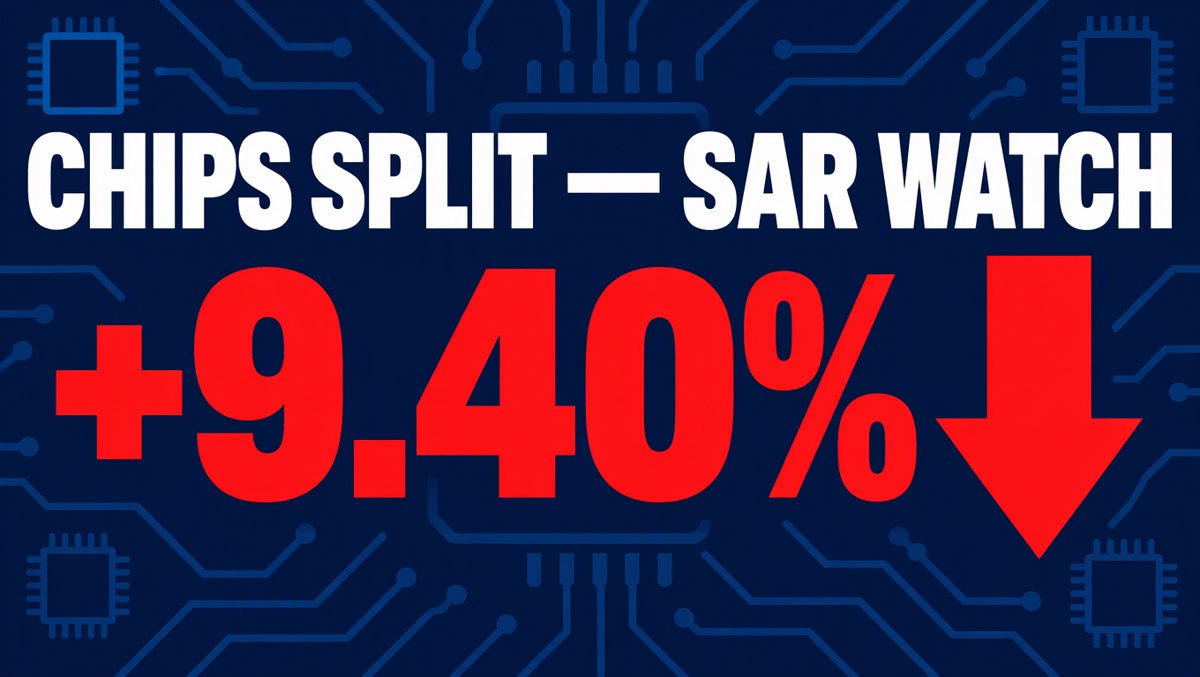
The reason is simple arithmetic. The bullish buffers are 12% deep, and Tuesday's worst bullish name — AMD — only fell 0.17%. The bearish walls, meanwhile, slipped lower again mechanically, which narrowed NVDA's flip distance to 9.40% even on a red day. The board is digesting rather than decisively re-rating. Tonight's Nvidia earnings report, out after the close, will change that math for everyone at once.
📊 Parabolic SAR Dashboard
Data as of November 17, 2026 post-close | SAR(0.02, 0.20) — matches Futu/Niuniu app
| Stock | Price | Change | SAR | Signal | Days | Flip Price | Flip % |
|---|---|---|---|---|---|---|---|
| AVGO 🟢 | $341.60 | +2.46% | $300.18 | BULLISH | Day 5 | $300.18 | -12.12% |
| AMD 🟢 | $503.41 | -0.17% | $442.30 | BULLISH | Day 6 | $442.30 | -12.14% |
| NVDA 🔴 | $155.39 | -0.48% | $170.00 | BEARISH | Day 26 | $170.00 | +9.40% |
| MU 🔴 | $712.42 | -0.92% | $848.46 | BEARISH | Day 12 | $848.46 | +19.09% |
| INTC 🔴 | $55.17 | -0.49% | $71.32 | BEARISH | Day 13 | $71.32 | +29.27% |
No flips today. No near-flips either — nobody is within 3% of a flip. The nearest trigger remains NVDA, which would need a 9.40% rise to reclaim its bullish dot at $170.00. On the bullish side, AVGO and AMD are virtually tied for the thinnest cushion, both sitting just over 12% above their dots — and AVGO's cushion actually widened today because price rose while the SAR rose only modestly.
🔬 Individual SAR Analysis
🟢 AVGO — BULLISH (Day 5): The Only Green Light
Close: $341.60 | +2.46% | Flip at $300.18 (-12.12%)
Broadcom was the board's standout. After opening at $335.59, dipping to a $330.13 intraday low, then rallying to close at $341.60 — up 2.46% from $333.40 on 25.0 million shares — AVGO did what no other chip managed today: it rose. The bullish SAR ticked up to $300.18 from $297.28, so the buffer grew from 10.83% to 12.12% in a single session. That widening gap on a green day is the cleanest bullish SAR signature there is. Post-market showed $342.55, up another 0.28%, with no hint of a give-back. In a tape where NVDA earnings are dominating every other headline, AVGO's quiet strength suggests rotation money is finding the names whose technical structures are intact — and AVGO's is the most intact of the five. Watch for a hold above $340; a break toward the $344 intraday high would slow the SAR's chase on the downside and open room toward the $367 two-hundred-day average. The $330.13 low is the day's line in the sand.
🟢 AMD — BULLISH (Day 6): Six Days and Counting, Tested by a $480 Intraday Dip
Close: $503.41 | -0.17% | Flip at $442.30 (-12.14%)
AMD opened at $512.12, faded to a $480.50 intraday low — its weakest print of the session — then recovered to close at $503.41, down just 0.17% from $504.28 on 34.1 million shares. That intraday dip to $480.50 deserves attention: it was the closest any bullish name came to real danger today, and it held by more than $38 above the $442.30 SAR. More importantly, the dot rose again, from $432.62 to $442.30, now 12.14% below price. Six straight bullish sessions through the worst chip tape of the year is not luck — it is distance doing its job. Social sentiment stayed constructively mixed (score +18, high buzz), with the Susquehanna $650 target still circulating, but today's session proved the point that sentiment does not drive SARs; price distance does. The watch level is $480.50: a close below that low in the next two sessions would compress the buffer toward 8% and make the dot a live target for the first time in the run.
🔴 NVDA — BEARISH (Day 26): $150 Tapped, Earnings Binary Tonight
Close: $155.39 | -0.48% | Flip at $170.00 (+9.40%)
NVIDIA opened at $156.90, drifted between $150.33 and $157.46, and closed at $155.39, down 0.48% from $156.14 on heavy volume of 345.4 million shares. The $150.33 intraday low is the second-lowest print since the November 12 air pocket ($148.80) and the lowest of this four-session slide — a probe of the round number that held. The bearish SAR fell to $170.00 from $172.00, narrowing the flip distance to 9.40%. NVDA is still the nearest flip on the board, but 9.40% is a full monster day, not a bounce. Post-market showed $155.07, down 0.25%, as traders waited for the Q3 FY2027 report after the close.
The news flow was dominated by Jensen Huang's first public statement since resigning. He said he would be "honored" to return as CEO if the board asks, acknowledged "serious mistakes," and said he owns them completely — prompting a fresh wave of coverage from the Wall Street Journal, CNBC, the New York Times, and others. The New York Times framed it as an investor test: Nvidia must now prove its semiconductors, not Jensen Huang, are what make it indispensable. Reuters added that California's Attorney General called the scandal a source of "red flags" that could lead to a probe, while Barron's warned that mixed chip-export signals and leadership uncertainty threaten confidence in the whole AI trade. New Street Research's Pierre Ferragu countered that the selloff strengthens the buy case ahead of earnings. For SAR traders, the earnings print tonight is the binary: guidance and AI-ecosystem financing language will decide whether $150 is a floor or a waypoint. A gap up through $170 on volume would flip the trend bullish for the first time in 26 sessions; another red day at these levels keeps the bearish dot grinding lower.
🔴 MU — BEARISH (Day 12): A $666 Intraday Test That Bounced, But the Wall Is Still 19% Away
Close: $712.42 | -0.92% | Flip at $848.46 (+19.09%)
Micron opened at $726.20, sold to a $666.88 intraday low — the weakest print of its recent slide — then bounced to close at $712.42, down 0.92% from $719.02 on 30.9 million shares. That $666.88 low matters for context: it is the lowest level in the SAR lookback since the November 5 capitulation zone, and the bounce off it was real but modest. The bearish SAR fell to $848.46 from $861.12, leaving a 19.09% wall. MU remains the second-widest bearish structure on the board after INTC and cannot flip on any normal bounce — it needs a sustained multi-week repair.
The day's one company-specific catalyst was negative. Invezz reported that GF Securities lowered its NAND price forecasts on concerns about a potential memory oversupply next year, sending MU down more than 2% intraday. That headline landed on top of the sector-wide Nvidia-earnings jitters, and it explains why MU was the board's weakest name despite the small closing decline. The bounce off $666.88 into the close keeps the immediate technical door open above that low; a loss of it would reopen the $650 area from early November. Social sentiment cooled to neutral (+8) from Monday's +35, consistent with a trader base that is waiting on both the Nvidia print and fresh memory-cycle data before adding.
🔴 INTC — BEARISH (Day 13): Drifting at the Low End, Widest Wall Intact
Close: $55.17 | -0.49% | Flip at $71.32 (+29.27%)
Intel opened at $55.17, ranged tightly between $52.42 and $55.24, and closed at $55.17, down 0.49% from $55.44 on 99.8 million shares — the second-heaviest volume on the board, yet the smallest price move. That combination — heavy volume, tiny range — reads as absorption rather than distribution, but for a 13-day bearish trend it is neither here nor there. The bearish SAR slipped to $71.32 from $73.04, still 29.27% above price. INTC now needs roughly three consecutive 10% up days to even reach its dot, and the dot would rise with each one. There was no Intel-specific news catalyst in today's feed; the session was pure sector beta plus its own established downtrend. Social sentiment stayed neutral (0) on low buzz. The only level that matters near-term is the $52.42 intraday low — a break below it on expanding volume would be the first sign that the bottom of this two-week range is giving way.
🗞️ What's Driving Today's Action
| Catalyst | Impact |
|---|---|
| Nvidia Q3 FY2027 earnings after the close — first test since Huang's exit; NYT: stocks down ahead of report | NVDA -0.48% (low $150.33); sector — positioning before binary; Vera Rubin demand cited as bull case |
| Jensen Huang first statement: would return if board asks, "honored," owns "serious mistakes" (WSJ, CNBC, NYT, Investopedia) | NVDA — whipsaw headline; board still not considering reinstatement per Monday's reports; adds headline risk into earnings |
| WSJ: Investors press for answers — Nvidia must prove chips, not Jensen, are indispensable | NVDA, sector — reframes tonight's call as a succession and moat test, not just a numbers print |
| Reuters: California AG calls Nvidia scandal "red flags," could lead to probe | NVDA — fresh regulatory overhang on the same day as earnings; layered over national-security investigation |
| Barron's: Nvidia bet big on AI stocks; mixed export signals threaten AI trade confidence | NVDA, sector — billion-dollar ecosystem stakes transmitted to neocloud and partner names |
| GF Securities cuts NAND price forecasts on oversupply fears (Invezz) | MU -0.92% (intraday -2%+) — memory-specific headwind on top of sector beta; intraday low $666.88 |
| Anthropic to price IPO above $70-$78 range; WSJ: plans to raise price after strong demand; pricing Wednesday | AI complex — crowding into the private AI debut drains marginal liquidity from public chips ahead of Nvidia print |
| S&P 500 testing key technical floor, below 200-day average (MarketWatch); VIX 25.56 (+11.53%) | All five — broad de-risking; every major global index red; Dow -1.64% led U.S. indexes |
📈 Market Context
Tuesday's tape was a study in positioning. The indexes fell — every major global index in the pull was red, from the Dow (-1.64%) to Korea (-2.59%) to Taiwan (-2.31%) — yet the chip board's declines were the smallest in this entire 2-for-5 regime: 0.17% to 0.92% for the four red names, with AVGO green at +2.46%. Two sessions ago, a 2.49% NASDAQ drop produced a 7.62% MU decline and a 7.02% INTC decline. Today, a 0.74% NASDAQ drop produced virtually nothing. That compression in beta is what a market looks like when it is waiting for a single binary print rather than liquidating. Traders were not selling chips today; they were refusing to buy them until Nvidia spoke. The volume tells the same story — NVDA traded 345 million shares, INTC 100 million — heavy, but range-bound. Heavy and range-bound is hedging, not capitulation.
The 2-for-5 structure's durability is now a five-session fact. AMD and AVGO have held their bullish dots through the worst semiconductor tape since the October AI-debt scare, and today's AVGO green close actually widened its buffer. The arithmetic explanation is that the bullish dots sit 12% below price — roughly two to three bad days of buffer — while the bearish walls sit 9% to 29% above. That asymmetry is why the board splits instead of flipping: a single red day cannot close a 12% gap, and a single bounce cannot climb a 29% wall. The only name where one big day could matter is NVDA, at +9.40%. And tonight is exactly the night where one big day is on the table.
The Huang statement cycle is the day's most important non-price development. Huang's first public words since resigning — contrite, cooperative, open to returning — landed the same morning as a California AG "red flags" comment and a Wall Street Journal piece demanding that Nvidia prove its moat is its silicon, not its founder. Layered together, tonight's earnings call is now three tests in one: the numbers, the succession, and the regulatory trajectory. Interim CEO Colette Kress's tone on AI-ecosystem financing, China commentary, and the 70% growth outlook will move all five SARs, not just NVDA's. That is why the board's deceptively calm closes are misleading: a stock can close flat at $155 and still gap 8% on the call. Position size into that gap risk, not today's 0.48% decline, is the real risk number.
Macro offers no rescue and no additional damage. CPI remains 4.08% year-on-year, the 10-year yield print was unavailable in today's pull, gold is described in MarketWatch coverage as sitting in a bear market, and the Anthropic IPO — pricing Wednesday, likely above its $70-$78 range according to the New York Post — continues to siphon marginal AI dollars into the private market. The market is pricing a series of interlocking AI binaries — Anthropic Wednesday, Nvidia tonight — and until at least the first of those clears, the 2-for-5 board owes its stability to distance, not to conviction.
🎯 Key Takeaways
- 2-for-5 holds for a fifth straight session with zero flips — AMD (Day 6) and AVGO (Day 5) kept their dots; AVGO's +2.46% green close actually widened its bullish buffer to 12.12%.
- NVDA is the nearest flip at +9.40% — and tonight is the one night a single session could cover it — the $170.00 SAR is the first true trend-reversal line in 26 bearish sessions; earnings decide if $150.33 is a floor.
- The board's tiny declines (-0.17% to -0.92%) show hedging, not capitulation — heavy volume, tight ranges, and compressed beta into a binary print; do not mistake calm closes for low risk tonight.
- MU's $666.88 intraday low is the memory trade's line — GF Securities' NAND downgrade made MU the weakest name; a break of that low reopens early-November levels, while a hold keeps the bounce alive under a 19% wall.
- Huang's return statement is a headline machine, not a signal — the board has not signaled reinstatement; the call's guidance, China language, and succession tone matter more than any statement headline for tomorrow's SARs.
By Stock King, Financial Analyst & Technical Writer at NXagents.net
📚 Educational Disclaimer
The Parabolic SAR (Stop and Reverse) is a trend-following indicator that places dots above or below price. Dots below price = Bullish (uptrend). Dots above price = Bearish (downtrend). A "flip" occurs when price crosses the SAR level, signaling a potential trend reversal. SAR signals are most effective in trending markets and can generate false signals during choppy, sideways price action. This analysis is for educational and informational purposes only. It does not constitute financial advice, investment recommendation, or solicitation to buy or sell any security. Past performance does not guarantee future results. Always conduct your own due diligence and consult a qualified financial advisor before making investment decisions.