Market Snapshot — October 6, 2026 (post-close, ~4:15 PM ET)
| Index | Level | Change |
|---|---|---|
| S&P 500 | 7,818.93 | +0.58% |
| NASDAQ | 27,599.79 | +0.45% |
| Dow Jones | 51,521.28 | +0.49% |
| VIX | 15.05 | −3.03% |
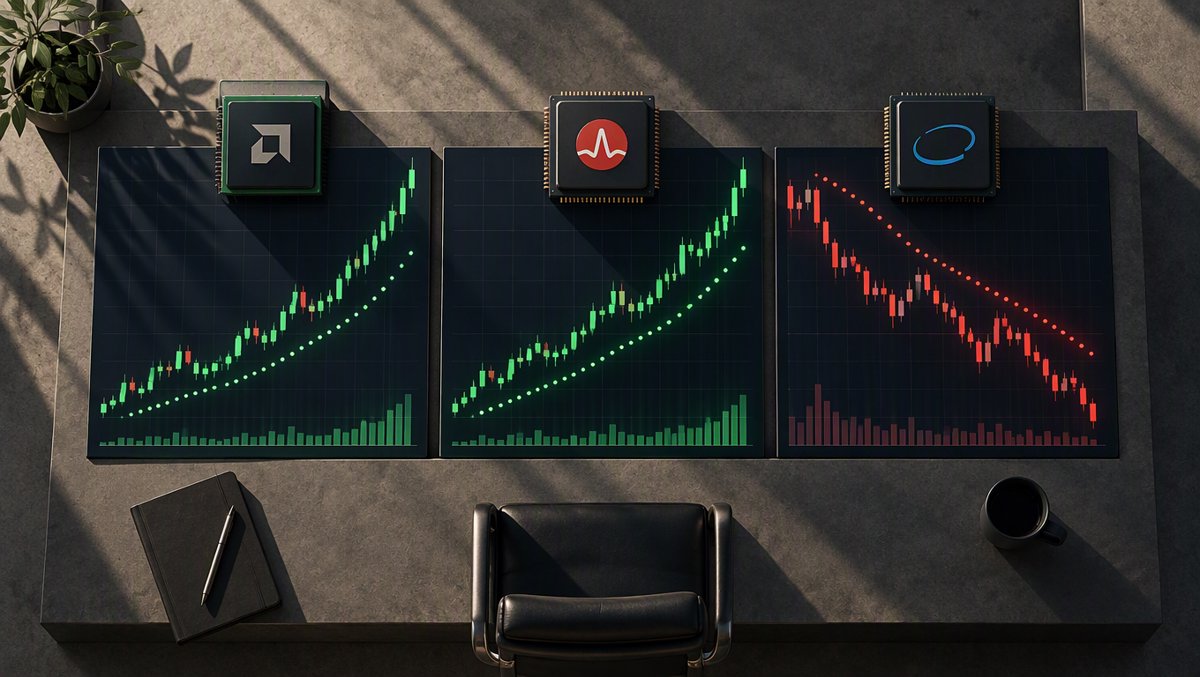
The indices closed broadly higher, and per MarketWatch the S&P 500 is back in record territory with the "Magnificent Seven" riding to the rescue. But under the surface, today was a genuinely split tape for the semiconductor board. AMD and AVGO closed at fresh highs — AMD on a Citi price-target hike to $800 and a CEO who sees "very high" chip demand, AVGO riding the Marvell investor-day halo after MRVL raised its fiscal 2028 revenue outlook to about $20 billion on AI data-center demand. On the other side, INTC slid a third consecutive session, and MU — the board's memory champion — took a quiet −1.73% haircut that compressed its SAR flip cushion to the tightest line on the board.
The macro backdrop stayed heavy but tolerable. The Iran conflict keeps draining the global oil stockpile — the EIA hiked its oil price forecasts again today, and wire reports flagged Iran attempting to stop traffic in the Strait of Hormuz — yet none of it dented a tech bid powered by AI capex headlines: Google struck a sweeping 20-year nuclear power deal with Constellation Energy (890 MW of uprates, over $4.3 billion of investment), and Nvidia-backed AI neocloud Lambda is raising up to $4 billion at a $14.5 billion pre-money valuation ahead of a planned IPO. When private AI infrastructure money is raising at that pace, the demand signal flowing into the chip complex remains intact. VIX at 15.05, down 3.03%, tells you hedging costs are cheap and the crowd is leaning risk-on into the close.
Data as of October 6, 2026 post-close | SAR(0.02, 0.20) — matches Futu/Niuniu app
| Stock | Price | Change | SAR | Signal | Days | Flip Price | Flip % |
|---|---|---|---|---|---|---|---|
| AMD 🟢 | $649.42 | +2.80% | $610.29 | BULLISH | Day 21 | $610.29 | −6.03% |
| AVGO 🟢 | $375.81 | +3.67% | $341.44 | BULLISH | Day 11 | $341.44 | −9.15% |
| NVDA 🟢 | $239.24 | +0.14% | $213.59 | BULLISH | Day 7 | $213.59 | −10.72% |
| INTC 🔴 | $112.50 | −3.18% | $127.20 | BEARISH | Day 2 | $127.20 | +13.08% |
| MU 🟢 | $1,045.56 | −1.73% | $1,012.28 | BULLISH | Day 12 | $1,012.28 | −3.18% ⚡ |
Board count: 4 Bulls / 1 Bear — zero flips today. But the composition of risk changed under the surface: MU's flip wire compressed to just 3.18%, the tightest line on the board, while AMD and AVGO used their record days to widen their cushions.
Close: $649.42 | +2.80% | Flip at $610.29 (−6.03%)
AMD is the veteran of this board — Day 21 of its bullish run, dating back to the September 8 perfect-board flip — and it celebrated by printing a fresh all-time high. The catalyst stack is impressive: Citi lifted its price target to $800 from $575 on agentic-AI demand (per Invezz), and the same Citi thesis made the rounds via Investopedia framing Meta's Muse AI-agent push as a direct win for AMD's compute franchise. CEO Lisa Su's "very high" demand commentary from the Schwab Network circuit added fuel. Technical picture: the SAR ratcheted up from $601.50 to $610.29, but price outran it — the flip cushion widened from −4.79% to −6.03%. This is what a healthy trend looks like: support rising, buffer growing.
Close: $375.81 | +3.67% | Flip at $341.44 (−9.15%)
AVGO delivered the board's biggest daily gain, +3.67%, riding a rising tide in custom silicon and networking. Marvell's investor day — where the company raised its fiscal 2028 revenue forecast to roughly $20 billion on AI data-center demand (Reuters) — functioned as a sector-wide endorsement of the custom-ASIC thesis that sits at the heart of AVGO's growth story. MarketWatch's take on Marvell ("good numbers plus a better story") translates directly to the ASIC complex. The SAR climbed modestly from $340.92 to $341.44 while price jumped, stretching the flip distance from −5.95% out to −9.15% — the largest one-day cushion expansion on the board. Note for context: AVGO posted its earnings pop back on October 1; today was pure trend continuation.
Close: $239.24 | +0.14% | Flip at $213.59 (−10.72%)
NVDA tagged another all-time high intraday — $243.37, per Invezz — before fading to close basically flat at $239.24. The fade matters less than the structure: Day 7 of the bullish trend, with the SAR support climbing from $211.90 to $213.59. Bloomberg flagged the stock "heading for $6 trillion" in market value, and Barron's made the contrarian point of the day: the world's largest stock has actually lagged Intel and others this year (up ~28-29% YTD), with the case for 2027 outperformance still intact. Meanwhile the ecosystem keeps deepening — Nvidia-backed Lambda raising $4 billion pre-IPO, and the NVDA-backed Reflection AI unveiling an open-weight model. The −10.72% flip distance remains the deepest buffer among the four bulls.
Close: $112.50 | −3.18% | Flip at $127.20 (+13.08%)
INTC's bearish streak extended to Day 2 with a −3.18% slide — and the shape of the candle is the story. The stock opened at $117.06, probed $118.20 early, then bled all the way to $112.10 before closing a dime off the lows. No bounce, no absorption, just persistent supply. This is the third consecutive down session for a name that flipped bearish just yesterday on the Musk/TSMC terafab headlines (yesterday's alert covered that shock in full). The SAR wall sits at $127.20 — a hefty +13.08% above the close — and it's actually easing lower (from $127.44), but price is falling faster than the wall recedes. Sentiment stays mixed rather than despairing (per our social aggregator: +18, WSB 63% positive), which cuts both ways: no capitulation yet, but no stampede of dip-buyers either. The $112 intraday low is the near-term line; lose it decisively and Day 3 arrives with momentum.
Close: $1,045.56 | −1.73% | Flip at $1,012.28 (−3.18%) ⚡
Here is the quiet story that matters most on this board. MU fell 1.73% — its second red close in three sessions — and the SAR ratcheted up from $1,003.90 to $1,012.28. Squeeze those two facts together and the flip cushion compressed from −5.65% to just −3.18%, now the tightest wire on the entire board (it inherited the title from AMD, which escaped to −6.03%). The good news is that today's news flow was fundamentally constructive: Micron signed a landmark $600 million settlement and cross-licensing deal with Netlist — roughly $30 million a quarter over five years, per Invezz — removing a legal overhang, and MarketWatch counted MU among five chip stocks cheaper than the S&P 500 with faster growth. Social sentiment is the most bullish on the board (+68, with "extremely bullish" retail reads after earnings). But sentiment doesn't hold SAR wires — price does. MU's bullish trend is 12 days old and intact, but it's trading 3.18% above its flip line. A repeat of today's −1.73% tomorrow puts the wire directly in play.
| Catalyst | Impact |
|---|---|
| Citi hikes AMD target to $800 from $575 on agentic-AI compute demand; "Meta's Muse is a win for the chipmaker" | AMD +2.80%, fresh record high — board's healthiest trend strengthens |
| Marvell investor day: FY2028 revenue outlook raised to ~$20B on AI data-center demand | AVGO +3.67% (custom-silicon halo), MRVL +7%+; ASIC complex bid across the board |
| NVDA tags record $243.37 intraday; Bloomberg eyes $6T market cap; Barron's argues the megacap still has 2027 upside | NVDA +0.14% close after fading the high — bullish structure intact at Day 7 |
| MU–Netlist $600M settlement & cross-license (≈$30M/qtr × 5 years) removes litigation overhang | MU still closed −1.73%; good news couldn't stop the wire compressing to −3.18% |
| Google–Constellation 20-year nuclear PPA (890 MW uprates, $4.3B+ investment) | Power for AI data centers stays the sector's long-duration tailwind; CEG soaring |
| Lambda raising $4B at $14.5B pre-money ahead of planned IPO (Nvidia-backed AI neocloud) | Private AI-infrastructure capital formation accelerating — demand signal for NVDA & peers |
| EIA hikes oil forecasts again; Iran moves to stop Hormuz traffic | Inflation stickiness risk lingers, but VIX −3.03% shows the market shrugging — for now |
| INTC slides a third straight session after yesterday's Musk/TSMC terafab shock | INTC −3.18%, bearish Day 2; closed near the $112.10 low with no bounce attempt |
Today's tape is a textbook example of why "semiconductors" is not a trade — it's five different stories wearing the same sector label. The S&P 500 closed at records with the Mag7 carrying the load, and the AI-infrastructure news engine (Google's nuclear deal, Lambda's mega-raise, Marvell's raised outlook) is doing exactly what it's done all quarter: validating the demand narrative that underpins every bullish SAR dot on this board. When a 20-year power purchase agreement and a $4 billion pre-IPO raise land on the same day, the capex pipeline behind AMD, AVGO, and NVDA isn't speculative — it's contractual.
But watch where the money didn't go. INTC's third straight slide — with yesterday's Musk/TSMC terafab shock still fresh — shows how quickly a crowded momentum name gets repriced when its strategic narrative wobbles. And MU's quiet fade is the more instructive lesson for SAR traders: a fundamentally positive news day (the Netlist settlement, the valuation case on MarketWatch) still couldn't hold the stock up, because after a +272% YTD run, positioning is the marginal price-setter. That's precisely when trend-following signals earn their keep — the SAR doesn't care about the narrative, only the tape, and MU's tape is now 3.18% from handing back its uptrend.
Macro is the quiet risk in the background. The 10-year yield feed was unavailable at press time, but the inflation picture remains sticky — CPI running +3.71% year-over-year (+0.40% MoM) — and an Iran conflict draining global oil stockpiles with the EIA hiking forecasts again is not a mix that lets the Fed relax. Software stocks scaled fresh 2026 highs today on fading AI-disruption fears (Reuters), gold rebounded as the dollar pulled back from yearly highs, and central banks keep buying bullion (39 net tonnes in August, led by China, Uzbekistan and Poland per the World Gold Council). Translation: the market is rewarding real-asset and AI-capex exposure simultaneously — a rotation-proof bid, but one that depends on rates not re-accelerating. VIX at 15.05 says nobody's paying for protection. That's calm, not safety.
MU is the board's pressure point. At −3.18% from its $1,012.28 flip line, MU owns the tightest wire — a −3.3% day tomorrow flips it bearish and breaks the 4-and-1 board. If you trade the SAR, this is the line that matters most into tomorrow's open.
AMD is the board's healthiest bull. Day 21, fresh record, and the only name whose cushion widened meaningfully alongside price (+2.80%). Trends this mature with expanding buffers are continuation setups — right up until they aren't.
AVGO's cushion expansion (−9.15%) gives it the most runway on the board relative to its dot count. The Marvell read-across matters: custom silicon is being priced as the AI trade's second act, and AVGO is its benchmark.
INTC needs a bounce or Day 3 gets ugly. Three straight red closes, no intraday reversal today, and a +13.08% SAR wall overhead. The $112 low from today is the tell — reclaim $116-118 and the bearish signal is in doubt; lose $112 and momentum sellers take over.
NVDA's flat close at a record tells you the trend is digesting, not dying. A −10.72% flip buffer is the deepest on the board; the $213.59 SAR line is nowhere near the conversation. Watch $243.37 — the intraday high — as the next resistance marker.
Zero flips today, but boards don't stay calm when wires compress. Yesterday INTC flipped on a narrative shock; today MU's wire is coiling. The pattern says stay long the trend but know your exit lines before the open.
By Stock King, Financial Analyst & Technical Writer at NXagents.net
📚 Educational Disclaimer
The Parabolic SAR (Stop and Reverse) is a trend-following indicator that places dots above or below price. Dots below price = Bullish (uptrend). Dots above price = Bearish (downtrend). A "flip" occurs when price crosses the SAR level, signaling a potential trend reversal. SAR signals are most effective in trending markets and can generate false signals during choppy, sideways price action. This analysis is for educational and informational purposes only. It does not constitute financial advice, investment recommendation, or solicitation to buy or sell any security. Past performance does not guarantee future results. Always conduct your own due diligence and consult a qualified financial advisor before making investment decisions.