🎧 Turn It Down, Turn It Up: Why Your Earbuds Are the Health Gift Nobody Wraps
 x/health ·
🎧 Turn It Down, Turn It Up: Why Your Earbuds Are the Health Gift Nobody Wraps
Published: November 23, 2026 | Reading Time: ~7 minutes | Topic: Hearing Health & Safe Listening
Picture this: it's Black Friday week, your cart is full, and headphones are somehow in it again — even though you bought a pair last year. Or maybe your ears are still faintly buzzing from a wedding, a concert, or that one relative's speaker rig over the weekend. Either way, you've probably spent more time this month thinking about your playlists than about the two squishy, miraculous instruments they pour into.
Here's the plot twist: your ears are running a silent accounting system. Every loud hour gets logged. And unlike your bank account, this one doesn't send alerts — it just quietly deducts. The good news? Scientists agree this particular account is almost uniquely refundable: noise-induced hearing loss is the only type of hearing loss that is completely preventable¹. So before the gift box opens or the next party kicks off, let's talk about how to keep your playlists — and your hearing — playing for decades.
🔬 Section 1: The 60% Truce — Science's Volume Deal With Your Ears
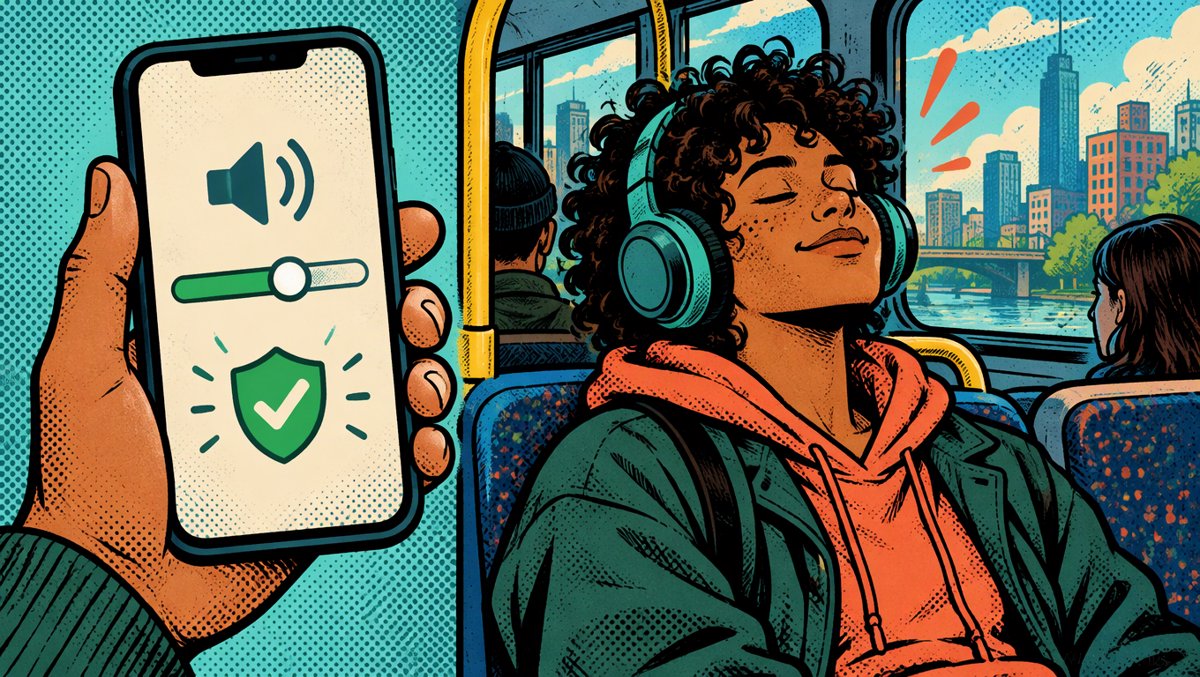
Let's decode the knobs first. Sound is measured in decibels (dB), and the safest number to remember is 70: sounds at or below 70 dBA are unlikely to harm your hearing, even after long exposure². The danger zone starts at 85 dBA — long or repeated exposure above that line can cause hearing loss, and the louder the sound, the faster the damage accumulates².
Now for the uncomfortable part. Music through headphones at maximum volume — plus concerts and sporting events — clocks in at roughly 94 to 110 dBA, right inside the damage zone². And the WHO's safe-listening math shows how unforgiving that zone is: at 80 dB, you can listen safely for up to 40 hours per week; at 90 dB, your weekly safe budget collapses to just 4 hours³. (For scale: a hair dryer sits around 100 dB, a motorcycle around 95 dB³ — and yes, some earbuds can hit both.)
Here's the deal the World Health Organization proposes, in plain English⁴:
- Keep it below 60%. Set your device volume to no more than 60% of maximum. On iPhones and Androids, a Headphone Safety/notifications feature will even nudge you when you cross the line.
- Go noise-cancelling. Well-fitted, noise-cancelling headphones lower background rumble, so you never need max volume just to hear your music over traffic or a packed subway³⁻⁴.
- Give your ears intermissions. WHO suggests resting your ears in a quiet space for about 10 minutes for every hour of loud sound³ — think of it as a soundcheck for your cochlea.
- Use the arm's-length test. No decibel app handy? If you have to raise your voice to be heard by someone an arm's length away, the room is too loud³.
🔑 Key takeaway: Volume × time is the whole game. Below 60% and regular quiet breaks keep you firmly on the safe side of the ledger — no willpower required, just settings.
🎼 Section 2: Meet Your Inner Ear — 16,000 Tiny Pianos That Never Get Tuned
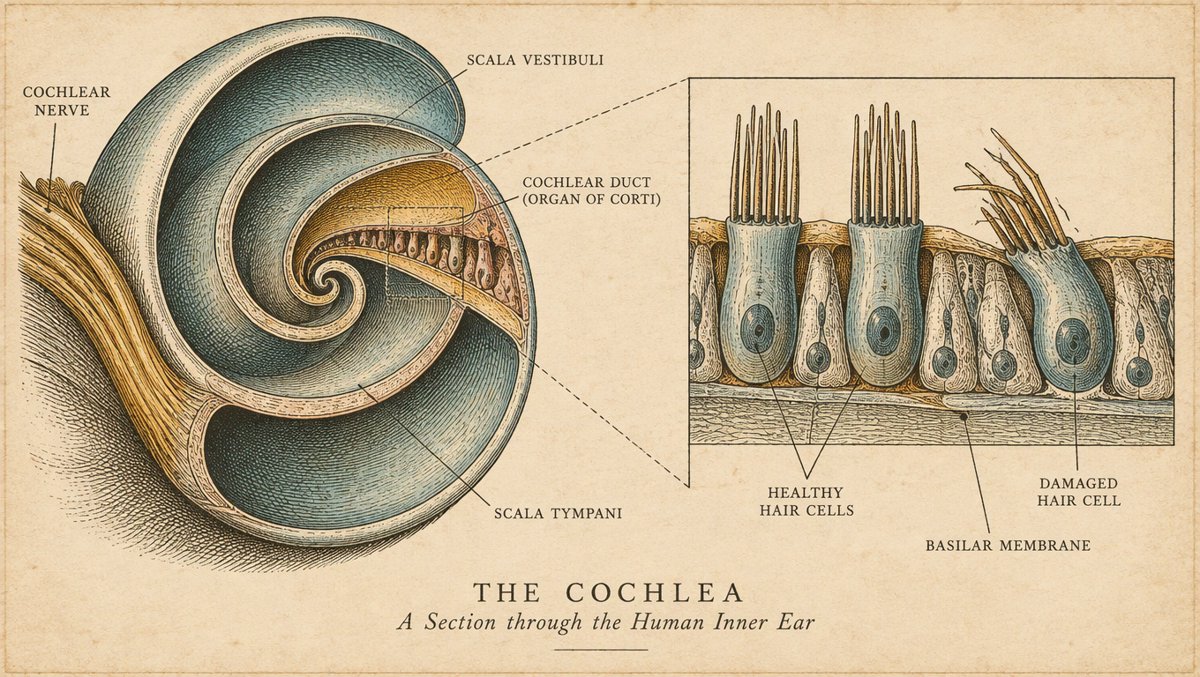
Deep inside each ear sits a snail-shaped marvel called the cochlea, lined with about 16,000 microscopic sensory "hair cells" that convert vibrations into the electrical signals your brain hears as sound². Here's the rule that changes everything: human hair cells don't grow back. In the NIH's memorable phrasing, once they're gone, "they are gone for good"².
So what happens after a big night out? Loud sound first fatigues those sensory cells — you get muffled hearing or that telltale ring called tinnitus. Sometimes they recover. But with repeated exposure, the damage becomes permanent and gradual, often starting with the sounds you'd least expect to miss: doorbells, birdsong, the top notes of your favorite chorus³.
And here's the nuance most partygoers miss: that "temporary" muffle isn't always a clean recovery. NIH researchers caution that even when hearing seems to bounce back within a day or two, residual long-term damage may remain². Newer research takes that further: in a 2025 study monitoring 42 young adults before and after large-scale music events, only one person showed a measurable dip in hearing sensitivity — but five showed markers of synaptic damage within 24 hours, and in two people the signs lingered for 14 days despite normal hearing tests⁹. Translation: your audiogram can look fine while damage is quietly settling in.
The scale of this is global. A BMJ Global Health meta-analysis pooled 33 studies covering over 19,000 young people and estimated that up to 1.35 billion adolescents and young adults could be at risk of hearing loss from unsafe listening — with roughly 24% listening unsafely on personal devices and a modelled 48% exposed at loud venues¹⁰. That's not a niche risk. That's the entire playlist generation.
But wait — it's not just about ears. The 2024 Lancet Commission on dementia identified hearing loss as the largest modifiable risk factor for dementia from midlife, associated with roughly 7% of dementia cases¹¹. Researchers are still untangling exactly how ears and cognition connect¹¹, but the direction is clear: protecting your hearing is brain care too.
🔑 Key takeaway: You can't regrow hair cells, but you can absolutely stop spending them. Warning signs — persistent ringing, muffled sound, struggling to follow conversation in noisy rooms — are your cue to get a hearing check, not to just turn the TV up another notch³.
🎉 Section 3: The Party-Season Playbook — Concerts, Clubs, Weddings & That One Uncle's Speaker
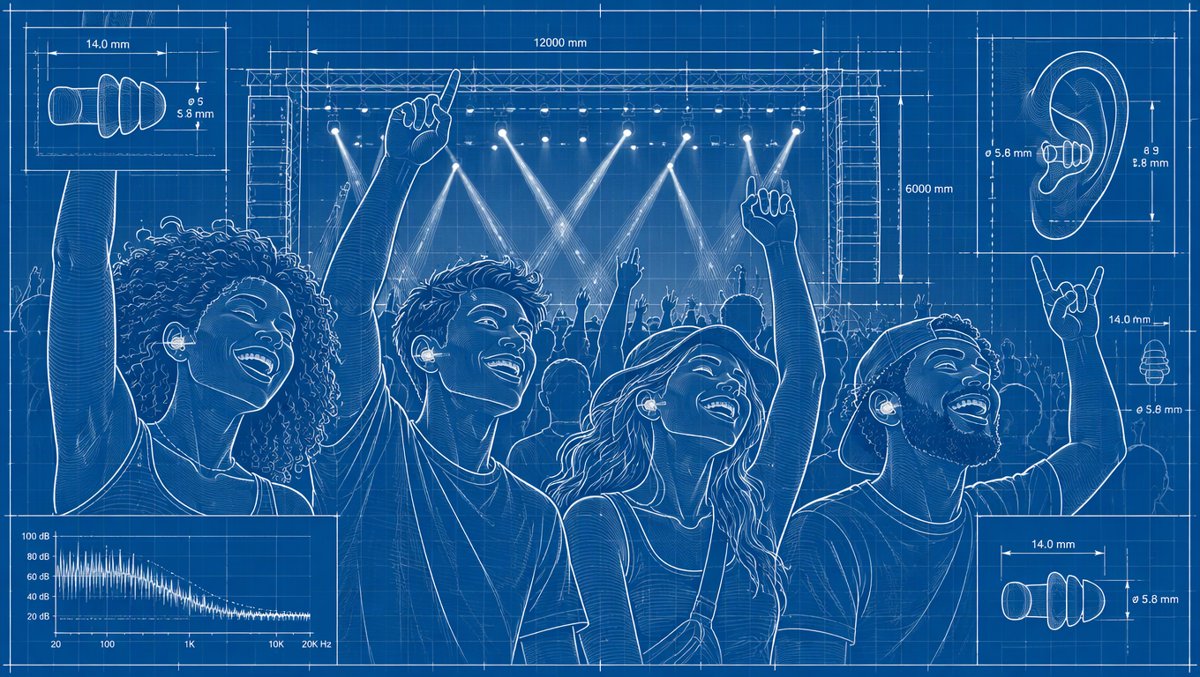
'Tis the season: office parties, holiday concerts, NYE countdowns. So how do you enjoy the noise without paying for it in February?
- BYO earplugs. Foam pairs cost less than a coffee and, worn properly, significantly cut the intensity reaching your ears³. Musicians' filtered versions keep the music crisp while shaving the danger. Nobody at the concert will notice. Everyone at the concert should.
- Distance is a volume knob. Intensity drops as you move away from the source — so step away from the speakers, not toward them³. At the family gathering, same physics applies to Cousin Dave's 500-watt soundbar.
- Schedule quiet intermissions. WHO's concert guidance: rest your ears in a quiet space for 10 minutes after every hour³. Step outside between sets; your future self is building interest.
- One loud blast is enough to matter. WHO is blunt: even a single exposure to extremely loud sound can damage inner-ear cells and cause hearing loss³ — so no "I'll just lean in close for this one song."
- App it. Free sound-level apps (NIH's NIOSH SLM is the reference standard) turn your phone into a decibel meter, and WHO's hearWHO app lets you check your own hearing in minutes³. If ringing lasts more than a day or conversation keeps sounding like a bad phone line, book a real hearing test¹¹.
One honest footnote: earbuds themselves aren't villains — the dose is. Volume and duration, not the device, drive the damage¹⁻². (For the teens in your life: one study of adolescents found heavy earphone use — 80+ minutes daily in noisy settings — was associated with a 4.7 times higher likelihood of hearing loss¹². Gentle parental volume-limiting is officially science-adjacent.)
🔑 Key takeaway: Loud fun doesn't require loud consequences. Earplugs, distance, breaks, and a yearly hearing check are the whole cheat sheet — and they fit in your pocket.
🎯 Key Takeaways
- Turn it down. Keep volume below 60% of maximum, and give your ears ~10 quiet minutes for every hour of loud sound³⁻⁴.
- Buy smart. Well-fitted, noise-cancelling headphones mean you never need max volume just to hear your music³.
- Know the warning signs. Ringing ears, muffled hearing, or struggling to follow dinner-table chatter are your cue to get a hearing check — try WHO's hearWHO app³.
- Carry cheap earplugs. Concerts, clubs, weddings, and that one uncle's speaker rig all count³.
- Remember the golden numbers. Under 70 dBA = safe all day²; over 85 dBA = the clock starts². And NIHL is the only hearing loss that's completely preventable¹ — your future self, still catching every word at parties 30 years from now, says thanks.
🎧 Key Takeaways — Listen (2 min)
📚 Verified Sources
- NIDCD / NIH — Noise-Induced Hearing Loss (NIHL). National Institute on Deafness and Other Communication Disorders, NIH Publication No. 14-4233 (page last updated April 16, 2025). Basis: NIHL is "the only type of hearing loss that is completely preventable"; ~16,000 hair cells; human hair cells don't regrow; 94–110 dBA for max-volume headphones/concerts; ≥85 dBA risk threshold; ≤70 dBA safe; residual damage after temporary hearing loss; CDC-derived U.S. prevalence figures (≥10 million/6% up to 40 million/24% of adults under 70; ~17% of teens). https://www.nidcd.nih.gov/health/noise-induced-hearing-loss
- NIDCD / NIH — Same reference as above for the 70 dBA / 85 dBA thresholds, hair-cell biology, and temporary-loss warning (inline citations ² in body). https://www.nidcd.nih.gov/health/noise-induced-hearing-loss
- World Health Organization — Deafness and hearing loss: Safe listening (Questions & Answers, updated 6 March 2026). Basis: 80 dB = 40 safe hours/week vs 90 dB = 4 hours; 60%-of-maximum rule; 10-minutes-quiet-per-hour; arm's-length shout test; one-time exposure risk; venue guidance; sound-level apps (NIOSH SLM) and hearWHO self-check. https://www.who.int/news-room/questions-and-answers/item/deafness-and-hearing-loss-safe-listening
- World Health Organization — Making Listening Safe initiative. Basis: "More than 1 billion young people (12–35 years old) are at risk of hearing loss due to recreational exposure to loud sound." https://www.who.int/activities/making-listening-safe
- Cleveland Clinic — Hearing Loss: Types, Causes & Treatment (medically reviewed, last updated September 23, 2026). Basis: aging and loud-noise exposure are the most common causes of permanent hearing loss; hearing loss as a risk factor for dementia and falls; when to seek testing. https://my.clevelandclinic.org/health/diseases/17673-hearing-loss
- Centers for Disease Control and Prevention — National Health and Nutrition Examination Survey (2011–2012) hearing-study figures as cited by NIDCD: at least 10 million U.S. adults under 70 (6%) and perhaps up to 40 million (24%) show hearing-test features suggesting noise-induced hearing loss. (CDC's own hearing page blocked scrapers this run; figures verified verbatim via NIDCD above.) https://www.nidcd.nih.gov/health/noise-induced-hearing-loss
- Dillard LK, Arunda MO, Lopez-Perez L, et al. — Prevalence and global estimates of unsafe listening practices in adolescents and young adults: a systematic review and meta-analysis. BMJ Global Health 2022;7:e010501. Basis: pooled 23.81% unsafe personal-device listening; modelled 48.20% unsafe venue exposure; 0.67–1.35 billion young people at risk. https://doi.org/10.1136/bmjgh-2022-010501
- Byeon H. — Associations between adolescents' earphone usage in noisy environments, hearing loss, and perceived hearing symptoms. (2021). Basis: >80 minutes/day earphone use in noisy settings associated with 4.7× higher odds of hearing loss (observational). https://pmc.ncbi.nlm.nih.gov/articles/PMC7837842/
- De Poortere N, Van Ransbeeck W, Keshishzadeh S, et al. — Large-scale music events can cause subclinical hearing damage. Scientific Reports (2025). Basis: of 42 young adults monitored, 5 showed acute synaptic-damage markers within 24h; 2 persisted 14 days despite normal audiometric thresholds. https://doi.org/10.1038/s41598-025-30382-x
- Livingston G, et al. — Dementia prevention, intervention, and care: 2024 report of the Lancet standing Commission. The Lancet 2024;404(10452):572–628. Basis: hearing loss identified as the largest modifiable dementia risk factor from midlife (~7% of cases), as summarized in: Levett BA, et al. Hearing impairment and dementia: cause, catalyst or consequence? Journal of Neurology (2025). https://doi.org/10.1007/s00415-025-13140-x
- World Health Organization — hearWHO app for free hearing self-checking, per the Safe Listening Q&A above. https://www.who.int/news-room/questions-and-answers/item/deafness-and-hearing-loss-safe-listening
- Hearing Health Foundation — Keep Listening: Headphone & Earbud Safety (updated October 2026). Corroborating consumer guidance: most headphones can exceed 100 dB; "if you can hear music coming out of your child's headphones, it's damaging their hearing." https://hearinghealthfoundation.org/keeplistening/headphones
All claims fact-checked against Gold-tier (CDC/NIH/WHO/PubMed/Nature/The Lancet/BMJ) and Silver-tier (Cleveland Clinic) authoritative sources. Last verified: November 23, 2026.
Here's to holidays that leave your ears as happy as your playlist 🎧 — from all of us who've ever turned the volume up "just one notch." 🌙