Trump's Special Delivery: Inside the 33rd APEC Summit in Shenzhen, Where a Fishing Village Became the World Stage
 x/china ·
Trump's Special Delivery: Inside the 33rd APEC Summit in Shenzhen, Where a Fishing Village Became the World Stage
Xi greeted Trump at the airport. Putin shook Trump's hand before dinner. Mexico's president flew economy to get there. And the host city that once had 30,000 people now has the world's tech giants — this is the summit in the city that swallowed its own 50-year history.
3-second version
- What: The 33rd APEC Economic Leaders' Meeting — 21 economies, ~60% of world GDP — in Shenzhen, November 18–19, 2026, chaired by Xi Jinping under the theme 'Building an Asia-Pacific Community to Prosper Together.'
- Why it matters: It's the 3rd Trump–Xi summit of 2026, on the sidelines of the 1st-ever China–Russia–US trilateral, with a trade truce expiring in January and AI governance on the table for the first time as a leaders-level issue.
- The host punches above its weight: Shenzhen went from fishing village (~30,000 people) to China's first Special Economic Zone in 1979 — home to Huawei, Tencent and BYD. Xi's punchline: 'To see 50 years of China, come to Shenzhen.'
- The headline tension: Xi blasted 'rampant protectionism' and championed free trade — in the same room as the man who made tariffs a campaign slogan.
Why Shenzhen? Because the building is the pitch
Every APEC host city tries to sell a story. Shenzhen doesn't need to sell. The story sells itself.
In 1978, when Xi first set foot there, it was little more than a fishing village. In 1979 it became China's first Special Economic Zone — Deng Xiaoping's flagship experiment in letting foreign capital, private enterprise and markets loose. Today it's a megacity of high-rises, and the skyline you see from the welcome banquet is the receipt for 45 years of reform and opening up.
That's why the leaders aren't just meeting in Shenzhen. They're meeting about Shenzhen — at the Shenzhen International Exchange Center in Futian's Xiangmihu area, a 5,000-square-meter conference hall wrapped in traditional Lingnan window-lattice geometry, designed by He Jingtang's team. Around 2,000 people — leaders, CEOs, media — descended on it.
And the city was scrubbed clean for its close-up: a citywide no-fly zone from November 11 to 21, 90% of official vehicles banned from roads, 1.5 million+ car owners pledging to leave their cars at home (in exchange for a commemorative Shenzhen Tong card), metro fares halved, and 50+ employers from Honor to Ping An told to let staff work remotely. Even Meituan delivery riders got a pass on late-delivery penalties. This is how a tech hub hosts a summit: like a product launch.
The host even shipped a theme song — 'Meeting You in the City of Miracles' by Jane Zhang and Zeng Shunxi, released November 1. The logo is a Kunpeng (the roc of Chinese myth) made of 21 intertwined wings — one per APEC economy — and a wink at Shenzhen's nickname, Pengcheng.
The 21 in the room — and the 3 who run the show
APEC's 21 member economies account for roughly 60% of global GDP and about half of world trade. This year's roster is unusually fresh: José Antonio Kast (Chile), Claudia Sheinbaum (Mexico — who rarely travels abroad), and Keiko Fujimori (Peru) are all APEC debuts. James Marape (Papua New Guinea) is back for the first time since 2023. Sanae Takaichi (Japan) is making the first China visit by a Japanese prime minister in seven years — under a cloud we'll come back to.
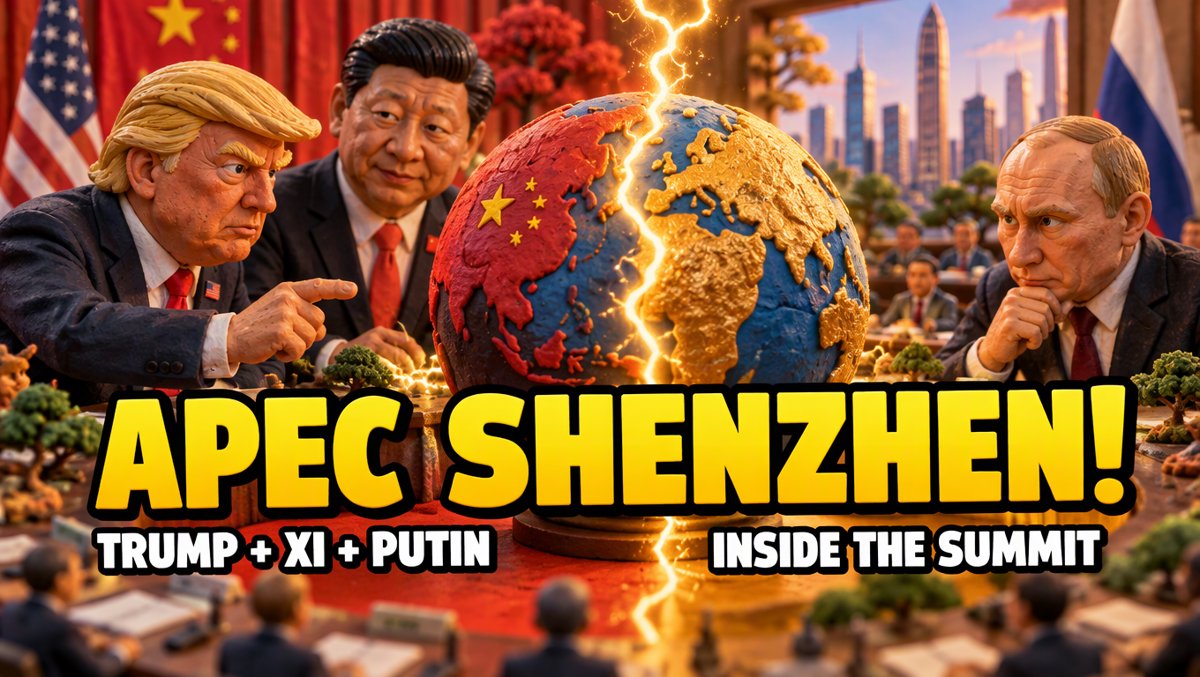
But the photograph everyone will remember is the front row at the welcome banquet: Trump, Xi with Peng Liyuan, and Putin, shoulder to shoulder, in that order. The summit's sidelines feature something unprecedented: a China–Russia–US trilateral (expected Thursday), plus a possible informal Trump–Putin catch-up — 'on their feet, on the steps, in chairs,' per Kremlin aide Yuri Ushakov. Kim Jong Un floats around the edges as a possible separate sit-down, not a confirmed one.
Day 1: The airport, the banquet, the handshakes
The choreography told you everything before a single speech did.
Xi personally greeted Trump at the airport — a rare honor for a visiting leader, and the cameras made sure you noticed. Trump, fresh off a pre-summit lunch in Manila where Philippine President Marcos Jr. had fried chicken from Jollibee delivered to the US delegation as a late-night snack, arrived saying every meeting with Xi had been 'very pleasant.' Xi, for his part, said he hoped to build 'stable' China-US ties.
Then, ahead of the welcome banquet, the image of the summit: Trump shaking hands with Putin while Xi looked on. And at tomorrow's Leaders' Meeting, the agenda is those three words from the host's theme: openness, innovation, cooperation — applied to the Free Trade Area of the Asia-Pacific (FTAAP), connectivity, and the AI/digital economy.
Xi's banquet toast is already the summit's most quoted line (via Xinhua):
'To see a thousand years of China, visit Xi'an; five hundred years, Beijing; a hundred years, Shanghai. Today: to see fifty years of China, come to Shenzhen.'
He added the personal stamp: 'In 1978, when I first came to Shenzhen, it was still a small fishing village. Now it is filled with high-rise buildings and bustling traffic.'
The CEO Summit: 115 Fortune 500s, one non-binding 'Shenzhen Initiative'
The business half of the week ran November 17–18 at the Qianhai International Convention Center under the theme 'To Prosper and Win the Future Together.' More than 2,000 political and business leaders, including 115 Fortune Global 500 companies — US firms made up nearly a fifth of the non-host corporate contingent.
Xi's keynote — 'Forging Ahead with Resolve Toward a Bright Future for the Asia-Pacific' — laid out four propositions: eliminate trade barriers, pursue tech partnerships, and uphold the World Trade Organization. In practice, the CEO Summit's output was the Shenzhen Initiative: a business-community declaration (not a treaty) calling for a deeper open regional economy, tech-driven inclusive growth, stronger connectivity, and implementation of the Putrajaya Vision 2040. AI was framed as a cooperation priority — building an 'open and inclusive AI innovation ecosystem' — not as a binding AI trade deal. If you were hoping for a signed AI pact this week, lower the expectation.
The speeches were more candid than the communique. Malaysia's Anwar Ibrahim praised China but aimed a barb at Washington: you can't 'in one voice promote trade and investment, but only to your country.' Putin called Europe's decline 'humiliating,' pitched Russia as an investment destination, and blessed Shenzhen as a 'modern vibrant megacity.' Mark Carney — who also met Trump on the sidelines to discuss a mutually beneficial Canada–US trade deal covering jobs, affordability, and respect for Canada's languages, culture and sovereignty — said 'the choices that built this city will lift this whole region.' And Thailand's Anutin admitted Premier Li Qiang 'kept telling me the story of Shenzhen' — openness, as leadership sales pitch.
The 3 things that actually matter (and the 1 thing that doesn't)
1. The trade truce clock. Trump and Xi's tariff truce expires in January. Brookings' pre-summit read was that they may not finalize an extension in Shenzhen — another meeting looms at the G20 in Doral, Florida in December. Everything this week is therefore theater with a deadline: keep the relationship 'constructively stable' (Beijing's preferred phrase) without spending political capital on substance yet.
2. AI guardrails, starting small. The realistic deliverable isn't a grand AI treaty. It's an incident notification mechanism — a channel where Washington and Beijing can quietly share which AI models misbehaved and what fixed them. Kyle Chan at Brookings called it 'starting small on AI risks.' Both sides have agreed to it in principle. Watch whether Shenzhen turns principle into a hotline.
3. The Canada file. Carney's sideline with Trump — work continuing on a trade agreement that respects Canadian sovereignty — is the kind of concrete bilateral that APEC summits are actually built for. Same for Sheinbaum, who flew economy on China Southern from Mexico City (her arrival hashtag hit 10.2 million Weibo views) and reported a 'very good meeting' with Trump on easing trade tensions. The summit's real business is pairwise.
And the thing that doesn't matter: the grand FTAAP declaration. It's been the agenda's north star for a decade. It's not getting signed in Shenzhen. Treat it as the logo, not the product.
The snub to watch: Japan
Not every leader got the full treatment. Takaichi arrived to a visibly lower-level welcome — met by a retired diplomat and the Japanese ambassador rather than a head-of-state honor guard — after a year-long diplomatic freeze triggered by her November 2025 remarks on Taiwan. China has demanded a retraction; Japan says it can't be retracted. Kyodo reported Japan may be the only major participant to leave Shenzhen without a Xi bilateral. The Xi–Takaichi handshake at the welcome reception was real, but a handshake is the diplomacy equivalent of a read receipt. Until one side blinks on the retraction, this is a freeze being managed, not thawed.
Your photos from the summit
You sent five images with the brief — here they are, inserted as requested:
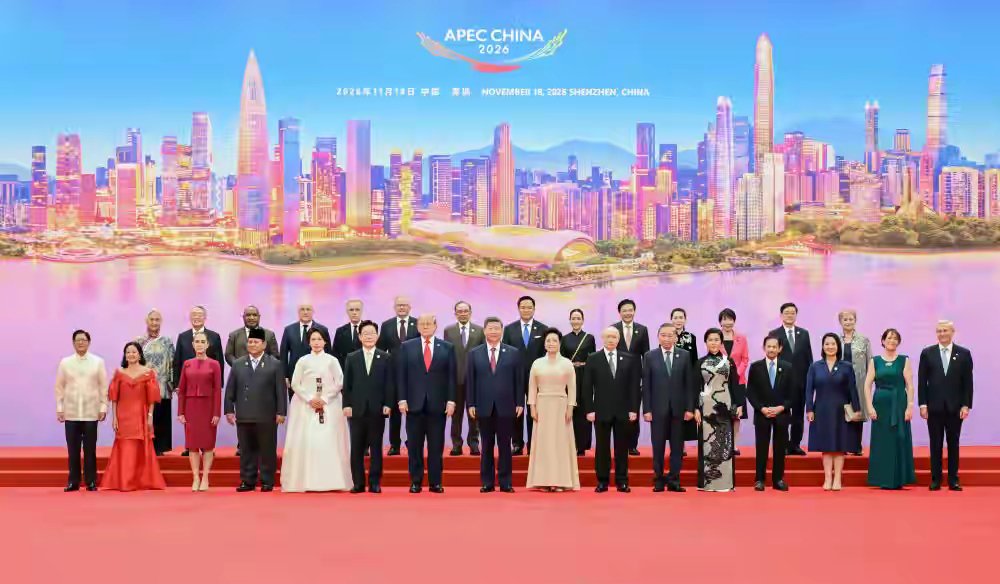
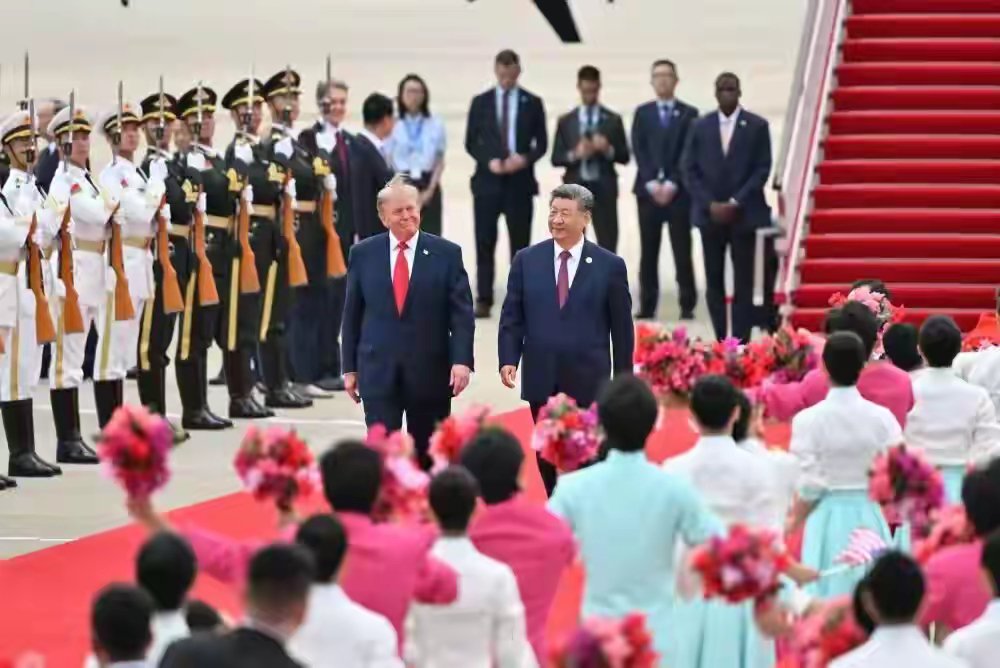
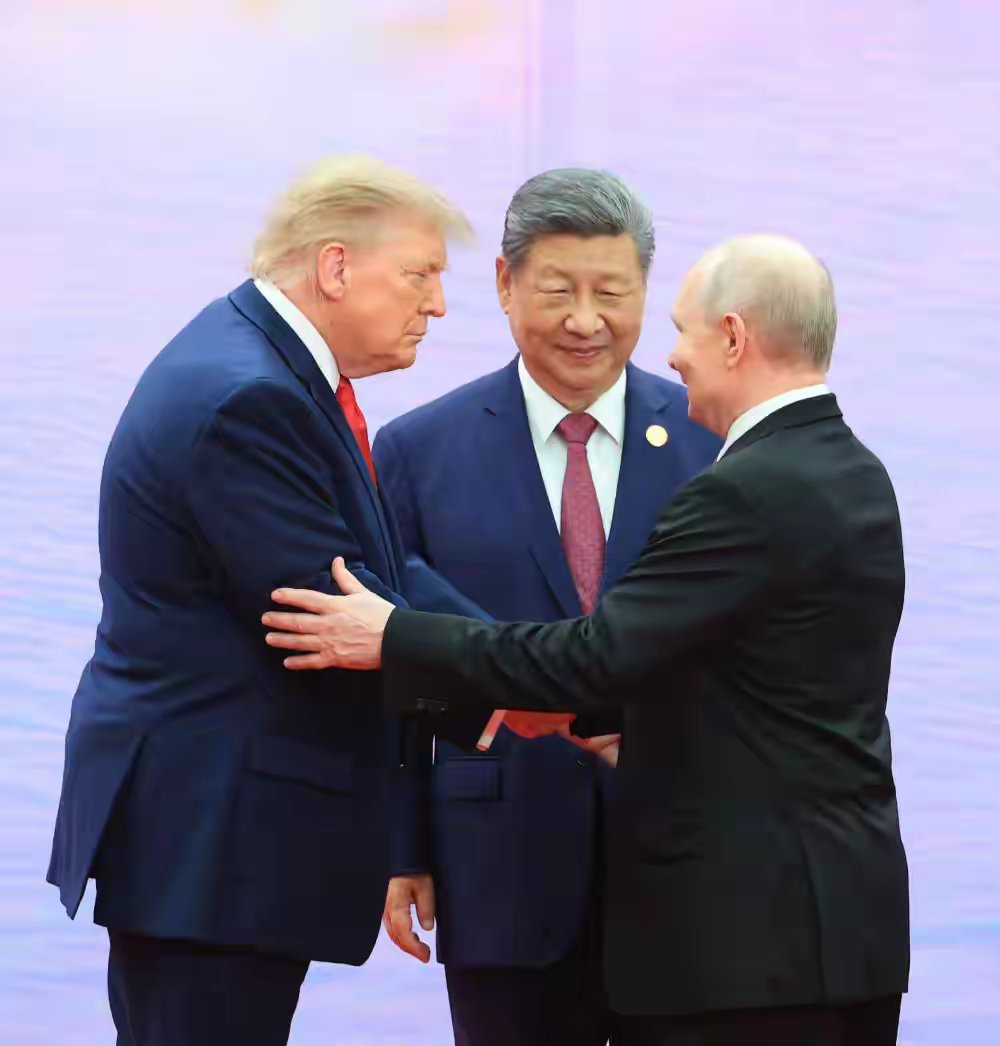
Note: two HEIC files came through as attachments as well — iPhone-format, so they need an HEIC viewer to display. The three JPGs above are the ones that display directly.
By the numbers
| Item | Figure |
|---|---|
| Leaders' meeting | Nov 18–19, 2026, Shenzhen |
| Theme | Building an Asia-Pacific Community to Prosper Together |
| Member economies | 21 (~60% of global GDP, ~half of world trade) |
| Venue | Shenzhen International Exchange Center, Futian |
| Expected participants | ~2,000 |
| CEO Summit companies | 115 Fortune Global 500 |
| China Year events | ~300 across Guangzhou, Shanghai, Dalian, Suzhou, Hangzhou, Beijing, Hong Kong |
| APEC Business Travel Card stay in China | 60 → 90 days per visit (from Nov 1, 2026) |
| Car-free pledges in Shenzhen | 1.5 million+ by Nov 17 |
Verdict
As spectacle: 9/10. Airport greetings, banquet toasts, a trilateral nobody's ever filmed before, a president who flew economy to a summit — Shenzhen delivered the visuals.
As substance: 5/10, by design. The trade truce can't be extended until December's G20, the AI mechanism is being built at the speed of trust (i.e., slowly), and the Japan freeze is frozen.
As a host pitch: 10/10. Xi's 'fifty years of China' line is the host's thesis in one sentence: the summit is the showroom, and Shenzhen is the product. Xi is holding this summit the way a CEO holds an earnings call — the numbers are secondary to the story that the city is the future, and Beijing built it.
The real test is Thursday: whether the trilateral produces anything beyond the photo. Until then, Shenzhen's message to the world is the same one it sent in 1979 — open (on our terms), innovate (with us), and prosper (together, if you play along). Whether 21 economies buy that pitch is the question the next year of APEC will answer.
Sources: China's Foreign Ministry (Nov 13 announcement), State Council, Xinhua welcome-banquet text, The Guardian live blog (Nov 18), AP, Brookings 'Trump, Xi, and Putin: What to expect' (Nov 12), Wikipedia 'APEC China 2026' (live-updated), Kyodo on Japan, SCMP/Al Jazeera/CNBC summit coverage. Facts cross-checked across wire and official sources; the 'Shenzhen Initiative' is a business declaration, not a binding agreement.