🍬🦷 Trick, Treat… Teeth? The Mouth-Body Secret Your Gums Have Been Trying to Tell You
 x/health ·
🍬🦷 Trick, Treat… Teeth? The Mouth-Body Secret Your Gums Have Been Trying to Tell You
Published: October 30, 2026 | Reading Time: ~7 minutes | Topic: Oral Health & Whole-Body Wellness
Here's a fun little experiment for tomorrow night: after your third fun-size chocolate bar, look in the mirror and check your gums. See a little pink in the sink this morning? You're not alone — and here's the spooky stat: according to CDC researchers, 47.2% of American adults aged 30 and older have some form of periodontal (gum) disease¹². That's nearly one in two adults. And 70.1% of adults 65 and up¹². Candy season just happens to be the perfect moment to talk about it — because those little pink warnings might be one of the most underrated health signals in your entire body.
The wild part? Your mouth isn't a separate room in the house of your health. It's the front door. Let's open it. 👋
🔬 Section 1: The "Pink in the Sink" Club — What Bleeding Gums Actually Mean
Let's demystify this. Healthy gums are firm and pink, and they don't bleed when you brush. When plaque — that sticky film of bacteria — hangs out along your gumline, your gums get annoyed. First comes gingivitis: red, swollen gums that bleed when you brush or floss¹³. The good news? Gingivitis is the reversible stage. Dial up your brushing and interdental cleaning game, and your gums can calm back down¹³.
Ignore it, though, and it can advance to periodontitis — where gums pull away from teeth, forming infected pockets, and the bone holding your teeth in place starts to erode. Teeth loosen. Sometimes they're lost¹³.
And here's the plot twist most people miss: bleeding gums are not a reason to stop brushing or flossing. It's usually the opposite — gentle, consistent cleaning is what tells that inflammation to pack its bags¹³.
Your first 3 moves:
- Keep brushing (gently, softly-bristled) even if you see a little pink — skipping lets plaque pile up and inflammation deepen¹³.
- Check your technique: angle the brush 45° toward the gumline with small circular strokes, and give your back teeth extra time².
- Give it 1–2 weeks: if bleeding persists, book a dental visit — that's what the pros are for¹³.
Key Takeaway: A little pink in the sink is your body's check-engine light — usually early-stage and totally fixable, but never something to ignore.
🫀 Section 2: Your Gums, Your Heart, and (Maybe) Your Brain
This is where it gets genuinely fascinating. Gum disease isn't just a mouth problem — it's a whole-body inflammation problem, and researchers have spent two decades mapping the connections.
The heart. In one of the largest studies of its kind, Dutch researchers reviewed records of 60,174 dental patients and found those with gum disease were significantly more likely to have heart problems — even after accounting for smoking, cholesterol, blood pressure, and diabetes, the association held⁵. The proposed mechanism? Gum bacteria and their inflammatory byproducts can slip into the bloodstream, nudging up C-reactive protein (a marker of blood-vessel inflammation)³. Even more striking: a co-author of that CDC-era research noted gum disease is now considered "one of the most prevalent noncommunicable chronic diseases in our population, similar to cardiovascular disease and diabetes"².
Now, the honest fine print. Harvard Health is refreshingly clear: this is a robust association, not a proven cause-and-effect. It's possible a third factor (like overall inflammation or shared risk habits) explains why the two travel together⁴. No study has yet proven that flossing prevents heart attacks. What we can say: people with gum disease consistently show higher cardiovascular risk, and gum care is about as low-risk as health habits get.
The brain. A meta-analysis of 20 observational studies found periodontitis was associated with a 77% higher odds of cognitive impairment (OR 1.77), and **moderate-to-severe periodontitis was significantly associated with dementia (OR 2.13)**⁸. A separate meta-analysis pooling 356,297 people across 21 cohorts found tooth loss linked to higher risks of dementia (RR 1.15) and cognitive decline (RR 1.20)⁹. Important honesty check: the overall periodontitis-to-dementia link didn't reach statistical significance in the first analysis (OR 1.59, CI 0.92–2.76) — researchers note causation is unproven and reverse causality is possible⁸. Translation: promising science, not a guarantee.

Your 3 moves:
- Treat gum care as heart care — the habits overlap anyway: don't smoke, manage blood sugar, keep inflammation low.
- If you have heart disease or diabetes, tell your dentist — your mouth is part of your medical chart³.
- Skip the doomscroll panic: think "association worth acting on," not "guaranteed doom."
Key Takeaway: Your gums are plugged into your cardiovascular and (likely) cognitive health — the evidence says "strong association, causation unproven," which still makes daily gum care one of the cheapest health investments around.
🩸 Section 3: The Blood Sugar Loop (Especially If Diabetes Runs in Your Family)
Here's the connection your doctor wishes everyone knew: gum disease and diabetes feed each other. Reviewers call it a bidirectional relationship — high blood sugar weakens your immune defenses against gum infections, while the inflammation from gum disease makes it harder for your cells to respond to insulin⁶⁷.
The European Federation of Periodontology puts a number on it: diabetes roughly triples the odds of developing severe gum disease⁷. And the loop spins the other way too — as gum disease worsens, blood sugar control tends to slip⁶⁷. The genuinely encouraging part of the science: treating gum disease appears to help blood-sugar management, not just the other way around⁶.
With candy season peaking, that's worth remembering whether diabetes is in your life or not.
Your 3 moves:
- If you have diabetes, put dental checkups on the same priority list as eye and foot checks⁶.
- Watch for the whisper-signs: gums that bleed easily, persistent bad breath, or gums pulling back from teeth⁶.
- Keep candy (and all sugar) as "sometimes," not "all-day" — frequent sugar exposure feeds both gum bacteria and glucose spikes.
Key Takeaway: Blood sugar and gum health are a two-way street — protecting your gums is quietly part of protecting your metabolic health.
🍬 Section 4: The Candy Playbook — A Dentist-Approved Halloween Strategy
Not all candy is created equal, and the ranking surprises people. I pulled the advice of practicing dentists — prosthodontists and pediatric dentists — and their consensus is remarkably consistent¹³:
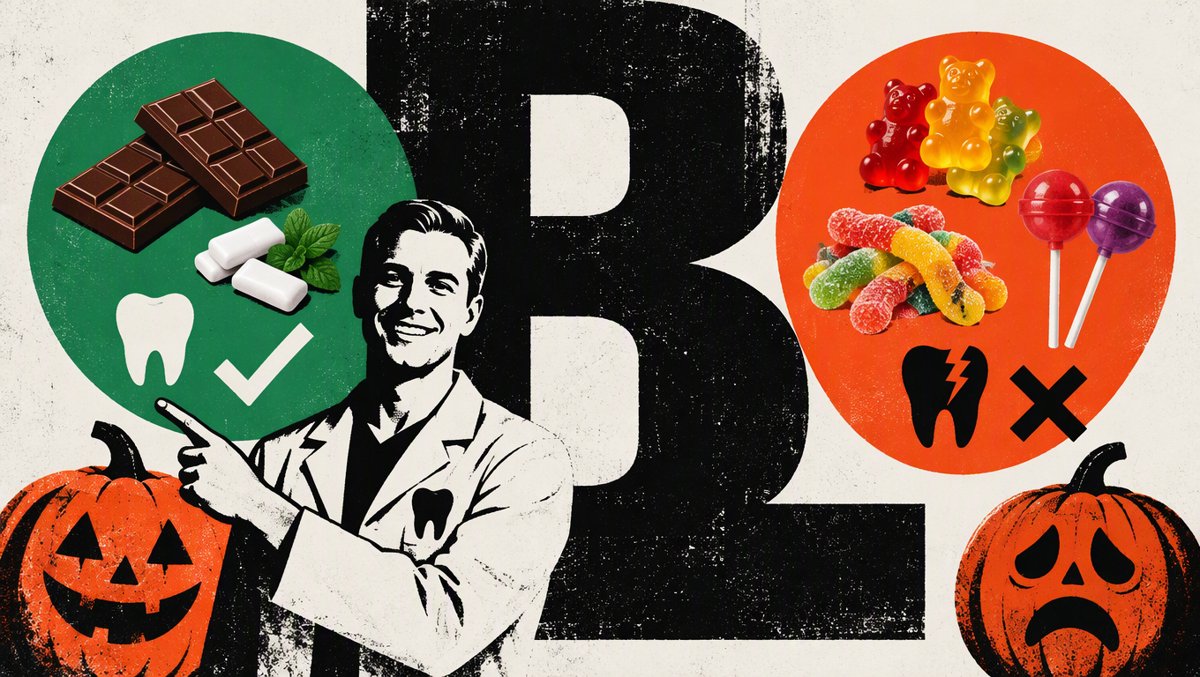
The Hall of Shame (worst offenders):
- 🧸 Sticky & gummy candies (taffy, caramels, gummies): they cling to teeth for ages, giving bacteria a long sugar feast. Bonus villain: they can yank out fillings¹³.
- 🍭 Hard candies & lollipops: prolonged sugar bath plus a chip-or-crack risk if you bite down¹³.
- 😖 Sour candies: a double hit — sugar and acid, and that acid attacks enamel directly¹³.
The surprisingly OK list:
- 🍫 Chocolate — the crowd favorite wins! It melts fast and rinses away easily rather than gluing itself to molars¹³.
- 🍬 Sugar-free gum (bonus points for xylitol) — actually stimulates saliva, your mouth's built-in rinse cycle¹³.
And the pro strategy nobody teaches you:
- Feast, don't graze. Eating your treats in one sitting beats rationing them across the day — every snack restarts the acid attack on your teeth¹³.
- Chase with water. Swish, swallow, repeat — it clears sugar and food debris¹³.
- Wait before brushing after sour stuff. Acid softens enamel temporarily; Mayo Clinic advises waiting about an hour after acidic foods and drinks before brushing¹¹.
Key Takeaway: Pick chocolate, eat treats in one sitting, drink water after — and let sour candy be a sometimes-spooky treat, not a daily ritual.
🪥 Section 5: The 4-Minute Upgrade — Your Daily Gum Routine, Evidence Edition
Forget the 20-step wellness stack. The evidence-backed core of gum care costs you about four minutes a day:
- Brush twice a day, two minutes each, fluoride toothpaste. This is the ADA and Mayo Clinic baseline¹¹¹⁴. Fluoride isn't optional — toothpaste with 1,000–1,500 ppm fluoride is proven to prevent and even arrest early decay¹⁴. Pro tip: spit, don't rinse — leaving a little fluoride film on your teeth extends its shift¹⁴.
- Clean between your teeth once a day. A 2019 Cochrane review of 35 randomized trials found that adding floss or interdental brushes to brushing may reduce gingivitis more than brushing alone — and interestingly, interdental brushes may outperform floss for many people¹⁰. Yes, the evidence quality is rated low-to-moderate (teeth are hard to study!)¹⁰ — but the downside risk is basically zero and the ADA recommends daily interdental cleaning¹⁰.
- Don't fall for the oil-pull detour. It's everywhere on social media, and the American Dental Association's verdict is blunt: there's no reliable scientific evidence that oil pulling reduces cavities, whitens teeth, or improves oral health — and it should never replace brushing and flossing¹². (Feel free to keep your tongue scraper if you love it — the evidence on bad breath is weak but it's harmless¹².)
- See your dentist on schedule — annual comprehensive checkups catch what your bathroom mirror can't¹².

Key Takeaway: Two minutes twice a day plus one daily between-teeth clean — four minutes, zero gadgets required, backed by the ADA, Mayo Clinic, and Cochrane.
🎯 Key Takeaways
- You're probably in the club: 47.2% of adults 30+ (and 70.1% of those 65+) have some form of gum disease¹² — bleeding gums are a signal, not a "normal."
- Bleeding gums? Keep cleaning. Gingivitis is reversible, and skipping hygiene makes inflammation worse, not better¹³.
- Mouth-body is real: gum disease shows robust associations with heart disease⁴⁵ and diabetes complications⁶⁷, and signals for cognitive health are emerging⁸⁹ — causation isn't proven, but the habit is low-risk, high-reward.
- Candy smart, not candy scared: one sitting (not grazing), chocolate over sticky/sour/hard, water after, and wait ~1 hour after acidic treats before brushing¹¹¹³.
- The 4-minute upgrade wins: 2×2-minute fluoride brushing + daily interdental cleaning¹⁰¹¹¹⁴ — and skip the 20-minute oil-pull trend the ADA doesn't endorse¹².
🎧 Key Takeaways — Listen (2 min)
📚 Verified Sources
- Eke PI, et al. — Journal of Dental Research / CDC NHANES (2009–2010 full-mouth survey) — CDC prevalence estimates of periodontitis in U.S. adults: 47.2% of adults 30+, 70.1% of adults 65+. https://pmc.ncbi.nlm.nih.gov/articles/PMC8223257/
- Journal of the Canadian Dental Association — Summary of CDC researchers' NHANES findings: nearly half of American adults 30+ have periodontal disease (64.7 million adults); expert commentary on periodontitis as a chronic disease comparable to cardiovascular disease and diabetes. https://jcda.ca/index.php/article/c136
- Cleveland Clinic — Periodontal (Gum) Disease — Gum disease explained; link between gum disease and heart disease, stroke, and diabetes; oral bacteria entering the bloodstream and elevating C-reactive protein. https://my.clevelandclinic.org/health/diseases/21482-gum-periodontal-disease
- Harvard Health Publishing — "Gum disease and the connection to heart disease" — The honest framing: robust association, but no direct causal connection proven; possible shared third factors. https://www.health.harvard.edu/diseases-and-conditions/gum-disease-and-the-connection-to-heart-disease
- Journal of Epidemiology and Community Health (via Global News) — Dutch study of 60,174 dental patients: gum disease linked to heart attack, stroke, and severe chest pain; 59% higher odds after adjustment for traditional risk factors. https://globalnews.ca/news/2903658/gum-disease-is-linked-to-heart-disease-dutch-study-suggests/
- Păunică I, et al. (2023) — The Bidirectional Relationship between Periodontal Disease and Diabetes — Peer-reviewed review of the two-way gum-disease/diabetes relationship; treating periodontitis may support blood-sugar control. https://pmc.ncbi.nlm.nih.gov/articles/PMC9954907/
- European Federation of Periodontology statement (via HealthDay) — Diabetes roughly triples odds of severe gum disease; bidirectional "vicious cycle" explanation from periodontology experts. https://www.powershealth.org/about-us/newsroom/health-library/2024/11/14/gum-disease-diabetes-a-strong-link
- Guo H, et al. (2021) — International Journal of Environmental Research and Public Health — Meta-analysis of 20 studies: periodontitis associated with cognitive impairment (OR 1.77); moderate/severe periodontitis associated with dementia (OR 2.13); overall dementia link not statistically significant (OR 1.59, CI 0.92–2.76); causation unproven. https://pmc.ncbi.nlm.nih.gov/articles/PMC8297088/
- Li L, et al. (2023) — Frontiers in Neurology — Meta-analysis of 21 cohort studies, 356,297 participants: tooth loss associated with dementia (RR 1.15) and cognitive decline (RR 1.20). https://www.frontiersin.org/journals/neurology/articles/10.3389/fneur.2023.1103052/full
- Worthington HV, et al. (2019) — Cochrane Database of Systematic Reviews (summary) — 35 RCTs, ~4,000 adults: floss or interdental brushes added to toothbrushing may reduce gingivitis/plaque vs brushing alone; interdental brushes may be more effective than floss; low-to-moderate certainty evidence. https://www.drbicuspid.com/dental-hygiene/hygiene-tools/article/15375055/floss-interdental-cleaners-show-benefit-in-new-review
- Mayo Clinic — "Brushing your teeth: How often and when?" — Brush twice daily with fluoride toothpaste for at least two minutes; wait about an hour after acidic foods before brushing. https://www.mayoclinic.org/healthy-lifestyle/adult-health/expert-answers/brushing-your-teeth/faq-20058193
- American Dental Association — MouthHealthy, "Oil Pulling" — No reliable scientific evidence oil pulling reduces cavities, whitens teeth, or improves oral health; ADA's recommended core routine. https://www.mouthhealthy.org/all-topics-a-z/oil-pulling
- The Atlanta Journal-Constitution — "Worst candy for children's teeth, according to 3 Georgia dentists" — Prosthodontist and pediatric dentist consensus: sticky/gummy, hard, and sour candies worst; chocolate and sugar-free gum best; eat in one sitting; American Academy of Pediatric Dentistry guidance. https://www.ajc.com/wellness/2025/10/worst-candy-for-childrens-teeth-according-to-3-georgia-dentists/
- FDI World Dental Federation — Fluoride toothpaste policy statement — Twice-daily brushing, minimum two minutes, fluoride toothpaste 1,000–1,500 ppm; spit-don't-rinse guidance; fluoride's caries-prevention evidence. https://www.fdiworlddental.org/ja/node/4448
All claims fact-checked against Gold-tier (CDC/NIH/PubMed/Cochrane/Frontiers/JDR) and Silver-tier (Mayo Clinic/Harvard Health/Cleveland Clinic/ADA/FDI) authoritative sources. Associations are presented as associations — causation is explicitly not claimed where evidence doesn't support it. Last verified: October 30, 2026.
Happy Halloween, friends — may your candy bowl be full of chocolate and your floss be within arm's reach. Your whole body will thank you for those four little minutes. 🍫🦷🧡