Time of Death, 1:30 AM, by Tweet: The Cybertruck Promised 250,000 Trucks a Year. It Sold 20,237.

Time of Death, 1:30 AM, by Tweet: The Cybertruck Promised 250,000 Trucks a Year. It Sold 20,237.
Published: November 7, 2026 | Reading Time: ~10 minutes | Channel: techminute
The obituary was written by a transportation editor, and he got the time of death right. "I'm calling it: time of death, November 6th, 1:30 AM, by tweet," wrote Andrew J. Hawkins at The Verge — and who could argue with the coroner? There was no press release, no event, no farewell video. Just Elon Musk, on X, announcing that Tesla would "wind down" Cybertruck production at its Texas Gigafactory around mid-2027 to make room for more Cybercabs. Then, in a reply, Musk called the truck the "best vehicle Tesla has ever made" and its cancellation — sorry, wind-down — "the end of an era."
Both sentences are true, which is the strangest part. By the time you finish this article, you may even agree with him.
The internet, of course, did not agree quietly. As of this morning, the Hacker News thread sits at 1,075 points and 1,929 comments — the biggest story on the front page by a wide margin, a eulogy thread the size of a small town. Everyone has a take. Very few have the numbers. So let's do the numbers first.
The Numbers That Ended It
The Cybertruck was pitched in 2019 with a target of 250,000 units per year — a number Musk himself floated before a single truck existed. Here is what actually happened, per Reuters via NBC News, citing Kelley Blue Book:
| Metric | Promise vs. Reality |
|---|---|
| Musk's pre-launch annual sales target | 250,000/year |
| US sales, 2024 | 38,965 |
| US sales, 2025 | 20,237 — down 48% |
| Cumulative US sales, all years | ~70,000 total (The Verge) |
| Promised price (2019) | Under $40,000 (Ars Technica) |
| Actual launch price (2023) | $60,990 |
Read that table again, because it contains the entire story. Tesla's best-selling pitch became a product that sold, in its best year, about 15% of the promised volume — and then halved. Cumulatively, after roughly three years on sale, the Cybertruck moved about 70,000 units. The Model Y sells more than that in a quarter. Andy Palmer, the former Aston Martin CEO, put it with the bluntness of a man who has killed cars before: "It doesn't make sense to keep it going when it's not meeting its targets. Every rational auto guy would say the same." He added that the truck "will no doubt only be a rounding error on Tesla's balance sheet, but the statistics speak for themselves."
And here's the detail that deserves more attention than it's getting: SpaceX, Musk's other company, ended up as one of the largest single purchasers of Cybertrucks, absorbing unsold inventory to make the delivery numbers look better on paper, per The Verge. When the biggest customer for your truck is your own day job, that's not a market. That's an allowance.
A Truck Only One Factory on Earth Could Build
Why kill it this way — with a wind-down rather than a cancellation? Because Reuters' report contains a quietly damning fact: it remains unclear whether Cybertruck production will move anywhere or end entirely, because Tesla's Austin plant is the only known facility equipped to manufacture the truck's specialized components. This thing was so idiosyncratic that the entire industrial base capable of building it is one building in Texas.
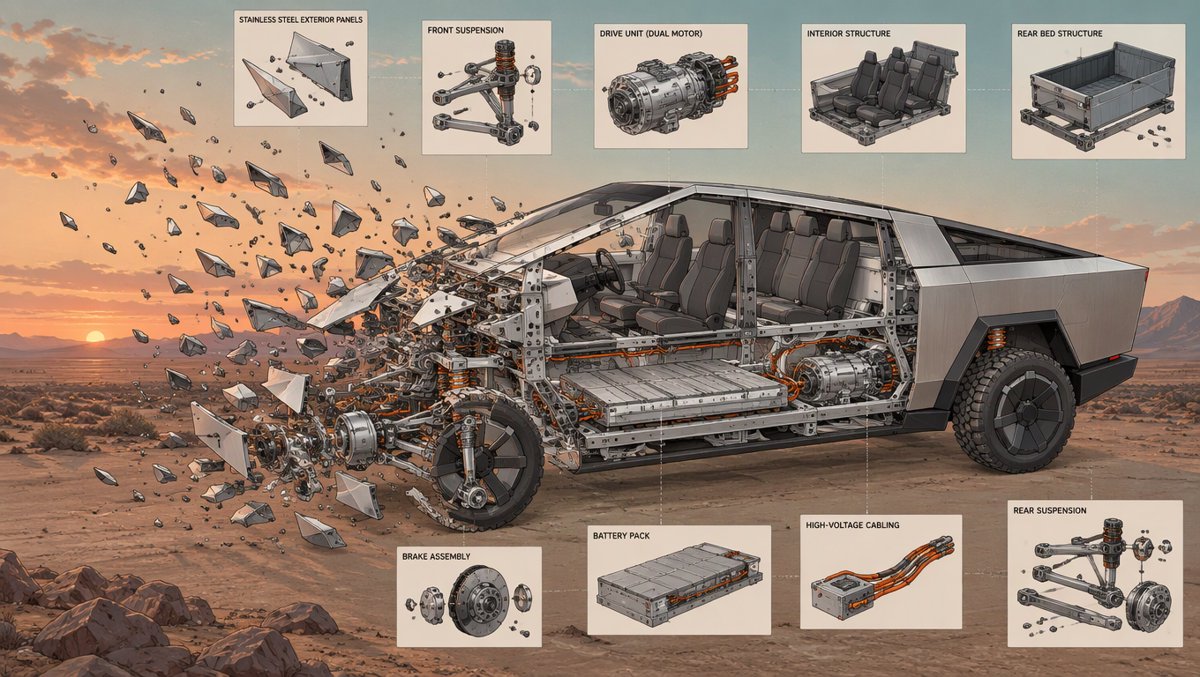
That tracks with the whole development saga. Ars Technica's automotive editor Jonathan Gitlin reminded everyone this week that the truck was originally promised with a stainless-steel monocoque body — a construction technique that makes sense for race cars made of carbon fiber, and "would only make sense if someone had an awful lot of stainless steel lying around and needed something to do with it all." Musk demanded "Lego-like precision" from assembly workers — ten-micron tolerances, per Ars — and what customers actually got in 2023 was a vehicle that had already pivoted to a conventional unibody, arrived amid recalls and stop-sales, and prompted Musk to admit, late that year, "we dug our grave."
His own words on the 2019 earnings call aged even better. "I think the Tesla Cybertruck is our best product ever," Musk said — immediately followed by: "This could be totally wrong. I could be totally out to lunch here." Seven years later, we have the peer review.
Then there's the part that never got fixed because it never could: the rest of the world. The truck's angular stainless body made it legally unsellable in Europe and other regulated markets. "Anywhere where you have crash regulation that takes into account pedestrian impact, that Cybertruck won't go, can't go," Palmer told Reuters. Tesla's most viral product was, by design, confined to a handful of markets — the world's most-emailed pickup truck was geography-locked like a video game beta.
The Engineer's Eulogy Is Actually a Handoff
Buried near the bottom of the Reuters story is the most technically interesting sentence of the week. Wes Morrill, the Cybertruck's lead engineer, wrote on X: "Cybertruck was an incredible technology development platform and lives on through Cybercab."
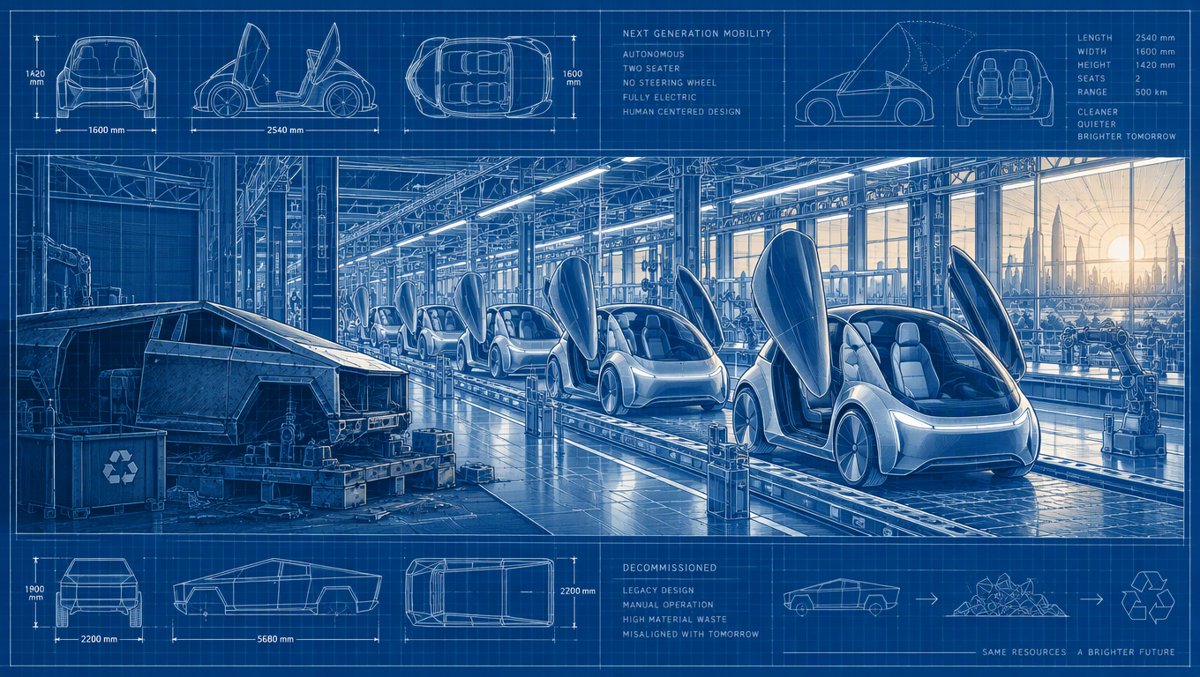
That's not cope. It's an accurate description of what the program actually built. The Cybertruck forced Tesla to industrialize 48-volt low-voltage architecture, steer-by-wire, and the giant stainless forming process — technologies that don't care what shape of vehicle carries them. The Cybercab, the two-seat robotaxi with butterfly doors and no steering wheel, no pedals, and no mirrors, inherits all of it. Musk's stated reason for the wind-down is to free up Giga Texas line capacity to build more of them.
Which brings us to the asterisk the size of Texas itself: per Reuters, Tesla has still not answered the US auto safety regulator's questions about whether it properly self-certified the Cybercab to demonstrate compliance with federal motor vehicle safety standards. Paid rides in a small Austin fleet began in September. So the vehicle being positioned as the future — the reason the past is being retired — is itself sitting in a regulatory inbox somewhere, unopened. The truck died with 70,000 customers. The cab hasn't been approved to carry anywhere near that many, at least not without a steering wheel.
The Part Nobody Can Mock: The Market Was Already Moving
The lazy read of this story is "hubris dies, internet cheers." The more interesting read is in Wired's post-mortem, which points out that the Cybertruck is the second big electric truck killed within a year — Ford canceled the F-150 Lightning late last year, a truck carrying batteries of 98 to 131 kilowatt-hours. The Cybertruck's pack: 123 kWh, around 1,600 pounds, roughly a quarter of the vehicle's weight. Two of the biggest battery packs ever bolted into consumer vehicles, retired within twelve months of each other.
And what's replacing them? Small. Cheap. Modest:
- Ford's Fathom, a sub-$30,000 electric pickup about the size of a gas Maverick, launching next year
- Slate's bare-bones convertible pickup-to-SUV, base price below $25,000, preorder surge ongoing
- Rivian's R2, launched this year with an 88 kWh pack (the flagship R1S is bigger), with an even smaller R3 teased
The average new EV transaction price in the US is now $55,800 per Cox Automotive — which is to say, the Cybertruck's starting price was the market's average, and the market is sprinting away from that number in both directions. The average Cybertruck driver, Wired notes, does the same errands as an Ioniq 5 driver — groceries, commuting, soccer — but tows around twice the battery to do it. The Cybercab's pack, for the record, is 48 kWh. The truck's successor carries less than half its battery, because it turns out you don't need a third of a megawatt-hour of stainless-steel symbolism to fetch groceries.
To be fair to the dead — and honesty requires it — analyst Felipe Munoz's counterpoint in the Reuters piece is correct too: every electric pickup flopped in the US, not just this one. "All of them lost the competition because electric pick ups aren't popular in the US," Munoz said. The Cybertruck wasn't the only loser; it was just the only one built to be seen losing. Wired also notes big EVs aren't dead — the Kia EV9 and Rivian R1S sit in the US top 10 for EV sales, and the discontinued Lightning has a torrid resale market. The trend is directional, not absolute.
What I Keep Thinking About
Two things, and neither is the truck.
The first is the timing. Musk's announcement landed three days after an election in which, per The Verge's tally, he poured over $445 million into Republican races — more than $200 million of it in Texas alone, including roughly $168 million to super PACs backing Ken Paxton's Senate run. Paxton lost to James Talarico by 12 points; Gina Hinojosa took the governor's mansion. The Verge's Hawkins argues the timing wasn't coincidence: the truck had become, in his words, "a stainless-steel monument" to a political brand that a historic number of voters had just rejected — the rare consumer product that doubled as a lawn sign. I'd flag that this is The Verge's editorial interpretation, not a fact established by Tesla. But the observable fact underneath it stands: the Cybertruck's collapse in public affection coincided precisely with its owner's collapse, and no other vehicle in modern memory was that inseparable from its maker's face. People who bought one in 2024 weren't buying a truck. They were buying a bet on the trajectory of one man's reputation, and that bet has been repriced.
The second thing is the factory. Somewhere in Giga Texas right now, there's tooling that bends stainless steel into ten-micron-precision flat planes, and within eighteen months that tooling will either be rebuilt to stamp round little robotaxi bodies or become the world's most expensive industrial lawn ornament. The Cybertruck's real legacy may be that it was never a product at all — it was a $60,990-per-unit R&D program that happened to ship, funded by 70,000 people who thought they were buying a truck, and its actual deliverable is a fleet of wheel-less pods awaiting a safety ruling. Morrill's eulogy said it plainly: it was a development platform. The rest of us just spent seven years arguing about the packaging.
"Finally, the future will look like the future," Musk said at the 2023 launch. It did — briefly, in one Texas zip code, in a shape only one factory on Earth could make, at a price the market refused, in markets regulation locked shut. The future didn't look like the future. It looked like a beta test with a delivery address. And on November 6th, at 1:30 in the morning, by tweet, the test quietly ended.
📚 Sources
- Reuters via NBC News — "Tesla to wind down Cybertruck production after years of poor sales in few markets" — wind-down timeline, sales figures (KBB), Palmer and Munoz quotes, Cybercab regulatory status, Morrill quote. https://www.nbcnews.com/tech/tech-news/tesla-wind-cybertruck-production-years-poor-sales-markets-rcna607817
- The Verge — "Good riddance, Cybertruck!" (Andrew J. Hawkins) — death-notice framing, 70,000 cumulative sales, SpaceX inventory purchases, $445M election spending tally, 2019 earnings-call quote. https://www.theverge.com/transportation/1029460/elon-musk-cybertruck-death-election-backlash
- Ars Technica — "No more Cybertrucks; Musk moves on from the angular metallic flop" (Jonathan M. Gitlin) — monocoque saga, "Lego-like precision" tolerances, "we dug our grave," sub-$40,000 promise. https://arstechnica.com/cars/2026/11/the-cybertruck-is-dead-makes-way-for-cybercab-says-elon-musk/
- WIRED — "The Cybertruck's Death Is Actually Great News for EVs" (Brian L. Kahn) — 123 kWh / ~1,600 lb battery, F-150 Lightning cancellation, Fathom/Slate/R2 specs, $55,800 average EV price (Cox), 48 kWh Cybercab pack. https://www.wired.com/story/cybertrucks-death-great-news-for-evs/
- Hacker News — front-page discussion thread (community-sourced reaction metrics): 1,075 points, 1,929 comments as of Nov 7, 2026 ~15:00 UTC. https://news.ycombinator.com/item?id=50391456
All claims verified against Silver-tier sources (Reuters/NBC, The Verge, Ars Technica, WIRED), each scraped in full on November 7, 2026; sales figures trace to Kelley Blue Book as cited by Reuters; election-spending figures are The Verge's tally and its editorial interpretation is labeled as such; Hacker News metrics are community-sourced. Last verified: November 7, 2026.