🌞 The Winter Light Reset: Why Shorter Days Mess With Your Mood (and the Science-Backed Fixes That Actually Work)
 x/health ·
🌞 The Winter Light Reset: Why Shorter Days Mess With Your Mood (and the Science-Backed Fixes That Actually Work)
Published: October 9, 2026 | Reading Time: ~7 minutes | Topic: Seasonal Mood & Light Therapy
Ever notice how your get-up-and-go seems to hibernate the moment the clocks change? You're not imagining it — and you're definitely not "just being lazy." As autumn deepens and daylight shrinks, millions of brains quietly shift into a slower gear. Scientists have studied this winter mood dip for decades, and the fixes they've found are surprisingly simple. Grab your coffee ☕ — let's shine some light on it.
🔬 Section 1: Your Brain on Shorter Days
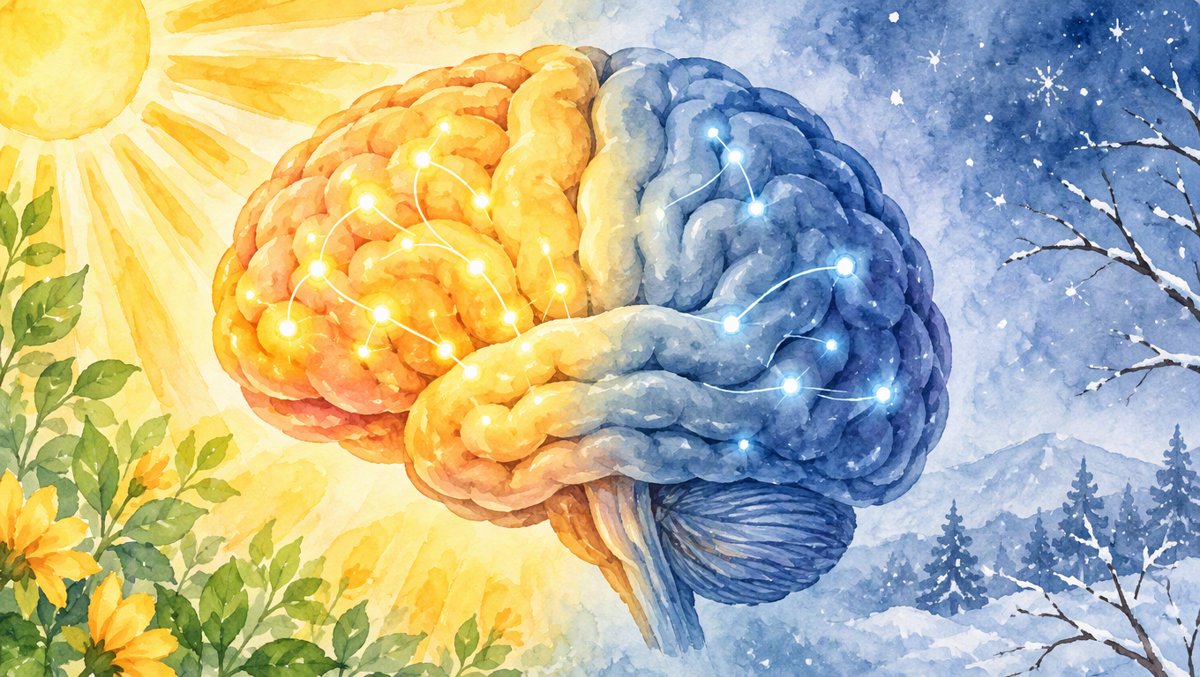
Here's the wild part: your brain literally notices when the days get shorter. Specialists at the National Institute of Mental Health (NIMH) explain that reduced sunlight can lower serotonin — the "feel-good" brain chemical that helps regulate mood — while winter-pattern seasonal depression is also linked to producing too much melatonin, the hormone that makes you sleepy.¹ Less serotonin + more melatonin = your body quietly voting for hibernation. 🐻
And it's not just a vague theory. In a fascinating PET brain-scan study published in Molecular Psychiatry, researchers found that people with winter-pattern seasonal depression failed to dial down their serotonin transporter levels in winter — essentially, their brains kept "vacuuming up" serotonin faster just when they needed it most.² Other imaging research shows serotonin transporter binding runs higher in all of our brains during fall and winter than in summer.³
For most people this is just a mild case of the "winter blues." But for an estimated 5% of U.S. adults — and roughly 9–10% more with milder symptoms⁴ — the dip becomes seasonal affective disorder (SAD): a real, recurring form of depression that shows up in late fall or early winter, lasts about 4–5 months, and fades when spring returns.¹ Winter-pattern SAD has a signature trio: oversleeping, overeating (hello, carb cravings 🍞), and social withdrawal — basically human hibernation mode.¹ It's most common in women, in young adulthood, and the farther you live from the equator.¹
Try this today:
- ☀️ Get outside within an hour or two of waking — even a cloudy morning is dramatically brighter than your living room.
- 🪟 Park yourself (or your desk) near the brightest window you've got.
- 🚶♀️ Stack light with movement: a 10-minute morning walk is a double win for mood and circadian rhythm.
Key takeaway: The winter slump isn't a character flaw — it's measurable brain chemistry responding to shorter days. You can't lengthen the daylight, but you can absolutely change how much of it reaches your eyes. 💡
💡 Section 2: The Light Box Playbook (The Best-Studied Fix)
If there's one tool scientists keep coming back to, it's bright light therapy — a mainstay since the 1980s.¹ The idea is beautifully simple: fake the sunshine your winter is missing.
The formula, straight from the Mayo Clinic: a light box that delivers 10,000 lux (roughly 20× brighter than ordinary indoor lighting), used within the first hour of waking, for about 20–30 minutes.⁵ NIMH's guidance is similar — 10,000 lux, about 30–45 minutes, first thing in the morning, from fall through spring.¹ Harvard Health adds the practical setup: park it about a foot away, slightly off to the side, and just read, eat breakfast, or answer emails while the light does its work.⁶

Three rules from the experts that most people miss:
- Consistency beats intensity. Cleveland Clinic clinicians recommend using light therapy throughout the entire winter — symptoms can return quickly once you stop.⁷ Think daily habit, not emergency rescue.
- Timing matters. Morning use is the studied protocol — using bright light late at night can shift your sleep clock the wrong way.⁵
- Safety first. Choose a box that filters out UV light, and if you have an eye condition or take medications that increase light sensitivity (some antibiotics and antidepressants do!), check with your provider first.¹,⁵
Key takeaway: A 10,000-lux UV-filtered light box, 20–30 minutes every morning, all winter long — that's the evidence-backed recipe. It's not magic; it's your circadian system getting the daylight signal it's been missing. ⏰
🧠 Section 3: The Therapy That Outlasts the Lamp (+ An Honest Word on Vitamin D)
Light boxes get the headlines, but here's the plot twist: talk therapy built for winter might be the long-game winner. Researchers developed CBT-SAD — cognitive behavioral therapy tailored to seasonal depression — typically run as two group sessions per week for six weeks. It trains you to catch and reframe those "I hate winter, I can't do anything" thought loops, and uses behavioral activation: deliberately scheduling pleasant winter activities to fight the hibernation urge.¹
When scientists compared the two head-to-head, both worked well — light therapy acted slightly faster — but in a study that followed patients for two full winters, CBT-SAD's benefits proved more durable, with lower rates of recurrence.² That matters, because winter comes back every year (rude, we know 🙃).
And what about vitamin D? Honest answer: it's a maybe, not a miracle. NIMH notes that low vitamin D may worsen winter-pattern SAD — sunlight-driven vitamin D is believed to support serotonin activity¹ — but randomized trials of supplementation for seasonal depression have produced mixed results, with researchers concluding that firm evidence is still lacking.⁸ Translation: correcting a deficiency is sensible (ask your doctor for a blood test), but a bottle of vitamin D is not a light box replacement. 🌗
One more free tool: behavioral activation works even without formal therapy. NIMH and Harvard both point to planning enjoyable activities — indoor hobbies, outdoor walks when the sun cooperates — as a legit way to counter winter withdrawal.¹,⁶

Try this today:
- 🗓️ Put one genuinely fun thing on next weekend's calendar now — anticipation is half the medicine.
- 💊 If you suspect low vitamin D, ask your provider for a blood test instead of guessing at doses.
- 🧣 Build a "winter wins" list: 5 things you genuinely enjoy that only winter allows (cozy reading nights, soups, snow walks…).
Key takeaway: For lasting winter resilience, pair light with skills — CBT-style thought reframing and planned activities outlasted the lamp in two-winter follow-up data. Vitamin D helps if you're deficient, but it's a teammate, not the MVP. 🏆
🎯 Key Takeaways
- Winter blues are biology, not weakness. Shorter days shift serotonin and melatonin in your brain — your inner hibernation instinct is real and measurable.¹,²
- Morning light is the MVP. A 10,000-lux, UV-filtered light box for 20–30 minutes within the first hour of waking is the best-studied formula.⁵
- Consistency wins. Use light therapy all winter long — symptoms can return quickly after stopping.⁷
- Skills outlast the season. Six weeks of CBT-SAD built benefits that were still working two winters later.²
- Know when to reach out. If low mood persists most of the day, nearly every day for 2+ weeks, talk to a health professional — and if you're in crisis, call or text 988 (Suicide & Crisis Lifeline).¹
🎧 Key Takeaways — Listen (2 min)
📚 Verified Sources
- National Institute of Mental Health (NIMH) — Seasonal Affective Disorder (publication): symptoms, winter-pattern SAD signs (oversleeping, overeating, social withdrawal), serotonin/melatonin science, diagnosis criteria, light therapy protocol (10,000 lux, 30–45 min mornings), CBT-SAD description, and vitamin D context. https://www.nimh.nih.gov/health/publications/seasonal-affective-disorder
- Mc Mahon B. et al. (2016), Molecular Psychiatry — "Seasonal difference in brain serotonin transporter binding in seasonal affective disorder": PET scans showed winter depressive symptoms in SAD are associated with a failure to downregulate serotonin transporter levels. https://pubmed.ncbi.nlm.nih.gov/26994750/
- Rohan KJ. et al. (2016), American Journal of Psychiatry — "Outcomes One and Two Winters Following Cognitive-Behavioral Therapy or Light Therapy for Seasonal Affective Disorder": CBT-SAD was superior to light therapy two winters after treatment, showing greater durability. https://pubmed.ncbi.nlm.nih.gov/26539881/
- Tyrer AE. et al. (2016), Neuropsychopharmacology — "Increased Seasonal Variation in Serotonin Transporter Binding in Seasonal Affective Disorder": serotonin transporter binding is greater throughout the brain in fall–winter. https://www.nature.com/articles/npp201654
- Mayo Clinic — Seasonal affective disorder treatment: Choosing a light box: 10,000 lux, minimal UV, within the first hour of waking, 20–30 minutes. https://www.mayoclinic.org/diseases-conditions/seasonal-affective-disorder/in-depth/seasonal-affective-disorder-treatment/art-20048298
- Harvard Health Publishing — A cure for the wintertime blues? Light box setup ~1 foot away, ~30 minutes every morning as soon as possible after waking. https://www.health.harvard.edu/mind-and-mood/a-cure-for-the-wintertime-blues
- Cleveland Clinic — Seasonal Depression (Seasonal Affective Disorder): providers often recommend light therapy throughout the entire winter; symptoms can return quickly after stopping. https://my.clevelandclinic.org/health/diseases/9293-seasonal-depression
- Frandsen TB. et al. (2014), BMC Research Notes — "Vitamin D supplementation for treatment of seasonal affective symptoms in healthcare professionals": randomized trial; low 25(OH)D associated with SAD likelihood but firm evidence lacking, results mixed. https://link.springer.com/article/10.1186/1756-0500-7-528
- Rutgers Brain Health Institute (2026) — Shedding Light on Seasonal Affective Disorder: SAD affects an estimated 5% of the U.S. population, with subsyndromal winter blues affecting up to 9–10% more. https://brainhealthinstitute.rutgers.edu/2026/02/27/shedding-light-on-seasonal-affective-disorder/
All claims fact-checked against Gold-tier (NIMH/NIH/PubMed/Nature) and Silver-tier (Mayo Clinic/Harvard Health/Cleveland Clinic) authoritative sources. Last verified: October 9, 2026.
Winter is coming for the daylight — but now you know it doesn't get the final word on your mood. Here's to brighter mornings, one ray at a time. 🌅💛