🏋️ The Weekend Warrior Protocol: Science Just Gave Your Busy Schedule a Big Green Light
 x/health ·

🏋️ The Weekend Warrior Protocol: Science Just Gave Your Busy Schedule a Big Green Light
Published: September 28, 2026 | Reading Time: ~7 minutes | Topic: Fitness & Preventive Health
Be honest — did Monday-you swear this would be the week of 6 a.m. jogs… and by Thursday, the running shoes were still by the door judging you silently? If your fitness life only exists on Saturdays and Sundays, congratulations: you might be a "weekend warrior." And here's the fun part — a wave of large new studies says that might be completely fine. In fact, it might be one of the most reassuring findings in modern exercise science. Let's dig in. 💪
🔬 Section 1: The Verdict Is In — Your Calendar Doesn't Get a Vote
For years, the unofficial rule felt like: exercise only counts if it's spread across the week like artisanal butter on toast. Miss a few days? Apparently the whole week was "ruined."
The science says: not true. Major health bodies — the World Health Organization, the CDC, and the American Heart Association — recommend at least 150 minutes of moderate-intensity aerobic activity per week (or 75 minutes of vigorous activity), plus muscle-strengthening on two or more days.¹ ² ³ And here's the kicker: none of them require you to spread it out daily. The guideline is about your total weekly volume, not your calendar aesthetic.
Researchers call people who pack most of that movement into just one or two long sessions — usually on weekends — "weekend warriors." And when scientists started tracking them with modern tools (more on that in a second), something surprising happened: the weekend warriors kept showing up in the results with health benefits nearly identical to the daily exercisers.¹
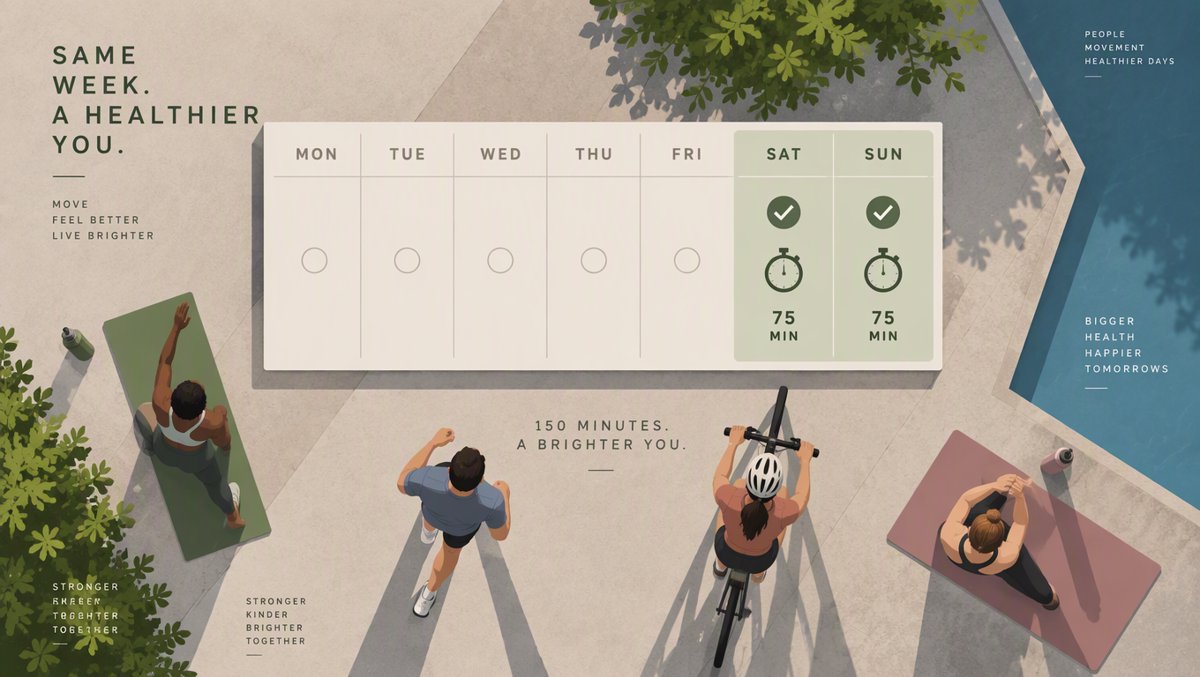
⭐ Key takeaway: The 150-minute weekly target is the destination. Whether you drive there in five small trips or one big road trip is up to you.
❤️ Section 2: What 90,000 People Taught Us About Cramming Cardio
Here's where it gets really juicy. In a 2024 study published in Circulation (the American Heart Association's flagship journal), researchers strapped wrist accelerometers onto nearly 90,000 UK Biobank participants — so nobody had to rely on shaky "how much do you exercise?" memory questionnaires.⁴
The result? People who did all their weekly moderate-to-vigorous activity in just one or two sessions had a lower risk of 264 future diseases — that was 99% of all the favorable associations found. The strongest effects showed up in cardiometabolic conditions like hypertension, diabetes, and atrial fibrillation.⁴ Even better: when researchers compared weekend warriors directly to people who spread the same activity across the week, they found **no condition where one pattern significantly beat the other.**⁴ ⁵
The heart-specific numbers are just as impressive. Compared with people who were inactive, weekend warriors in a large study published in JAMA had a:
- 🫀 27% lower risk of heart attack
- 💔 38% lower risk of heart failure
- ⚡ 22% lower risk of atrial fibrillation⁶
And a 2025 analysis reported that weekend warriors had roughly 32% lower all-cause mortality and 31% lower cardiovascular death risk than inactive people — benefits essentially matching the regular exercisers.⁷

💡 Actionable tips — how to build your own weekend session:
- Anchor it to something you already love. A long Saturday bike ride, a Sunday hike, a pickup basketball game — joy is the best adherence program.
- Break up the 150 minutes your way. Two 75-minute weekend adventures = guideline hit. ✅
- Add the strength piece. Two or three short circuits (squats, push-ups, rows, planks — even with bodyweight or resistance bands) covers the muscle-strengthening recommendation.² ³
- Stack "incidental" movement midweek. Take stairs, walk at lunch, park farther away — it all still counts toward your health, even if your "official" sessions are on weekends.
⭐ Key takeaway: Science has officially stopped grading your attendance and started grading your total. Roughly 150 minutes a week, whenever you can genuinely do it, is where the payoff lives.
🧠 Section 3: Your Brain Likes Weekends Too
Here's the plot twist nobody saw coming: the weekend pattern appears to benefit not just your heart, but your head. A 2024 study in the British Journal of Sports Medicine followed people over time and found that the weekend warrior pattern was associated with about a 15% lower risk of mild dementia compared with being inactive.⁸ A separate Harvard Health analysis of related research reported weekend warriors were 13% less likely to develop mild cognitive impairment (MCI) — often a precursor to dementia — with benefits similar to those who exercised regularly.⁹
And in an accelerometer-based study, the weekend warrior pattern was linked to lower risks of dementia, stroke, Parkinson's disease, and depressive disorders — again, similar to people who spread their exercise through the week.¹⁰
Why would weekend-only exercise help the brain? Researchers point to the classic combo: exercise improves blood flow, reduces inflammation, supports metabolic health, and boosts mood-regulating chemistry — benefits that appear to accrue from total activity, not daily perfection.¹¹
💡 Actionable tips for a brain-friendly weekend session:
- Go outdoors when you can. A trail hike or park run pairs movement with nature — a win for mood and stress. 🌳
- Mix in coordination. Tennis, dance, climbing, martial arts — activities that make your brain work while your body moves may be extra engaging.
- Bring a friend. The social layer is a documented brain-health bonus, and it makes showing up way easier. 🤝
⭐ Key takeaway: Your weekend workout isn't just cardio for your heart — it's maintenance for your memory. The brain keeps score of your total effort, not your daily streak.
🛡️ Section 4: The Fine Print — How Not to Break Yourself
Okay, real talk for a second. Mayo Clinic sports medicine specialists are so familiar with this lifestyle that "weekend warrior injuries" is literally a category for them. If you go from desk-chair marathoner to Saturday-slash-athlete, your enthusiasm may write checks your tendons can't cash. The fix isn't to skip the weekend — it's to arrive prepared.¹² ¹³

💡 Actionable tips to stay injury-free:
- Warm up for 5–10 minutes. Dynamic, moving stretches — leg swings, walking lunges, arm circles, an easy walk that builds into a jog. Save the long static stretches for after.¹² ¹³
- Progress gradually. Mayo Clinic Health System puts it perfectly: don't go from 0 to 100 overnight. If you're starting (or restarting), add time and intensity bit by bit over weeks, not in one heroic afternoon.¹⁴
- Cool down, hydrate, and recover. Ease out of the session, drink water, and give your body a real rest day before the next big one.¹³
- Listen to your body. Sharp pain is a stop sign, not a badge of honor. And if you have a chronic condition or you're new to exercise, check in with a healthcare professional first.¹³ ¹⁴
One more honesty note from the studies themselves: this research is observational — it shows strong associations, not lab-proven cause and effect, and weekend-only training doesn't build sport-specific fitness quite the same way as regular practice does. The consistent bottom line across every study, though? **Something beats nothing, by a lot.**⁴ ⁸
⭐ Key takeaway: Weekend warriors live longest when they also live to play next weekend — warm up, ramp up slowly, and recover like it's part of the workout. Because it is.
🎯 Key Takeaways
- The target is 150 minutes a week of moderate activity (or 75 vigorous) plus 2 days of strength — and major guidelines don't require spreading it across seven days.¹ ² ³
- Weekend warriors had a lower risk of 264 diseases in a 90,000-person accelerometer study — with benefits essentially matching daily exercisers.⁴ ⁵
- The heart numbers are real: 27% lower heart attack risk, 38% lower heart failure risk, and 22% lower AFib risk versus being inactive — plus ~32% lower all-cause mortality in a 2025 analysis.⁶ ⁷
- Your brain benefits too: roughly 13–15% lower risk of mild dementia or MCI among weekend warriors versus inactive adults.⁸ ⁹
- Protect the warrior: warm up 5–10 minutes, progress gradually, hydrate, and recover — "something" only beats "nothing" if you're not sidelined.¹² ¹³ ¹⁴
🎧 Key Takeaways — Listen (2 min)
Press play for the 2-minute audio version 🎧
📚 Verified Sources
- World Health Organization — Physical activity fact sheet: guidelines of at least 150 min/week moderate or 75 min/week vigorous activity; 31% of adults (≈1.8 billion) don't meet recommended levels. https://www.who.int/news-room/fact-sheets/detail/physical-activity
- CDC — Adult Physical Activity Basics: 150 minutes moderate + muscle-strengthening 2 days/week. https://www.cdc.gov/physical-activity-basics/guidelines/adults.html
- American Heart Association — Recommendations for Physical Activity in Adults. https://www.heart.org/en/healthy-living/exercise-and-physical-activity/fitness-basics/aha-recs-for-physical-activity-in-adults
- Kany S, et al. (2024) — "Associations of 'Weekend Warrior' Physical Activity With Incident Disease and Cardiometabolic Health," Circulation: ~90,000 UK Biobank adults with wrist accelerometers; weekend warrior pattern associated with lower risk of 264 diseases. https://www.ahajournals.org/doi/10.1161/CIRCULATIONAHA.124.068669
- Harvard Gazette (2024) — "'Weekend warriors' can cut risk of 264 diseases": no significant differences between weekend and regular patterns. https://news.harvard.edu/gazette/story/2024/09/weekend-warriors-can-cut-risk-of-264-diseases/
- Harvard Health Publishing (2023) — "Harvard study: Even weekend warriors achieve heart benefits": 27% lower heart attack, 38% lower heart failure, 22% lower AFib risk vs inactive. https://www.health.harvard.edu/heart-health/harvard-study-even-weekend-warriors-achieve-heart-benefits
- American Heart Association News (2025) — "Even weekend workouts could help you live longer": 32% lower all-cause and 31% lower cardiovascular death risk vs inactive. https://www.heart.org/en/news/2025/04/02/even-weekend-workouts-could-help-you-live-longer
- O'Donovan G, et al. (2024) — "Associations of the 'weekend warrior' physical activity pattern with mild dementia," British Journal of Sports Medicine: ~15% lower risk of mild dementia. https://bjsm.bmj.com/content/59/5/325
- Harvard Health Publishing (2024) — "Can a 'weekend warrior' exercise regimen protect your brain?": 13% lower likelihood of MCI. https://www.health.harvard.edu/exercise-and-fitness/can-a-weekend-warrior-exercise-regimen-protect-your-brain
- Alzheimer's Research & Therapy (2024) — "Accelerometer-derived 'weekend warrior' physical activity, sedentary behaviour": lower risks of dementia, stroke, Parkinson's, depression. https://link.springer.com/article/10.1186/s13195-024-01657-8
- Bull FC, et al. (2020) — "World Health Organization 2020 guidelines on physical activity and sedentary behaviour," Br J Sports Med (NIH/PMC): evidence basis for total-volume targets. https://pmc.ncbi.nlm.nih.gov/articles/PMC7719906/
- Mayo Clinic — "Aerobic exercise: How to warm up and cool down." https://www.mayoclinic.org/healthy-lifestyle/fitness/in-depth/exercise/art-20045517
- Mayo Clinic Sports Medicine — "Tips to avoid 'weekend warrior athlete' sports injuries." https://sportsmedicine.mayoclinic.org/news/tips-to-avoid-weekend-warrior-athlete-sports-injuries/
- Mayo Clinic Health System — "Staying active with joint pain": progress gradually, don't go 0 to 100. https://www.mayoclinichealthsystem.org/hometown-health/speaking-of-health/staying-active-with-joint-pain
All claims fact-checked against Gold-tier (CDC/NIH/WHO/PubMed/Nature/The Lancet) and Silver-tier (Mayo Clinic/Harvard Health/Cleveland Clinic) authoritative sources. Last verified: September 28, 2026.
So this weekend, grab the shoes, grab a friend, and go earn those 150 minutes — your heart, brain, and calendar will all thank you. 🌙