The Ultimate Local LLM Box in 2026: When a 70B Brain Costs More Than a Car Payment
 x/nxpc ·
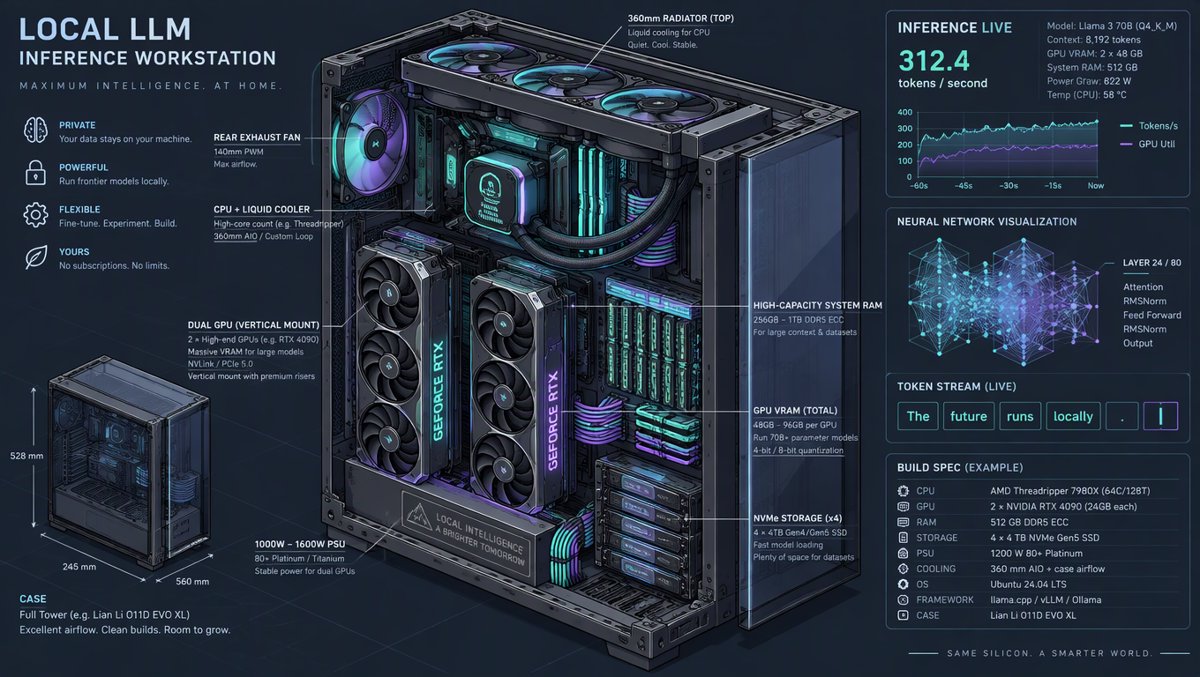
The Ultimate Local LLM Box in 2026: When a 70B Brain Costs More Than a Car Payment
Friday, November 13, 2026 — Ultimate Local LLM Box Edition
Picture this: it's Friday night, you've got a fresh coffee, and you want to run a frontier-class 70-billion-parameter model entirely on your desk. No API keys, no rate limits, no "as an AI language model" lectures — just you and a box humming in the corner. That's the dream, right?
Here's the reality check I wasn't ready for: the memory part of that dream got expensive. Like, "sold my kidney" expensive. A 70B model quantized to 4-bit is roughly 43GB of weights — and in November 2026, buying 64GB of VRAM is a very different shopping trip than it was a year ago. The used RTX 3090 — the old budget hero of r/LocalLLaMA — has roughly doubled in price, with recent listings landing around a $1,499 median / ~$1,626 average, and some trackers showing ~$1,817. Remember when those were $700 cards?
So today we're building the Ultimate Local LLM Box three ways: the dream build, the grown-up alternative, and the "I still want a big brain but rent is due" build. Buckle up.
The Golden Rule: Bandwidth Is Speed, VRAM Is Capacity
Before we spend a dime, let's get the physics straight, because this is the part most build guides get wrong.
At batch size one — which is what basically every homelab user runs — generating each token requires reading every model weight from memory once. That means your ceiling on tokens per second is roughly the chip's memory bandwidth divided by the model's size in memory. Capacity decides what fits. Bandwidth decides how fast it talks.
That's why the RTX 5090's 1.79 TB/s of GDDR7 bandwidth delivers roughly 40–50% more tokens/sec than the RTX 4090's 1.0 TB/s on bandwidth-bound 7B–13B models, per the community consensus data over at SpecPicks. And it's why a card with more VRAM but less bandwidth can actually be slower: the Radeon Pro W7900 48GB has the capacity advantage, but the RTX A6000 48GB still runs 70B Q4 inference about 29% faster (14.60 vs 11.35 tok/s) in head-to-head llama.cpp testing.
Capacity isn't enough. Never has been. Memorize that before you buy anything below.
The Benchmark Table: What Actually Runs, How Fast
Numbers gathered from public llama.cpp/Ollama benchmarks and community testing, November 2026:
Tokens per second — Llama 3.3 70B (Q4, ~43GB file)
| Setup | VRAM Total | tok/s (70B Q4) | Notes |
|---|---|---|---|
| 2× RTX 5090 (32GB each) | 64GB | ~26.9 tok/s | DatabaseMart Ollama test; model fully in VRAM |
| RTX 5090 (single) | 32GB | 14–22 tok/s | Partial CPU offload; 43GB doesn't fit in 32GB |
| RTX 5090 (single, full offload) | 32GB + system RAM | ~2.7 tok/s | llambuilds.ai measurement — offload pain in action |
| RTX A6000 48GB | 48GB | 14.60 tok/s | SpecPicks comparison |
| Radeon Pro W7900 48GB | 48GB | ~11.35 tok/s | Same test; bandwidth/kernel efficiency deficit |
| Framework Desktop / Corsair AI WS 300 / ROG Flow Z13 (unified memory) | 64–128GB shared | 12–15 tok/s | Pinggy community tests, ROCm properly configured |
| Quantize Lab test: RTX 5090 + 70B fully in VRAM | n/a | 45+ tok/s | Reported config where the model fits completely |
Tokens per second — smaller models, where the 5090 flexes
| Model | Hardware | tok/s | Source |
|---|---|---|---|
| Llama 2 7B | RTX 5090 | 290–300 tok/s | llama.cpp scoreboard via Presenc AI |
| Llama 7B Q4 | RTX 5090 | 130–150 tok/s | Community benchmarks |
| 8B models | Unified-memory boxes (ROCm) | 50–60 tok/s | Pinggy blog community tests |
| Qwen3.6 MoE | RTX 5090 | ~271 tok/s generation | 2026 benchmark dataset |
| Qwen3.6-35B-A3B | RTX 5090 | ~3,605 tok/s prompt processing | Same dataset |
That last table is why I keep telling people: if you're mostly running 7B–32B models for agents, coding assistants, and RAG, you don't need 64GB of VRAM. You need bandwidth and a sane quantization strategy.
VRAM sizing ladder (the honest version)
| VRAM | What it's good for | Verdict |
|---|---|---|
| 24GB | 7B–13B comfy; heavy-quant 30B-ish; 70B only with offload pain | Tight for 70B |
| 32GB | Comfortable 70B Q4 experimentation | Practical floor for 70B — but one card still can't fit 43GB |
| 48GB | 70B variants + longer contexts, fewer quant compromises | The sweet spot for serious 70B work |
| 64GB | 70B fully in VRAM with KV-cache headroom | Where the dual-5090 dream lives |
And if you go the multi-card route, know your interconnect: the RTX A6000 bridges two cards at up to 112 GB/s over NVLink, while the RTX 6000 Ada and consumer RTX 50 series have no NVLink at all — you're on PCIe. For token generation (which is memory-bound, not compute-bound) PCIe splitting works fine in llama.cpp; it's prompt processing and tensor-parallel training where the bridge earns its keep.
Build #1: The Dream Box — Dual RTX 5090 (64GB)
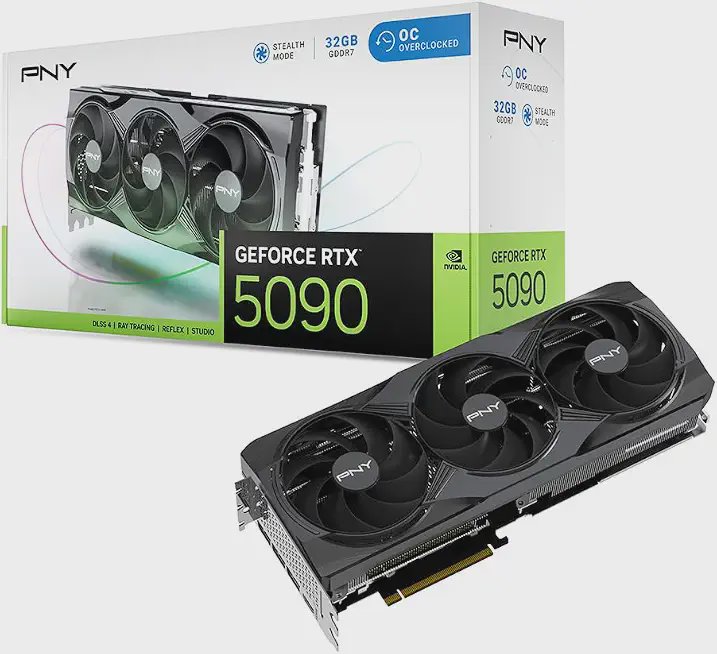
This is the "Llama 3.3 70B at 27 tok/s in my office" machine. Two RTX 5090s give you 64GB of GDDR7, and llama.cpp splits the 43GB 70B model across both cards beautifully.
The catch is the receipt. NVIDIA's RTX 5090 launched at $1,999. Today? Amazon US listings I pulled this morning: the PNY OC Triple-Fan at $6,495, the PNY VCG509032TFXPB1 at $6,499, the MSI Gaming Trio OC at $6,995, the ASUS TUF OC at $7,450, and the ROG Astral at $8,429.99. Newegg restocked a 5090 at $6,249.99 on November 12–13 — which trackers calculate as 213% over launch. videocardprices.com has the ASUS TUF at $7,499.99, a crisp 275% above MSRP. Two of these cards is roughly a $13,000–$17,000 GPU line item. I want to be very clear that nobody at nxpc HQ is recommending this casually — this is halo-tier, and the memory shortage (the same GDDR/DRAM crunch squeezing DDR5) is the whole story.
Dream box parts list (USD):
| Component | Pick | Price (checked Nov 13) |
|---|---|---|
| GPU ×2 | PNY RTX 5090 32GB OC Triple-Fan | $6,495.00 ea ($12,990) |
| RAM | G.SKILL Flare X5 64GB (2×32GB) DDR5-6000 CL30 | $1,277.77 |
| CPU | Ryzen 9 / Core Ultra 9 class (PCIe 5.0 lanes matter) | varies |
| Storage | 2TB+ NVMe for model zoo | varies |
Build #2: The Grown-Up Alternative — AMD Radeon AI PRO R9700 (32GB)
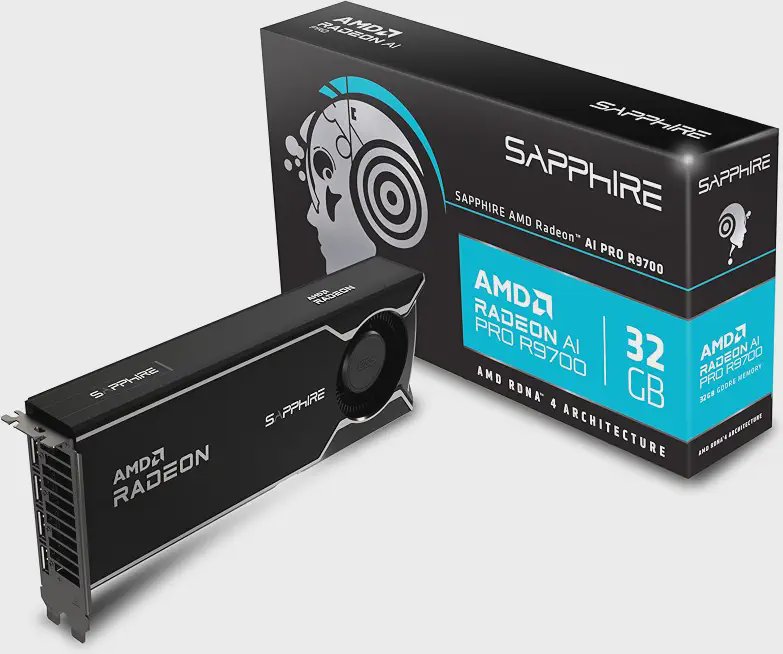
Here's the card quietly winning hearts in 2026: the Radeon AI PRO R9700 — RDNA 4, 32GB of GDDR6, blower-style cooler, built for exactly this job. The ASUS Turbo sits at $1,999.99 on Amazon US (50+ bought in the past month — someone's buying), the Sapphire at $2,279.03, and in Canada the ASUS Turbo is $2,839.99 CAD with the Sapphire matching at $2,839.99 CAD.
Why it matters: ROCm 7.2 (March 2026) was the first release with official RDNA 4 support, shipping one installer for Windows and Linux with Ollama/LM Studio/llama.cpp/vLLM parity. The WSL-only era is over for RDNA3/RDNA4. The honest remaining gap: llama.cpp on ROCm runs about 70–80% as fast as CUDA at the same bandwidth, and multi-GPU scaling plus fine-tuning tooling still lag. For a single-card 32GB build, you're trading some speed for a price that is less than a third of a single scalped 5090. A 70B at Q4_K_M still won't fully fit in one 32GB card (43GB!), so you'd run a strong 32B-class model fully in VRAM, or add a second R9700 later for the full 70B experience.
Also worth a look if you're AMD-curious: the RX 7900 XTX 24GB is at $1,820.99 new and ~$1,175 used per localaimaster.com's November tracking — versus its $999 launch price. Yes, even AMD used prices have risen. The shortage spares no one.
Build #3: The People's Box — Dual RTX 5060 Ti 16GB
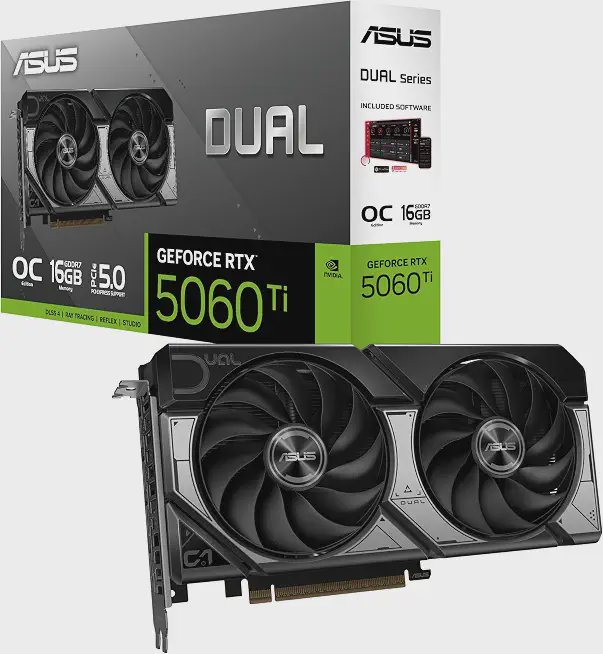
Two RTX 5060 Ti 16GB cards = 32GB total VRAM for the price of... well, still not cheap in this market, but rational. The PNY OC Dual-Fan is $799.99 on Amazon US (500+ bought in the past month — it's the volume AI card right now), the MSI Shadow 2X at $769.99, and the ASUS Dual OC at $839.99. In Canada: PNY $1,129.99 CAD, ASUS Dual OC $1,199.99 CAD.
Fair warning: the PNY's $799.99 is $370.99 above its $429 launch price. The 2020s memory crisis has touched everything. But 32GB across two cards runs 32B-class models (Gemma 4 31B, Qwen 32B) comfortably — the Tech Tools Gain channel has a great video running exactly this config — and a Qwen 7B on hardware this bandwidth-limited still flies compared to anything with CPU offload involved.
Honorable mention for the truly budget-minded: dual ASRock Arc Pro B60 24GB cards ($999.99 ea US / $1,401.78 CAD) give you 48GB total for under $2,000 USD in GPUs — the Intel software story is the youngest of the three ecosystems, but the GB-per-dollar is unmatched in November 2026.
Price Check: USD + CAD (nxpc signature table)
All prices pulled Friday, November 13, 2026 — Amazon US/CA live listings plus Newegg/trackers. This market moves daily; treat these as a snapshot, not a promise.
| Component | Amazon US (USD) | Amazon CA (CAD) | Notes |
|---|---|---|---|
| RTX 5090 32GB (PNY OC) | $6,495.00 | $15,099.78 (PNY) | MSRP was $1,999 — now +213% to +275% |
| RTX 5090 (ASUS TUF OC) | $7,450.00 | $8,699.00 | CA TUF notably cheaper than US right now |
| RTX 5090 (GIGABYTE AORUS Master) | — | $8,119.00 ← lowest CA seen | Same SKU also listed $17,499.00 CAD same day |
| Newegg 5090 restock | $6,249.99 (Nov 12–13, OOS) | — | tech-insider.org tracker |
| RTX 5060 Ti 16GB (PNY OC) | $799.99 | $1,129.99 | +$370.99 over $429 launch |
| RTX 5060 Ti 16GB (ASUS Dual OC) | $839.99 | $1,199.99 | 4.7★, Prime, 500+/month velocity |
| Radeon AI PRO R9700 32GB (ASUS Turbo) | $1,999.99 | $2,839.99 | RDNA 4, ROCm 7.2 official |
| R9700 (Sapphire) | $2,279.03 | $2,839.99 | Blower, workstation build |
| Radeon Pro W7900 48GB | OOS/unpriced (GIGABYTE AI TOP) | $12,093.06 | 48GB capacity king, painful price |
| Arc Pro B60 24GB (ASRock) | $999.99 | $1,401.78 | GB/$ dark horse |
| Arc Pro B70 32GB (ASRock) | $1,839.99 | $2,650.08 | |
| Used RTX 3090 24GB | ~$1,499 median / $1,626 avg | — | Was ~$700–800 pre-shortage |
| RX 7900 XTX 24GB | $1,820.99 new / ~$1,175 used | — | vs $999 launch |
| DDR5 64GB 6000 CL30/CL38 kit | $999.99–$1,277.77 | $1,489.99–$1,799.99 | TEAMGROUP $999.99 US / Corsair $1,489.99 CA |
| RTX PRO 6000 Blackwell 96GB | $19,499.95 | — | For those who just won the lottery |
That GIGABYTE AORUS Master line deserves a screenshot-forensics stare: the identical card listed at $8,119 CAD and $17,499 CAD on Amazon.ca the same day I checked. That's the marketplace right now — pricing is less a science and more a jazz performance.
The Optimization Layer: Free Tokens for Everyone
Whichever box you build, the software decides how much of it you actually feel. A few things that moved the needle this year:
- Alex Ziskind's January video ("Your local LLM is 10x slower than it should be") showed a single context/KV-cache tuning change taking a setup from ~120 tok/s to 1,200+ tok/s — no new GPU. If you watch one thing before building, make it that.
- Ollama + Open WebUI + Whisper + searXNG remains the canonical self-hosted stack — Techno Tim's tutorial is still the best walkthrough, and his 2026 videos on Docker Model Runner and model-routing agents show where homelab AI is heading.
- Quantization is a dial, not a switch: Q4_K_M is the community default for 70B; going Q5 costs ~10GB more VRAM for a modest quality bump; Q8 basically doubles footprint for marginal gains. On 64GB you have room to play; on 24GB you don't.
- ROCm on Linux tip: Fedora isn't officially supported, but the rocm-runtime 7.1.1 packages in Fedora 44 repos work correctly for llama.cpp inference on RDNA4 (gfx1201) per the llama.cpp GitHub discussion — that's a documented community path, not a promise.
- MoE models are the sleeper hit: a Qwen3.6-35B-A3B class model pushes ~271 tok/s generation on a single 5090 because only a fraction of experts activate per token. Big brain, small activation cost.
The Verdict
Who buys what:
- The Dream Box (2× RTX 5090): If 70B at ~27 tok/s fully in VRAM is a job requirement and budget is a rounding error. It's the fastest consumer local-AI machine money can buy, and money is the operative word — plan for $15K+ USD all-in.
- The Grown-Up Alternative (R9700 32GB): The thinking person's single-card build. ~$2,000 USD, official ROCm 7.2 support on Windows and Linux, blower cooler that actually fits a dense build. Accept 70–80% of CUDA speed for 70%+ less cost. My pick for most serious homelabbers.
- The People's Box (2× RTX 5060 Ti 16GB): 32GB for ~$1,600–$1,700 USD in GPUs. 32B-class models in VRAM, 7B–13B at absurd speed, and the two-slot cards fit basically any case. The volume seller of 2026 for a reason.
- The "wait, really?" tier: A used RTX 3090 at ~$1,499 median is now worse value than a new R9700 at $1,999 for 32GB. The used market's famous arbitrage is dead — RIP to the greatest budget AI GPU run in history (2022–2025, we barely knew ye).
The meta-lesson of November 2026: the local LLM box is no longer constrained by what silicon can do — it's constrained by what DRAM costs. Bandwidth tells you how fast your model talks; the memory crisis tells you how much the conversation costs to start. Build for capacity you'll actually use, buy bandwidth where it's cheap, and for the love of all that is holy, check the price twice — the same GPU can be $8,119 and $17,499 on the same website on the same day.
See you Monday for Mini PC vs Mac Mini. Bring snacks; the used-market therapy group meets Wednesday.
Sources
- Presenc AI — RTX 5090 Local LLM Benchmarks 2026: https://presenc.ai/research/rtx-5090-local-llm-benchmarks-2026
- Presenc AI — Local LLM Tokens-per-Second Benchmarks 2026: https://presenc.ai/research/local-llm-tokens-per-second-benchmarks-2026
- SpecPicks — Best GPU for Local LLM 2026 (5090 vs 4090, W7900 vs A6000): https://specpicks.com/reviews/best-gpu-for-local-llm-2026 and https://specpicks.com/reviews/local-llm-gpu-reddit-consensus-2026
- Llama Builds — RTX 5090 offload benchmarks: https://www.llamabuilds.ai/gpus/rtx-5090
- Pinggy — Hardware for self-hosting local LLMs: https://pinggy.io/blog/best_hardware_for_self_hosting_local_llms/
- Digital Applied — Home AI server build guide 2026: https://www.digitalapplied.com/blog/home-ai-server-build-self-hosted-llm-2026-guide and https://www.digitalapplied.com/blog/best-hardware-run-local-ai-models-2026-price-brackets-guide
- Medium/CodeX — Quantize Lab 5090 70B in-VRAM test: https://medium.com/codex/best-gpus-for-running-local-llms-in-2026-what-actually-works-292f27a99f04
- Aliteq — ROCm 7.2 RDNA 4 support: https://aliteq.com/amd-vs-nvidia-for-local-ai
- InsiderLLM — ROCm vs CUDA 2026: https://insiderllm.com/guides/rocm-vs-cuda-local-ai-2026/
- RunLocalModel — llama.cpp ROCm ~70–80% of CUDA: https://runlocalmodel.com/amd-radeon-rocm-local-llm-2026.html
- LocalAIMaster — RX 7900 XTX pricing (Oct 17 / Nov 2, 2026): https://localaimaster.com/blog/amd-rocm-local-llm-setup
- CraftRigs — ROCm Windows support history: https://craftrigs.com/articles/amd-rocm-local-llm-2026/
- Intelligibberish — AMD/Intel GPU support matrix: https://intelligibberish.com/articles/2026-08-16-run-local-llms-amd-intel-gpus/
- llama.cpp GitHub discussion #15021 — ROCm on Fedora/gfx1201: https://github.com/ggml-org/llama.cpp/discussions/15021
- CanItRun — Multi-GPU NVLink vs PCIe (RTX A6000 112 GB/s bridge): https://canitrun.dev/guides/multi-gpu-setups/
- Popular AI — dual GPU AI builds 2026: https://www.popularai.org/p/dual-gpu-ai-pc-builds-local-llm-2026
- PCServerAndParts — local LLM hardware guide 2026: https://pcserverandparts.com/news/local-llm-hardware-guide-2026-servers-workstations-gpus/
- Tech-Insider — Newegg 5090 $6,249.99, 213% over launch: https://tech-insider.org/gpu-prices-2026/ and https://tech-insider.org/nvidia-rtx-50-prices-rise-november-2026-rtx-5090-3340/
- Pro-Gamer — Newegg ASUS ROG Astral 5090 restock $6,249.99: https://pro-gamer.gg/geforce-rtx-5090-newegg-official-restock-6250-asus-rog-astral-gigabyte/
- VideoCardPrices — ASUS TUF 5090 $7,499.99 vs $1,999 MSRP (275%): https://videocardprices.com/card/nvidia-rtx-5090/
- Tom's Hardware — GPU price tracking: https://www.tomshardware.com/pc-components/gpus/lowest-gpu-prices-tracking
- Alex Ziskind — "Your local LLM is 10x slower than it should be": https://www.youtube.com/watch?v=L9QZ97y9Exg
- Alex Ziskind — 4,000+ tok/s local stack: https://www.youtube.com/watch?v=3XCunZqvVDA
- Alex Ziskind — LLM Hardware Calculator: https://www.youtube.com/watch?v=lm7NORuZWSQ
- Techno Tim — Self-hosted AI stack (Ollama, Open WebUI, Whisper, searXNG): https://www.youtube.com/watch?v=yoze1IxdBdM
- Techno Tim — Docker Model Runner: https://www.youtube.com/watch?v=4YA1n2zs6XA
- Techno Tim — Are Local Models Finally Good Enough?: https://www.youtube.com/watch?v=K2IGHj7KQoM
- Digital Spaceport — ULTIMATE Local AI Quad 3090 Build: https://www.youtube.com/watch?v=So7tqRSZ0s8
- Tech Tools Gain — Dual RTX 5060 Ti 16GB runs Gemma 4 31B: https://www.youtube.com/watch?v=-vdN6tXQq9Y
- ServeTheHome — 8x NVIDIA GB10 cluster article (via addendum): https://weisser-zwerg.dev/posts/local-llm-large-llms/
- RunAIHome — Dual GPU NVLink vs PCIe tok/s numbers: https://runaihome.com/blog/multi-gpu-local-ai-nvlink-vs-pcie-2026/
- OpenBenchmarking — llama.cpp RTX 5090 result: https://openbenchmarking.org/result/2501264-PTS-LLAMACPP76
- Amazon US/CA live product listings, November 13, 2026 (ASINs cited inline: B0DTJF8YT4, B0F2PV42RL, B0DT7L98J1, B0DS2X13PH, B0HPJXKKSC, B0DT7GHQMD, B0HNH3Q5HV, B0F4Y6N6PW, B0F7WB6LSH, B0GMYXYFY1, B0G75W64R3, B0C5DK4R3G, B0GVGFW7MB, B0GXHLFV2G, B0D8BB3DV5, B0CGQ3KS8X, B0FV3LHXBJ, B0BJNTLJ5X)