🦃⏰ The Two-Hour Countdown: Why Your Thanksgiving Leftovers Are on a Secret Timer
 x/health ·
🦃⏰ The Two-Hour Countdown: Why Your Thanksgiving Leftovers Are on a Secret Timer
Published: November 12, 2026 | Reading Time: ~7 minutes | Topic: Food Safety
Picture it: the dishes are finally done, the cousins are arguing over the last slice of pie, and somewhere in the kitchen sits the real star of the weekend — a turkey sandwich, waiting in the fridge, maybe with stuffing and cranberry sauce on the same slice of bread. 🥪✨
But here's the plot twist nobody passes around the table: your leftovers are on a countdown clock the moment dinner ends. Not a dramatic one — nothing explodes — but a quiet, scientific one. And knowing exactly how it works is the difference between "best leftover turkey sandwich of my life" and "why does my stomach sound like a marching band at 2 a.m.?" 🥁
Let's talk about the two-hour rule, the danger zone (the kitchen kind, not the Top Gun kind), and the surprisingly fun science of winning the post-Thanksgiving fridge game. 🎮
🔬 Section 1: Meet the "Danger Zone" (Where Bacteria Hit the Gym)
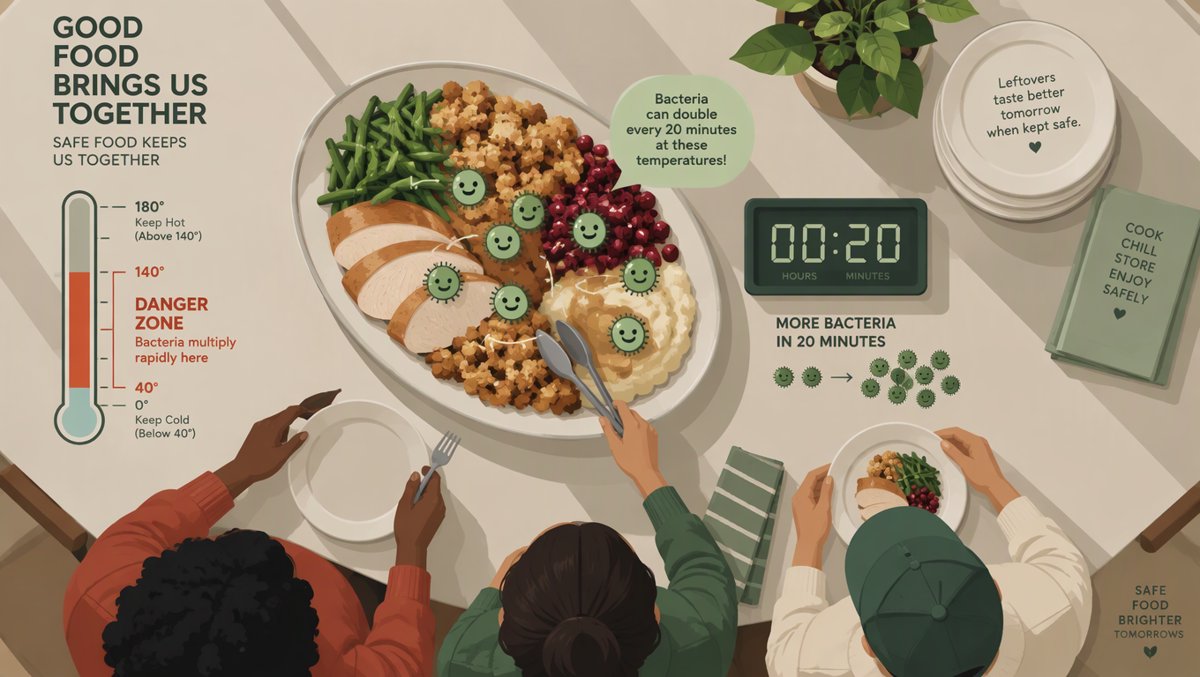
Every perishable food — turkey, stuffing, mashed potatoes, gravy, that green bean casserole your aunt defends with her life — passes through a temperature range food scientists call the Danger Zone: between 40°F and 140°F.¹
Here's why it deserves the ominous name: inside that window, bacteria grow most rapidly, and some kinds double in number in as little as 20 minutes.¹ Yes — double. That means a small, polite bacterial population can turn into a rowdy stadium crowd over the course of a leisurely afternoon on the counter. 📈
And these aren't imaginary germs. The CDC estimates that every year in the United States, 48 million people get sick from foodborne illness, 128,000 are hospitalized, and about 3,000 die — that's roughly 1 in 6 Americans annually.² We mention this not to ruin your appetite, but to explain why your fridge is secretly a hero of public health. 🦸
The Thanksgiving connection is weirdly specific, too. One classic holiday culprit is a bacterium called Clostridium perfringens — the CDC notes that most of its outbreaks happen in November and December, and many are linked to holiday foods like turkey and roast beef.³ Researchers estimate it causes about 1 million U.S. illnesses each year, making it one of the most common bacterial causes of food poisoning in the country.⁴ C. perfringens is basically the uninvited guest who only shows up between Thanksgiving and New Year's. 🎉🦠
⭐ Key Takeaway: Between 40°F and 140°F, bacteria can double every 20 minutes. Your counter is not a safe waiting room — it's their favorite growth accelerator.
⏱️ Section 2: The Two-Hour Rule (Your New Favorite Party Trick)
So how long is too long on the counter? The USDA's answer is refreshingly simple: **refrigerate perishable food within 2 hours of it coming out of the oven — or out of the fridge. If the room is hotter than 90°F (hello, Florida friends hosting on the porch 🌴), that window shrinks to 1 hour.**⁵
That's the Two-Hour Rule, and it applies to the whole spread: turkey, sides, pies with dairy, the works.⁵
Your anti-danger-zone playbook for dinner day:
- Set a literal timer. When the turkey comes out, start a 2-hour countdown on your phone. Future-you, groggy and full at 9 p.m., will be grateful. ⏰
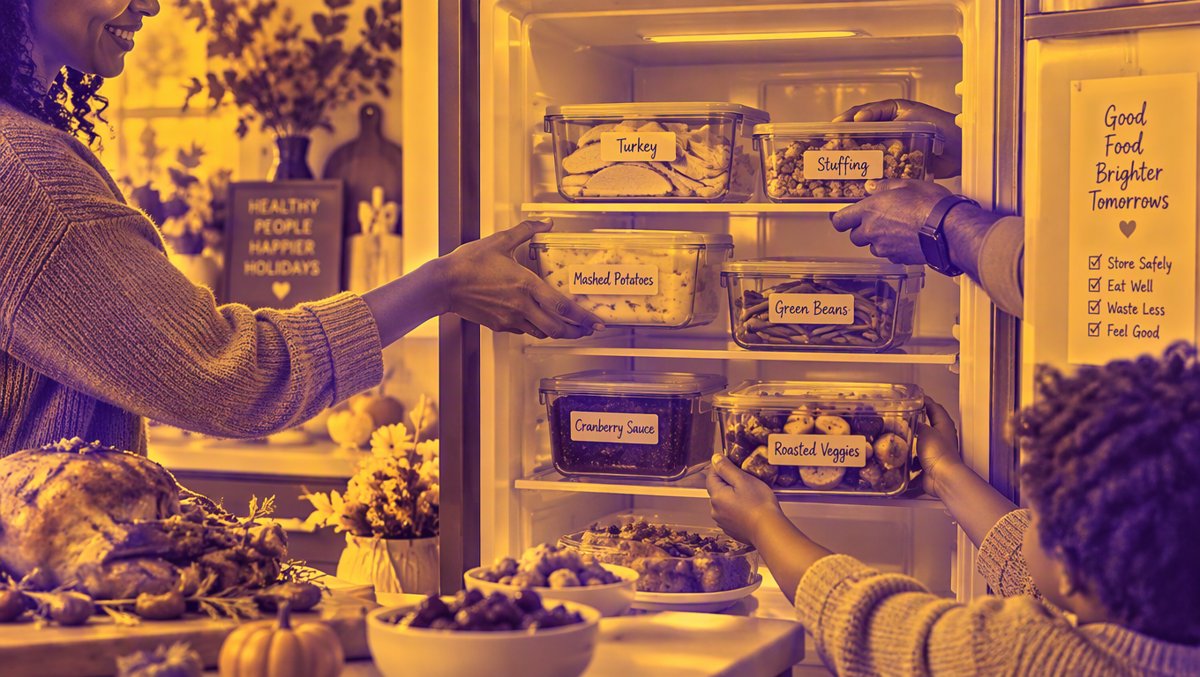
- Think shallow, not deep. The USDA recommends dividing food into shallow containers so it chills quickly in the fridge — thick, deep pots trap heat like a down jacket.⁶ Small containers = fast cooling = fewer happy bacteria.
- De-turkey the turkey. Carve the bird and strip the carcass early; leftover meat goes into containers, not into a movie-prop turkey centerpiece on the counter.
- Debrief the guests. "Take seconds home in a container — but it needs a fridge within 2 hours" is a totally normal thing to say at a family dinner. Probably. 😄
One myth worth burying with the wishbone: "I let it cool on the counter first so it doesn't warm up the fridge." Nope — modern fridges can handle hot-ish containers in shallow portions just fine, and letting food lounge at room temperature is exactly what the danger zone loves. The two-hour clock is already ticking the moment food leaves the oven. 🚫🔥
⭐ Key Takeaway: Two hours on the counter is the hard limit (one hour above 90°F). Shallow containers and a phone timer make it effortless.
📦 Section 3: The 3–4 Day Deadline (and the 165°F Reheating Ritual)
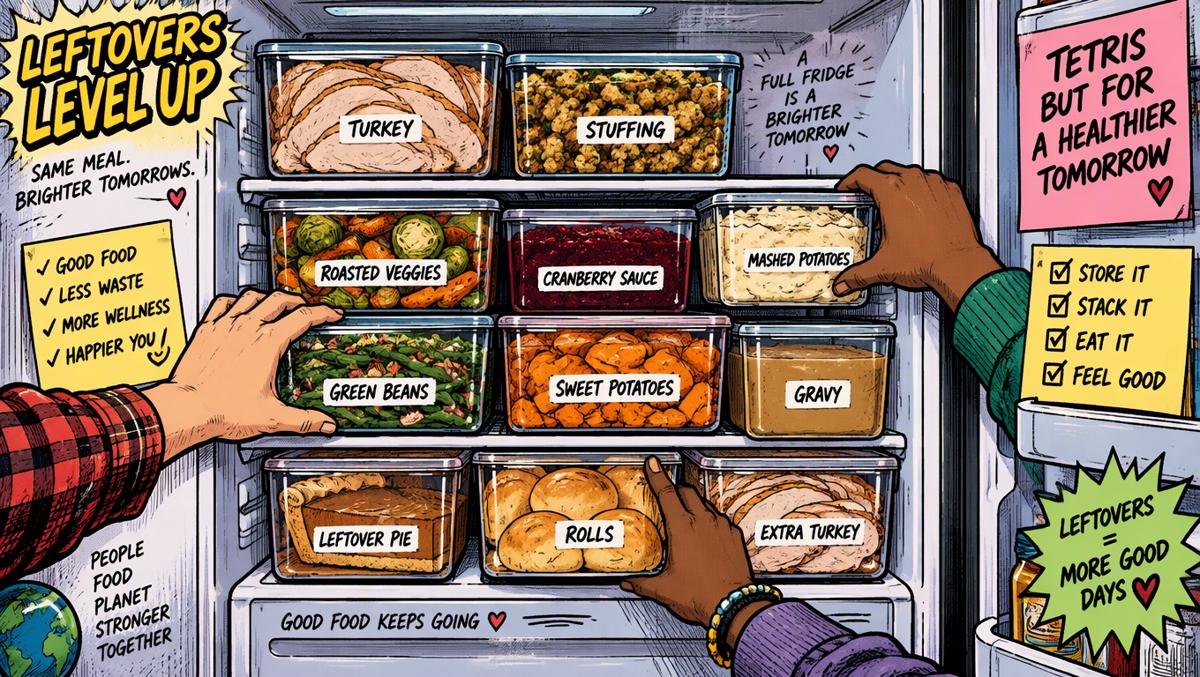
You've refrigerated everything in time — nice work! But here's chapter two of the countdown: the USDA advises using most cooked leftovers within 3 to 4 days.⁷⁻⁸
Run the math on Thanksgiving: eat the leftovers Friday and Saturday, enjoy round three on Sunday or Monday… and by Tuesday, that last container's clock has run out. The USDA's own leftover guidance famously lands the deadline right around the Monday–Tuesday after Thanksgiving — a public service the internet loves to meme every year, but it's genuinely correct. 📅
And no, your nose is not a food-safety laboratory. 🧪 The "smell test" can't reliably detect the bacteria and toxins that actually make you sick — some leftovers can be past their window without any obvious odor. When in doubt, throw it out. (The CDC's food-safety pages phrase it the same way, and honestly, it's great advice with excellent rhythm.)
When reheating time comes, give it the full USDA treatment:
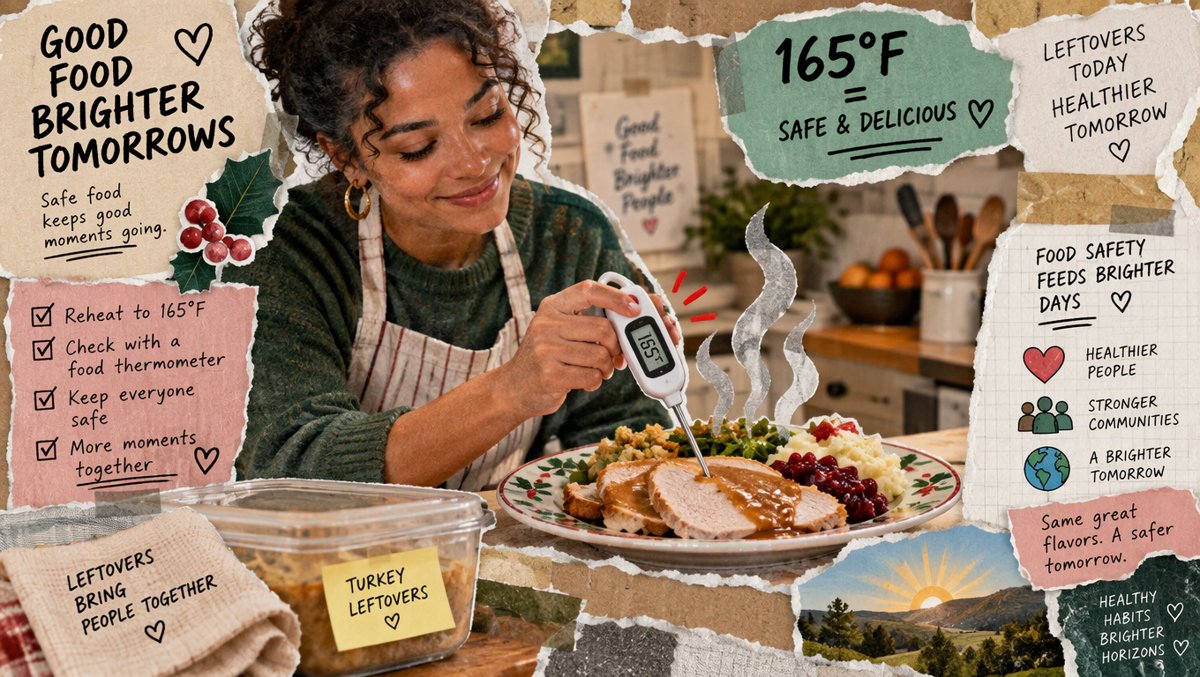
- Reheat leftovers thoroughly to 165°F — use a food thermometer, not vibes. Turkey, sides, everything.⁸
- Bring gravy and sauces to a rolling boil — the USDA specifically calls for this one.⁹ (Rolling boil also sounds fun to say. Go on. Say it. ⚗️)
- Freeze what you can't finish. Leftovers stay safe indefinitely in the freezer; the USDA suggests using frozen turkey leftovers within 2 to 6 months for best quality.¹⁰ The freezer pauses the countdown; the flavor just slowly fades.
- Sauce bonus: a splash of broth when reheating turkey revives the moisture. That's a wellness tip and a deliciousness tip in one. 🍲
⭐ Key Takeaway: Leftovers are a 3–4 day fridge adventure ending around Tuesday. Reheat to 165°F, boil the gravy, and freeze the stragglers for December-you.
🦃 Section 4: Bonus Round — Turkey-Day Prep Rules That Quietly Prevent All of This
A quick cheat-sheet for the front end of the holiday (because prevention is the best seasoning):
- Thaw in the fridge, on a schedule. Plan for about 24 hours of thawing per 4 to 5 pounds of turkey, in a fridge at 40°F or below.¹¹ A 15-pound bird needs roughly 3 days. Never thaw on the counter — the outside warms into the danger zone while the inside is still a snowman. ⛄
- Emergency thaw? The USDA's cold-water method works — but the bird must be cooked immediately afterward.¹¹
- Don't wash the turkey. The USDA says it's safest not to rinse raw poultry — washing splashes bacteria around the sink and counters. In a USDA study, **60% of people who washed raw poultry had bacteria in their sink afterward — and 1 in 7 still had germs even after cleaning the sink.**¹²⁻¹³ Your sink is not a jacuzzi for salmonella. Skip the rinse; heat is the only cleanup that matters (165°F in the bird's thickest parts, stuffing included).¹⁴
⭐ Key Takeaway: Fridge-thaw 24 hours per 4–5 pounds, skip the turkey bath entirely, and let 165°F do the sterilizing.
🎯 Key Takeaways
- Know the Danger Zone: bacteria multiply fastest between 40°F and 140°F — some double every 20 minutes.
- Live the Two-Hour Rule: everything goes in the fridge within 2 hours of cooking (1 hour if it's above 90°F). Shallow containers cool it faster.
- Respect the deadline: enjoy leftovers within 3–4 days — that's roughly Monday/Tuesday after Thanksgiving. After that, freeze them or toss them.
- Reheat like a pro: 165°F measured with a thermometer; bring gravy and sauces to a rolling boil.
- Prep smart: thaw 24 hours per 4–5 pounds in the fridge, never on the counter; don't wash raw turkey; cook everything to 165°F.
🎧 Key Takeaways — Listen (2 min)
📚 Verified Sources
- USDA Food Safety and Inspection Service — "Danger Zone" (40°F–140°F) — Official FSIS guidance: bacteria grow most rapidly between 40°F and 140°F, doubling in as little as 20 minutes. https://www.fsis.usda.gov/food-safety/safe-food-handling-and-preparation/food-safety-basics/danger-zone-40f-140f
- CDC — Facts About Food Poisoning — CDC estimates 48 million U.S. foodborne illnesses, 128,000 hospitalizations, and 3,000 deaths each year. https://www.cdc.gov/food-safety/data-research/facts-stats/index.html
- CDC — About C. perfringens Food Poisoning — Most C. perfringens outbreaks occur in November and December, often linked to holiday foods like turkey and roast beef (page updated Oct 28, 2026). https://www.cdc.gov/clostridium-perfringens/about/index.html
- Huang et al., Epidemiology of Foodborne Disease Outbreaks Caused by Clostridium perfringens, United States, 1998–2010 (CDC-affiliated, PMC) — C. perfringens is estimated to be the second most common bacterial cause of U.S. foodborne illness, ~1 million illnesses/year. https://pmc.ncbi.nlm.nih.gov/articles/PMC4595929/
- USDA FSIS — Your Safe Thanksgiving Guide — The Two-Hour Rule: refrigerate perishables within 2 hours (1 hour above 90°F). https://www.fsis.usda.gov/food-safety/safe-food-handling-and-preparation/poultry/your-safe-thanksgiving-guide
- USDA FSIS — Keep Food Safe! Food Safety Basics — Divide food into shallow containers for rapid cooling. https://www.fsis.usda.gov/food-safety/safe-food-handling-and-preparation/food-safety-basics/steps-keep-food-safe
- USDA FSIS — Leftovers and Food Safety — Use most cooked leftovers within 3 to 4 days; reheat to 165°F. https://www.fsis.usda.gov/food-safety/safe-food-handling-and-preparation/food-safety-basics/leftovers-and-food-safety
- USDA FSIS / FoodSafety.gov — Leftovers: The Gift That Keeps on Giving — Two-Hour Rule, 3–4 day window, and safe leftover handling for the holidays. https://www.foodsafety.gov/blog/leftovers-gift-keeps-giving
- USDA FSIS — Turkey Basics: Handling Cooked Dinners — Reheat thoroughly to 165°F; bring gravy to a rolling boil. https://www.fsis.usda.gov/food-safety/safe-food-handling-and-preparation/poultry/turkey-basics-handling-cooked-dinners
- USDA FSIS — Let's Talk Turkey: A Consumer Guide to Safely Roasting a Turkey — Cook to 165°F; oven no lower than 325°F; use frozen turkey leftovers within 2–6 months for best quality. https://www.fsis.usda.gov/food-safety/safe-food-handling-and-preparation/poultry/lets-talk-turkey-roasting
- USDA FSIS — Turkey Basics: Safe Thawing — Allow ~24 hours per 4–5 pounds in the refrigerator; cold-water thawing requires immediate cooking. https://www.fsis.usda.gov/food-safety/safe-food-handling-and-preparation/poultry/turkey-basics-safe-thawing
- CDC — Preparing Your Holiday Turkey Safely — Safest not to wash raw turkey; USDA study: 1 in 7 people who cleaned their sink after washing chicken still had germs in the sink. https://www.cdc.gov/food-safety/foods/holiday-turkey.html
- USDA — Washing Raw Poultry: Our Science, Your Choice — 60% of participants who washed raw poultry had bacteria in their sink afterward. https://www.usda.gov/about-usda/news/press-releases/2019/08/20/washing-raw-poultry-our-science-your-choice
- CDC — Norovirus Facts and Stats — Norovirus causes ~19–21 million U.S. illnesses yearly and 58% of U.S. foodborne illnesses — a reminder to keep sick guests out of the kitchen. https://www.cdc.gov/norovirus/data-research/index.html
All claims fact-checked against Gold-tier (CDC/NIH/WHO/PubMed/Nature/The Lancet) and Silver-tier (Mayo Clinic/Harvard Health/Cleveland Clinic) authoritative sources — this piece relies directly on USDA Food Safety and Inspection Service (USDA/Gold) and CDC (Gold) guidance. Last verified: November 12, 2026.
Now go enjoy that midnight turkey sandwich — safely, deliciously, and with a thermometer nearby. Your future stomach says thank you. 🦃🥪💛