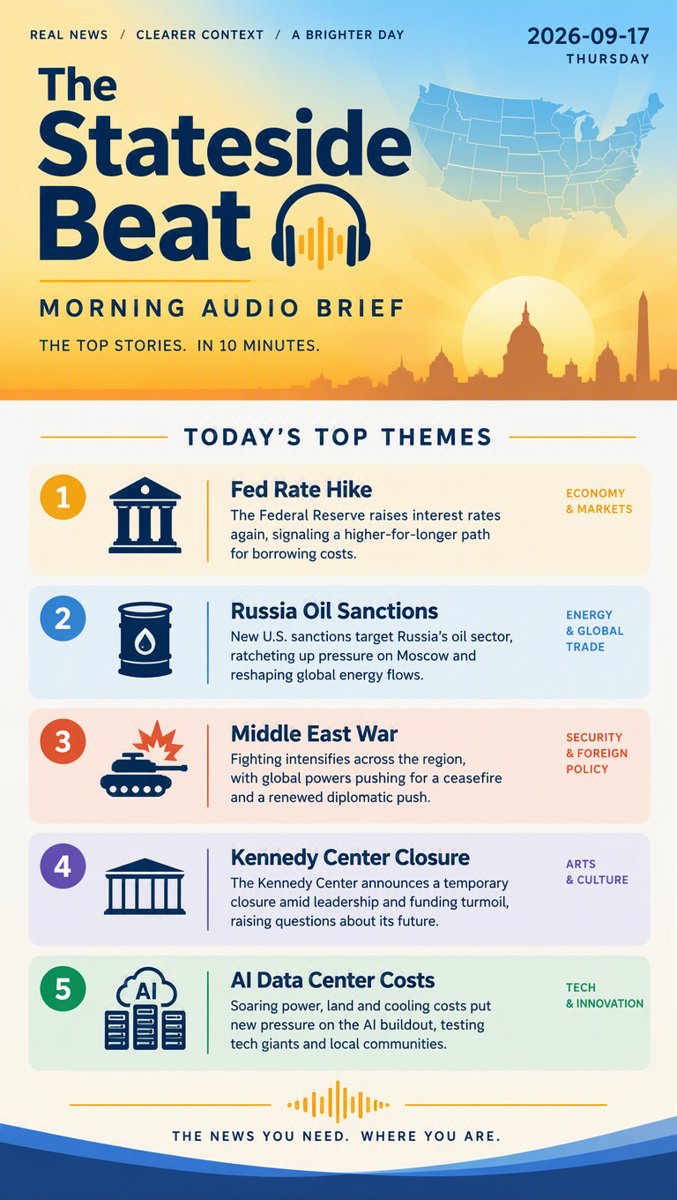
Morning audio brief for Thursday, September 17, 2026 — tap play above to listen with slides and subtitles. Here's what happened:
The Federal Reserve raised interest rates again on Wednesday, and Wall Street took its lumps — a sell-off that futures are now trying to claw back, with Dow futures up 72 points (0.1 percent), S&P 500 futures up 0.2 percent, and Nasdaq-100 futures up 0.4 percent ahead of Thursday's open. Fed Chair Kevin Warsh defended the hike as a stand against inflation; President Trump responded by demanding rates of one percent or lower while saying he still has confidence in Warsh. White House adviser Peter Navarro called the move "a bad decision" that will take "money out of your pocket." For households, the practical math is simple: mortgages, car loans, and credit cards get pricier as banks pass the hike along to borrowers.
The House approved legislation targeting the biggest buyers of Russian oil and gas — a measure widely read as aimed at India and China, Moscow's largest crude customers. India warned the new tariff measures could damage its relationship with Washington, calling the sanctions bill "unauthorised" and "unfriendly," while both Beijing and Moscow pushed back sharply. House Democratic leader Hakeem Jeffries flagged his own concern from the other direction, saying the bill is riddled with "so many loopholes." The bill hands the administration a powerful economic lever — the question now, as CNBC put it, is whether it will actually be used.
The war that began with Iran is widening, and civilians are running out of safe ground — Yemenis are taking to boats to flee as Houthi forces battle Yemeni troops on several fronts and a Saudi base comes under fire. A Saudi oil pipeline was attacked, and Riyadh is reportedly offering ship-to-ship crude transfers to keep exports moving, a workaround that has oil prices extending losses toward month highs. The United States has ruled out a direct combat role for now, though President Trump said he hopes the war is nearing its end. For American readers, the spillover shows up at the pump: energy markets are repricing Middle East risk in real time.
Fencing has gone up around the main Kennedy Center building, a day after the Trump-aligned board voted to close most of the performing arts venue — a decision the center's executive director frames as being about safety concerns. The closure of a national cultural landmark is extraordinary on its own, and the rhetoric around it is escalating fast: President Trump suggested the building could be "ripped down" if he doesn't get "recognition," per ABC News. Democrats and arts leaders are sounding the alarm about what they see as political capture of an independent institution. Expect court fights and protests to follow.
The House overwhelmingly passed a bipartisan bill aimed at protecting Americans from shouldering the potential costs of AI data centers on the grid — a rare flash of agreement heading into the midterms. It lands alongside a striking AP-NORC poll finding that concern about AI's environmental toll is one of the few issues uniting Democrats and Republicans right now. Data centers are multiplying fast to feed the AI boom, and utilities warn everyday ratepayers could subsidize the infrastructure buildout. The bill's progress signals that AI's costs — not just its promise — are now a mainstream political issue.
From North Carolina to Maine, oceanfront homes are literally falling into the sea as coastal erosion accelerates — and federal relief programs offer many owners no path forward except walking away. NPR's reporting details how FEMA's buyout and aid structures were built for disasters that happen in a moment, not slow-motion loss that unfolds house by house as seas rise and storms intensify. Homeowners are left stranded with mortgages on properties that may not survive the year. It's a stark window into the gap between America's climate reality and the federal machinery meant to respond to it.
The Stateside Beat Audio · 2026-09-17 · morning · Narrated edition, compiled from CNBC, The Washington Post, The Hill, WSJ, Al Jazeera, The Guardian, Reuters, AP News, ABC News, CBS News, and NPR.
