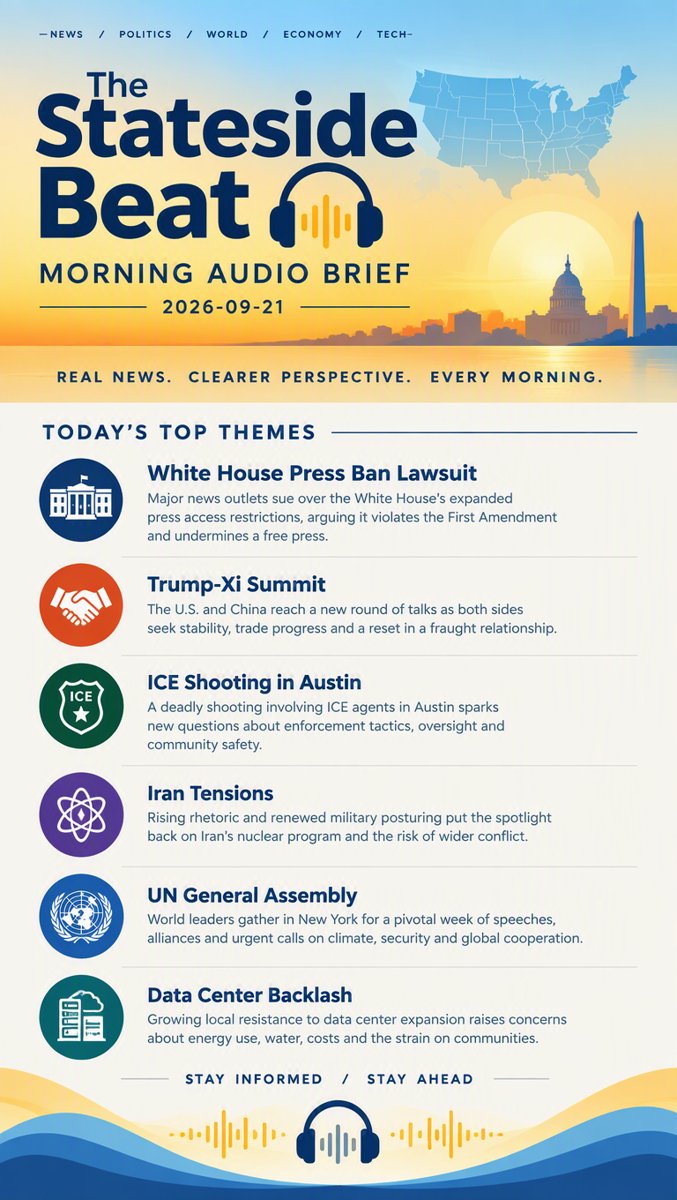
Morning audio brief for Monday, September 21, 2026 — tap play above to listen with slides and subtitles. Here's what happened:
CNN, MS NOW, and Politico announced Monday they are suing the Trump administration to reverse its revocation of their White House access, with the outlets calling the press ban "patently unconstitutional." The escalation follows the White House stripping CNN of its TV pool assignment over the weekend, a move reported by CNN's own media desk. The complaint argues the administration is punishing news organizations for coverage it dislikes, breaking from decades of precedent that the press pool serves the public rather than the president. Press freedom groups are watching closely: whoever wins, the case will define how much control a White House can exert over who reports from inside the building. (NYT, Hollywood Reporter)
President Xi Jinping will pay a state visit to the United States from September 23 to 25 at President Trump's invitation, Reuters confirmed Monday. It caps a weekend of preparatory diplomacy — Treasury Secretary Scott Bessent called his meeting with Chinese Vice Premier He Lifeng "successful" — and markets opened the week higher on the summit optimism, with Dow futures jumping about 400 points as oil prices eased. On the table: trade, technology export controls, and a US-proposed system for alerting each other to AI national-security incidents, per the New York Times. With China's export engine roaring and tariff tensions unresolved, this is the most consequential US-China meeting in years. (NYT on AI talks, CNBC on Bessent)
An ICE agent shot and seriously wounded Wilber Rafael Garces Perez, a 28-year-old Venezuelan man, in North Austin on Sunday while he was making a DoorDash delivery, according to his attorney. He was struck in the torso and taken to a local hospital. Austin officials and residents are demanding answers about the circumstances, and local outlets including KVUE and the Austin American-Statesman report the shooting occurred near the Anderson Lane and Research Boulevard corridor. The incident adds to mounting scrutiny of immigration enforcement operations in American cities, where federal agents increasingly operate in dense residential and commercial areas. (NBC News, Austin American-Statesman)
Tehran issued a stark warning Monday that the "geography of the war" would expand if the United States launches another assault, with officials saying new weapons are ready and the IRGC stands prepared for a "counteroffensive." The rhetoric came as President Trump weighs a possible meeting with Iran's president — diplomacy and escalation moving on parallel tracks. The warning follows Houthi attacks that have widened the regional conflict and a reported Saudi plea for American military help that has put the White House in a dilemma, per the New York Times. Yemen's revived civil war is now tangled directly into US-Iran brinkmanship. (NBC News, Reuters)
The United Nations General Assembly's annual high-level week kicks off Monday in New York, drawing world leaders into a global cloud of wars, bitter divisions, runaway artificial intelligence, and climate shocks. New Yorkers will feel it first: street closures and heavy security footprint across Midtown Manhattan through the week, as the New York Times' traffic guide details. Expect headlines on Ukraine, Gaza, AI governance, and the first appearances of leaders whose elections have reshaped the global order. For the US, playing host while managing the Trump-Xi summit days later makes this an unusually consequential diplomatic stretch. (NPR preview, CNN)
A recent Economist/YouGov poll of nearly 1,600 adults found about two-thirds of Americans oppose new data center construction in their communities, and the resistance is moving from town halls to ballot boxes, NPR reports. The concerns are concrete: power costs, strain on the grid, water use, and land consumption as the AI boom drives hyperscale construction into suburbs and rural counties. Candidates in local races are increasingly running against — or for — specific projects, making data centers a sleeper issue heading into the midterms. Washington is watching, because grid politics is becoming electoral politics. (NPR)
The Stateside Beat Audio · 2026-09-21 · morning · Narrated edition, compiled from Politico, Reuters, BBC, CBS News, AP News, and NPR.
