Morning audio brief for Sunday, September 13, 2026 — tap play above to listen with slides and subtitles. Here's what happened:
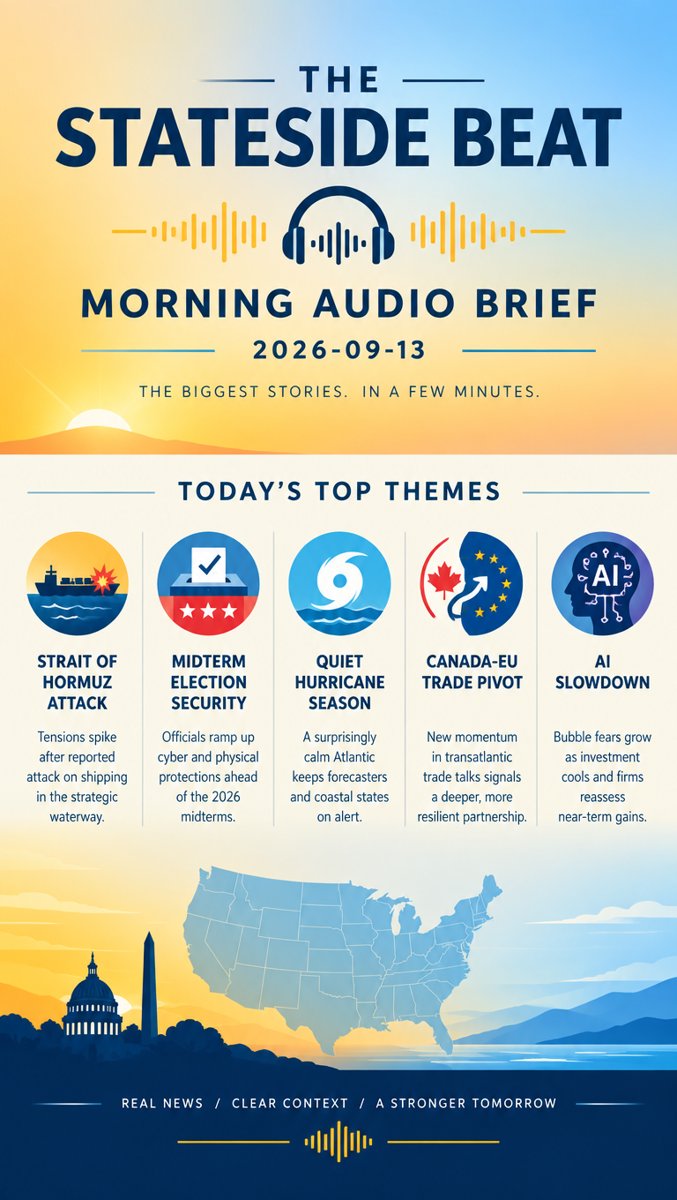
A commercial vessel was struck near the Strait of Hormuz early Sunday, and Iranian media report one crew member is dead and four wounded. The attack is the latest in a string of incidents targeting shipping in the strait, the chokepoint that carries roughly a fifth of the world's oil. Separately, Iraq's government confirmed that Friday night's attack on a key Saudi oil pipeline was launched from Iraqi territory, and President Trump has said Iran is likely responsible for that strike. No U.S. confirmation yet on responsibility for Sunday's ship attack. Expect shippers and insurers to reprice Gulf routes as the week opens — energy markets will be watching closely.
With seven weeks until Election Day, election officials are bracing for what The Washington Post describes as a new category of threat — not from hackers or foreign agents, but from the federal government itself. Their concerns include the potential seizure of ballots, troops deployed at polling places, and a postal system that could reject mail ballots. Officials across both parties are racing to harden procedures ahead of November. The story underscores how unprecedented this midterm cycle's security planning has become.
The Atlantic hurricane season has quietly made history by not making history — no hurricane has formed all year, a first for this point in the calendar, as The New York Times and CNN also report. A strong El Niño is disrupting storm formation over the Atlantic, offsetting what should be favorable warm-ocean conditions. It's welcome news for coastal communities still recovering from recent violent seasons. Forecasters caution that the official peak runs into October, so residents shouldn't pack away their plans just yet.
Canadian Prime Minister Mark Carney is accelerating a strategic pivot to Europe, asking the EU for "associate member" status after trade talks with Washington collapsed, The Wall Street Journal reports. The bid marks a dramatic realignment for one of the United States' largest trading partners. American exporters — from agriculture to autos — could feel the ripple effects as Canadian supply chains reorient toward Europe. Opinion pages on both sides of the Atlantic are already debating what the alliance means for North American trade.
The leaders of the world's biggest artificial intelligence companies are calling for a deliberate slowdown. Anthropic CEO Dario Amodei published a "We Must Pace the Frontier" essay, and OpenAI's Sam Altman said in an interview released Saturday that the company's highly anticipated IPO will not happen this year, calling AI extinction risk "unacceptable," per Reuters and The Guardian. One Anthropic researcher quit over what they described as "out-of-control" AI fears, according to The Wall Street Journal. Meanwhile, a bipartisan Senate AI safety bill remains stuck, leaving Washington's regulatory response lagging the industry's own warnings.
Affordability has become the defining issue of the 2026 midterms. The New York Times finds Democrats have recast the cost-of-living squeeze as a "five-alarm crisis" — an issue that helped propel President Trump's return to the White House is now central to campaigns on both sides. Candidates are pitching everything from grocery-price relief to housing plans with seven weeks left in the sprint. Expect affordability to dominate the final debate circuit.
The Stateside Beat Audio · 2026-09-13 · morning · Narrated edition, compiled from CNN, The Washington Post, AP News, The Wall Street Journal, Bloomberg, and The New York Times.
