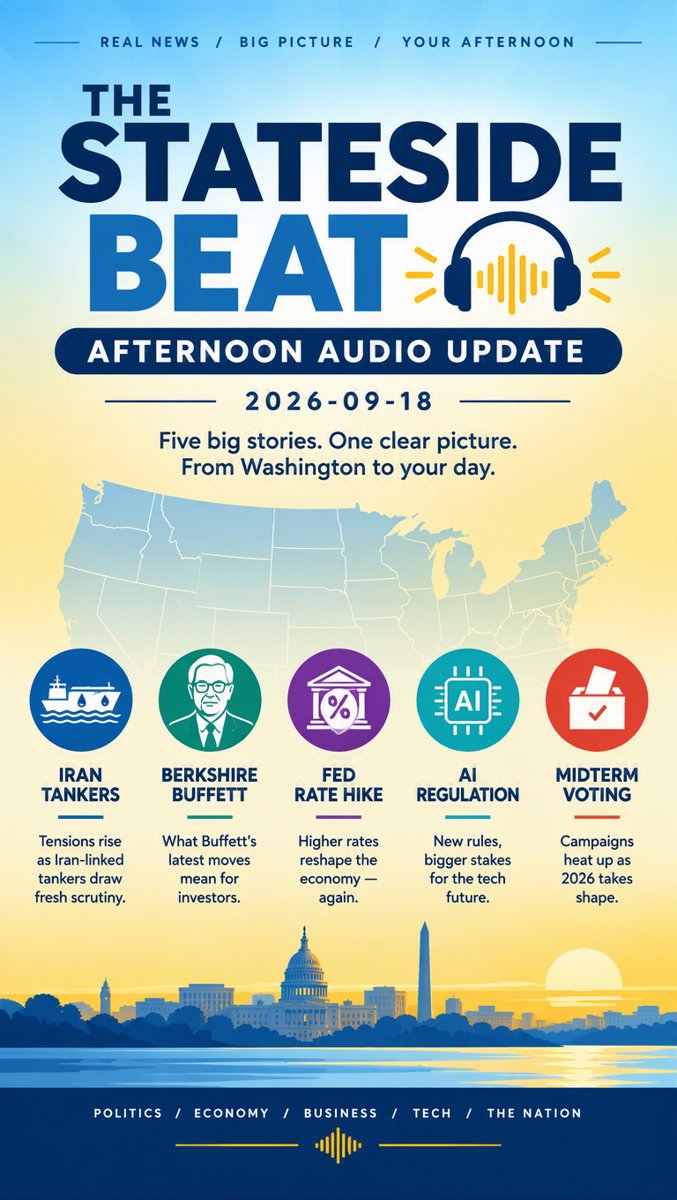
The Afternoon Update audio brief for Friday, September 18, 2026 — tap play above to listen with slides and subtitles. Here's what happened this Friday afternoon: a second tanker struck in the Strait of Hormuz, the end of Warren Buffett's run as Berkshire chairman, a quarter-point Fed hike, and early voting underway nationwide.
Two ships were attacked in the Strait of Hormuz on Friday, with Iran saying it struck the Togo-flagged tanker Trend for what it called an "illegal attempt" to pass through the waterway. The strait carries roughly a fifth of the world's oil, and the escalation has put energy markets on edge, with oil prices swinging through a volatile week. President Trump told Axios that a "big decision" is coming for the United States on the war, which is now in its seventh month, and warned the next move could be to "annihilate" the Iranian regime. The comments land as France calls for a G7 summit on releasing strategic oil reserves — a signal that allied capitals see the tanker campaign as a global economic threat, not a regional one.
Warren Buffett is stepping down as chairman of Berkshire Hathaway, with the board naming his son Howard Buffett to succeed him and the elder Buffett taking the title of chairman emeritus. It closes a chapter on more than six decades at the helm, during which Buffett turned a struggling New England textile maker into a conglomerate spanning insurance, railroads, energy and utilities. Howard Buffett brings an unusual résumé to the job — a former sheriff and war photographer who has long been groomed for a stewardship role focused on the company's culture and capital discipline. Markets shrugged off the news as a long-anticipated transition, with Wall Street bouncing back on Friday despite the bond rout.
The Federal Reserve raised its benchmark rate by a quarter percentage point on Wednesday, lifting the federal funds rate to a range of 3.75% to 4%. Fed Chair Kevin Warsh said the move reflects inflation that remains too stubborn to look past — a reversal that markets are still digesting after a violent bond rout. For households, the immediate effects are mixed: credit card APRs and car loans will drift higher, and home sellers may have to "take a hit" as mortgage rates climb, real estate analysts say. The silver lining is for savers — short-term Treasury yields are offering around 5%, the kind of risk-free return savers haven't reliably seen in years.
Governor Gavin Newsom signed an executive order on Friday to accelerate independent oversight of artificial intelligence and advance the creation of an AI "kill switch" — a mechanism to shut down advanced frontier models in a crisis. The order creates a panel on AI safety regulation and directs state agencies to evaluate mandatory safeguards, drawing a fast protest from Silicon Valley, which is already bracing for the compliance bill. Because California is home to nearly every major AI lab, rules written in Sacramento tend to become the de facto national standard — and several of the order's ideas echo the failed SB 53-style bills Newsom previously watered down. Supporters call it a necessary brake "before it's too late"; industry groups warn it could push model development out of the state.
In-person early voting for the 2026 midterm elections began Friday, ushering in the final six weeks for Americans to decide which party controls Congress. With both chambers narrowly divided, control is genuinely in play, and both parties are framing the fall as a referendum on the economy, the war in Iran, and the direction of the White House in the second half of President Trump's term. The starting gun also puts fresh attention on the mechanics of the vote itself — a DHS email this week raised new questions about the administration's election plans, including noncitizen voting enforcement. Expect record early-vote volumes, the courtroom fights that follow, and a debate season shaped by the inflationary bite of this week's Fed hike.
Pennsylvania health officials have formally requested CDC Epi-Aid assistance as a measles outbreak described by The Atlantic as "enormous" spreads across the state — but they conditioned the aid on the federal government recognizing four state-confirmed measles-associated deaths. That condition collides directly with Health Secretary Robert F. Kennedy Jr., who has resisted confirming measles deaths in the outbreak, prompting Governor Josh Shapiro to publicly demand the CDC acknowledge them. The stakes turned more urgent this week when health officials warned of possible measles exposure in the neonatal intensive care unit at Children's Hospital of Philadelphia, putting the most vulnerable infants at risk. It's the sharpest state-versus-federal public health standoff of the year, and a test of whether the CDC can still function as the country's outbreak referee.
The Stateside Beat Audio · 2026-09-18 · afternoon · Narrated edition, compiled from CBS News, Reuters, USA Today, CNBC, AP News, and The Hill.
