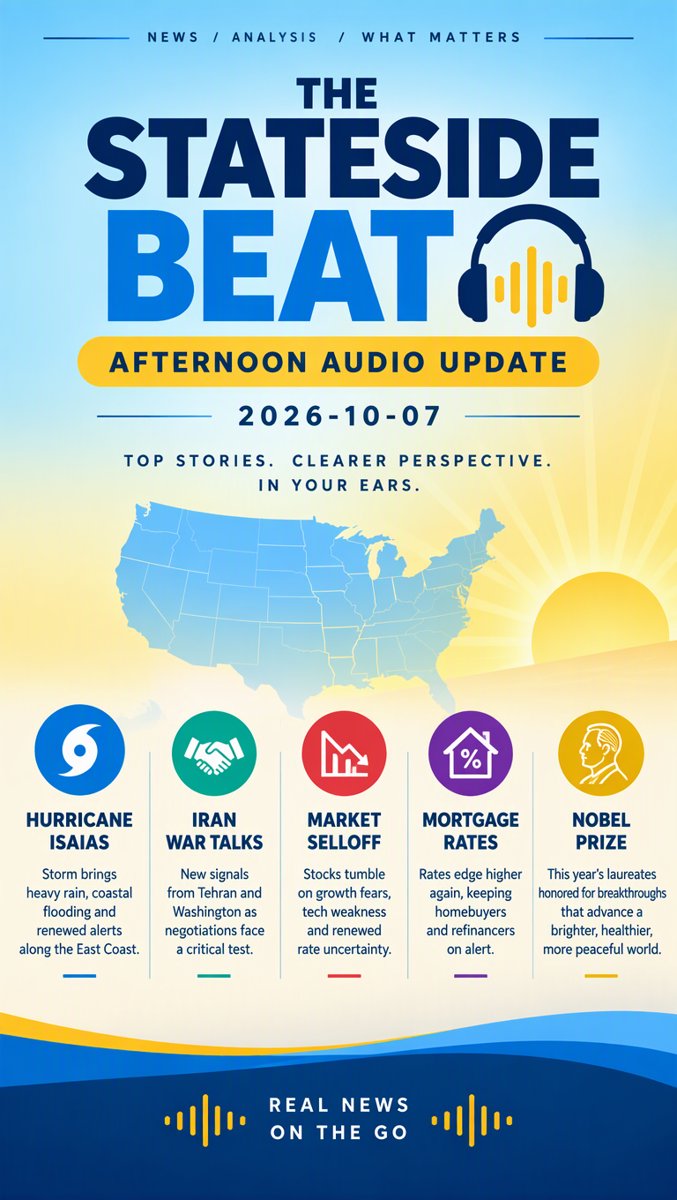
Afternoon audio brief for Wednesday, October 7, 2026 — tap play above to listen with slides and subtitles. Here's what happened while you were at lunch: Washington softened its demands on Iran, Hurricane Isaias spun up in the Gulf, and borrowing costs hit levels not seen in a generation.
The US appears to be lowering the bar for ending its war with Iran. Vice President JD Vance told Reuters that Tehran must deliver only a "meaningful" reduction in its nuclear capability — a notable softening from earlier demands for a full dismantling of the program. Meanwhile, Secretary of State Marco Rubio said Iran has "lost control" of the Strait of Hormuz, the chokepoint for roughly a fifth of the world's oil. Why it matters: any credible off-ramp toward negotiations would ease the pressure that's been driving oil prices — and the wider inflation anxiety — for weeks.
Tropical Storm Isaias is churning hundreds of miles south of the Gulf Coast and is expected to rapidly strengthen over the next 24 to 48 hours — likely becoming the Atlantic season's first hurricane by Friday. Florida has already declared a state of emergency in 25 counties. Forecasters project moderate to heavy rainfall reaching the Gulf Coast and into the Southeast this weekend into early next week. Why it matters: the season's first landfall threat arrives with little runway — coastal residents from Florida through the Southeast should watch updated forecasts closely through the weekend.
Wall Street had a rough session as borrowing costs surged. The Dow dropped more than 400 points after the 10-year Treasury yield climbed to its highest level in 24 years; the S&P 500 shed 0.6% and the Nasdaq slipped 0.7%. The pain isn't confined to trading floors — rates on 30-year fixed mortgages have now breached 7% for the first time since 2024. Why it matters: yields are the price of money, and when they hit multi-decade highs, everything from mortgages to car loans to business borrowing gets more expensive — a headwind heading into the midterms.
Lawyers for Christa Pike appeared in a Tennessee court Wednesday, days after the death-row inmate's execution was halted when it went wrong. Pike regained consciousness at a hospital, and her attorneys held a press conference ahead of the hearing to describe her condition. The case has thrust lethal injection protocols back into the national spotlight. Why it matters: Tennessee now faces an unprecedented question — whether it can lawfully attempt to execute the same person twice — just as Texas prepares to carry out the nation's next execution on Wednesday.
The 2026 Nobel Prize in Chemistry was awarded to Henri Kagan and Kenso Soai for solving a long-standing riddle of asymmetric "mirror image" molecules — the puzzle of why life on Earth overwhelmingly favors one handedness of certain molecules over its mirror twin. Their work on so-called homochirality underpins much of modern pharmaceutical chemistry, where the wrong-handed version of a drug molecule can be useless or even harmful. Why it matters: it's fundamental science that explains a deep quirk of biology — and it's the third Nobel handed out this week in Stockholm.
A new NBC News poll shows Republicans ahead in Florida's two marquee midterm races. In the governor's race, Republican Byron Donalds holds a 7-percentage-point advantage over Democrat David Jolly — a result consistent with a Mason-Dixon survey showing Donalds up 48% to 41%, with roughly 1 in 4 independents still undecided. Why it matters: Florida was once the ultimate swing state; if these leads hold, Democrats' hoped-for midterm breakthrough there looks increasingly like a long shot — and money and attention will flow to tighter battlegrounds.
The Stateside Beat Audio · 2026-10-07 · afternoon · Narrated edition, compiled from CBS News, ABC News, CNBC, BBC, Reuters, and NBC News.