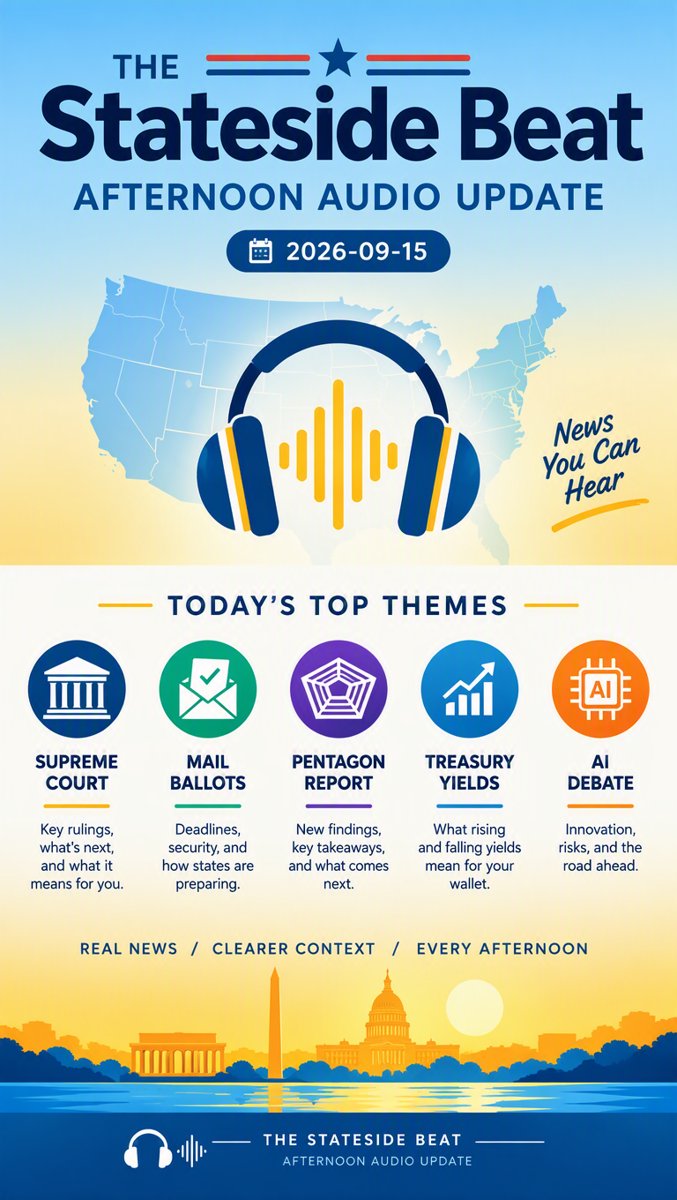
The Afternoon Update audio brief for Tuesday, September 15, 2026 — tap play above to listen with slides and subtitles, or read on for the full stories behind today's six headlines. It was a day the courts, the bond market and the Pentagon all moved at once: the Supreme Court swatted down mail-ballot restrictions ahead of the midterms, the ten-year Treasury yield crossed a threshold it hasn't seen in nearly two decades, and a watchdog report put hard numbers on the cost of the air campaign against Iran.
The Supreme Court rejected the administration's restrictions on mail voting, and President Trump responded within hours — blasting the ruling and, pointedly, his own appointees on the court. The New York Times called it a personal betrayal narrative; the Washington Post framed the loss as a rebuke from justices he nominated himself. AP reports the decision preserves expanded mail-ballot access in several states just weeks before the midterm elections — which is exactly why both parties treated it as a morning-defining story.
The Pentagon's Inspector General has put a number on the war's price tag in hardware: dozens of U.S. aircraft and hundreds of buildings at regional bases were destroyed or damaged during operations against Iran. USA Today and Breaking Defense both detail the scale of the losses, while Politico highlights the report's second finding — a munitions shortfall and restocking bottlenecks that could shape how quickly the military rebuilds its stockpiles. It's the first comprehensive public accounting of what the campaign actually cost.
Wall Street opened lower, with the Dow down about 200 points, as the ten-year Treasury yield climbed above 5 percent — CNBC notes it's the highest level since 2007, and traders are increasingly betting the Fed's next move could be a hike, not a cut. CNN reports the five-percent mark is a critical threshold for everything from mortgages to car loans. Oil is trading around $105 a barrel after the Saudi pipeline attack, and Treasury Secretary Scott Bessent spent the day testifying before a House panel defending the administration's economic record (Reuters live).
For the first time, a U.S. official has publicly confirmed that American weapons are stationed in Earth's orbit. Air Force Secretary Troy Meink made the acknowledgment Monday, and the Guardian and CNN both report the systems are described as defensive — designed to protect U.S. satellites from Russian and Chinese threats. The confirmation ends years of open secret status for orbital weaponry, and it lands at a particularly charged moment: NATO jets shot down a drone over Lithuania the same day.
NATO fighter jets downed a Russian drone that entered Lithuanian airspace — the first such intercept in the country's history. Hours earlier, the BBC reports, Denmark accused a Russian warship of firing two emergency flares at one of its military helicopters while it tracked the vessel. Two airspace incidents in one day on NATO's eastern flank are fueling fresh debate about alliance readiness and rules of engagement heading into the autumn.
The poles of American politics found common ground in Washington today: Senator Bernie Sanders and former Trump strategist Steve Bannon headlined the "Pro-Human Assembly," both calling for limits on artificial intelligence. NPR reports the unlikely duo are tapping the same anxiety about AI-driven job losses — and Futurism notes Sanders has gone as far as proposing a ban on superintelligent AI. The counterpoint came from the industry side: Nvidia CEO Jensen Huang pushed back on AI doom talk at a summit, with President Trump publicly backing him on a speakerphone call (NBC News).
The Stateside Beat Audio · 2026-09-15 · afternoon · Narrated edition, compiled from Politico, Al Jazeera, WSJ, The New York Times, AP News and NPR.
