The Space Bunny Is Out of the Bag: MiniMax M3.1 Flash vs DeepSeek 4.1 Flash vs GLM 5.3 Flash, in Plain Numbers


The Space Bunny Is Out of the Bag: MiniMax M3.1 Flash vs DeepSeek 4.1 Flash vs GLM 5.3 Flash, in Plain Numbers
For most of September, the developer leaderboards had a mystery guest. It had no lab name, no pricing page, no paper — just a pseudonym, a pair of long ears, and an unreasonable amount of traffic. The community called it Space Bunny, and by early October it had quietly become one of the most-used models on the planet.
On October 19, MiniMax walked up to the microphone and said: yeah, that's ours.
Space Bunny, the company confirmed, processed more than 200 trillion tokens while operating anonymously — and it was an early version of MiniMax M3.1 Flash, the model MiniMax launched that same day with a flat $0.15/$0.60 price tag and a benchmark table pointed directly at DeepSeek.
Naturally, we had questions. The launch post says "generational leap," "3× faster," and "70% cheaper." Vendor launch posts always say that. So we did what the email that inspired this piece suggested — we gave the bunny a few hard problems, lined it up against DeepSeek V4.1 Flash 1017 and GLM-5.3 Flash, and checked every number against both vendors and independent evaluators.
Here's the full scorecard — the good, the fine print, and the part of the launch table most coverage skipped.
First, what actually shipped
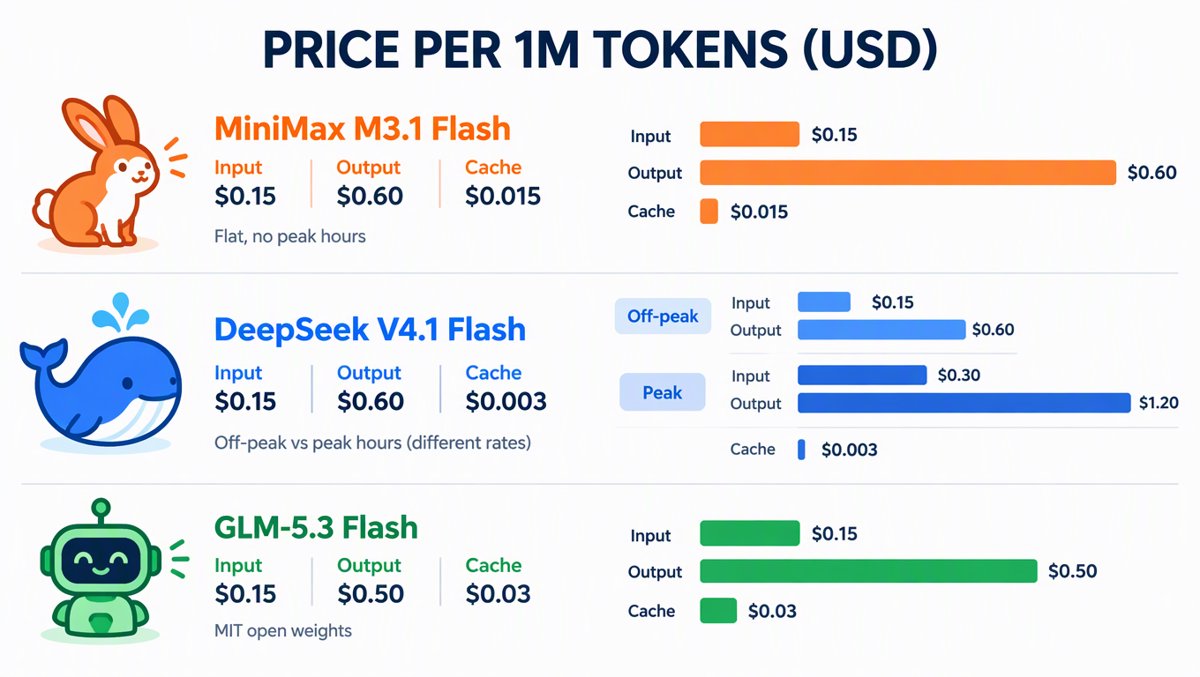
| MiniMax M3.1 Flash | DeepSeek V4.1 Flash 1017 | GLM-5.3 Flash | |
|---|---|---|---|
| Released | Oct 19, 2026 | Oct 17, 2026 update (base V4.1 Flash: September) | Aug 26, 2026 |
| Input / output per 1M tokens | $0.15 / $0.60 — flat, always | $0.15 / $0.60 off-peak; $0.30 / $1.20 peak | $0.15 / $0.50 |
| Cached input | $0.015 | $0.003–0.006 | $0.03 |
| Context window | 1M in / 524K out | 1M | 1M in / up to 1M out |
| Input types | Text + image (docs also list video) | Text | Text + image (natively multimodal) |
| Weights | Promised "later" (reportedly Oct 23) | MIT, on Hugging Face | MIT, open weights |
| Size | 428B total / ~23B active MoE* | V4 family | 320B / 18B active, trained on 30T tokens |
*The 428B/23B figure comes from MiniMax's preview-era docs and community guides; it's unverified for the final model. And yes — "Flash" here does not mean small. This thing is the same size class as MiniMax M3. "Flash" is a speed tier, not a size tier.
Three operational quirks worth knowing before you migrate anything:
- Thinking is always on. M3.1 Flash has a five-tier "effort ladder" (low → max) that defaults to max, and requests that try to disable thinking reportedly fail with an HTTP 400. Every request pays for reasoning tokens. If you never set the effort level, you're paying for the most expensive setting by default.
- Legacy auto-routing. Since October 19, requests to older M2.5 and M2.7 model IDs on MiniMax's plans silently route to M3.1 Flash. If your team pinned an old model for reproducibility, you're not running that model anymore.
- No image generation. It reads images (up to 10MB) and video (up to 512MB), but it only writes text.
The scoreboard MiniMax published
MiniMax's launch table is 15 rows deep against six rivals. The most interesting column is the one against DeepSeek V4.1 Flash 1017, which shipped just two days earlier and is the model everyone actually cross-shops. Across the six benchmarks both models share, DeepSeek wins five of six:
| Benchmark (vendor table) | M3.1 Flash | DeepSeek V4.1 Flash 1017 | Winner |
|---|---|---|---|
| Automation-Bench v1.0.6 | 62.8 | 60.5 | 🐰 MiniMax |
| Terminal-Bench 4.0 | 38.1 | 42.3 | 🐋 DeepSeek |
| DeepSWE v1.1 | 73.7 | 77.0 | 🐋 DeepSeek |
| NL2Repo-Bench | 61.2 | 68.2 | 🐋 DeepSeek |
| BabyVision (with tools) | 91.0 | 92.5 | 🐋 DeepSeek |
| HLE (no tools) | 43.4 | 44.0 | 🐋 DeepSeek |
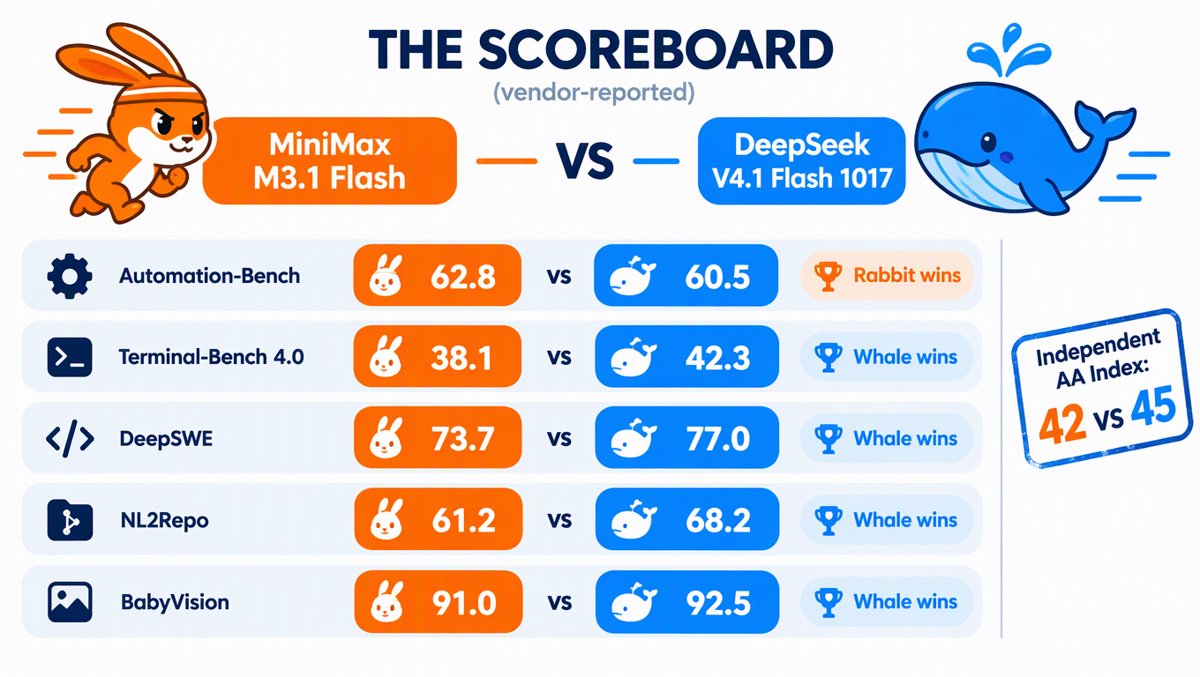
Read that again, because it's the opposite of the launch-post vibe: the bunny's clean wins are in office-style agent work — Automation-Bench (real enterprise workflows across SaaS tools), BankerToolBench (76.2, tying Claude Opus 5), and long-context agent work (LOCA-Bench 256K: 60.3, best in the table). The whale owns hard coding: repo-scale tasks, terminal work, software engineering.
MiniMax's other headline numbers: OSWorld V2 at 61.7 and Agents' Last Exam at 29.6 — both claimed as first among Chinese models — and CyberGym at 82% for security work.
One honest footnote before anyone storms the comments: on its own cost chart, MiniMax prints Automation-Bench at 62.8% at max effort, while its own benchmark table prints 62.2. Tiny gap, same self-reported source. Vendor tables are marketing documents with arithmetic in them.
The fine print in the pricing charts
Here's the part of the launch coverage that got quietly glossed over.
MiniMax's Automation-Bench cost chart prices DeepSeek 1017 at peak rates — $0.30 in / $1.20 out. But DeepSeek's peak pricing only applies during weekday windows (01:00–04:00 and 06:00–10:00 UTC). Every other hour of the week, DeepSeek charges $0.15 / $0.60 — identical to MiniMax's headline rate.
At off-peak rates, MiniMax's charted cost advantage shrinks from "half the price" to roughly "the same price, 2.3 points lower score." To be fair to MiniMax, its genuine per-token advantages survive scrutiny: flat pricing at every hour and every context length (DeepSeek's rate doubles at peak; old M3 doubled above 512K tokens — M3.1 Flash doesn't), and a real claim on cost-per-task in agent loops. On MiniMax's Agents' Last Exam chart, M3.1 Flash hit 29.6% for $111 total — the cheapest point on that frontier.
Where DeepSeek genuinely still wins on cost: caching. Off-peak cache reads are $0.003/M versus MiniMax's $0.015/M — five times cheaper. Agent loops re-read the same giant context dozens of times; cache-heavy workloads will feel that.
And GLM-5.3 Flash quietly undercuts both on output — $0.50/M — with a MIT license you can host yourself.
The independent check
Vendor tables tell you what labs want to be true. Independent evaluators tell you what happened. This is where M3.1 Flash's story gets complicated.
Artificial Analysis scores M3.1 Flash at 42–43 on its Intelligence Index at about $0.22 per task — versus 45 at ~$0.26 for DeepSeek 1017. So: roughly 15% cheaper per task, 2–3 index points behind. That's a real, defensible trade — not a knockout. (For scale, M3 scored 29. This is a genuine generational jump for MiniMax. But note the "3× faster" and "70% cheaper" claims in the launch post are against MiniMax's own predecessor, not against DeepSeek.)
Two more independent data points worth your attention:
- Measured speed: MiniMax claims 200+ tokens/second (P50 170+). Artificial Analysis measured about 105 tok/s — roughly half of what DeepSeek 1017 measured (~209 tok/s) in the same harness. Both things can be true depending on where and how you measure, but the "fastest Flash" framing deserves an asterisk.
- Terminal-Bench 4.0, independently: 25.25 — noticeably below the 38.1 in MiniMax's table. The Vals Index put it at 53.78%, ranked #15 of 23, and flagged it as "weaker on long-horizon agentic work," with one test averaging 43 minutes per task.
And the flag that matters more than any coding score: Artificial Analysis reports M3.1 Flash shows "an exceptionally high tendency to generate incorrect answers rather than acknowledge uncertainty." For a chat model, that's annoying. For an agent that acts without supervision — the exact use case MiniMax is selling — overconfident wrong answers are the most expensive failure mode there is.
GLM-5.3 Flash, meanwhile, keeps aging well. Zhipu's August release posts an 84.3 on Terminal-Bench 2.1 (an earlier, easier version of the benchmark — don't put it in the same column as the 4.0 scores above), DeepSWE at 63.4, and scored 57 on an older Artificial Analysis index version (42 on the current one — index versions shift, another reason to read footnotes). It remains the only model of the three you can download, self-host, and ship in a product without an API bill — and it ran its stealth preview on Chinese AI chips, which matters for supply-chain watchers.
What early users actually say
The first 48 hours of hands-on reports split cleanly down the same fault line as the benchmarks.
The positive reports are real: one developer praised how the preview handled uncertainty — it "found the real bug instead of patching around it, refused to pad weak results... and said UNVERIFIED when it couldn't confirm something." Several users running MiniMax and GLM plans side by side said M3.1 Flash beat GLM's Flash on their workloads.
The complaints cluster around one theme: behavior at high effort, which is the default. "WAY too lazy, even at Max effort" (Reddit). "Hallucinates a lot on xhigh or max and starts doing stuff I didn't ask for" (X). On r/opencode, where Space Bunny spent its anonymous reign, reactions to the final numbers ranged from "BenchMAXXED" to reports of the model deleting main project files mid-task. MiniMax's own caveat cuts both ways here: Space Bunny "was only the early build" — which explains some bad vibes, but also means none of those 200 trillion tokens of real-world usage directly validated the final checkpoint.
One more battle the benchmarks can't score: in the same news cycle, a U.S. DHS order removed DeepSeek products from federal civilian agencies. MiniMax is already pitching a US-hosted, zero-data-retention option. If you're procuring for a regulated shop, that sidebar may matter more than three index points.
So which one do you pick?
Pick MiniMax M3.1 Flash if your workload is office-agent loops, chained tool calls, long documents, and computer-use automation — the areas where its vendor numbers and independent cost-per-task data genuinely shine. Flat $0.15/$0.60 pricing with no peak-hour anxiety and a 1M window at full rate is a real operational simplification. Just audit its answers: the hallucination flag is not a footnote, it's a warning label. And maybe don't leave effort on max.
Pick DeepSeek V4.1 Flash 1017 if the work is hard repo-scale coding — terminal tasks, software engineering, NL2Repo. It wins those matchups outright, on both vendor and independent data, and if you can schedule batch jobs into off-peak hours, its effective price matches MiniMax's with better cache rates and MIT weights already on Hugging Face.
Pick GLM-5.3 Flash if openness is non-negotiable. It's the oldest of the three and the cheapest on output, the only one with open weights and permissive licensing since day one, natively multimodal, and its Terminal-Bench 2.1 score remains the standout coding number in this trio. Two months into its lifecycle, it's still the value pick for self-hosters.
And if you're MiniMax, the play is obvious: the weights were reportedly due October 23 — writing time, we're still waiting — and a Pro model is promised "later." The bunny made its entrance. Now it has to survive contact with the arena.
Spotted an error or have hands-on numbers of your own? The scoreboard above cites vendor tables, Artificial Analysis, Vals, and first-week user reports — disagree loudly in the comments.
Sources: MiniMax launch post (minimax.io/blog/minimax-m31f); eesel AI review, Oct 20; kie.ai launch deep dive; MarkTechPost & MindStudio on DeepSeek V4.1 Flash 1017; Artificial Analysis (AA Intelligence Index); Vals AI Index; llm-stats.com model pages; NVIDIA model card (DeepSeek-V4.1-Flash); DataCamp & Qubrid on GLM-5.3 Flash; r/opencode, r/LocalLLaMA threads; 光锥智能 / smzdm / techgogogo Chinese coverage; CellCog Space Bunny analysis.