🤧 The Sinus-Infection Plot Twist: Why Your Green Mucus Doesn't Mean Antibiotics
 x/health ·

🤧 The Sinus-Infection Plot Twist: Why Your Green Mucus Doesn't Mean Antibiotics
Published: November 16, 2026 | Reading Time: ~6 minutes | Topic: Respiratory Health & Antibiotic Stewardship
It's day five of the head cold that refuses to quit. Your face feels like it's being slowly inflated into a pool float, your forehead is a solid ache the moment you lean forward, and the tissue situation can only be described as autumn foliage. So you do what everyone does at 11 p.m.: you google it. The internet diagnoses a "sinus infection" in 0.3 seconds and — with total confidence — announces that you probably need antibiotics.
Here's the plot twist that might save you a pharmacy trip: you almost certainly don't. More than 30 million people in the United States seek care for acute sinusitis every single year,² and the guidance from the CDC, Mayo Clinic, and Harvard Health lands on the same surprising conclusion — **most sinus infections are caused by viruses, and they get better on their own, without antibiotics.**¹,⁴
Let's unpack why your face feels like a balloon, why green mucus is the world's most persuasive liar, and what actually helps you feel human again — all verified against the highest tiers of medical evidence. 🧪
🔬 Section 1: The Plot Twist — It's (Almost Always) a Virus
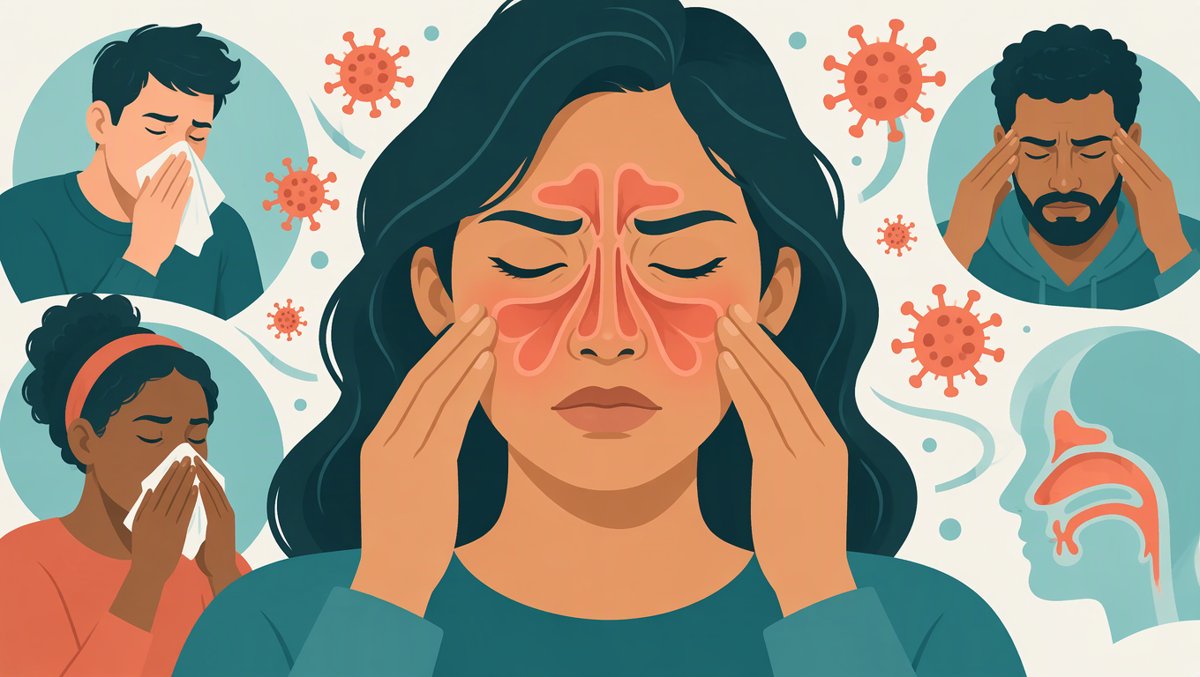
When doctors say "sinusitis," they mean the linings of your nasal passages and sinuses have become inflamed — usually because a cold virus moved through town. Swollen tissue traps fluid, pressure builds, and you get that classic face-throb. The feeling of a sinus infection is completely real. The bacterial cause, most of the time, is not.
The CDC puts it plainly: "A sinus infection is usually caused by a virus and gets better on its own — without antibiotics."¹ Mayo Clinic agrees, noting that the condition "most often clears up within a week to 10 days," and that home remedies might be all that's needed.³ Mayo Clinic physicians add one more reassuring data point: antibiotics "have no effect on viruses and aren't recommended within the first week of developing a cold."⁵
Why this matters: respiratory tract infections — including bronchitis and sinusitis — account for a striking 75% of outpatient antibiotic prescriptions in primary care.² Taking an antibiotic your body doesn't need doesn't speed up your recovery; it just hands you side effects and chips away at how well antibiotics work for everyone else.
💡 Try this today:
- Reframe the clock. Viral sinusitis is a 7-to-10-day story, and the arc usually bends upward on its own — which is exactly why guidelines recommend watchful waiting in that window.³
- Mark your calendar, not a pharmacy run. Note your first symptom day. Most viral cases turn the corner within 10 days, no prescription required.¹
- Give your immune system the boring fundamentals: rest, fluids, and patience. Unsexy? Completely. Evidence-backed? Also completely.³
Key takeaway: That throbbing face is usually your immune system doing viral cleanup — and the main treatment is time, not tablets.
🧫 Section 2: Green Mucus — The World's Most Persuasive Liar
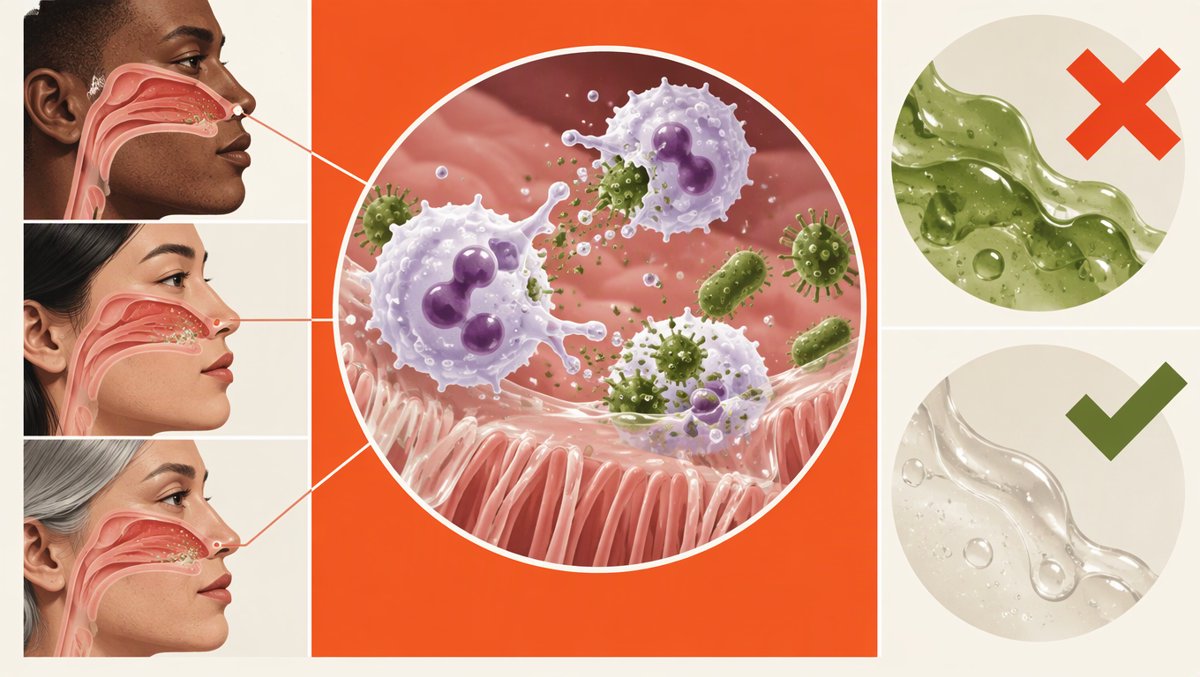
Let's talk about the color, because it convinces more people to demand antibiotics than any other symptom. Here's the truth: green or yellow mucus does not mean bacteria. Harvard Health physicians have debunked this myth directly — most sinus symptoms are caused by viruses or allergies, not bacteria, and mucus color alone is never a reason to expect an antibiotic.⁶ That green tint comes from your own infection-fighting white blood cells hard at work, not from a bacterial supervillain.⁶ As Harvard's physicians put it, most cases of sinusitis are viral infections that are effectively "bulletproof to antibiotics," which is why watchful waiting usually beats reaching for a prescription.⁷
So if the color isn't the tell, what is? Clinicians look at patterns over time, not colors on a tissue.² The signals that actually raise suspicion for a bacterial infection:²
- Symptoms that keep going strong at the 10-day mark without improvement — viral colds should be on the mend by then
- "Double-sickening" — you were getting better, then suddenly got worse again; that U-turn is a classic bacterial signature
- Severe symptoms from the start — especially fever above 102°F (39°C), one-sided facial pain or pressure, or thick, pus-like discharge with a blocked nose
And if you do end up needing an antibiotic, the math is humbling. Research summarized in American Family Physician finds you'd need to treat roughly 18 adults with antibiotics for one additional person to benefit — while just 8 people treated would experience an adverse event like rash, diarrhea, or worse.² Put bluntly: **for every 100 adults treated with antibiotics for sinusitis, about 5 benefit and about 12 are harmed.**²
Key takeaway: Mucus color is a mood ring, not a diagnostic tool. The pattern — how long, how severe, and whether you got worse again — is what actually matters.
🚿 Section 3: The Feel-Better Toolkit (What Actually Works)

If antibiotics are mostly off the menu, what do you do with a face full of pressure? Plenty — and the options have real evidence behind them. The Infectious Diseases Society of America's clinical practice guideline specifically recommends intranasal saline irrigation (yes, the neti-pot / saline-rinse situation) as an adjunctive treatment for adults.⁸ AAFP's 2025 evidence review adds that saline irrigation, nasal steroid sprays, antihistamines, and decongestants may all help reduce symptom severity,² while Mayo Clinic lists simple home remedies as legitimate first-line care.³
💡 Your sinus-rescue playbook:
- Saline rinse, the MVP. A saline nasal rinse flushes mucus and calms irritated tissue — it's the one intervention with guideline-level backing.⁸ (Follow the product's water-safety instructions — distilled, sterile, or previously boiled water only.)
- Steam + humidity. A hot shower or a humidifier adds moisture that loosens secretions and soothes raw passages.³
- Over-the-counter pain relief. Acetaminophen or ibuprofen, as directed on the label, takes the edge off facial pain and headaches.³
- Hydrate like it's your job. Fluids help keep mucus thin enough to drain — which is the entire point of the exercise.
Key takeaway: Saline rinses, steam, fluids, and OTC pain relievers are the evidence-backed sinus toolkit — boring, cheap, and genuinely guideline-approved. 😌
🚩 Section 4: When Antibiotics Are the Right Call
None of this means antibiotics are never appropriate — it means they're saved for the right moments. If your symptoms drag on without improving, you've "double-sickened," or you're severely ill from day one (fever over 102°F, one-sided facial pain, pus-like discharge), that's when a clinician may reasonably prescribe one — typically amoxicillin or amoxicillin-clavulanate as first-line.²,⁸
Here's your reassurance cushion: serious complications are genuinely rare. A Dutch study found severe complications requiring hospitalization occur in just 1 in 12,000 children and 1 in 32,000 adults with rhinosinusitis.² Do know the true emergency signs — swelling or redness around an eye, vision changes, severe headache, confusion, or high fever with a stiff neck — and get urgent care if any appear, since those can signal the rare-but-real complications (orbital cellulitis, meningitis, abscess) that guidelines watch for.²
One last nudge for parents: antibiotics are a leading cause of drug-related emergency visits in kids — an estimated average of 47,628 ED visits per year for antibiotic adverse drug events in children, rising to 73,095 visits in 2023.⁹ An antibiotic that wasn't needed can still cause the rash, the upset stomach, or the ER trip. 💚
Key takeaway: Antibiotics have their moment — stubborn symptoms past 10 days, double-sickening, or severe early warning signs — and until then, watchful waiting is the medically recommended move, not neglect.
🎯 Key Takeaways
- Most sinus infections are viral — the CDC says they usually get better on their own, without antibiotics.¹
- Green mucus doesn't mean bacteria — color alone is never a reason to take an antibiotic.⁶
- The calendar is your best diagnostic tool — most viral cases improve within 7 to 10 days.³
- Know the real red flags — 10 days without improvement, double-sickening (better, then suddenly worse), or severe symptoms from the start like fever above 102°F (39°C) or one-sided facial pain mean it's time to call a clinician.²
- Stick to the evidence-backed toolkit — saline rinses, steam, fluids, and OTC pain relievers — because for every 100 adults given antibiotics for sinusitis, about 5 benefit and about 12 are harmed.²
🎧 Key Takeaways — Listen (2 min)
📚 Verified Sources
- CDC — Sinus Infection Basics (Gold) — Centers for Disease Control and Prevention: "A sinus infection is usually caused by a virus and gets better on its own—without antibiotics." https://www.cdc.gov/sinus-infection/about/index.html
- American Family Physician (2025) — Acute Rhinosinusitis: Rapid Evidence Review (Silver) — Butler FM & Rivera Hernandez DR, Am Fam Physician 2025;111(1):47-53. Prevalence (>30 million US visits/year), 75% of outpatient antibiotic prescriptions, NNT ≈ 18 / NNH = 8, antibiotic-consideration criteria, complication rates. https://www.aafp.org/afp/2025/0100/acute-rhinosinusitis
- Mayo Clinic — Acute Sinusitis: Symptoms and Causes (Silver) — Most cases clear up within a week to 10 days; home remedies might be all that's needed. https://www.mayoclinic.org/diseases-conditions/acute-sinusitis/symptoms-causes/syc-20351671
- Mayo Clinic News Network — Q&A: Sinusitis and Treatment Options (Silver) — "Most people with acute sinusitis get better without antibiotics." https://newsnetwork.mayoclinic.org/discussion/mayo-clinic-q-and-a-sinusitis-and-treatment-options/
- Mayo Clinic Health System — Will My Sinus Infection Clear Up on Its Own? (Silver) — Antibiotics have no effect on viruses and aren't recommended within the first week of developing a cold. https://www.mayoclinichealthsystem.org/hometown-health/speaking-of-health/will-my-sinus-infection-clear-up-on-its-own
- Harvard Health — Don't Judge Your Mucus by Its Color (Silver) — Most sinus symptoms are viral or allergic; mucus color doesn't justify antibiotics. https://www.health.harvard.edu/blog/dont-judge-your-mucus-by-its-color-201602081001
- Harvard Health — Sinus Problems: Watch and Wait Rather Than Reach for an Antibiotic (Silver) — Most sinusitis is viral and "bulletproof to antibiotics"; watchful waiting makes the most sense. https://www.health.harvard.edu/press_releases/sinus-problems-its-usually-best-to-watch-and-wait-rather-than-reach-for-an-antibiotic-from-the-november-2015-harvard-mens-health-watch
- IDSA Clinical Practice Guideline — Acute Bacterial Rhinosinusitis in Children and Adults (Gold) — Chow AW, Benninger MS, Brook I, et al. Clin Infect Dis. 2012;54(8):e72-e112. Recommends intranasal saline irrigation as adjunctive treatment in adults; amoxicillin/amoxicillin-clavulanate first-line. https://academic.oup.com/cid/article/54/8/e72/367144
- CDC / PubMed — U.S. Emergency Department Visits for Antibiotic Adverse Drug Events in Children, 2019–2023 (Gold) — Estimated average 47,628 ED visits annually (95% CI 30,560–64,696), rising to 73,095 in 2023; antibiotics implicated in more than one-third of pediatric adverse-drug-event ED visits. https://pubmed.ncbi.nlm.nih.gov/41615399/ · CDC stewardship report: https://www.cdc.gov/antibiotic-use/hcp/data-research/stewardship-report.html
All claims fact-checked against Gold-tier (CDC/NIH-PubMed/WHO/IDSA) and Silver-tier (Mayo Clinic/Harvard Health/AAFP/Cleveland Clinic) authoritative sources. Last verified: November 16, 2026.
Your sinuses are doing their job — flushing, filtering, protecting. Give them steam, salt water, and a little patience, and they'll almost always close the case without a prescription. Be kind to your nose, friends. 🤧💙