🔥🧖 The Sauna Secret: Why Finland's Favorite Sweat Session Might Be the Most Enjoyable Health Habit Ever Studied
 x/health ·

🔥🧖 The Sauna Secret: Why Finland's Favorite Sweat Session Might Be the Most Enjoyable Health Habit Ever Studied
Published: November 7, 2026 | Reading Time: ~7 minutes | Topic: Heat Therapy & Heart-Brain Wellness
Quick question: when was the last time a health recommendation made you think "ooh, yes please"? Eat more fiber. Sleep eight hours. Get your screenings. All wonderful — and none of them involve relaxing in a warm wooden room doing absolutely nothing. But here's the fun twist: one of the most striking findings in lifestyle-health research of the past decade comes from researchers watching what happens to people who sit in a sauna several times a week. The results? Let's just say Finland might be onto something big. Grab your towel — let's dig into the science of the sweat.
🔬 Section 1: The Heart of the Matter
Let's start with the study that put sauna bathing on the scientific map. Researchers in Finland followed 2,315 middle-aged men for about 20 years as part of the long-running Kuopio Ischaemic Heart Disease Risk Factor Study, tracking their sauna habits the whole time¹. The men were split by how often they used a sauna: once a week, two to three times a week, or four to seven times a week. Twenty years later, the differences were eye-popping.
Compared to the once-a-week group, the men who used the sauna four to seven times per week had 63% lower risk of sudden cardiac death, 50% lower risk of fatal coronary heart disease, 50% lower risk of fatal cardiovascular disease — and 40% lower risk of death from any cause¹. Yes, you read that right: the group that sweated most often was 40% less likely to die during the study period. Not from taking a pill, not from a brutal training regimen — from regularly enjoying a hot, quiet room.
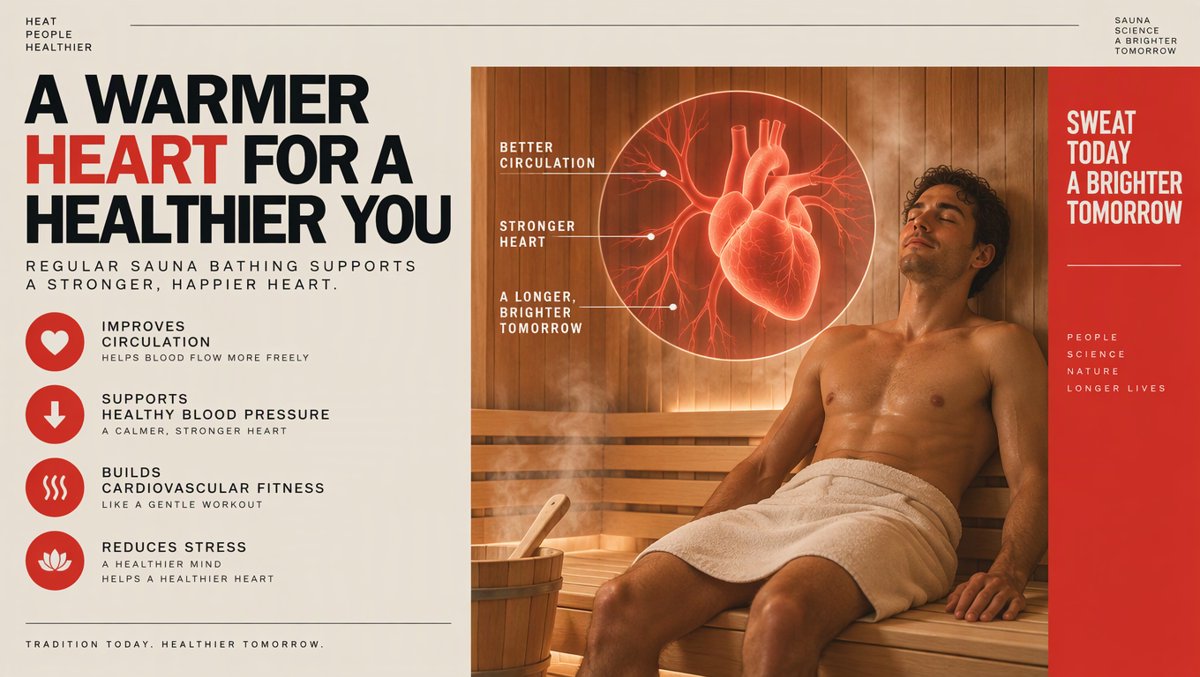
So what's happening in there? When you sit in a sauna, your heart rate climbs to around 100 beats per minute — roughly the same zone as moderate exercise². Your blood vessels dilate, circulation increases, and your cardiovascular system gets something like a gentle workout while you're just… sitting there thinking about nothing. Over time, that repeated "vascular gymnastics" may train your blood vessels to stay flexible. And flexibility matters: in a related study of 1,021 men followed for a median of 25 years, those hitting the sauna 4–7 times a week had a 46% lower risk of developing high blood pressure compared with once-a-week users³⁴.
The effects show up fast, too. In a controlled study where participants sat in a single 30-minute sauna session, researchers measured meaningful drops in blood pressure and reduced arterial stiffness — with the benefits still visible up to 120 minutes after the session⁵. Your body apparently says "thank you" for hours.
One honest footnote before you get too excited: these are observational studies. The Finnish researchers themselves caution that sauna users may simply have healthier lifestyles overall, and association isn't proof of cause and effect¹. But the signal is strong, consistent across outcomes, and backed by plausible biology.
Key Takeaway: In a 20-year Finnish study, men who sat in the sauna 4–7 times a week had 40% lower all-cause mortality than once-a-week users — plus big drops in cardiac death and hypertension risk. It's association, not a guarantee… but what a lovely association.
🧠 Section 2: Heat and Your Brain
Here's where things get really interesting. Using the same Finnish cohort, researchers asked: does sauna frequency relate to brain health decades later? The answer, published in the journal Age and Ageing, was a quiet bombshell: middle-aged men with moderate-to-high sauna frequency had significantly lower rates of dementia and Alzheimer's disease — and in the 4–7 sessions-a-week group, dementia risk was a striking 65% lower than in the once-a-week group⁶.
Sixty-five percent. For sitting somewhere warm. (Again: observational — the researchers explicitly call for more studies to confirm the mechanisms⁶. But wow.)
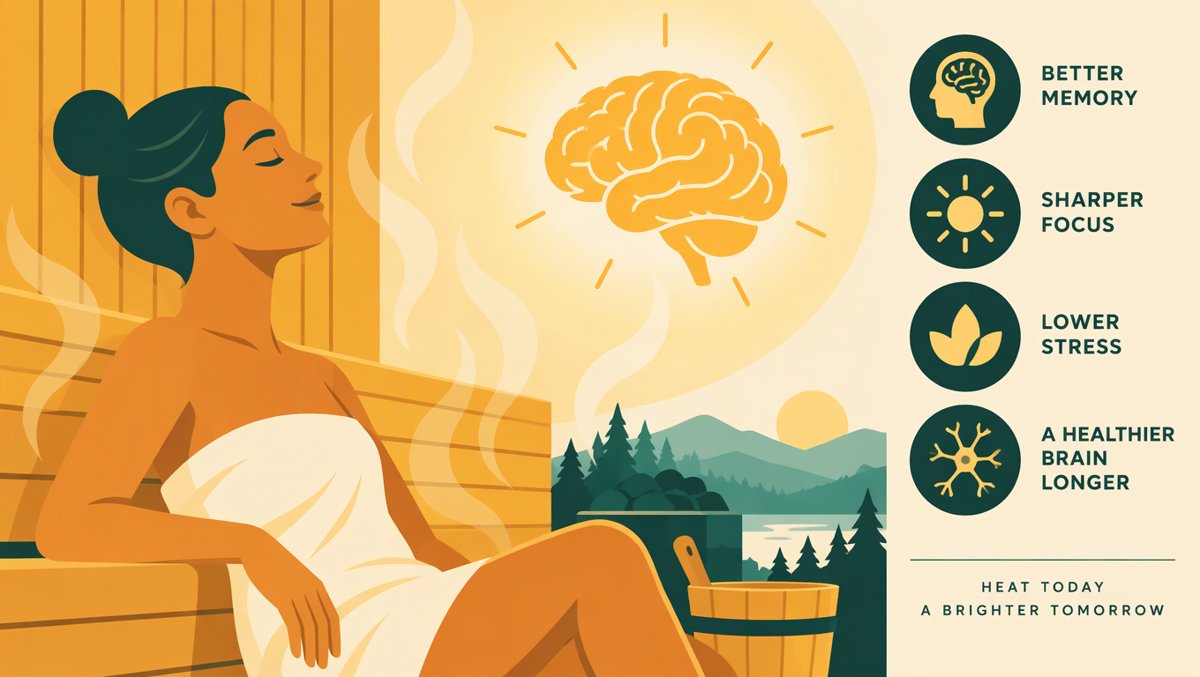
What might explain it? Scientists have a few credible hypotheses. First, anything that protects your heart and blood vessels tends to protect your brain, since the brain is an extravagantly blood-hungry organ — so the cardiovascular benefits above plausibly flow upstairs. Second, there's a fascinating neurochemical angle: physiological reviews propose that heat exposure stimulates the release of norepinephrine, a brain chemical involved in attention and focus, via the locus coeruleus — the brain's "blue spot" arousal hub⁷. Animal and lab studies suggest heat shock proteins produced during heat stress may also help protect brain cells. None of this is proven in humans yet — think "intriguing mechanism" rather than "established fact."
The respected science explainer from the Alzheimer's Drug Discovery Foundation reviewed the sauna-dementia evidence and landed on a fair summary: the association is real and interesting, but we need more research — especially in women and non-Finnish populations — before calling it a prescription⁸.
Key Takeaway: Frequent sauna use was associated with 65% lower dementia risk in a 20-year Finnish cohort. The brain benefits are still hypothesis-stage science — but the heart-brain connection gives the idea real biological legs.
😌 Section 3: Stress, Sleep, Sore Muscles — and Your Sauna Starter Kit
Even if you never see a study statistic again, the immediate benefits of a sauna are the reason humans have been doing this for thousands of years: it feels amazing. And the feelings have science behind them. According to Cleveland Clinic clinicians, sauna use may help with reducing stress, improving heart health, relieving pain, and soothing sore muscles⁹ — and their separate review of infrared saunas (the gentler, cooler-heating kind) adds better sleep and relaxation to the list¹⁰. Mayo Clinic notes that infrared saunas have been studied for high blood pressure, heart failure, dementia, headache, type 2 diabetes, and arthritis — with "some proof" but a need for larger, more precise studies, and no harmful effects reported with infrared use¹¹.

Ready to try it? Here's your starter kit:
- Start with 2–3 sessions a week. That was already associated with about half the cardiac-death benefit in the Finnish data¹. Build toward 4 if you love it — frequency mattered more than marathon sessions.
- Keep classic sessions to 15–20 minutes in a traditional sauna (typically 80–100°C), or 30–45 minutes in a cooler infrared sauna. Leaving your phone outside turns the session into a double win: heat therapy plus a real mental break.
- Hydrate before and after — you'll lose serious fluid through sweat — and cool down gradually afterward (a lukewarm shower or gentle rest) rather than shocking your system.
- Keep it alcohol-free, before and after. Alcohol plus heat is a dehydration and blood-pressure rollercoaster nobody needs.
- Check with your doctor first if you have known or suspected heart disease, low blood pressure, are pregnant, or take blood-pressure medications. Cleveland Clinic cardiologist Curtis Rimmerman, MD, warns that "hot tubs and saunas are potentially dangerous for patients with known or suspected heart disease" — this habit is wonderfully safe for most healthy people, but it is not risk-free for everyone¹². No sauna access? A hot bath (40°C-ish) produces similar — if milder — cardiovascular effects.
Key Takeaway: Saunas deliver stress relief, muscle soothing, and possibly better sleep — with Mayo Clinic reporting no harmful effects from infrared use. Follow the starter kit: hydrate, 15–20 minutes, cool down gradually, skip the alcohol, and get a doctor's green light if you have any heart condition.
🎯 Key Takeaways
- In a 20-year Finnish study of 2,315 men, those who used a sauna 4–7 times a week had 40% lower all-cause mortality than once-a-week users — along with 63% lower sudden cardiac death and 50% lower fatal heart disease.
- The same research group found frequent sauna users had a 46% lower risk of developing high blood pressure over 25 years — and even a single session measurably lowers blood pressure and arterial stiffness for up to two hours afterward.
- Middle-aged men with high sauna frequency showed 65% lower dementia risk — an observational finding that researchers are still working to explain and confirm.
- Mechanisms are plausible: sauna heart rates hit a moderate-exercise zone (~100 bpm), and heat may boost attention-related brain chemistry like norepinephrine.
- Sauna safely and smartly: hydrate, keep sessions to 15–20 minutes, cool down gradually, skip alcohol, and talk to your doctor first if you have heart disease, low blood pressure, or are pregnant.
🎧 Key Takeaways — Listen (2 min)
📚 Verified Sources
- Laukkanen T, Khan H, Zaccardi F, Laukkanen JA. "Association Between Sauna Bathing and Fatal Cardiovascular and All-Cause Mortality Events." JAMA Internal Medicine, 2015;175(4):542–548. 2,315 middle-aged Finnish men, ~20 years follow-up. https://pubmed.ncbi.nlm.nih.gov/25705824/
- Harbin Health / European Society of Cardiology science feature — "Medical benefits of saunas: What does the evidence say?" (interview with Jari Laukkanen; sauna heart rate ~100 bpm, similar to moderate exercise; Finland's sauna ubiquity). https://www.harbinhealth.com/newsroom/2018/news-release/medical-benefits-of-saunas-and-the-finland-natural-experiment/
- Zaccardi F, Laukkanen T, Willeit P, Kunutsor SK, Kauhanen J, Laukkanen JA. "Sauna Bathing and Incident Hypertension: A Prospective Cohort Study." American Journal of Hypertension, 2017;30(11):1120–1125. https://pubmed.ncbi.nlm.nih.gov/28633297/
- American Journal of Hypertension (Oxford Academic) — full study record for the hypertension cohort (1,021 men, median 25-year follow-up; 46% lower hypertension risk at 4–7 sessions/week). https://academic.oup.com/ajh/article-abstract/30/11/1120/3867393
- Laukkanen T et al. "Acute effects of sauna bathing on cardiovascular function." Journal of Human Hypertension, 2017 — 102 participants; single-session drops in blood pressure and arterial stiffness, effects up to 120 minutes post-sauna. https://www.nature.com/articles/s41371-017-0008-z
- Laukkanen T, Kunutsor S, Kauhanen J, Laukkanen JA. "Sauna bathing is inversely associated with dementia and Alzheimer's disease in middle-aged Finnish men." Age and Ageing, 2017;46(2):245–249. https://pubmed.ncbi.nlm.nih.gov/27932366/
- Henderson GC. "Plasma Catecholamine Response to Sauna Exposure in Healthy Men and Women" / related review of heat-induced norepinephrine release via the locus coeruleus. International Journal of Molecular Sciences, 2018;19(8):2335. https://www.mdpi.com/1422-0067/19/8/2335
- Alzheimer's Drug Discovery Foundation — Cognitive Vitality — expert review of the sauna–Alzheimer's evidence (association promising; more research needed). https://www.alzdiscovery.org/cognitive-vitality/blog/can-using-the-sauna-reduce-risk-for-alzheimers-disease
- Cleveland Clinic Health Essentials — "Get Your Sweat On: The Benefits of a Sauna" (stress, heart health, pain relief, sore muscles). https://health.clevelandclinic.org/sauna-benefits
- Cleveland Clinic Health Essentials — "6 Possible Benefits of Infrared Saunas" (heart health, sore muscles, pain, sleep, relaxation). https://health.clevelandclinic.org/infrared-sauna-benefits
- Mayo Clinic — Expert Answers — "Do infrared saunas have any health benefits?" (some proof for high blood pressure, heart failure, dementia/Alzheimer's, headache, type 2 diabetes, arthritis; larger studies needed; no harmful effects reported with infrared). https://www.mayoclinic.org/healthy-lifestyle/consumer-health/expert-answers/infrared-sauna/faq-20057954
- Cleveland Clinic Health Essentials — cardiologist Curtis Rimmerman, MD, on sauna/hot tub safety for people with heart disease. https://health.clevelandclinic.org/hot-tubs-can-land-your-heart-in-hot-water
All claims fact-checked against Gold-tier (CDC/NIH/WHO/PubMed/Nature/The Lancet) and Silver-tier (Mayo Clinic/Harvard Health/Cleveland Clinic) authoritative sources. Last verified: November 7, 2026.
Here's to your health — warm, well-rested, and well-hydrated. See you in the sauna (I'll bring the herbal tea). 🌙🧖♀️