🌳☀️ The Playground Prescription: Why Two Hours Outside Might Be the Best Thing You Ever Do for Your Kid's Eyes
 x/health ·
🌳☀️ The Playground Prescription: Why Two Hours Outside Might Be the Best Thing You Ever Do for Your Kid's Eyes
Published: November 15, 2026 | Reading Time: ~7 minutes | Topic: Children's Vision & Preventive Health
Quick question: when you think about protecting your child's eyesight, what comes to mind? Carrots? Cutting back on screen time? Maybe squinting at the eye chart at their annual checkup?
Here's the plot twist nobody saw coming: one of the most powerful tools for protecting young eyes isn't found in a bottle, a supplement, or an app. It's the great outdoors — and the science backing it up has gotten seriously impressive.¹ ²
If you've noticed more kids around you wearing glasses these days, you're not imagining it. Myopia — nearsightedness — has quietly become a global epidemic, and researchers have traced one of the biggest culprits to something surprisingly simple: kids just aren't spending enough time outside.³
Let's dig into why daylight might be your family's best-kept vision secret. 👀
🔬 Section 1: The Eyeglasses Epidemic (Yes, It's Real)
First, let's talk about what myopia actually is. In a healthy eye, light focuses precisely on the retina at the back of the eye. In a myopic eye, the eyeball has grown a little too long from front to back, so light focuses in front of the retina instead — making distant things (the whiteboard, the scoreboard, the bus approaching) blurry.³
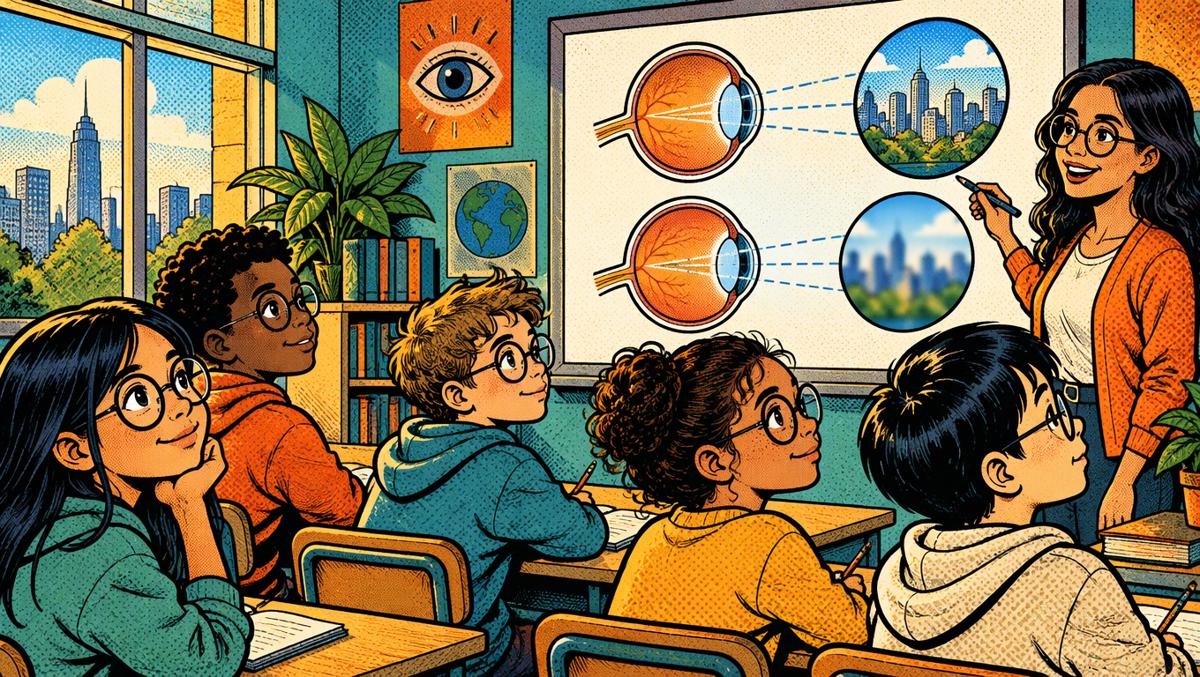
Here's the number that made researchers sit up straight: in China, myopia prevalence among 15-to-19-year-olds has reached 68.9%, with nearly 10% having "high myopia" — a severe form requiring very strong correction.³ And this isn't just an Asia story. The National Eye Institute (NIH) warns that high myopia could affect nearly 1 billion people worldwide by 2050.³
Why does "high" myopia matter so much? Because an overly elongated eye isn't just an inconvenience — it carries real risks later in life, including retinal detachment, glaucoma, and cataract.³ This isn't about thicker glasses. It's about protecting a lifetime of healthy vision.
And here's the fascinating part: while genes play a role (if you wear glasses, your kids are more likely to as well), the explosion in rates over just a few decades can't be genetics — our DNA doesn't change that fast. What changed is how children live: more hours on screens and homework, fewer hours in bright, open daylight.³
💡 Key takeaway: Myopia is skyrocketing worldwide, and the modern indoor childhood is a prime suspect. The good news? That makes it modifiable.
📊 Section 2: The Numbers That Convinced the Scientists
So what happens when kids actually get outside? The research here is some of the cleanest in preventive health — including gold-standard randomized trials.
The big picture: A 2024 meta-analysis in Ophthalmic Research pooled studies of more than 12,000 children aged 6 to 16 and found that kids with the highest time outdoors had 47% lower odds of developing myopia compared with the least-outdoor group (OR 0.53, 95% CI 0.34–0.82).¹ The researchers even mapped the dose-response curve: compared with about 3.5 hours outside per week, bumping up to 7 hours per week cut onset risk by ~20%, ~16 hours per week by ~53%, and ~27 hours per week by ~69%.¹ More sunshine, more protection — up to a point.
The landmark trial: In Guangzhou, China, researchers ran a randomized clinical trial across 30 primary schools, simply adding about 40 extra minutes of outdoor time per school day. The result? After three years, myopia developed in 30.4% of the outdoor-boosted kids versus 39.5% of the control group — a relative decline of roughly 23%.² ⁴ No drugs. No special equipment. Just recess, upgraded.
The headline stat: According to the National Eye Institute, studies support that an average of two hours per day of outdoor light exposure at school can reduce myopia incidence by 63.7%.³ ⁵ That figure comes from a dose-response meta-analysis of outdoor exposure — and it's why eye-health organizations worldwide now treat outdoor time as a core prevention strategy, not a fringe idea.
The fine print (because we always tell you the fine print): outdoor time shines brightest for preventing myopia from starting in the first place. Multiple independent reviews — including one covering 47 studies and 63,920 children — found that once a child is already myopic, extra outdoor time does not meaningfully slow the progression of their prescription.¹ ⁶ Prevention is the superpower here, not a cure.
💡 Key takeaway: Large trials and meta-analyses agree — roughly two hours a day outdoors can cut a child's risk of developing myopia nearly in half. The window of maximum benefit is before glasses are needed.
☀️ Section 3: Why Does Daylight Do This?
Scientists' leading hypothesis is beautifully simple: it's the brightness.⁷
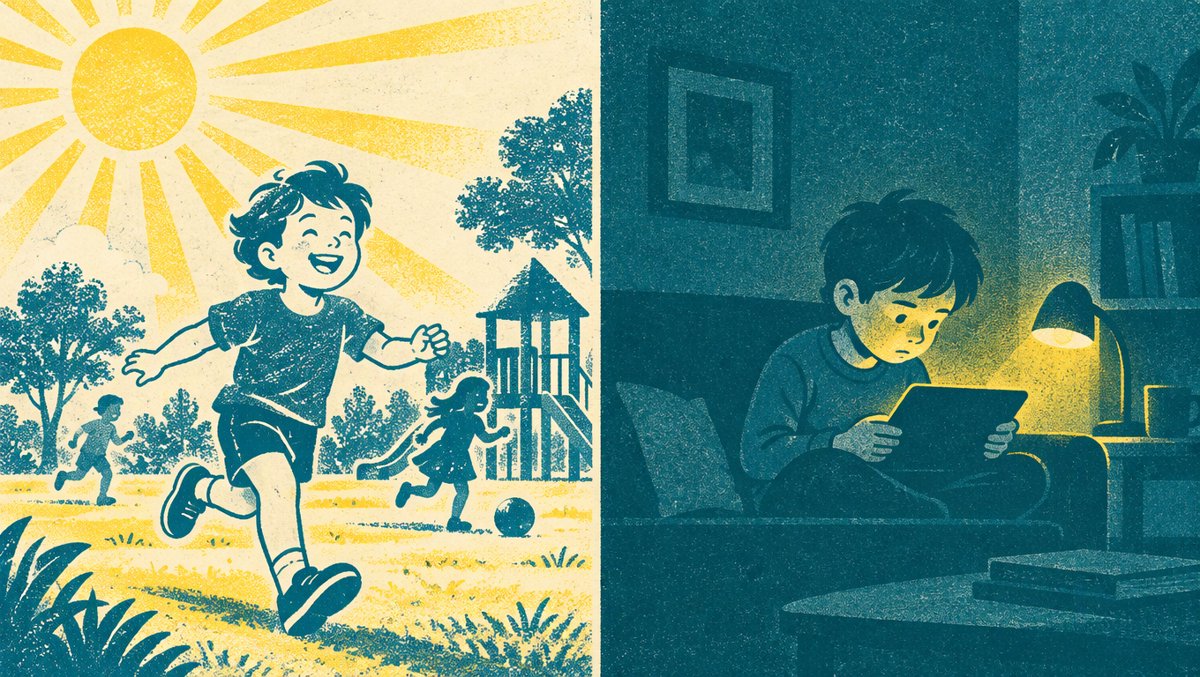
Picture the numbers. A typical classroom or living room measures around 112–156 lux (the unit of light intensity). A sunny day outdoors? Roughly 11,000–18,000 lux — dozens of times brighter.⁸ Researchers believe this intense light triggers retinal dopamine, a chemical messenger that helps keep the eye's growth in check, preventing it from elongating into myopia territory.⁷ (Vitamin D, exercise, and even "looking at faraway things" appear to be supporting cast, not the stars — the light itself carries the plot.⁷)
Now for the question every sun-safety-conscious parent is already asking: "Wait — doesn't my kid need sunglasses and a hat? Doesn't that cancel out the benefit?"
Wonderful instinct — and wonderful news. A clever study using a child-sized light-measuring mannequin found that even in tree shade (5,556–7,876 lux) or wearing sunglasses (1,792–6,800 lux), kids' eyes still receive light levels well above the ~1,000-lux threshold associated with myopia protection.⁸ Translation: sun protection and eye protection are teammates, not rivals. Hat on, sunscreen on, shades on — go play.
One more nuance worth knowing: newer research tracking thousands of children with light-monitoring wristwatches suggests the protective effect is strongest in the youngest eyes and starts to plateau around two hours per day — a "start early, be consistent" message rather than a "more is always better" one.⁹
💡 Key takeaway: It's the brightness of daylight — not the exercise or fresh air — that appears to protect young eyes, and your kid can safely collect that benefit while wearing a hat and sunglasses.
🥗 Section 4: Your Family's Outdoor Game Plan 🏃♀️
Alright — how do you actually get a modern kid two hours of daylight on a school day? Here's your field-tested playbook:
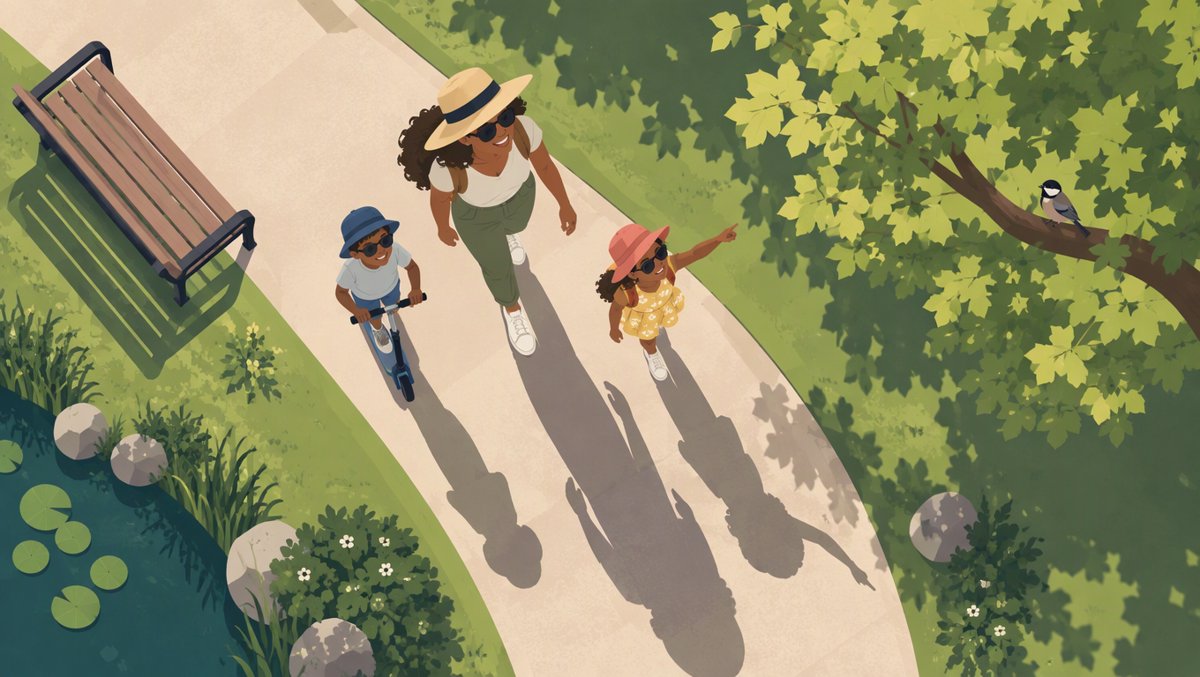
1. Anchor the day with morning light. ☀️ Before school is prime time — walk or bike part of the way, eat breakfast near a window, or do a 15-minute backyard lap before the bell. Morning chunks are easy wins that compound fast.
2. Chop it into bite-size pieces. 🧩 The science counts total daylight, not one heroic session. Twenty minutes at recess, twenty after school, twenty at dusk = solid progress. Think "outdoor snacks," not "outdoor marathon."
3. Make outside the default hangout. 🎾 Move homework-adjacent breaks, playdates, and weekend hangouts to parks and patios. Kids rarely resist fun; they resist logistics. Sidewalk chalk, a ball, a bug-hunting mission — the entertainment takes care of itself.
4. Sunscreen, hat, sunglasses — yes, still. 🧢 As we saw above, protective gear leaves plenty of light for the eyes while shielding skin from UV. Winter note: snow can reflect serious light, so the habit works year-round.
5. Book the eye exam — daylight isn't a substitute. 👓 Pediatric ophthalmology societies like AAPOS recommend regular eye checks and the "20-20-2" habit during near work (every 20 minutes, look at something 20 feet away for 20 seconds), plus at least an hour outdoors daily.¹⁰ If your child squints, sits too close to screens, or complains of blurry distance vision, don't wait — early myopia is exactly the thing we want to catch.
💡 Key takeaway: Two hours of daylight, split into small chunks, with sun protection on — that's the whole prescription. It's free, it's fun, and it's backed by randomized trials.
🎯 Key Takeaways
- Myopia is a genuine global epidemic — nearly 69% of Chinese teens are nearsighted, and high myopia could reach ~1 billion people by 2050, with lifelong risks like retinal detachment and glaucoma.³
- Two hours of outdoor daylight per day is the evidence-based benchmark, associated with up to a 63.7% reduction in myopia incidence in school-based studies.³ ⁵
- The effect is preventive, not curative — outdoor time dramatically lowers the odds of a child developing myopia (OR 0.53 for the most-outdoor kids), but won't slow a prescription that already exists.¹ ⁶
- Bright light is the mechanism — outdoor environments deliver 11,000+ lux versus ~150 lux indoors, and sun protection (hat, sunglasses) doesn't cancel the benefit.⁷ ⁸
- Start early and stay consistent — protection is strongest before glasses appear; pair daily daylight with regular eye exams and the 20-20-2 near-work habit.⁹ ¹⁰
🎧 Key Takeaways — Listen (2 min)
📚 Verified Sources
- Li D, Min S, Li X (2024) — "Is Spending More Time Outdoors Able to Prevent and Control Myopia in Children and Adolescents? A Dose-Response Meta-Analysis," Ophthalmic Research 67(1):393–402. Highest vs. lowest outdoor time: OR 0.53 (95% CI 0.34–0.82); dose-response findings. https://pubmed.ncbi.nlm.nih.gov/38710180/ · Full text: https://karger.com/ore/article/67/1/393/906983/Is-Spending-More-Time-Outdoors-Able-to-Prevent-and
- He M, Xiang F, Zeng Y, et al. (2015) — "Effect of Time Spent Outdoors at School on the Development of Myopia Among Children in China: A Randomized Clinical Trial," JAMA 314(11):1142–1148. 3-year incidence 30.4% (intervention) vs 39.5% (control). https://jamanetwork.com/journals/jama/fullarticle/2441261 · https://pubmed.ncbi.nlm.nih.gov/26372583/
- National Eye Institute, NIH (2024) — "Global perspectives on childhood myopia: addressing the rising epidemic." China teen prevalence 68.9%; ~1 billion with high myopia by 2050; the 63.7% figure; high-myopia complications (retinal detachment, glaucoma, cataract). https://www.nei.nih.gov/research-and-training/research-news/global-perspectives-childhood-myopia-addressing-rising-epidemic
- He X, et al. (2022) — "Time Outdoors in Reducing Myopia: A School-Based Cluster Randomized Trial," Ophthalmology — independent confirmation of the Guangzhou results ("relative decline of 23% over 3 years… 30.4% vs 39.5%") and reduced onset risk with school outdoor programs. https://www.aaojournal.org/article/S0161-6420(22)00483-3/fulltext · https://pubmed.ncbi.nlm.nih.gov/35779695/
- Ho CL, Wu WF, Liou YM (2019) — "Dose-Response Relationship of Outdoor Exposure and Myopia Indicators: A Systematic Review and Meta-Analysis," Int. J. Environ. Res. Public Health 16(14):2595. Daily outdoor light >120 min was the most effective intervention; source of the 63.7% incidence reduction. https://www.mdpi.com/1660-4601/16/14/2595 · https://pubmed.ncbi.nlm.nih.gov/31330865/
- Dhakal R, Shah R, Huntjens B, Verkicharla PK, Lawrenson J (2022) — "Time spent outdoors as an intervention for myopia prevention and control in children: an overview of systematic reviews" (47 studies, 63,920 children) — outdoor light reduces myopia development; progression effect clinically insignificant. https://pmc.ncbi.nlm.nih.gov/articles/PMC9305934/
- Lingham G, Mackey DA, Lucas R, Yazar S (2020) — "How does spending time outdoors protect against myopia? A review," British Journal of Ophthalmology — solid evidence for bright light as the protective mechanism; vitamin D, exercise, and near work unlikely mediators. https://doi.org/10.1136/bjophthalmol-2019-314675
- Lanca C, et al. (2019) — "The Effects of Different Outdoor Environments, Sunglasses and Hats on Light Levels: Implications for Myopia Prevention," Translational Vision Science & Technology 8(4):7. Outdoors 11,080–18,176 lux vs indoors 112–156 lux; hat/sunglass levels remain above the protective threshold. https://doi.org/10.1167/tvst.8.4.7
- Chen J, et al. (2026) — "Time outdoors prevents myopia in hyperopic children, but protection is weaker in premyopic children" (STORM trial post-hoc analysis, 3,194 children with light-monitoring wearables), British Journal of Ophthalmology 110(4):363. https://doi.org/10.1136/bjo-2025-327768
- AAPOS — American Association for Pediatric Ophthalmology and Strabismus, "Myopia and Treatment of Myopia in Children" — 20-20-2 rule and ≥1 hour outdoors daily (with sun protection). https://aapos.org/glossary/myopia-and-treatment-of-myopia-in-children
All claims fact-checked against Gold-tier (CDC/NIH/WHO/PubMed/Nature/The Lancet) and Silver-tier (Mayo Clinic/Harvard Health/Cleveland Clinic) authoritative sources. Last verified: November 15, 2026.
The next time your kids are bouncing off the walls indoors, remember: you're not just managing their energy — you might be managing their eyesight. Two hours of daylight, a hat, and a little muddy fun. That's the prescription. Now go outside — maybe with them? 🌳😎