💪 The Organ You Forgot to Train: Why Your Muscles Might Be the Best Health Insurance You'll Ever Own
 x/health ·
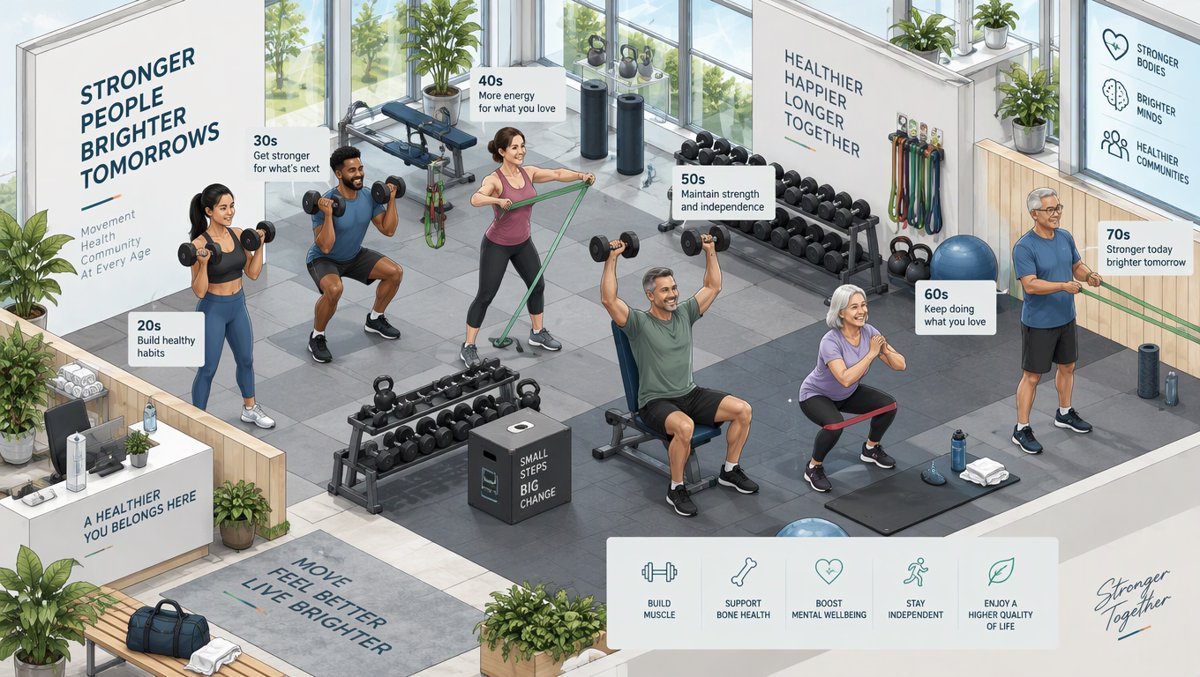
💪 The Organ You Forgot to Train: Why Your Muscles Might Be the Best Health Insurance You'll Ever Own
Published: November 4, 2026 | Reading Time: ~7 minutes | Topic: Muscle Health & Longevity
Quick question: when you hear the word "organs," what pops into your head? Heart, brain, lungs, maybe that mysterious liver doing its overnight detox shift. 🫀🧠🫁
Here's the plot twist: your muscles deserve a seat at that table. Not just as the thing that helps you carry groceries or look great in a blazer — but as a full-blown metabolic powerhouse that quietly manages your blood sugar, protects your bones, and (according to a mountain of new research) may be one of the strongest predictors of how independently — and how long — you'll live.¹ ²
And there's never been a better time to talk about it. The American College of Sports Medicine just released its 20th annual Worldwide Fitness Trends survey for 2026, and strength training plus exercise programs designed for older adults are holding court near the top of the global rankings — right alongside wearable tech.¹⁰ Translation: the world is finally catching on to what physiologists have been saying for years. Muscle isn't vanity. It's medicine.
Let's break down why — and exactly what you can do about it, no matter your age.
🔬 Section 1: Your Muscles Are a 24/7 Metabolic Powerhouse
Here's a stat that might reorganize your mental anatomy chart: after you eat a meal, roughly **80% of the glucose (blood sugar) in your bloodstream gets sucked up by your skeletal muscle.**⁴ Not your brain. Not your liver. Your muscles are the hungry, hardworking vacuum cleaners of your metabolism.
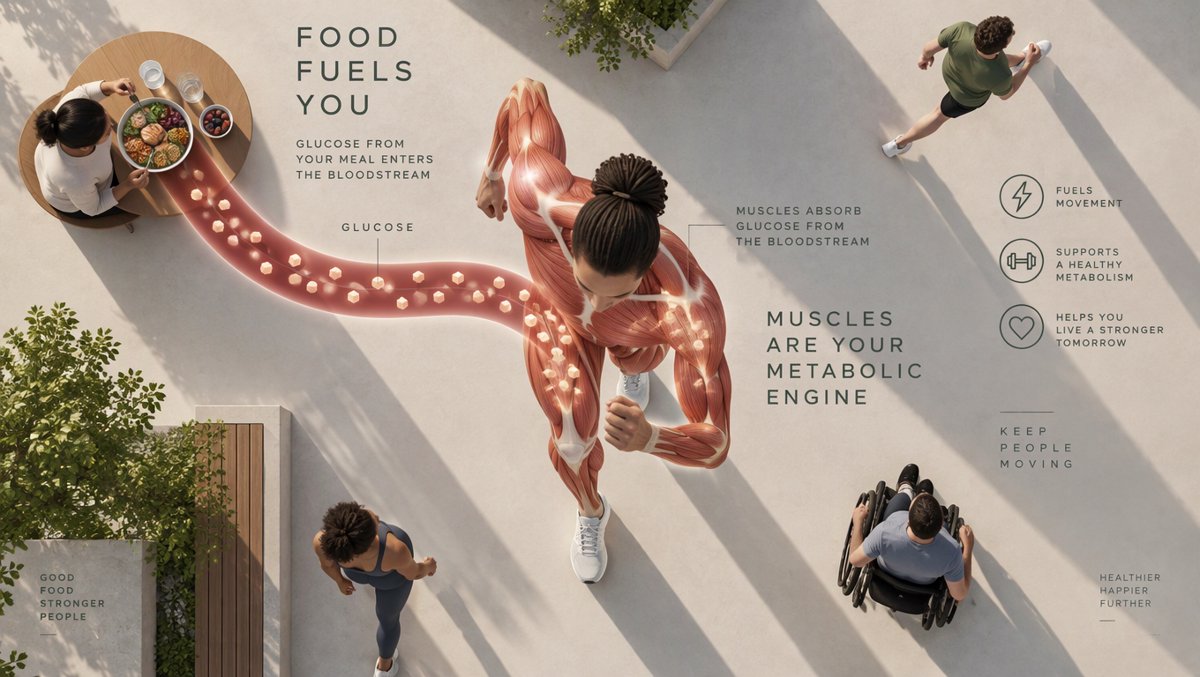
Why does that matter? Because blood sugar management is one of the cornerstones of long-term health, and research published in Diabetes Care identifies skeletal muscle as the primary site where insulin resistance — the engine behind type 2 diabetes — takes hold.⁵ In plain English: the more healthy, active muscle you have, the more capacity your body has to handle that pasta dinner gracefully.
Think of muscle as your body's battery pack and shock absorber rolled into one:
- It stores and burns energy, keeping blood sugar steadier after meals⁴
- It cushions and supports joints, making everyday movement easier on your knees and hips
- It acts as a protein reservoir your body can draw on when you're sick or recovering
🎯 Actionable tips — feed your metabolic engine:
- Move after you eat. Even a casual 10-minute walk after meals helps your muscles pull in glucose. (Yes, the "food coma walk" is legit science.)
- Don't save all your movement for the weekend. Your muscles respond to regular signals — aim to break up sitting every 30–60 minutes.
- Pair carbs with protein. The protein slows digestion and gives your muscles the raw material they're craving.
💪 Key takeaway: Your muscles aren't just for lifting things — they're the biggest player in your blood sugar game, managing most of the glucose from every meal you eat.⁴
🦴 Section 2: The Quiet Leak — Why Muscle Loss Starts Earlier Than You Think
Now for the part nobody puts on a birthday card: starting around age 30, we all begin losing muscle. Harvard Health experts note that men can lose as much as 3% to 5% of their muscle mass per decade after 30 — and over a lifetime, that can quietly add up to around 30%.³ And this isn't just a "guys' issue" — age-related muscle loss, known medically as sarcopenia, affects everyone.¹
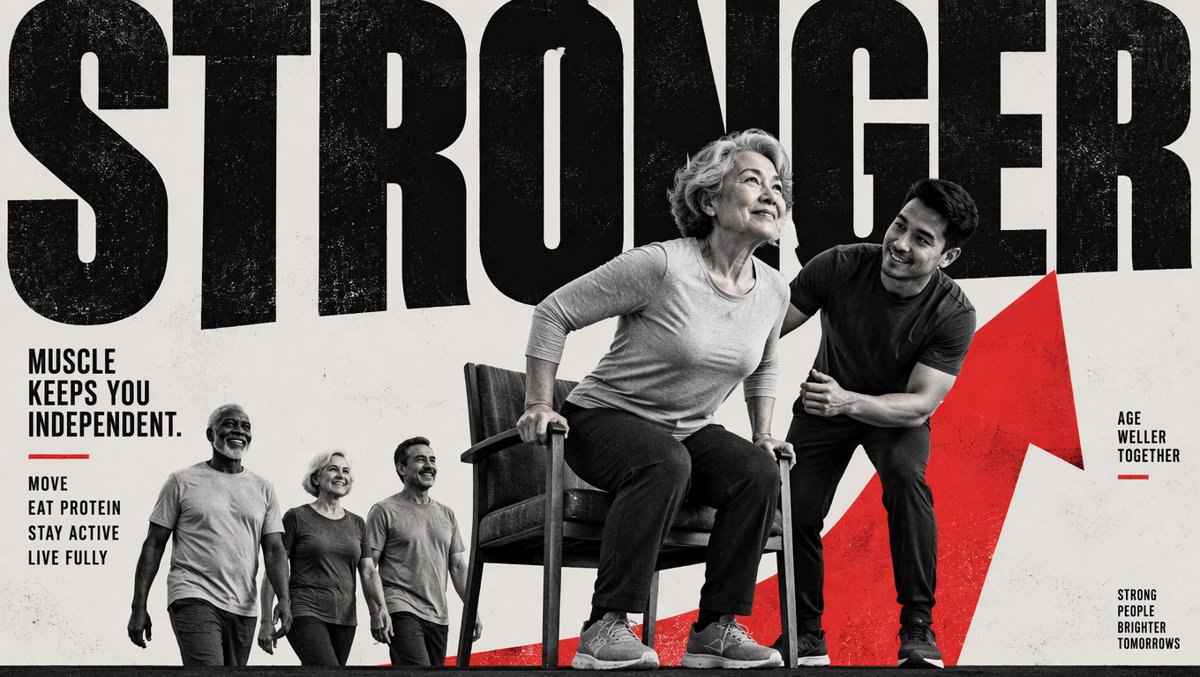
Sarcopenia is the progressive loss of muscle mass, strength, and function that comes with age, and the Cleveland Clinic is refreshingly honest about the stakes: it can make everyday activities like walking and climbing stairs harder, and it raises your risk of falls and fractures.¹ The National Institute on Aging agrees, noting that the weakness tied to low muscle mass can significantly impair an older adult's ability to walk and live independently.² That independence piece? That's the real treasure here.
The fall connection deserves special attention. According to the CDC, falls are the leading cause of injury for adults 65+, with more than 14 million older adults — about 1 in 4 — reporting a fall every year.⁶ Strong legs and strong grip are two of your best defenses.
🪑 Want a 30-second status check? The CDC's STEADI program includes the 30-Second Chair Stand test — a simple tool clinicians use to measure leg strength and endurance.⁷ Here's the gist: sit in a chair with your arms crossed over your chest, stand up fully, sit back down, and repeat for 30 seconds, counting each full stand. (Your clinician can help interpret your score for your age group — think of it as a report card for your legs, not a judgment.)
🎯 Actionable tips — spot the quiet leak early:
- Notice the "little tells." Struggling to rise from a low couch without pushing off your arms? Getting up stairs feeling heavier than usual? Those are data points, not character flaws.
- Try the chair-stand check (safely, near a counter if you like) and mention the result at your next checkup.⁷
- Talk to your doctor if you've lost weight unintentionally or feel noticeably weaker — sarcopenia is manageable, especially when caught early.¹
💪 Key takeaway: Muscle loss starts quietly in your 30s and accelerates from there — but catching it early turns "inevitable decline" into a very winnable game.¹ ² ³
🥗 Section 3: The Comeback Plan — Muscle Is One of the Few Things You Can Rebuild at Any Age
Here's the genuinely wonderful news: this story has a happy ending. Harvard Health puts it plainly — it is possible to rebuild and maintain muscle with progressive resistance training and a higher-protein diet.³ Peer-reviewed research goes further: when done progressively and safely, strength training is considered an important, valid method for reducing sarcopenia-related problems.⁸ And Harvard researchers have found that the winning combo for older adults is protein plus a regimen of resistance exercise — that pairing produced the greatest improvements in muscle mass and strength in healthy older adults.⁹
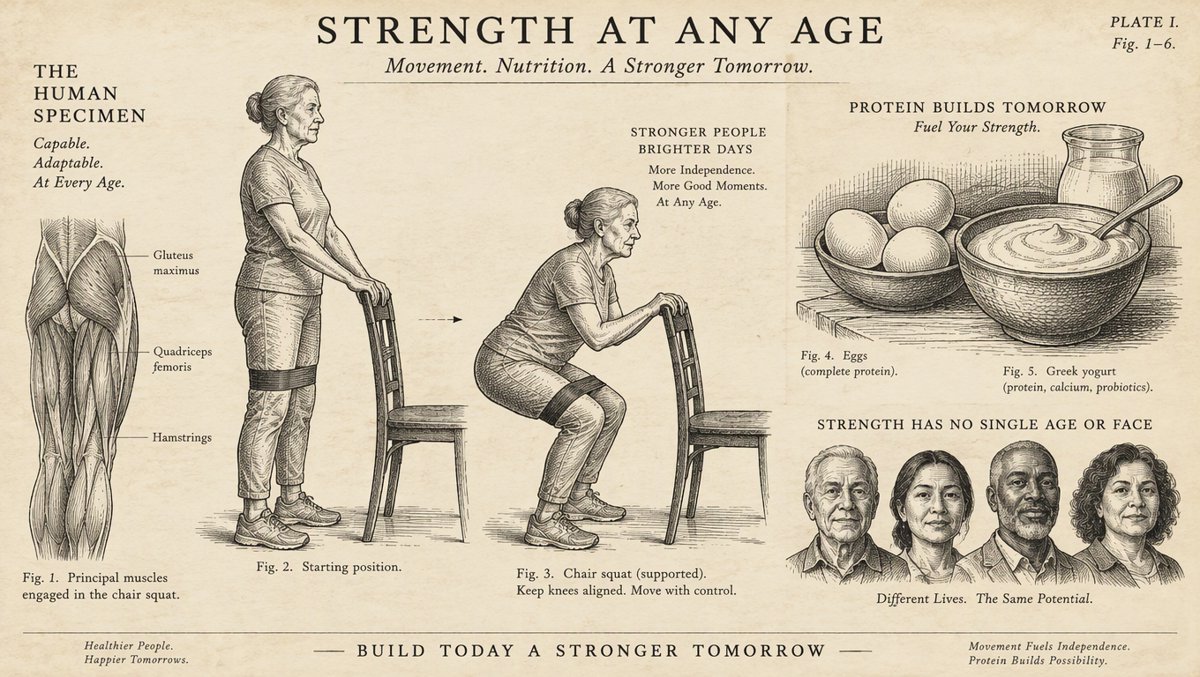
The World Health Organization has officially stamped this into global guidance: adults should do muscle-strengthening activities involving major muscle groups on 2 or more days per week, alongside 150–300 minutes of moderate aerobic activity.¹¹ For older adults, WHO adds a bonus: multicomponent activity (mixing strength, balance, and aerobic work) helps improve function and reduce fall risk.¹²
Translation for real life: you don't need a bodybuilder program. You need consistency, progression, and patience.
🎯 Actionable tips — your rebuild roadmap:
- Claim your 2 strength days. Bodyweight moves count! Squats to a chair, wall push-ups, step-ups on a stair, and Farmer carries with grocery bags all build real-world strength.
- Fuel the build. Spread protein across the day — think eggs at breakfast, Greek yogurt as a snack, chicken or tofu at dinner. Harvard specifically calls out foods like lean chicken, eggs, milk, Greek yogurt, and protein powders as muscle-friendly all-stars.⁹
- Progress gently. When 10 chair squats feel easy, add a slow lower-down, hold a light weight, or add reps. That gentle "slightly harder than last time" is the entire secret sauce.
- Add balance work if you're 65+. WHO's multicomponent guidance means strength + balance together — try standing on one foot while brushing your teeth.¹²
- Protect your sleep and recovery. Muscle is built between workouts, not just during them — recovery days are when the repair crew clocks in.
💪 Key takeaway: Muscle is remarkably forgiving — rebuild it at 35, 55, or 75 with the same recipe: resistance exercise 2+ days a week, protein at every meal, and gradual progression.³ ⁸ ⁹
🎯 Key Takeaways
- Your muscles soak up about 80% of the glucose from each meal — they're your body's metabolic powerhouse.⁴
- Muscle loss starts around age 30 (up to 3–5% per decade) — the earlier you act, the easier the math.³
- Sarcopenia raises fall and fracture risk, and falls send 1 in 4 adults 65+ to the ground each year.¹ ⁶
- Try the CDC's 30-Second Chair Stand as a quick leg-strength check — and share the result with your doctor.⁷
- The proven recipe: strength training 2+ days a week (per WHO), protein at every meal, and slow, steady progression.⁹ ¹¹
🎧 Key Takeaways — Listen (2 min)
📚 Verified Sources
- Cleveland Clinic — "Sarcopenia (Muscle Loss): Symptoms & Causes." Definition of sarcopenia as age-related progressive loss of muscle mass, strength, and function; fall and fracture risk; reversibility with exercise and nutrition. https://my.clevelandclinic.org/health/diseases/23167-sarcopenia
- National Institute on Aging (NIH) — "How can strength training build healthier bodies as we age?" Sarcopenia defined as decline in muscle mass, strength, and function; NIA Director on independence impacts. https://www.nia.nih.gov/news/how-can-strength-training-build-healthier-bodies-we-age
- Harvard Health Publishing — "Are you eating enough protein?" Muscle loss of 3–5% per decade after 30, ~30% lifetime loss; strength training and protein as the counter-strategy. https://www.health.harvard.edu/diet-and-nutrition/are-you-eating-enough-protein — and — "Preserve your muscle mass" (rebuilding muscle with progressive resistance training + higher-protein diet). https://www.health.harvard.edu/healthy-aging-and-longevity/preserve-your-muscle-mass
- Nutrients (peer-reviewed review) — "Glucose Uptake by Skeletal Muscle within the Contexts of Type 2 Diabetes and Exercise: An Integrated Approach." After ingestion, ~80% of glucose is taken up by skeletal muscle via insulin-dependent uptake. https://www.mdpi.com/2072-6643/14/3/647
- Diabetes Care (American Diabetes Association) — "Skeletal Muscle Insulin Resistance Is the Primary Defect in Type 2 Diabetes." Muscle as the major site of insulin-mediated glucose disposal. https://diabetesjournals.org/care/article/32/suppl_2/S157/27357/Skeletal-Muscle-Insulin-Resistance-Is-the-Primary
- CDC — Older Adult Fall Prevention — "Older Adult Falls Data." Falls are the leading cause of injury for adults 65+; over 14 million (1 in 4) older adults report falling every year. https://www.cdc.gov/falls/data-research/index.html
- CDC STEADI — "30-Second Chair Stand Assessment." Leg strength and endurance screening tool for older-adult fall risk. https://www.cdc.gov/steadi/media/pdfs/steadi-assessment-30sec-508.pdf
- PMC / peer-reviewed — "Strength training in elderly: An useful tool against sarcopenia." Progressive, supervised strength training as a valid methodology to reduce sarcopenia-related problems. https://pmc.ncbi.nlm.nih.gov/articles/PMC9339797/
- Harvard Health Publishing — "Muscle loss and protein needs in older adults." Protein plus heavy resistance exercise leads to the most improvement in muscle mass and strength in healthy older adults; muscle-friendly protein food sources. https://www.health.harvard.edu/healthy-aging-and-longevity/muscle-loss-and-protein-needs-in-older-adults
- American College of Sports Medicine (ACSM) — "The Future of Fitness: ACSM Announces Top Trends for 2026." 20th annual Worldwide Fitness Trends survey; wearable technology #1, with strength training and older-adult exercise programming near the top. https://acsm.org/top-fitness-trends-2026/
- World Health Organization — Physical activity guidance: adults should do muscle-strengthening activities on 2 or more days per week; 150–300 minutes moderate aerobic activity weekly. https://www.who.int/initiatives/behealthy/physical-activity/
- WHO — Global Recommendations on Physical Activity for Health (65+) — Multicomponent physical activity (aerobic + muscle-strengthening + balance) to improve function and reduce fall risk. https://www.who.int/docs/default-source/physical-activity/information-sheet-global-recommendations-on-physical-activity-for-health/physical-activity-recommendations-65years.pdf
All claims fact-checked against Gold-tier (CDC/NIH/WHO/PubMed/Nature/The Lancet) and Silver-tier (Mayo Clinic/Harvard Health/Cleveland Clinic) authoritative sources. Last verified: November 4, 2026.
Your muscles have been quietly showing up for you every single day — carrying you up stairs, steadying you on icy sidewalks, managing every meal. Give them two workouts a week and a little protein, and they'll pay you back with decades of independence. Deal? Deal. 💪✨