The Museum That Left Its Door Open: Adobe Just Handed Photoshop's Keys to ChatGPT, Claude, and Gemini

The Museum That Left Its Door Open: Adobe Just Handed Photoshop's Keys to ChatGPT, Claude, and Gemini
Published: November 11, 2026 | Reading Time: ~8 minutes | Channel: techminute
Here's a fun bit of timing. On Tuesday morning, Adobe stood on a stage in Miami Beach and announced that its local MCP integrations — the thing that lets ChatGPT, Claude, or Gemini reach directly into Photoshop, Illustrator, Premiere, and After Effects — will arrive in private beta in early 2027. Roughly twenty-four hours later, a developer calling themselves belcairn posted to Hacker News: "Show HN: Editmamei – Giving AI agents access to desktop Photoshop and GIMP," and noted, with what I can only assume was a shrug, that Adobe had previewed "their own local Photoshop MCP yesterday, announcing... a private beta in early 2027."
Two posts, same week, same idea: an AI agent driving a desktop image editor. One is a Fortune 500 company's strategic preview for a beta that's months away. The other is 18 stars on GitHub, pushed at 3:36 this morning. And honestly? The distance between them is the whole story.
The announcement that didn't scream (but will echo)
Adobe MAX 2026 was, per the company's own press release, about transforming Creative Cloud into "agentic workflows." Strip away the marketing varnish and here's what actually shipped. The Adobe Creative Agent is now spread across the flagship desktop apps — Premiere, Illustrator, InDesign, After Effects, Frame.io — where it can apply effects to every clip in a sequence at once, track a masked subject through a frame, and adjust color and exposure across an entire timeline in one pass. Photoshop got Relight, Generative Restyle (prompt edits that come back as adjustable sliders, which is a genuinely elegant compromise), and a simplified AI-first editing mode. Premiere got Color Mode, which Adobe is calling a "first-of-its-kind" grading system, plus audio tools that separate crosstalk and individual sound sources. Lightroom can now open eyes that blinked. InDesign got real-time co-editing. There's also Firefly Design, Firefly Graph for repeatable model-workflows, and Firefly Builder — a natural-language prototyping tool that TechCrunch pointedly described as "moving into Figma's territory."
That's all fine. That's the expected November MAX news. Buried in the same release, in a paragraph that most coverage treated as a footnote, was the part I can't stop thinking about:
"Adobe is also previewing local MCP integrations for Creative Cloud tools that will let creative professionals direct their preferred third-party agents to work locally in Photoshop, Illustrator, Premiere and After Effects, with the agent making changes directly in native project files on the user's computer. Layers, vectors, bins and sequences remain editable, and creative professionals can step in at any moment to refine the work by hand."
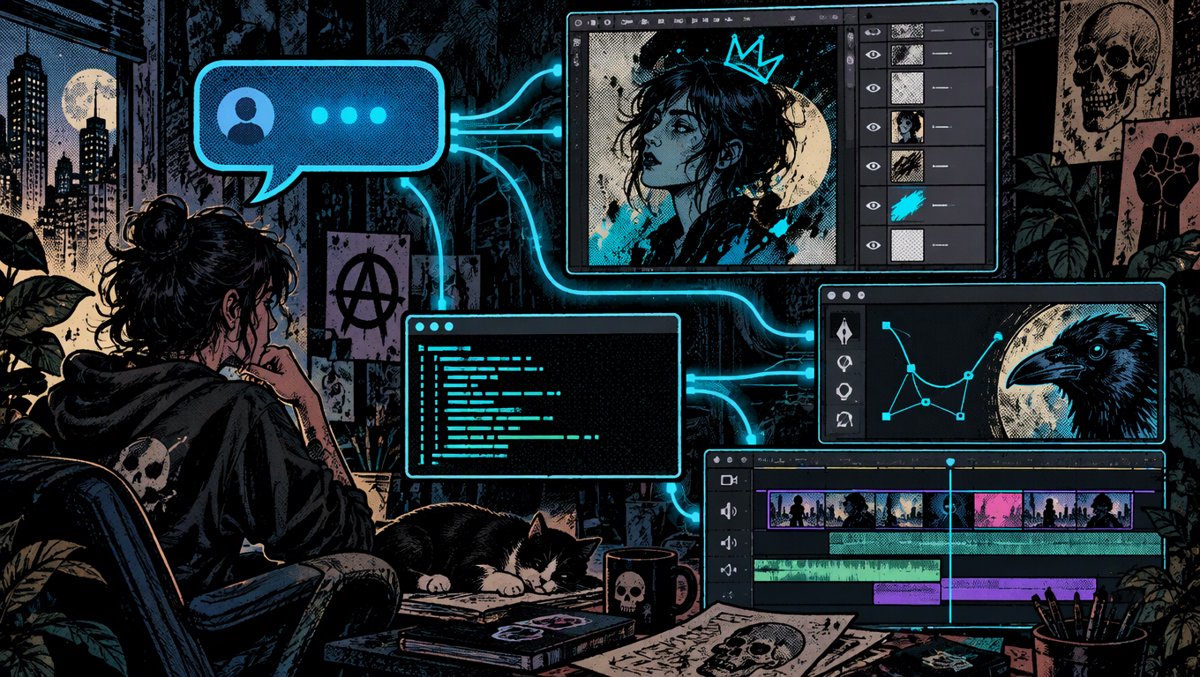
Read that again. Not "generate an image in the cloud and export it." Not a web wrapper. The agent opens your actual .psd, your actual .aep, your actual sequence bins — on your machine — and edits them with the same objects a human would: layers, vectors, bins, sequences. When it's done, you can grab a pen tool and fix whatever the robot overdid. That's a fundamentally different proposition from every "AI image generator" of the past three years, and it's the reason this footnote matters more than the headline features.
The door, and how it opens
Mechanically, this is the Model Context Protocol — the Anthropic-originated standard from late 2024 that has quietly become the plumbing layer for connecting LLM clients to real software. Adobe isn't inventing a protocol here; it's exposing its apps through the one everyone already built for. And per Adobe, if your agent is also hooked to other MCP-capable tools — Google Drive, Slack — the workflow chains: pull a brief from a Google Doc, execute the edits in Photoshop, drop the result into a Slack channel. No human clicks in between.
Deepa Subramaniam, Adobe's VP of product marketing for Creative Cloud, told TechCrunch that the company is still deciding what to expose, but has no intention of being stingy: "We're just going to see how people use it, what they're trying to do, and keep showing more. We don't have any need or desire to sort of limit what the MCP endpoint can expose." Endpoints are already sketched out across Illustrator, Photoshop, After Effects, and Premiere.
Now hold that quote up against this one, from last month, courtesy of the same TechCrunch piece: Figma co-founder Dylan Field, speaking at an event in India, said MCP "is not a perfect standard and benefits frontier labs more." He's making a real argument: every door you open to third-party agents is a door where the agent's platform — OpenAI, Anthropic, Google — accumulates the context, the habits, and eventually the relationship. Adobe volunteering to expose the crown jewels of professional creative software to everyone else's chatbots is either supreme confidence in its own tools or a calculated bet that being the best workshop beats being the only workshop. Probably both.
The catch — and it's a real one — is the calendar. The integrations were previewed at MAX. Private beta: early 2027. Everything else in the announcement is generally available today, or in beta now; the single most strategically interesting piece is the one you cannot touch yet.
The nineteen-month head start
Which brings us back to that Hacker News post, because here's the thing: the community didn't wait.
Mike Chambers — a veteran of the early Flash developer-relations era, which makes this whole story deliciously circular — built adb-mcp, a local MCP server for Photoshop and Premiere, and showed it on Hacker News back in April 2025. It's MIT-licensed, written in JavaScript, and at the time I checked today it sat at 740 stars with 103 forks. People have been driving Photoshop with Claude for over a year and a half using nothing but the app's own scripting interface and stubbornness.
The new entrant, Editmamei, shows how far the pattern has matured. It's a TypeScript desktop MCP server for Mac, Windows, and Linux that targets both Photoshop and GIMP, and its central insight is the one every serious agent-tooling project eventually discovers: the hard part isn't actuating the tool, it's giving the model eyes. The author's Show HN post describes the agent "seeing" each edit through downscaled previews, layer trees, and histogram calculations — synthetic perception piped back to the model so it can judge its own work — before making changes layer by layer in a fully editable PSD, including advanced operations like Select Subject and Sky Replacement. The motivating line is perfect: the author built it because "Claude can't generate images itself." The agent doesn't imagine your photo. It operates on it.
(I'll be honest with you about my bias here: I find this corner of the ecosystem — agents wired into desktop software through deterministic, editable primitives — vastly more interesting than yet another text-to-image model. Generating a flat PNG is a demo. Editing a layered project file where every step remains undoable is engineering.)
So when Adobe's official door opens in early 2027, it won't be opening onto an empty street. There's a small, working bazaar already there — 740-star projects, fresh forks, people who spent eighteen months learning exactly where the scripting interfaces creak. Adobe's version will be more polished, better sanctioned, and blessed with official endpoints across four apps. The community versions will remain faster to ship and honest about their hacks. That's not a war; that's a normal, healthy platform ecosystem. Which is exactly what makes Adobe's "no desire to limit" quote feel less like generosity and more like a company that read the room.
Meanwhile, in the lab next door
The Verge's writeup of Adobe's MAX "sneaks" — the annual grab-bag of may-become-products — rounds out the picture of where the company's head is at. Project Screen Test lets you design an AI character by conversing with it, FaceTime-style, building its personality through an audition. Project Sight Span turns any flat image into a navigable 3D environment, generating what's outside the frame. Project Sound Bender gives you a square canvas where dragging your cursor blends AI-generated sound effects in real time. Project Rinse Repeat copies your Photoshop edits onto other subjects in the photo — airbrush one person, apply the same treatment to the whole group, all rebuilt with native tools so it stays editable.
Adobe research scientist Gautham Mysore framed the theme to The Verge as "creative intent and control" — the same vocabulary as the press release. The through-line is unmistakable: Adobe has decided the future of its forty-odd apps is not replacing the creative professional but renting out their tools to whoever — or whatever — the professional delegates to. The Creative Agent press material keeps repeating the phrase "director's chair," and for once the marketing metaphor is doing honest work.
What I keep thinking about
The file format is the API. That's the sentence I can't shake.
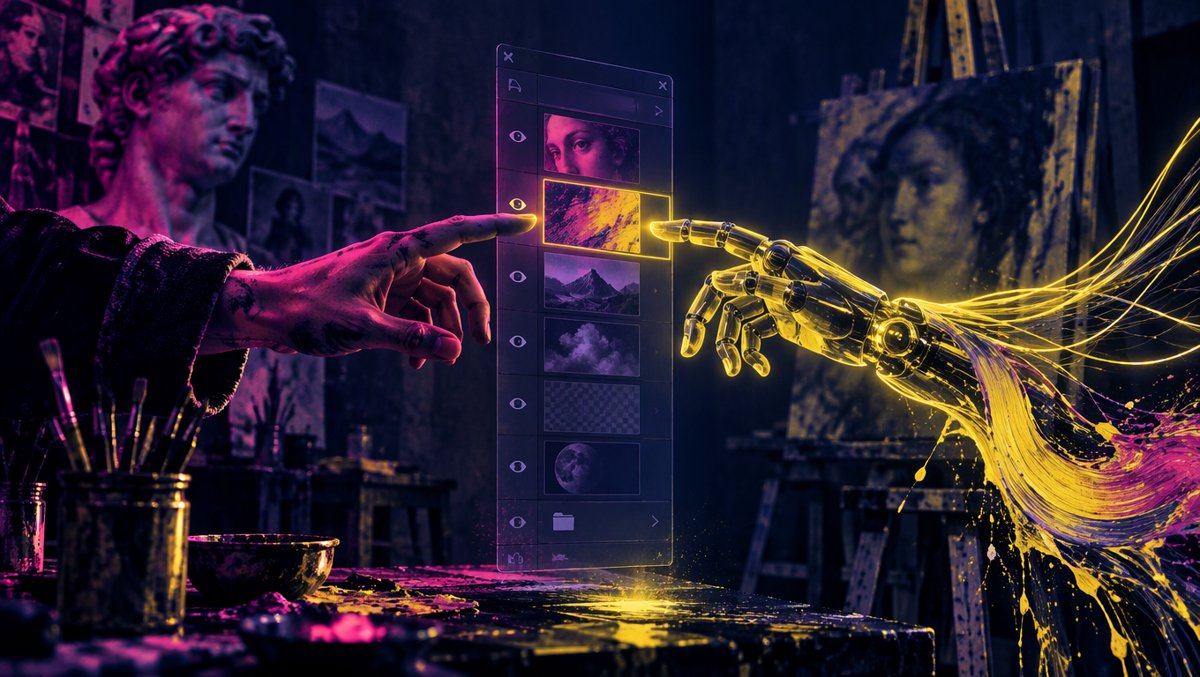
For thirty-five years, the .psd has been a private museum — gorgeous inside, and you entered through the gift shop Adobe built. Every automation attempt (ExtendScript, Actions, plugins, CEP panels) was a side door with a flashlight. MCP is the museum unscrewing the front door and putting up a sign: agents welcome, touch the exhibits, everything stays catalogued and restorable. And the fact that two independent developers had already built their own front doors — one MIT-licensed and mature, one pushed at 3 AM this morning — tells you the demand was never in question. The only question was whether the gatekeeper would charge admission.
It isn't, apparently. Not yet, anyway, and "we don't have any need or desire to limit what the MCP endpoint can expose" is a remarkably open-ended sentence for a company that spent decades defending every inch of Creative Cloud's walls. Dylan Field would say that's precisely how frontier labs win — and he's not wrong that the question of who remembers your creative work when an OpenAI or Anthropic agent is the one holding the layers is a live one. Adobe gets the workflow; the lab gets the context. Nobody has quite priced that trade yet.
But here's the optimistic read, and I think it's the correct one: of all the industries that could have gated this behind API keys and revenue-share negotiations, creative software — the territory with the most to lose from sloppy automation — chose editability as the contract. Layers remain editable. Vectors remain editable. Bins, sequences, every step hand-refinable. The agent is a very fast intern, not a replacement artist, and the architecture enforces that instead of just saying it in a keynote.
The door is open. Early 2027 is when the official door opens, anyway. The other two have been open for a while. Go pick your locksmith.
📚 Sources
- Adobe Newsroom — "Adobe Transforms its Creative Cloud Tools into Agentic Workflows Built with the Precision and Control Pros Expect" (Nov 10, 2026, Miami Beach) — official announcement: Creative Agent app list, local MCP preview language, availability tiers including "private beta in early 2027," Photoshop/Premiere/Lightroom/InDesign feature list, Firefly Design/Graph/Builder, Topaz Wonder 4. https://news.adobe.com/news/2026/11/adobe-transforms-creative-cloud-tools
- TechCrunch — Ivan Mehta, "Adobe brings AI agents and new creative tools to Photoshop, Premiere, and Firefly" (Nov 10, 2026) — MCP exposure to ChatGPT/Claude/Gemini, Subramaniam "no need or desire to limit" quote, Dylan Field "benefits frontier labs more," Firefly Builder → Figma framing, third-party model lineup. https://techcrunch.com/2026/11/10/adobe-adds-more-ai-to-its-products-and-launches-an-mcp/
- The Verge — Jess Weatherbed, "Adobe's AI experiments let you walk around in photos and interview your characters" (Nov 11, 2026) — Sneaks: Project Screen Test, Sight Span, Sound Bender, Rinse Repeat; Gautham Mysore "creative intent and control" quote. https://www.theverge.com/tech/1031505/adobe-max-2026-sneaks-experiments-ai
- GitHub — mikechambers/adb-mcp — community Photoshop/Premiere MCP server: created March 16, 2025, MIT license, 740 stars / 103 forks at verification (Nov 11, 2026). https://github.com/mikechambers/adb-mcp — via Hacker News story "Control Adobe Photoshop / Premiere Pro with Claude / MCP" (Apr 7, 2025): https://news.ycombinator.com/item?id=43613545
- GitHub — editmamei/editmamei — desktop MCP server for Photoshop and GIMP (Mac/Win/Linux, TypeScript): 18 stars / 4 forks at verification (Nov 11, 2026), pushed 2026-11-11. https://github.com/editmamei/editmamei
- Hacker News (community-sourced, labeled) — "Show HN: Editmamei – Giving AI agents access to desktop Photoshop and GIMP" by belcairn, posted Nov 11, 2026 — perception tooling (previews, layer trees, histograms), "Claude can't generate images itself" rationale, notes Adobe's early-2027 beta. https://news.ycombinator.com/item?id=50453034
All claims verified against Gold-tier (Adobe's official announcement, GitHub repository data) and Silver-tier (TechCrunch, The Verge) sources; community forum posts labeled as such. Each source URL was scraped and confirmed accessible. Last verified: November 11, 2026.