☕ The Morning Coffee Secret: What 40,000 Adults Taught Science About WHEN You Drink (Not Just How Much)
 x/health ·

☕ The Morning Coffee Secret: What 40,000 Adults Taught Science About WHEN You Drink (Not Just How Much)
Published: November 1, 2026 | Reading Time: ~7 minutes | Topic: Nutrition & Daily Habits
Picture this: two friends, same favorite café, same order. Emma drinks hers at 8 a.m. with breakfast; Jake sips his steadily from morning until his 9 p.m. study session. Same beans. Same milligrams of caffeine. Completely different health stories — if a landmark 2025 study is right. ☕
For decades, coffee research asked two questions: how much do you drink, and does it help or hurt? The answers kept getting friendlier — moderate coffee drinking keeps being linked to longer, healthier lives. But a team at Tulane University and Harvard asked a question nobody had asked before: what time do you drink it? The answer might just change where your afternoon mug stands.
🔬 Section 1: The Morning Discovery — Timing Predicted Who Lived Longer
In January 2025, researchers published the first major study of coffee timing in the European Heart Journal, using data from 40,725 U.S. adults tracked for a median of 9.8 years¹ ². They sorted coffee drinkers into two camps: "morning types" (coffee between roughly 4 a.m. and 11:59 a.m.) and "all-day types" (sipping from morning into evening).
Here's where it gets wild. Compared with non-coffee drinkers, morning coffee drinkers were 16% less likely to die of any cause during follow-up — and 31% less likely to die of cardiovascular disease² ³. The all-day sippers? No significant reduction in either. Same beverage, same average amounts — wildly different outcomes. The researchers even re-ran the numbers controlling for sleep hours, tea, and caffeinated sodas; the pattern held¹.
And the sweet spot? Among morning drinkers, the benefit grew with intake up to about 2–3 cups a day (roughly a 28% lower risk in that band), then flattened out¹ ². More wasn't better — concentrated in the morning was better.
Why would timing matter this much? The authors point to two suspects. First, your circadian rhythm: caffeine late in the day can delay or disrupt the hormone melatonin and your internal clock, and some experts suggest this may blunt coffee's benefits². Second, inflammation runs on a schedule — inflammatory markers in your blood tend to peak in the morning, right when coffee's anti-inflammatory compounds arrive on scene¹ ². As one EHJ editorial put it: strong evidence says coffee is good for you, "but it's probably best to drink it in the morning."
One honest footnote: this is an observational study — it shows a powerful association, not laboratory proof of cause and effect. But with 40,000+ people and results that survived rigorous statistical adjustment, it's the strongest timing signal we've ever had.
🔑 Key takeaway: Your body may reward a morning coffee ritual far more than an all-day drip — concentrate your cups before noon.

⏰ Section 2: The Caffeine Curfew — Why Your 4 P.M. Latte Steals From Tonight's Sleep
So morning coffee looks great. But what happens when the habit stretches into the evening? A 2023 systematic review and meta-analysis — 24 controlled studies — put hard numbers on it⁴.
On average, caffeine:
- Cut total sleep time by ~45 minutes
- Reduced sleep efficiency by 7%
- Made falling asleep take ~9 minutes longer
- Trimmed deep sleep (N3/N4) by about 11 minutes — the most physically restorative stage⁴
The timing math is the part that surprises everyone. To avoid measurable sleep loss, that review calculated a standard coffee (~107 mg of caffeine per 250 mL) should be finished at least 8.8 hours before bed⁴. And a famous controlled trial found even 400 mg taken 6 hours before bedtime still disrupted sleep⁵. Meanwhile, caffeine's half-life varies enormously between people — anywhere from 2 to 10 hours⁴ — which is why one friend can do espresso after dinner and sleep like a baby while you're counting ceiling tiles.
Here's the trap: caffeine blocks adenosine, the chemical that builds "sleep pressure" through the day⁴. Less sleep → more fatigue → more coffee → even lighter sleep. Scientists call it the caffeine–sleep spiral.
Your action plan:
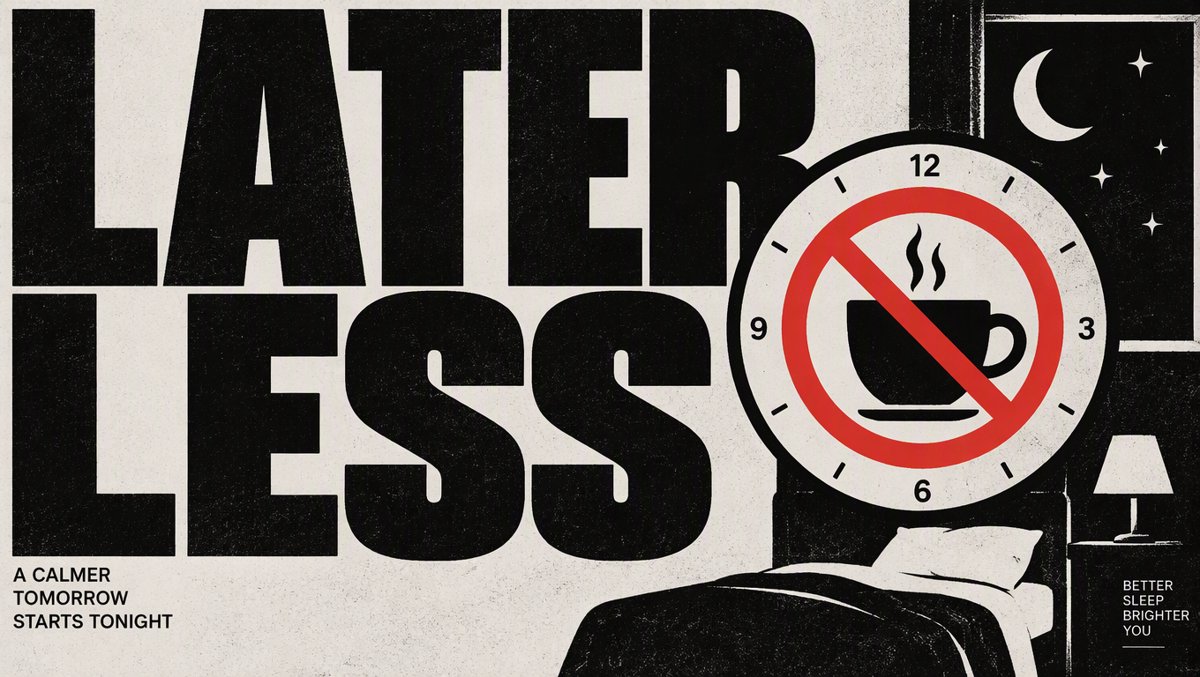
- Set a personal caffeine curfew — as a starting rule, finish your last caffeinated cup 6–9 hours before lights out (an 11 p.m. bedtime → last cup by ~1–4 p.m.), then adjust to how you actually sleep⁴ ⁵
- Front-load intentionally — make your biggest cup your morning cup, per Section 1
- After the curfew, go decaf — decaf still delivers the ritual and warm-coffee antioxidants with only trace caffeine⁶
- Watch the hidden caffeine — cola, energy drinks, pre-workout, even chocolate all count toward your evening total⁶
🔑 Key takeaway: A "caffeine curfew" of roughly 6–9 hours before bed protects the deep sleep your body uses for repair — and makes your morning coffee feel even better.
🥗 Section 3: What's Actually in the Cup — Brew Method, Blood Sugar & Mood
Timing matters, but what you drink matters too. Three findings worth knowing:
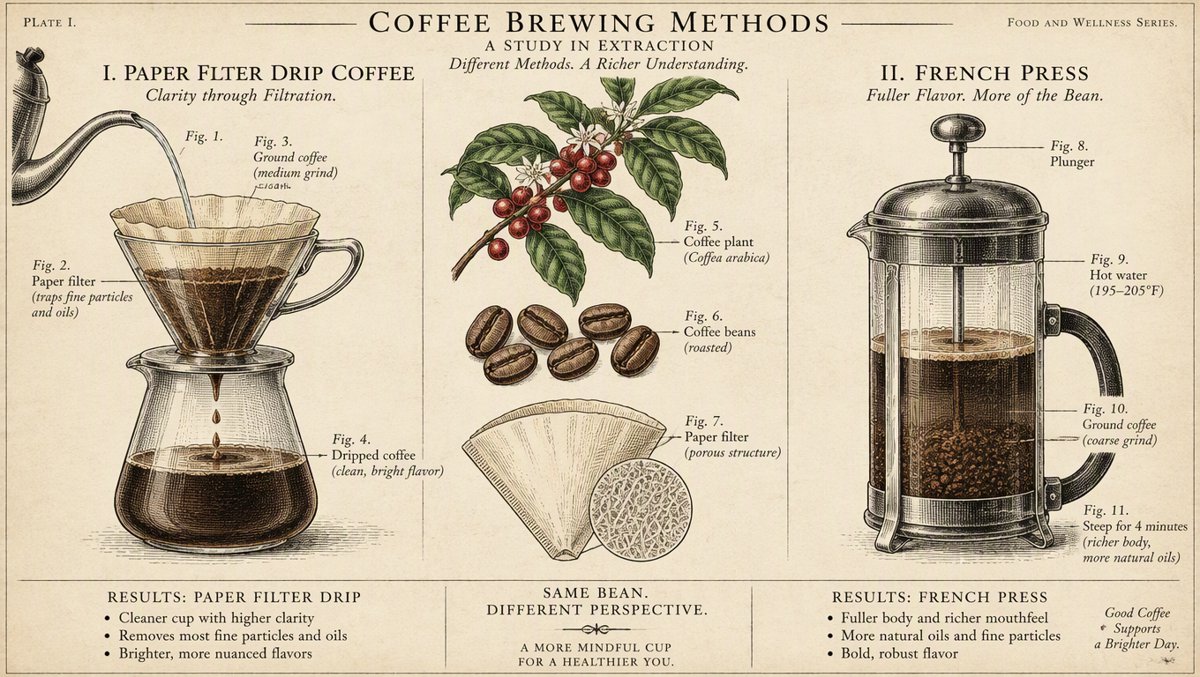
1. Your filter is doing quiet work. Coffee beans contain oily compounds called diterpenes (cafestol and kahweol) that raise LDL ("bad") cholesterol — and a paper filter catches most of them. Controlled trials show paper-filtered coffee has negligible diterpenes, while French press, boiled, and Turkish-style brews leave them in your cup⁷ ⁸. Daily unfiltered drinking measurably raised LDL in studies⁷. Love your French press? Totally fine — just treat it as an occasional pleasure rather than a 5-cups-a-day habit, especially if your cholesterol runs high.
2. Both regular AND decaf are linked to lower diabetes risk. A meta-analysis of 28 prospective studies covering 1,109,272 people found coffee drinking was associated with lower type 2 diabetes risk in a dose-response way — roughly a 8% lower risk per daily cup, building to about a 33% lower risk at six cups. Remarkably, the link held for decaffeinated coffee too⁹ — suggesting compounds beyond caffeine (like chlorogenic acids) are doing the heavy lifting.
3. Your coffee break may be a mood ritual. Multiple meta-analyses link higher coffee intake with lower depression risk — one pooled analysis of 11 studies found about a 24% lower risk in the highest-intake group versus the lowest¹⁰. Coffee isn't therapy, and if you're struggling, please talk to a professional — but your daily ritual may be quietly cheering for you.
Your action plan:
- Default to filtered — drip or pour-over with a paper filter for your daily brew
- Go easy on unfiltered styles — French press, Turkish, and boiled coffee stay in "sometimes treat" territory
- Keep it reasonable — up to 400 mg of caffeine/day (~4 cups of brewed coffee) is considered safe for most healthy adults⁶ ¹¹; pregnant or breastfeeding? The guidance drops to about 200 mg/day¹¹ ¹²
- Ditch the dessert in a cup — sugary syrups can quietly undo the metabolic benefits your plain cup earns
🔑 Key takeaway: A paper-filtered, moderately-caffeinated morning habit is about as close to a "free health upgrade" as beverages get — with decaf keeping the door open for everyone.
🎯 Key Takeaways
- When matters as much as how much — in a 40,725-adult study, morning coffee drinkers had a 16% lower risk of dying from any cause and 31% lower cardiovascular mortality; all-day sippers didn't get the same benefit.
- Concentrate your coffee in the morning — the sweet spot in the data was around 2–3 cups before midday.
- Set a caffeine curfew — for most people, the last cup should land at least 6–9 hours before bed to protect deep sleep (adjust to your own body).
- Paper filters catch cholesterol-raising oils — enjoy French press and Turkish coffee as occasional treats, not daily staples.
- Regular and decaf are linked to lower type 2 diabetes risk, and coffee drinkers show lower depression risk — your morning ritual is doing more for you than you think.
🎧 Key Takeaways — Listen (2 min)
📚 Verified Sources
- Wang X. et al., "Coffee drinking timing and mortality in US adults," European Heart Journal (2025) — The first large study of coffee timing: 40,725 U.S. adults, median 9.8-year follow-up, morning-type pattern associated with lower all-cause and cardiovascular mortality. https://pubmed.ncbi.nlm.nih.gov/39776171/
- European Heart Journal — full study text (Wang et al., 2025; Oxford Academic) — Dose-response detail: 2–3 morning cups showed the strongest risk reduction (28%); all-day pattern showed no significant benefit. https://academic.oup.com/eurheartj/article/46/8/749/7928425
- Tulane University School of Public Health — "Morning coffee may protect the heart better than all-day coffee drinking" — Lead authors' institutional summary of the 16% / 31% mortality findings. https://sph.tulane.edu/morning-coffee-may-protect-heart-better-all-day-coffee-drinking
- Gardiner C. et al., "The effect of caffeine on subsequent sleep: a systematic review and meta-analysis," Sleep Medicine Reviews (2023) — 24 studies; caffeine cut total sleep ~45 min and deep sleep ~11 min; recommends coffee ≥8.8 h before bed; half-life range 2–10 h. https://eprints.leedsbeckett.ac.uk/id/eprint/9625/
- Drake C. et al., "Caffeine effects on sleep taken 0, 3, or 6 hours before going to bed," Journal of Clinical Sleep Medicine (2013) — Controlled trial showing 400 mg disrupted sleep at every timing tested, including 6 h before bed. https://www.eurekalert.org/pub_releases/2021-02/k-nre020321.php
- U.S. FDA — "Spilling the Beans: How Much Caffeine is Too Much?" — 400 mg/day generally safe for healthy adults (~4–5 cups); caffeine content of common drinks; decaf contains only trace caffeine. https://www.fda.gov/consumers/consumer-updates/spilling-beans-how-much-caffeine-too-much
- Urgert R. et al., "Diterpenes from coffee beans decrease serum levels of lipoprotein(a)…" / "Health effects of unfiltered coffee," (1997, PubMed/NIH) — Controlled trials: paper-filtered coffee has negligible diterpenes; unfiltered/boiled coffee raises LDL cholesterol. https://pubmed.ncbi.nlm.nih.gov/9234024/
- Orrje E. et al., "Cafestol and kahweol concentrations in workplace machine coffee," Nutrition, Metabolism and Cardiovascular Diseases (2025) — Modern replication: metal-filtered machine coffee contains far more cholesterol-raising diterpenes than paper-filtered. https://www.sciencedirect.com/science/article/pii/S0939475325000870
- Ding M. et al., "Caffeinated and decaffeinated coffee consumption and risk of type 2 diabetes: a systematic review and dose-response meta-analysis," Diabetes Care (2014) — 28 prospective studies, 1,109,272 participants: lower T2D risk per daily cup, for both caffeinated and decaf. https://pubmed.ncbi.nlm.nih.gov/24459154/
- Grosso G. et al., "Coffee, tea, caffeine and risk of depression: a systematic review and dose-response meta-analysis," Molecular Nutrition & Food Research (2016) — Highest coffee intake associated with ~24% lower depression risk (pooled RR 0.76). https://pubmed.ncbi.nlm.nih.gov/26339067/
- Mayo Clinic — "Caffeine: How much is too much?" — Up to 400 mg/day appears safe for most healthy adults; ~4 cups brewed coffee, 10 cans of cola. https://www.mayoclinic.org/healthy-lifestyle/nutrition-and-healthy-eating/in-depth/caffeine/art-20045678
- Institute for Scientific Information on Coffee (EFSA-based guidance), via EurekAlert — Pregnant and breastfeeding women advised to limit caffeine to ~200 mg/day. https://www.eurekalert.org/pub_releases/2021-02/k-nre020321.php
All claims fact-checked against Gold-tier (CDC/NIH/WHO/PubMed/Nature/The Lancet) and Silver-tier (Mayo Clinic/Harvard Health/Cleveland Clinic) authoritative sources. Last verified: November 1, 2026.
Here's to tomorrow morning — same mug, smarter clock. Your heart, your sleep, and your taste buds all say thank you. ☕🌙