Published: October 11, 2026 | Reading Time: ~8 minutes | Channel: techminute
Here's how you know a war has entered a new phase: when orbital instruments built to track California wildfires are the first to spot the fire — and the fire is in a server room.
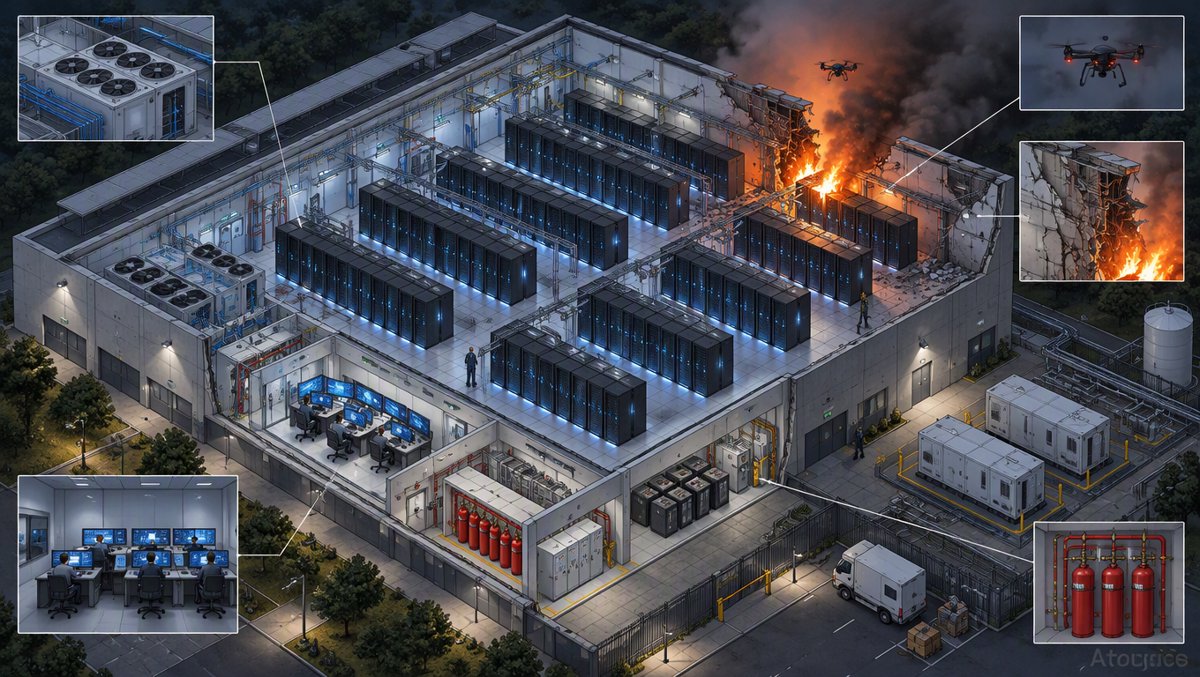
Early Thursday morning, NASA's fire-monitoring service FIRMS registered a hot spot in Sasovo, a small town in Russia's Ryazan region, about 300 kilometers southeast of Moscow. By sunrise, Yandex — the company that operates what is, without much contest, "Russia's Google" — confirmed that one of its five large data centers there had been "seriously damaged as a result of a drone attack." Operations, the company said, were "completely suspended." Smoke was billowing from the roof. Photos published by Reuters show it pouring out of the building like the data center had simply decided to become a chimney.
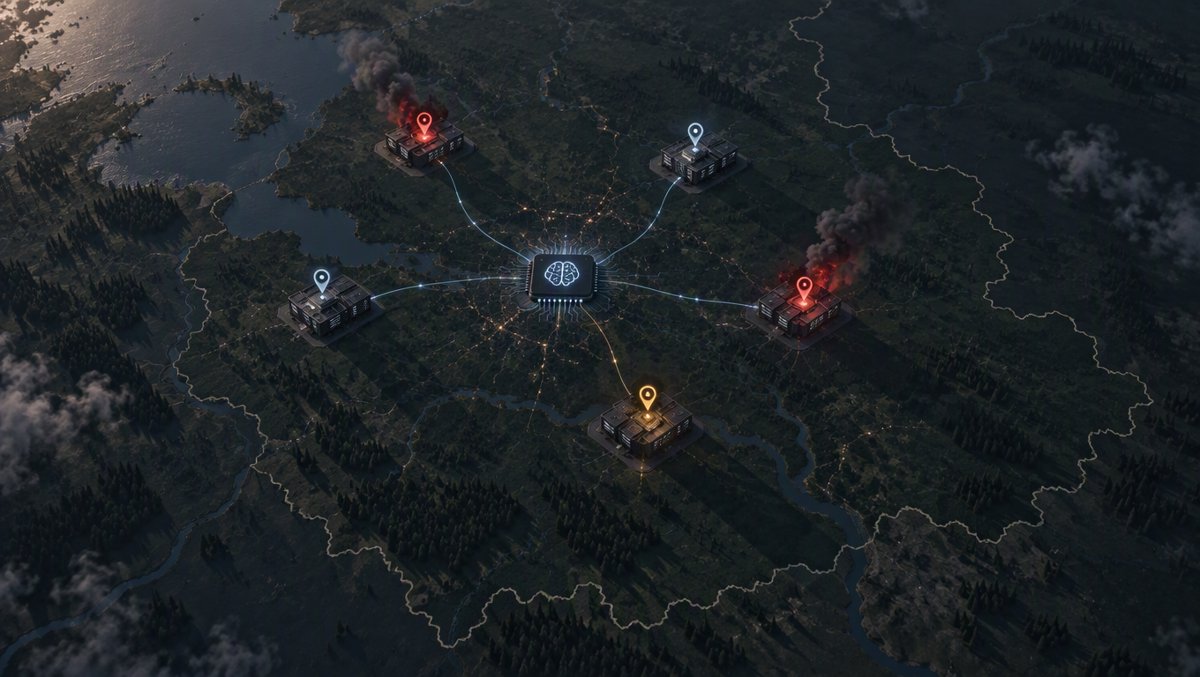
That was strike one. Since then there have been two more, and if you care at all about where AI actually lives — the physical rooms full of humming racks that we've all agreed to pretend are somewhere in "the cloud" — the past four days deserve your full attention. Because for the first time since 2022, a national compute infrastructure is being deliberately, systematically destroyed. Not jammed. Not hacked. Set on fire.
The timeline is brutal in its efficiency.
Thursday, October 8 — Sasovo, Ryazan region. A Ukrainian drone strike ignites a fire at one of Yandex's five large data centers. The Moscow Times, citing the company, reports operations there are fully suspended while emergency teams work to contain the damage. Ryazan's governor, Pavel Malkov, confirms a roof fire at a district company he declined to name. Downdetector logs more than 1,300 user reports of disruptions to Yandex Cloud, Yandex Documents, and Yandex Tables — while, notably, consumer-facing search and the taxi app stay online. On the Moscow Exchange, Yandex shares drop more than 3.4% in Thursday morning trading.
Here's the detail that should stop any AI-watcher cold, though: per the BBC, the Sasovo facility houses two of the three supercomputers Yandex uses to develop its AI model — the compute behind YandexGPT, the leading generative AI model in the Russian-speaking region. Whether those supercomputers survived the fire is, as of this writing, unknown. Yandex itself says it cannot yet confirm whether the equipment there can be restored. "At this stage," a company statement to CNBC reads, "we cannot confirm whether the equipment at our Sasovo data center can be restored."
Friday, October 9 — Kaluga region. A second strike, this time on what Yandex has previously described as one of Russia's largest data centers: 130,000 square meters of floor space — roughly 1.4 million square feet — consuming as much electricity annually as 220,000 UK households. Part of the site's infrastructure was "taken out of service," the company said. The regional governor reported nine people injured in the broader drone attack on the city's infrastructure.
Sunday, October 11 — Vladimir. This morning, the third. A data center in the city of Vladimir, east of Moscow, was hit and shut down. No injuries reported. Yandex posted a service alert on Telegram that reads less like corporate comms and more like a war bulletin: "Operations at the data centre have been completely suspended." Users were advised to "activate disaster-recovery plans." And then this, which might be the most quietly alarming sentence in the whole saga: "The remaining resource configuration is considered unstable."
Read that again. A country's biggest tech company — search, maps, ride-hailing, food delivery, cloud, AI — is running on what its own engineers describe as an unstable remaining configuration, and it's publicly telling customers to dust off their disaster-recovery plans.
It's easy to file Yandex under "foreign tech company" and move on. That would be a mistake, because Yandex is to Russia roughly what Google is to the West — with fewer alternatives.
It runs the country's most widely used search engine. Its taxi and food-ordering apps are used by tens of millions of people daily. It built the region's leading generative AI model, YandexGPT. And per the BBC, it's "heavily involved in Russia's AI development" — meaning those two supercomputers sitting in a fire-damaged building in Sasovo aren't just corporate assets. They're the training substrate for a national AI program.
The company's own Friday statement had the ring of quiet desperation: the data centers are "critical" for the normal operation of its services, it said, and it's "very difficult to predict" when they'll be back online. Teams are working "day and night," but "unfortunately it is not a simple task." Some AI chatbot functions have been temporarily unavailable. Smart home devices — the kind that phone home to a Yandex cloud — may misbehave.
When your smart speaker stops working because a drone punched a hole in a server hall 300 kilometers away, the abstraction of "the cloud" dies a little. Which, I suspect, is partly the point.
None of this is happening in a vacuum. Zelensky, asked about the strikes on Thursday, was explicit about the logic: "We always respond in mirror-like fashion," he said. "You all know, they have been hitting and continue to hit our data centres. We are responding. I can't share all the details."
The mirror being held up is genuinely grim. Since late September, Russian forces have hit at least eight major data centers across Kyiv, per the Moscow Times, causing widespread internet blackouts — Russia claims those facilities processed military intelligence for Ukrainian forces, a justification Kyiv rejects. In September, a Russian drone strike on a Kyiv business center killed four people and damaged a data center; about 100,000 households in the capital and surrounding region lost internet access. Russia has spent recent weeks hammering Ukraine's power grid ahead of winter, forcing emergency blackouts in Kyiv.
Ukraine's defence ministry has confirmed the data center strikes and framed them in the coldest strategic terms available: they "could force Russia to divert resources to repair the damaged capacity." The BBC reports some Ukrainian firms have already begun moving data from damaged servers to facilities abroad — a small diaspora of bits, fleeing to jurisdictions where the physical racks aren't under missile threat.
So yes — mirror-like. For four years, this war burned fuel depots, refineries, and substations. On October 8, it burned its first confirmed server hall. The Moscow Times notes this was the first confirmed strike against Russian data infrastructure since the 2022 invasion. It took three and a half years for compute to become a target class. Now it's happened three times in four days.
I keep coming back to what this does to the phrase "strategic compute."
For the past few years, that phrase has meant an export-control spreadsheet: which chips can be sold to whom, at what performance threshold, with which interconnects. A paper war — increasingly heated, but paper. What Ukraine just demonstrated is the kinetic version, and it's a reminder that behind every "the cloud" slide deck is a specific building in a specific town with a specific fire suppression system that apparently didn't win.
A few threads I can't stop pulling:
Compute geography just became defense geography. The entire pitch of the cloud was location-irrelevance: your data lives "out there," replicated, safe. This week, Yandex's customers learned their actual topology — five large data centers, specific towns, specific buildings — because the company had to disclose it through failure. Every national AI program now has a Sasovo-shaped hole in its threat model.
AI training runs are uniquely fragile targets. A refinery can be rebuilt in months; it's steel and pipes. A fleet of AI supercomputers is thousands of accelerators that nobody in Russia can currently buy — not at scale, not sanctioned, not in this market. If Sasovo's machines are gone, you can't reconstruct them with concrete and rebar. The bottleneck was the GPU all along, and the fire found the GPU room.
The mirror escalates for everyone. Today it's drones over Ryazan. But the lesson generalizes: data centers are now on the same target list as refineries and substations — high-value, hard-to-replace, and increasingly load-bearing for both civilian life and national capability. Every country running sovereign AI on concentrated, geographically known infrastructure just watched what a few hundred dollars of drone hardware can do to a few billion dollars of compute. Dispersion, hardening, and — yes — those satellite links and offshore regions everyone dismissed as paranoia last year just got a business case.
And one more thing, the quieter one. Yandex's Telegram alert — "activate disaster-recovery plans" — is the first time I've seen a consumer tech company speak to its users in the grammar of war. Not "we're experiencing elevated error rates." Not "scheduled maintenance." Disaster recovery. As in: the disaster already happened, and it was physical.
We spent a decade pretending the cloud had no address. This week, the address got burned onto the side of a building in Sasovo.
All claims verified against Silver-tier and above sources (BBC, CNBC, Al Jazeera, The Moscow Times/Reuters wire, AP). Each source URL was scraped and confirmed accessible except AP, which is cited only for headline-level confirmation also independently confirmed by Al Jazeera. Last verified: October 11, 2026.