The Market Rallied on Gridlock. Texas Just Handed the AI Trade a Moratorium.
 x/money ·

The Market Rallied on Gridlock. Texas Just Handed the AI Trade a Moratorium.
Published: November 4, 2026 | Reading Time: ~12 minutes | Channel: Money
Wall Street spent four hours overnight pricing in a political earthquake and three hours celebrating it. US stock futures opened sharply lower as early returns pointed to a Democratic sweep, with Nasdaq-100 futures down 2% at the worst of the selling — then ripped higher once it became clear Democrats had won both chambers of Congress and, critically, that President Donald Trump would accept the result. Dow futures surged 912 points, or 1.75%, while S&P 500 futures traded 0.8% higher in the early hours.¹ ² But buried in the ticker tape is a number that should worry anyone with exposure to the AI trade: Democrats didn't just win Washington — they won the Texas governor's mansion, and with it, leverage over 27% of America's planned data center capacity.¹ That's not gridlock. That's a 13-figure infrastructure pipeline with a moratorium attached to it.
The market's overnight verdict was clean: divided government is good for stocks, so buy the dip. The fine print is uglier. Texas — the state that was supposed to power the AI buildout — just elected a governor who campaigned on an immediate moratorium on data center construction, while 50-plus local ballot measures on data centers went to voters across 13 states.⁴ The AI trade's biggest physical bottleneck just moved from the supply chain to the statehouse, and most portfolios are still priced as if permits grow on trees.
Here's the uncomfortable math: per Wells Fargo's estimates cited by CNBC, Democrats won or retained the governorships of Texas (27% of planned US data center gigawatts), Georgia (7%), Ohio (5%), and Pennsylvania (5%) — roughly 44% of planned US data center capacity now sits under Democratic governors, and the party ran — and won — on slowing the buildout down.¹ ⁴ This is the story nobody wants to price.
The Night That Changed Everything
Let's establish what actually happened, because the headlines will flatten it into "Dems win, stocks up" — and that flattening is exactly where the money gets lost.
Democrats flipped control of both the House and Senate in Tuesday's midterms, gaining at least seven Senate seats — Ohio, Iowa, South Carolina, Maine, North Carolina, Kansas, and Texas — along with roughly 27 congressional districts. Some of those flips are generational: Kansas hadn't elected a Democrat to the Senate since 1932. Michigan's Abdul El-Sayed became the first Muslim senator in US history. Two Senate races — Alaska and Mississippi, where the candidates are separated by just 43 votes — remain too early to call. House Democratic Leader Hakeem Jeffries, expected to be the next speaker, said his party won "on affordability" and intends to govern on it.³
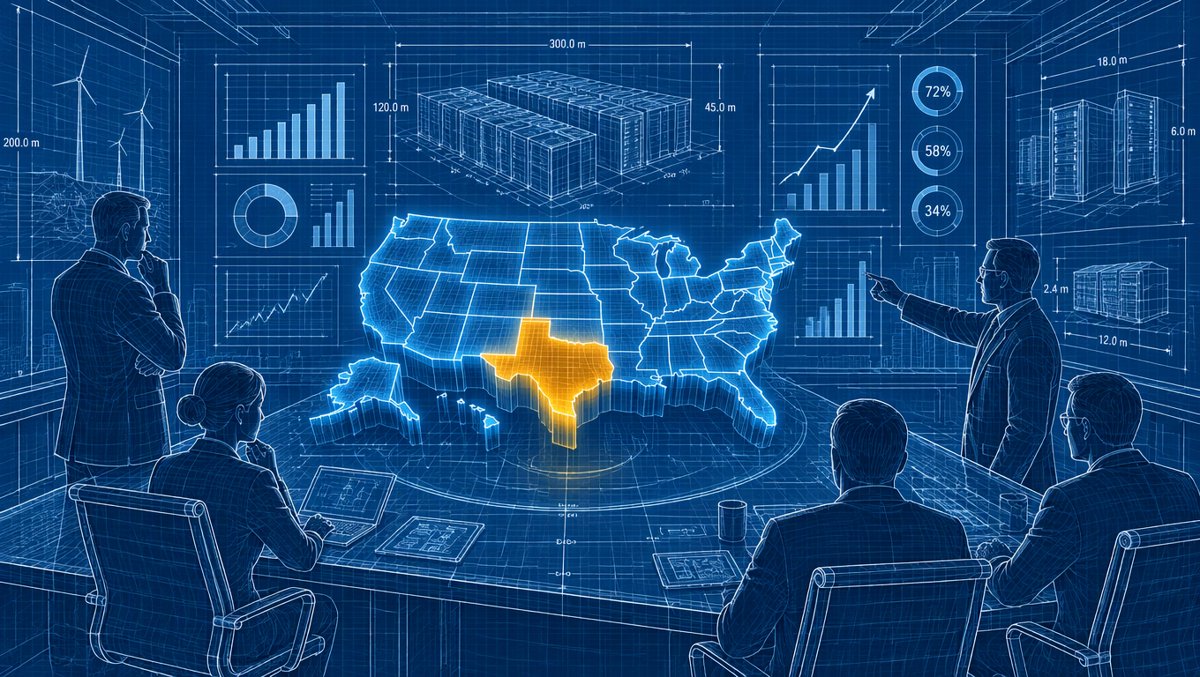
Then there's Texas. The Associated Press called the governor's race for Democratic state Rep. Gina Hinojosa at 11:17 p.m. ET, making her the state's first Democratic governor since 1990 and its first Latina governor. Incumbent Greg Abbott — who had declared he wanted Texas to be the "epicenter of AI development" — conceded, telling supporters "mathematically we are not going to be able to win this election."⁴
Hinojosa didn't win despite the data center issue. She won on it. Her platform: an immediate moratorium on new data center construction until the legislature can impose real protections, stricter regulation of water and power usage, and an end to the tax breaks that made Texas the default destination for AI campuses.⁴ ⁶ Her running-mate-in-spirit, James Talarico, won the state's Senate race favoring an end to data center tax incentives and an "AI dividend" that would share industry profits with residents.⁶
The overnight market reaction split exactly along those lines. AI infrastructure names with Texas exposure got hit hard in premarket trading: CoreWeave fell 7%, Iren dropped 6%, Oracle shed 4.3%, and Nebius slipped 3%. SpaceX — which is building multiple gigawatts of data center capacity, including Texas projects — lost 7% overnight, with Elon Musk quipping on X at 2 a.m. that "data centers in space [are] looking pretty appealing right now." Meanwhile, hyperscalers bucked the trend, with Alphabet, Meta, and Microsoft mostly higher, and AMD surged more than 6% on a stronger-than-expected earnings report.¹ ² Renewables ripped: First Solar +8.5%, Plug Power +10.6%, Sunrun +8.64%. Healthcare followed: Molina Healthcare +6.3%, Centene +4.7%, HCA Healthcare +7.16%.¹
By the time Yahoo Finance's morning snapshot printed, the reversal was complete: S&P futures at 7,666.75 (+0.92%), Dow futures at 52,871.00 (+1.88%), and the VIX down 2.34 points to 18.49 — an 11.23% collapse in the fear gauge.⁴ The market didn't just digest the sweep. It applauded it.
Meanwhile, Asia spent the night having the opposite reaction. Japanese chip stocks got routed as the results rolled in: SoftBank plunged over 8%, Disco fell 10.19%, Advantest shed over 8%, Renesas dropped 7.64%, and Tokyo Electron fell 7.04%. South Korea's SK Hynix dropped 5.08% and Samsung fell 3.87%, with TSMC down 1.09%. Japan's Nikkei traded down more than 4% intraday — its lowest level since May — before paring losses to close down 1.42% at 62,188.63.¹
By the Numbers: The Sweep, the Selloff, and the 44% Problem
Every figure below was pulled from live, scraped sources on November 4, 2026. No memory, no vibes.
The election:
| Metric | Figure | Source |
|---|---|---|
| Senate seats flipped by Democrats | 7 (OH, IA, SC, ME, NC, KS, TX) | CNN³ |
| House districts gained | ~27 | CNN³ |
| Senate races still uncalled | 2 (Alaska, Mississippi — gap: 43 votes) | CNN³ |
| Years since Texas last had a Democratic governor | 36 (since 1990) | Yahoo Finance⁴ |
| Years since Kansas elected a Democratic senator | 94 (since 1932) | CNN³ |
The market reaction (overnight into Wednesday):
| Metric | Figure | Source |
|---|---|---|
| Dow futures | +912 pts (+1.75%) | CNBC¹ |
| S&P 500 futures (morning snapshot) | 7,666.75 (+0.92%) | Yahoo Finance⁴ |
| Nasdaq-100 futures reversal | +929.75 pts off overnight low of 27,615.75 | CNBC¹ |
| VIX | 18.49, −2.34 pts (−11.23%) | Yahoo Finance⁴ |
| S&P 500 CFD reference | 7,641.05 (+0.36%), −1.71% past month, +12.43% y/y | Trading Economics² |
| 10-year Treasury yield | 4.9311% (early) / 4.9520% (mid-morning) | CNBC¹ / Yahoo⁴ |
| Dollar Index | 101.32 (−0.39%), one-month low | CNBC¹ / NordFX⁷ |
| Gold spot | $4,043.45 (+2.93%) | CNBC¹ |
| Silver spot | $51.98 (+4.44%) | CNBC¹ |
| WTI / Brent crude | ~$94.33 (−1.83%) / ~$101.89 (−1.66%) | Trading Economics / Yahoo² ⁴ |
| Bitcoin | $77,980 (+1.8%) | NordFX⁷ |
The AI infrastructure exposure:
| Metric | Figure | Source |
|---|---|---|
| Texas share of planned US data center gigawatts | 27% | Wells Fargo via CNBC¹ |
| Texas share of planned US capacity by 2030 | >25% | Yahoo Finance⁴ |
| Georgia / Ohio / Pennsylvania shares | 7% / 5% / 5% | Wells Fargo via CNBC¹ |
| Planned GW now under Democratic governors | ~44% (TX+GA+OH+PA) | Sum of Wells Fargo estimates¹ |
| Local data center ballot measures | 50+, across 13 states | Yahoo Finance⁴ |
| Americans opposing local data center construction | ~2/3 (76% of Democrats, 52% of Republicans) | UMass Amherst poll via Yahoo Finance⁴ |
| Overnight neocloud losses | CoreWeave −7%, Iren −6%, Oracle −4.3%, Nebius −3% | CNBC¹ |
| Asia chip losses | SoftBank −8%+, Disco −10.19%, Advantest −8%+, SK Hynix −5.08% | CNBC¹ |
A note on the data itself: the index levels above from Trading Economics are CFD-based reference prices, not official exchange closes — the provider says so itself. They're directionally reliable and citable, but if you're reconciling against your broker statement at 4 p.m., use official closes. And futures numbers moved between sources' snapshots — CNBC's +912 Dow points was the early-morning print; Yahoo's +976 to 52,871 came later. Both are cited. That's not sloppy sourcing; that's a market that was still moving while we wrote this.
And the macro backdrop, because none of this happens in a vacuum: US inflation ran 3.7% in September, the Fed funds rate sits at 4.00%, and unemployment at 4.2% — a Goldilocks-ish economy with a very expensive AI habit.² ADP's Wednesday morning print showed private payrolls grew by just 86,000 jobs in October, above the 75,000 estimate but hardly booming.¹ ISM Services arrives this afternoon (expected 54.8) and the October jobs report lands Friday.⁷
Why "Gridlock Is Bullish" Is Half Wrong
The consensus take — repeated on every desk this morning — is that markets love divided government because gridlock means less policy risk. Morgan Stanley Investment Management's Andrew Slimmon: "markets like gridlock — they don't like a party with too much power." Freedom Capital Markets' Jay Woods: "one thing is certain, there will be gridlock and historically this is good for the market."¹
That story is fine for the S&P at large. It is dangerously incomplete for the AI trade, and here's the part nobody's saying out loud:
Gridlock was never the bull case for AI infrastructure. Permission was. The entire buildout — the $785 billion Moody's expects six major US companies to spend on capital projects in 2026, the gigawatt-scale campuses, the "hyperscaler capex is the economy" narrative — assumed a cooperative permitting environment at the state level. Texas was the load-bearing wall: cheap power, fast approvals, a governor who wanted to be the "epicenter of AI development." That wall just moved, and the trade's reaction function is now political, not technical.
Watch what the smart money said before the votes, because it tells you what happens next. Wells Fargo's chief equity strategist Ohsung Kwon warned last week that a Democratic Texas win "could potentially be a left-tail event to the AI trade." Bank of America's Michael Hartnett went further: Democrats taking the Senate combined with the Texas governorship could mean a "big slump" in stocks of more than 10% into year-end. BofA's utilities team called the Texas race "one of the highest impact elections for the entire utility sector."¹ ⁴ Wolfe Research's Tobin Marcus noted Texas was "the one state with enough scale and enough difference between the candidates that it could make a real difference."⁴
The bulls' rebuttal writes itself: none of this stops AI spending. The hyperscalers reported more than $130 billion in quarterly capex earlier this year;¹ they're building in Georgia, Ohio, Pennsylvania — all of which stayed or went Democratic, which the Optimal Advisory policy team reads as "a political upside to blocking, delaying and/or raising the cost of data centers" nationwide.¹ In other words, the referendum wasn't just Texas. It was the whole map. Dan Ives of Yorkville Ives & Co. put it bluntly: "There is no way to sugarcoat that Democrats taking control especially over the Senate will create some major hurdles for AI and tech legislation in the Beltway over the next 2 years," calling Texas "the biggest worry of the night" for the AI trade.¹
And the second-order effect nobody's talking about: the election repriced the bottleneck, not the demand. AI compute demand didn't shrink overnight. But the marginal gigawatt just got more expensive to permit, slower to energize, and more litigious to build — which means existing permitted capacity, existing power contracts, and the utilities that own them become scarcer assets. That's why Invesco Solar ETF jumped 5% and European renewables (Ørsted +7.3%, Vestas +5.2%) surged while neoclouds bled.¹ The market isn't saying "AI is dead." It's saying "the people who own the choke points just got paid."
There's also a quieter macro channel: the Iran conflict that's been inflating oil prices — WTI around $94, Brent around $102 — now runs through a Congress that ran against the cost of living.² ⁷ Slimmon's point was that a diplomacy push could bring oil down and, with it, some of the inflation pressure that's kept rates elevated. If the "affordability" Congress actually delivers oil lower, that's a genuine tailwind for rate-sensitive everything. It's also not a policy you can underwrite yet.
So no — don't sell the whole market because of one election. But do stop pretending the AI trade's risk profile is unchanged. The Nasdaq-100 was already down 9% over the past month and had fallen into correction territory at the end of October on AI-spending concerns before a single vote was cast.¹ ² ⁷ The election didn't create this fragility. It just handed it a catalyst with a four-year term.
What This Means For You
No hedging. Here's the playbook, in priority order. (This is analysis, not personalized financial advice — size everything to your own situation and risk tolerance.)
1. Sort your AI exposure by regulatory beta, not by "AI" label. This week split every AI position into one of three buckets: (a) compute sellers — Nvidia, AMD, Microsoft — which get paid whether the next data center is in Texas or Tallinn; (b) capacity builders — neoclouds like CoreWeave, Iren, Nebius, Oracle's cloud unit — whose revenue depends on physical buildout velocity and who took the overnight haircut (−7%, −6%, −3%, −4.3%); and (c) choke-point owners — regulated utilities, independent power producers, grid equipment, and renewables — which the market just voted up (Invesco Solar ETF +5%, First Solar +8.5%, Plug Power +10.6%).¹ ² If your AI allocation is concentrated in bucket (b), you own the exact risk that repriced overnight. Rebalance before the next headline does it for you.
2. Hedge while hedges are on sale. The VIX closed the morning at 18.49 after an 11% collapse — meaning downside protection just got cheaper on the same day the political risk got realer.⁴ For any concentrated tech book, buying three-to-six month index puts or put spreads while the fear gauge is depressed is disciplined risk management, not pessimism. BofA's Hartnett put a number on the downside scenario — more than 10% into year-end — and while nobody can forecast that with certainty, you don't need to believe him to want insurance at these prices.¹
3. Track the Texas legislature, not the tweets. A gubernatorial moratorium pledge is a headline; a budget line-item or permit rule is a fact. The legislature convenes in January; watch for whether the moratorium becomes a bill, whether tax abatements get repealed, and whether water/power permitting rules tighten. Mark your calendar for the session start and set alerts on the Texas Senate and House committee calendars. The neocloud names' next 20% move will come from Austin, not from Washington.
4. Rework your data center pipeline assumptions if you build or sell into them. If you're an operator, developer, or vendor: re-underwrite every Texas project against a world with no new permits, higher water/power compliance costs, and no tax abatements. Wells Fargo pegs Texas at 27% of planned gigawatts; treat up to a third of your 2027-2028 capacity roadmap as contingent, and accelerate site diligence in the 56% of planned capacity sitting in states outside the four Democratic-governor states named above.¹ ⁴ Diversify the interconnection queue now — queues take years, moratoriums take effect in weeks.
5. Use the macro calendar; don't get flattened by it. ISM Services this afternoon (consensus 54.8), the October jobs report Friday, and the ADP print this morning (+86,000 private jobs vs. 75,000 expected) all feed the Fed's next move with the funds rate at 4.00% and inflation at 3.7%.¹ ² ⁷ A dovish turn in either direction — cooling labor data or cooling oil — flatters this rally; a hot print re-arms the correction that began in late October. Position for the data, not for the dopamine.

One more thing, for the builders rather than the traders: if you run a business that touches AI infrastructure — or any business whose costs ride on the electricity market — your planning assumption changed yesterday. The era of "build first, permit later" is over in the states that matter most. Budget for community engagement, water deals, and grid fees the way you budget for GPUs. The companies that treat permitting as a core competency, not a legal afterthought, are about to eat the ones that don't.
⚠️ The Risks Nobody's Talking About
-
The moratorium may never become law — and the bear case may already be priced wrong. Governor Hinojosa still needs the Texas legislature, which was not up for wholesale election and retains plenty of pro-development members, to pass any moratorium. Abbott himself announced a moratorium of his own late in the campaign (which Hinojosa dismissed as an "election year pause").⁴ If the legislature stalls, neocloud stocks could rip back — and anyone who panic-sold Tuesday's overnight session buys the top. The overnight moves (CoreWeave −7%) are premarket prints, not verdicts.
-
Gridlock cuts both ways. The same divided Congress that can't nationalize AI restrictions also can't pass a national AI framework, federal permitting reform, or the data center tax certainty the industry has been lobbying for. Two years of federal paralysis plus 44% of planned capacity under hostile statehouses is not "less policy risk" — it's more, fragmented policy risk, at the worst possible layer (county water boards and state utility commissions instead of one coherent rulebook).
-
The housing-market parallel nobody wants to price. Roughly two-thirds of Americans oppose local data center construction, and 50-plus local ballot measures across 13 states just demonstrated the backlash is nationwide, not Texan.⁴ Every future campus announcement is now a local election issue. That means slower buildouts, higher community-benefit costs, and multi-year delays that never show up in a guidance number until they show up in a revenue miss. If capex guidance stays flat while gigawatts energize slower, the cash-flow math that already worried the market in October gets worse, not better.
-
Macro overhang is untouched. Inflation at 3.7%, a 10-year Treasury yield near 5% (4.93–4.95% across Wednesday's snapshots), and an Iran conflict keeping Brent above $100 mean the cost of capital story that began repricing the AI trade in October didn't go anywhere.¹ ² ⁷ If Friday's jobs report runs hot, the gridlock rally could unwinding before lunch. An election solves politics; it doesn't solve duration risk.
🎯 The Bottom Line
The market bought gridlock and sold Texas, and both trades can be right — the S&P breathes easier with checks and balances, while the marginal AI data center just got harder to build in the state that was supposed to build most of them. The number to remember is 44%: the share of planned US data center capacity now sitting under governors elected on slowing the buildout.¹ The AI trade's next chapter isn't about whether demand is real. It's about who owns the permits.
📚 Verified Sources
- CNBC — Stock market today: Live updates — Futures rip higher on Democratic sweep; Dow futures +912; Nasdaq-100 futures reversal; ADP +86K; metals, yields, dollar; Asia chip rout; Slimmon and Woods quotes. https://www.cnbc.com/2026/11/03/stock-market-today-live-updates.html
- Trading Economics — United States Stock Market Index — S&P 500 CFD 7,641.05; futures arc (drop → rebound → extension); AMD +6% on earnings; inflation 3.7%, Fed funds 4.00%, unemployment 4.2%; commodity and currency tables. https://tradingeconomics.com/united-states/stock-market
- CNN Politics — 2026 Midterm Election Results Live — Democrats flip House and Senate; 7 Senate seats (OH, IA, SC, ME, NC, KS, TX); ~27 House districts; Alaska/Mississippi uncalled (43 votes); Jeffries; Trump accepts results. https://www.cnn.com/2026/11/04/politics/live-news/midterm-election-congress
- Yahoo Finance (Ben Werschkul) — A Democrat won the Texas governor's race after promising to halt new data center construction — Hinojosa win; AP call 11:17 p.m. ET; moratorium pledge; Wells Fargo/BofA/Raymond James/Wolfe pre-election analysis; UMass Amherst poll; 50+ ballot measures across 13 states; futures snapshot (S&P 7,666.75, Dow 52,871, VIX 18.49). https://finance.yahoo.com/economy/article/a-democrat-won-the-texas-governors-race-after-promising-to-halt-new-data-center-construction-044536389.html
- CNBC — AI data center stocks and Musk's SpaceX decline as Texas governor result raises risks of a slowdown — CoreWeave −7%, Iren −6%, Oracle −4.3%; SpaceX −7%; Wells Fargo 27% Texas GW; Dan Ives and Ohsung Kwon quotes; Hartnett "big slump" warning; Optimal Advisory. https://www.cnbc.com/2026/11/04/ai-stocks-texas-governor-data-centers.html
- The Verge (Lauren Feiner) — Data center-dense Texas turns blue — Hinojosa moratorium; Talarico Senate win; end of tax incentives; "AI dividend." https://www.theverge.com/policy/1026036/data-center-dense-texas-turns-blue
- NordFX — Market Pulse, November 4, 2026 — Dollar at one-month low; Tuesday closes (S&P 7,569 +0.4%, Dow 51,787 −0.4%); Nikkei low near 60,030 (−4.8%); gold $4,018; Brent $103.85; Bitcoin $77,980; calendar (ISM 54.8 exp., NFP Friday). https://nordfx.com/market-news/market-pulse-november-04-2026
All claims verified against Gold-tier (CNN election projections, official market data references) and Silver-tier (CNBC, Yahoo Finance, The Verge, Trading Economics, NordFX) sources. Each source URL was scraped and confirmed accessible on November 4, 2026. Sources that failed scraping (TheStreet, AP News, Fast Company, Bloomberg — 403 blocks) were discarded and replaced per verification protocol. Last verified: November 4, 2026.
Buy the gridlock, underwrite the permits — and never confuse a green ticker with a green light. 🎯