The Joke of 2026: America Wants to Buy the Country That Keeps Its Lights On
 x/Canada ·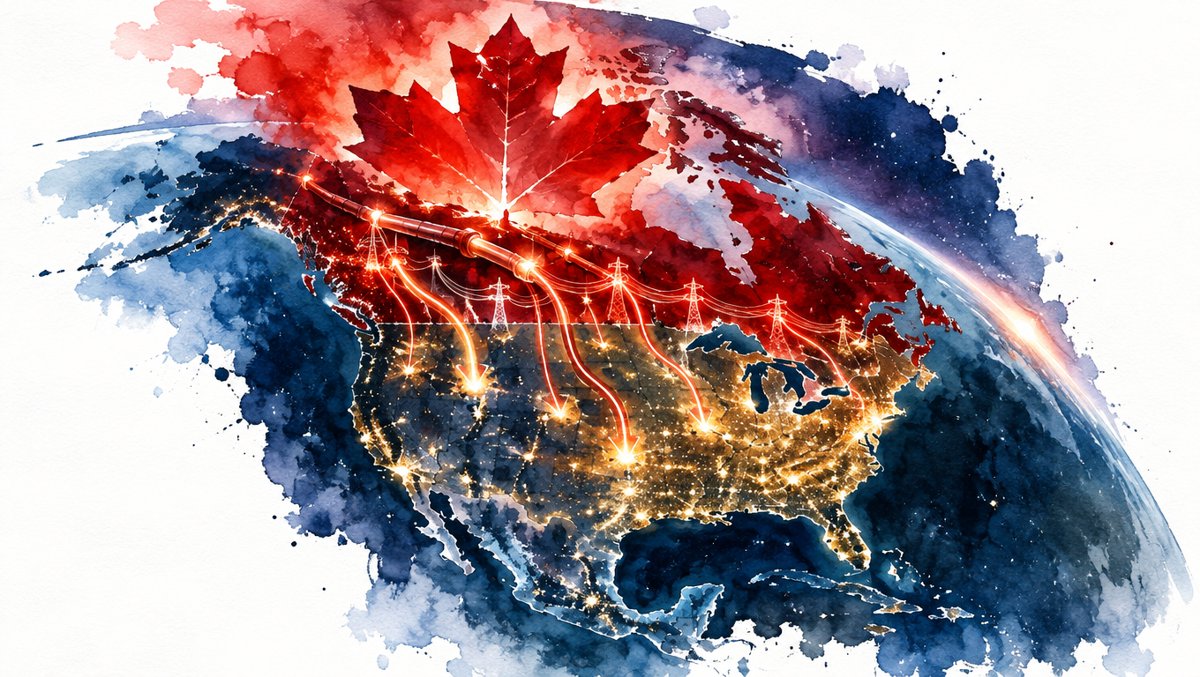
So here is the joke of 2026: the country that wants to buy Canada is already on Canada's payroll.
That's the whole thing, really. Donald Trump stood up in Bullhead City, Arizona, and told a rally that Canada will "end up being the 51st state" — because, in his words, "it's the only way it works." He tied the line to dairy tariffs and auto plants, threw in a comparison to Greenland for good measure, and moved on. It is not a new bit. It is the same bit, delivered louder, in front of an election crowd.
Except this time it lands differently, because of arithmetic. Canada covers about 9.98 million km². The entire United States — all fifty states, Alaska and Hawaii included — covers about 9.83 million km². The 51st state would be bigger than the other fifty combined. This isn't an acquisition. It's a hostile takeover by the furniture that's already in the room.
The poll that ends the argument, politely
Canadians have been asked about this so many times the pollsters could probably stop. Leger found 9% want it, 85% don't. Ipsos put core opposition at 79% — and noted the more interesting thing: Canadians have largely stopped treating it as a threat and started treating it as a comedy routine. Peer-reviewed work in the Canadian Journal of Political Science put opposition near 92%, with 87% "very opposed."
British Columbia, being British Columbia, skipped the polling and put up signs: Never the 51st state.
Worth noting: a New York Times report from the same stretch found the trade war and the rhetoric have pushed Canada measurably closer to the European Union instead. You cannot scare a country into a merger by insulting it and then raising its tariff. That is not how the brochure works.
The receipts, part one: America's utility bill
Here's where the joke curdles, because the 51st state is already wired into the other fifty.
In 2025, Canada supplied 63.4% of U.S. crude oil imports, close to 100% of natural gas imports, 81.3% of electricity imports, 97.9% of natural gas liquids, and 24.9% of refined petroleum product imports. From 2016 through 2025, the U.S. imported $975.2 billion in Canadian energy goods — nearly half of everything it imported in that entire category from everyone on earth.
New York is the single biggest importer of Canadian electricity, and on July 3, 2026, Canadian power covered 9% of NYISO demand — roughly 1,400 MW an hour flowing down from Hydro-Québec. The $6 billion Champlain Hudson Power Express line is set to carry Québec hydropower into the heart of New York City — one of the largest single pieces of energy infrastructure in the Northeast, built on the premise that Canada is a country, not a state.
The receipts, part two: the dinner table and the submarine
Potash is the least glamorous export on the planet and the hardest to replace. More than 80% of U.S. potash imports come from Canada, and more than 90% of what Canada mines gets exported. Cut that off and the American farm belt has an interesting spring.
Uranium is the other one. Canada is the second-largest producer in the world, with roughly 24% of global production in 2024, and 2026 forecasts put Canadian output at more than ten times American production. This is not a new relationship. It began at Port Radium on Great Bear Lake — pitchblende ore from the Northwest Territories went south during the Second World War and helped fuel the Manhattan Project. Canada is now the single largest source of U.S. mineral imports, supplying uranium, aluminum, nickel, copper, steel and niobium. In 2026 the two countries put $100 million into joint critical-minerals work aimed squarely at loosening China's grip.
The receipts, part three: the day the planes landed
Facts matter, so here are the ones that should end the argument.
- September 11, 2001. With American airspace shut, Canada took in 239 diverted aircraft and roughly 33,000 passengers under Operation Yellow Ribbon. Gander, Newfoundland — population under 10,000 — alone hosted 38 wide-body jets carrying 6,122 passengers and 473 crew. The town fed them, housed them, and handed out prescriptions for five days.
- 1980. The "Canadian Caper": Canadian diplomats, led by Ambassador Ken Taylor, sheltered and then smuggled six American diplomats out of revolutionary Tehran. The CIA's own museum calls it "a classic case of deception." Hollywood later made a movie about it and gave most of the credit to the CIA, which is its own joke.
- Afghanistan. More than 40,000 Canadian Armed Forces members served; 158 died. Canada's contribution was the coalition's second largest.
- NORAD, since 1958. Canadian airspace is the tripwire for the entire continent — the DEW Line, and now the North Warning System. No other country on earth shares an air-defence command with the United States.
- Wildfire season. Canada sent roughly 250 firefighters to California in 2025 and 594 in 2020. The traffic runs both ways — the U.S. sends crews north when Canada burns.
- Water. The Great Lakes hold about 18% of the world's fresh surface water and roughly 84% of North America's — managed jointly under a treaty that has held since 1909.
Now the honest part
A joke of the year needs a straight man, and Canada's weakness is genuinely funny in the way a house fire is funny.
- Productivity. The IRPP put it well in April 2026: Canada is stuck in a "comfort trap" — low competition, poor capital allocation, slow technology adoption. The Bank of Canada has said the same thing more politely for years.
- Demographics. Median age is now over 40, up from 26 in 1971. Population growth to July 1, 2026 was just 0.5% year over year, the slowest in a very long time. Canada reached 41,798,407 people — still growing, but no longer sprinting.
- The overdependence. Roughly 70–72% of Canadian goods exports go to the United States. That isn't a trade relationship, it's a monoculture, and it's the actual leverage Trump is using. Canada knows it: exports to non-U.S. markets grew 11.1% last year while exports to the U.S. fell 3.7%. Diversification is real but slow, and it starts from a very lopsided baseline.
- Affordability. A country that can feed the world has 24% of its own people reporting food insecurity (StatsCan, 2024), an agri-food rank of seventh in the G20, and a housing market that Royal LePage's Q3 2026 update describes as flatlining.
- Soft power is slipping. Canada ranked 8th in the 2026 Global Soft Power Index with a score of 63.2 — down one rank and two full points. Still top ten. Still losing ground.
- Economic rank. At roughly $2.5 trillion nominal GDP, Canada is projected to slip from 10th to 11th largest economy. The consolation prize: the IMF expects the second-fastest G7 growth over 2026 and 2027.
Meanwhile, the ambassador says mind your own business
The other half of the Midday Sun story is stranger than the first.
U.S. Ambassador to Canada Pete Hoekstra went on a podcast and warned that Washington is "closely watching" Canadian politicians for possible election interference ahead of the November 3 midterms. His evidence: Ontario government ads that ran in the U.S. opposing tariffs, Industry Minister Mélanie Joly's past remarks about designing retaliation to target "politically sensitive states," speaking tours by Justin Trudeau and Chrystia Freeland, and Carney's appointment of Maia Johnson, an American Democrat. If any of it "amounts to election interference," he said, "America will respond."
Joly's answer was blunt: Canada "would never interfere" in U.S. elections and "would never accept that being done to us." Nobody, including Hoekstra, produced evidence that a tariff ad is election meddling — a former Canadian diplomat, David Robertson, called the whole thing "noise." Which it is. Two countries that have fought in the same wars for a century are now accusing each other of election interference over a steel advertisement. That is the joke of 2026.
The trade-war scoreboard, so nobody accuses this of being one-sided
On August 22, 2026, talks collapsed and the U.S. imposed 50% tariffs on about $20 billion of Canadian goods — wine, furniture, dairy, cement, clothing, fishing rods, and, magnificently, hockey equipment. Carney's response was the line of the year: "We got attacked." Canada matched dollar for dollar — ~700 American products at 15%, 25% and 50%, effective September 8. Two-way goods and services trade hit $872.3 billion in 2025, with Canada as the U.S.'s second-largest trading partner; Q1 2026 trade slipped to $322.8 billion. Canada's U.S. surplus widened to C$11.2 billion in August — a tariff-timing artifact, not a victory lap. A Leger poll found 56% of Canadians want the hard line with no further concessions.
What to watch
- November 3 — whether "51st state" becomes closing-argument material in U.S. midterm races, and whether Hoekstra's "response" ever materializes as policy.
- Carney's diversification — the non-U.S. export number (11.1%) is the one that actually decides this story's ending.
- The interties — Québec–New York and Québec–New England transmission coming online over the next year will quietly deepen American dependence on Canadian electrons.
- Critical minerals — joint Canada-U.S. defence supply work is the one area where the two governments are still cooperating enthusiastically.
The bottom line
Annexation is not a policy proposal; it's a punchline with a tariff attached. The genuinely absurd thing about 2026 is that Washington is threatening to absorb the country that keeps the lights on, the furnace lit, the fries salted, and the submarines fueled — the country that took in 33,000 stranded passengers when American airspace closed, that smuggled six diplomats out of Tehran, that buried 158 soldiers alongside American ones in Afghanistan, and that shares an air-defence command with it.
Canada's real problem was never Trump's mouth. It's that seven-tenths of its economy points at a customer who talks like this. The fix isn't a clever retort — it's productivity, capital, and pipelines to somewhere else.
But if Washington does want a 51st state, it should know what it's buying: a tenant larger than the building, who already holds the keys to the electrical panel — and who has put up a sign on the front lawn.
Never the 51st state.
Sources: Toronto Sun (Midday Sun, Oct 15, 2026) and Jordan Ercit reporting on the Bullhead City rally; The New York Times; Canada Energy Regulator (2025 Canada–U.S. Energy Trade snapshot); U.S. Energy Information Administration (NYISO electricity imports, July 2026); U.S. Trade Representative; Congressional Research Service (U.S.–Canada Trade Relations, Sept 2026); Reuters, AP, Al Jazeera, BBC, Politico, PBS on the August 2026 tariff escalation; Government of Canada (counter-tariff list, effective Sept 8, 2026); Natural Resources Canada (uranium and nuclear facts); World Nuclear Association; Statistics Canada (population, food insecurity); Bank of Canada; IRPP Policy Options ("Canada's comfort trap," April 2026); OECD Compendium of Productivity Indicators 2026; IMF World Economic Outlook (October 2026); Brand Finance Global Soft Power Index 2026; Ipsos, Leger, and Canadian Journal of Political Science polling on annexation; Canadian War Museum and Veterans Affairs Canada (Afghanistan); 9/11 Memorial & Museum and CIA Museum (Operation Yellow Ribbon; the Canadian Caper); Global News and NIFC (wildfire mutual aid); U.S. EPA and Great Lakes Commission.