🌬️ The Invisible Roommate: Why Your Home's Air Might Be the Health Upgrade You Never Planned
Published: September 7, 2026 | Reading Time: ~7 minutes | Topic: Indoor Air Quality & Home Wellness
Quick question: do you know what's floating around your living room right now?
Not in a horror-movie way — in a science way. Here's the fun fact nobody warns you about: you have an invisible roommate. It follows you from bedroom to kitchen to home office, and you'll spend roughly 90% of your entire life together indoors.¹ That roommate is your indoor air — and honestly? Most of us have never given it a second thought. September is the perfect moment to change that: school's back, windows are about to stay shut, and cold-and-flu season is warming up in the background like a slow cooker.
So let's give your air the glow-up it deserves. No fear-mongering, no $800 gadgets required — just five genuinely doable, science-backed moves. 🏠✨
🔬 Section 1: Meet Your Air (It's More Crowded Than You Think)
First, the headline finding from the U.S. EPA: the air inside homes and other buildings can be more polluted than the outdoor air in even the largest, most industrialized cities.¹ Not sometimes — that's the general pattern, especially in well-sealed modern homes where very little fresh air leaks in.
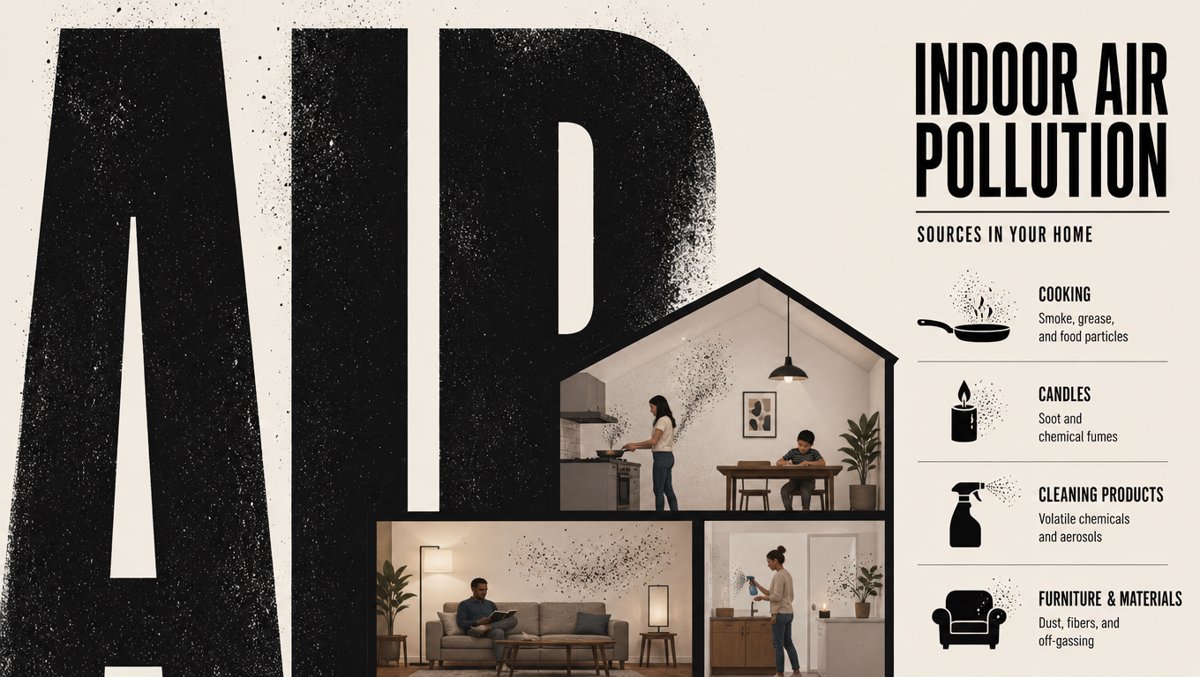
Why? Because modern life is basically an indoor chemistry experiment. Cooking, cleaning sprays, plug-in air fresheners, pressed-wood furniture, that gas stove, candles, carpets, hobbies — each one releases gases or particles.² Each source alone might be modest, but most homes have several stacked on top of each other, and when ventilation is weak, they accumulate instead of drifting away.¹
And the stakes are real. The American Lung Association's State of the Air 2026 report found that 44% of Americans — 152.3 million people — live in places with failing grades for unhealthy ozone or particle pollution, including nearly half of all children (46%).³ Particles in that pollution can be smaller than 1/30th the width of a human hair — small enough to slip past your body's built-in defenses.³ Globally, the World Health Organization links ambient and household air pollution to 6.7 million premature deaths a year.⁴
Here's the empowering part: unlike outdoor air, you actually control your indoor air. The EPA's #1 strategy isn't a fancy machine — it's source control: remove or reduce the things that pollute, before they ever enter the air.⁵
Your three moves:
Audit your sprays. Swap harsh cleaning products and synthetic air fresheners for fragrance-free or low-emission versions — the EPA lists these among the most common continuous indoor sources.² (Baking soda + vinegar can genuinely do most household jobs.)
Never smoke or vape indoors. Tobacco smoke is a top-tier indoor pollutant, and particles linger long after the smell fades.²
Use your kitchen and bathroom exhaust fans — they don't just smell-check your curry; they physically remove combustion byproducts and moisture at the source.²
Key takeaway: Your indoor air is a closed ecosystem you're the manager of. Cut pollution at the source first — it's the cheapest, most effective move on this whole list. 💪
🌬️ Section 2: The Free Upgrade Hiding in Your Window
Now for my favorite part — the hack that costs zero dollars and works in minutes: fresh air.
When the CDC updated its respiratory-virus guidance, it put ventilation alongside vaccination and hand hygiene as a core protective strategy — bringing fresh outdoor air in and moving stale, germ-carrying air out.⁶ The catch (and the CDC is refreshingly honest about this): "people can still get sick after ventilating a space," so it's one layer in a multi-layer approach, not a force field.⁶ Still — a layer! That stacks!
Three practical ways to layer it in:
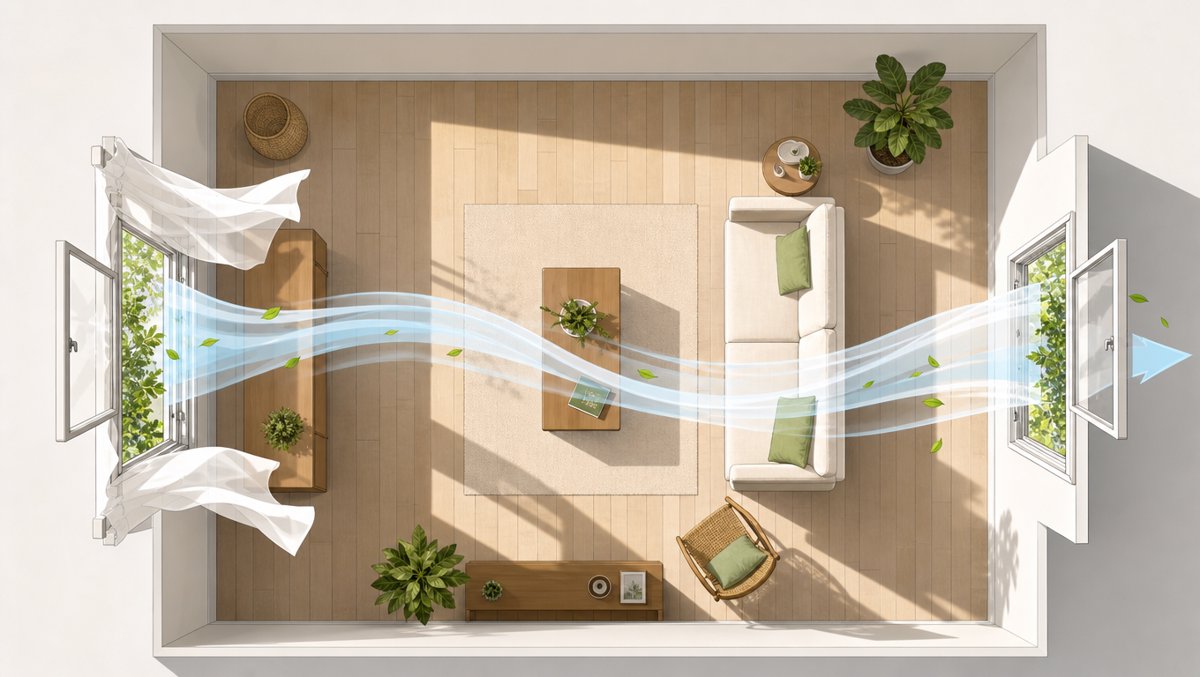
The 10-minute cross-breeze reset. Open windows on opposite sides of your home and let air actually flow through for 10 minutes — ideally twice a day when weather allows. It's called natural ventilation, and it's exactly what the EPA prescribes for flushing accumulated pollutants.¹ ˒ ⁹
Upgrade your furnace/HVAC filter to MERV-13 or higher. The CDC specifically calls out MERV-13 as the preferred filter rating for capturing respiratory particles.⁶ Check your system's manual first, swap filters on schedule, and if you want room-by-room backup, a portable HEPA air cleaner is an evidence-supported supplement — the EPA is clear it can't remove everything, but it meaningfully helps.⁵
Get nosy with a CO₂ monitor. The CDC notes portable carbon dioxide monitors can show how stale or fresh a room's air is — a surprisingly satisfying gadget when you're hosting a crowd or working in a closed office.⁶ Rising CO₂ = air that's been breathed too many times = time to crack a window. Bonus tip straight from the CDC: when you can, just move the activity outdoors.⁶
Key takeaway: Fresh air is free, fast, and CDC-endorsed. A daily cross-breeze + a MERV-13 filter is the indoor-air equivalent of flossing and brushing — boring, effective, deeply worth it. 🪟
💧 Section 3: The Goldilocks Zone (and One Silent Guest You Should Check For)
Two final pieces of the puzzle — one about moisture, one that most people have never tested for.
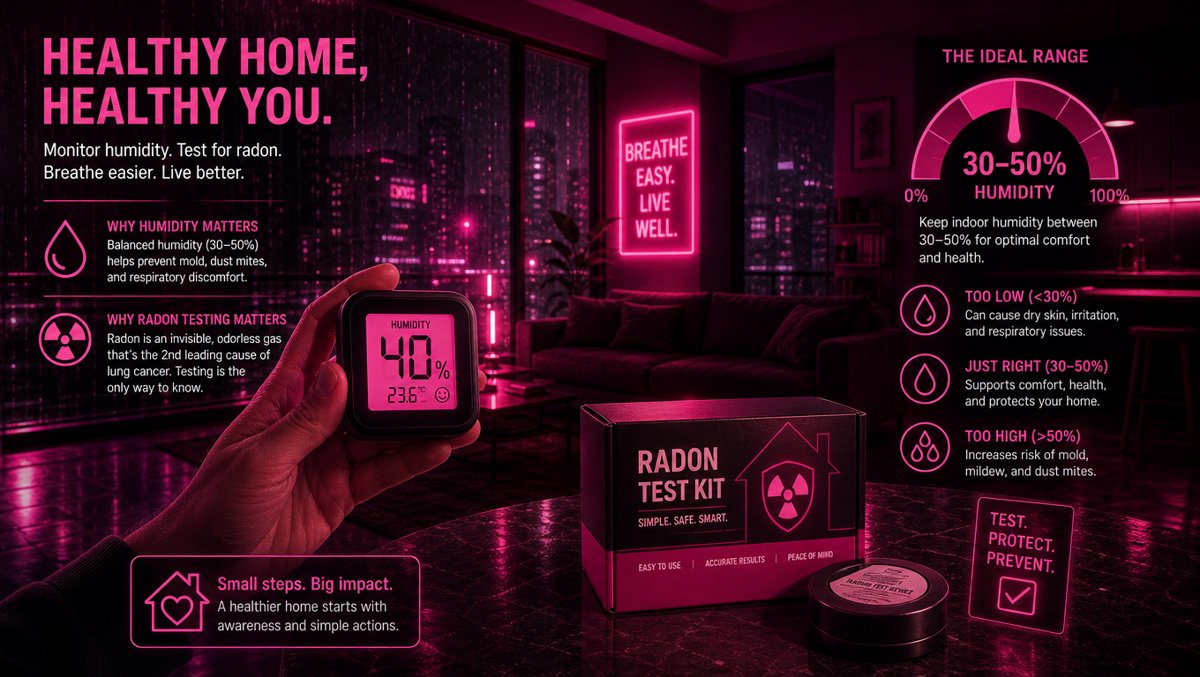
Humidity is a Goldilocks situation. The EPA recommends keeping indoor relative humidity below 60% — ideally between 30% and 50%. Too damp, and you're running a five-star hotel for mold and dust mites (mold needs just 24–48 hours on wet material to get established).⁷ Too dry — a winter classic when the heating kicks on — and pulmonologists at Cleveland Clinic say your nose, throat, and lungs get irritated, sleep gets worse, and congestion lingers.⁸
And if you run a humidifier, hygiene is everything: use distilled or demineralized water, change the water daily, and clean the unit every 2–3 days — a dirty humidifier can aerosolize exactly the stuff you don't want in your lungs.⁸ Grab a hygrometer (often under $20; the EPA notes good ones for under $50) so you're managing by data, not vibes.⁷ ˒ ⁸
Now the silent guest: radon. It's a naturally occurring radioactive gas that seeps from the ground into homes through cracks and foundations — colorless, odorless, and impossible to notice. The EPA calls it the #1 cause of lung cancer among people who have never smoked, and the second leading cause overall — about 21,000 U.S. lung cancer deaths every year, roughly 2,900 of them among never-smokers.⁹ The fix starts absurdly simple: a $15 test kit (available at hardware stores or from your state radon office). If levels come back at 4 pCi/L or higher, a professionally installed mitigation system resolves it — the EPA says homes should be fixed at that threshold.⁹
Your three moves:
Buy a hygrometer. Aim for 30–50% humidity — adjust with a humidifier in dry months, ventilation or a dehumidifier in muggy ones.⁷ ˒ ⁸
Order a radon test kit this week. It's the only way to know; testing is cheap, fixing is very doable, and the U.S. Surgeon General's office has been telling Americans to test their homes since 2005.⁹
Fix leaks within 24–48 hours. Wet drywall, carpet, or ceiling tiles are a mold countdown timer.⁷
Key takeaway: Humidity is a range you can manage with a $20 gadget, and radon is a risk you can test away for $15. Two of the highest-leverage health purchases per dollar you'll ever make. 📊
🎯 Key Takeaways
You manage a closed ecosystem. You spend ~90% of your life indoors, and indoor air can be more polluted than big-city outdoor air — but it's also the air you can most directly control.¹
Source control first. Cutting pollutants at the source (fragrance-free products, no indoor smoking, using exhaust fans) beats any gadget.¹ ˒ ⁵
Fresh air is your free daily upgrade. A 10-minute cross-breeze reset twice a day flushes accumulated pollutants and germs.⁶ ˒ ⁹
Filter smart: MERV-13. The CDC recommends MERV-13+ filters, with HEPA purifiers as a helpful supplement — not a substitute.⁵ ˒ ⁶
Test what you can't see: humidity + radon. A $20 hygrometer (aim 30–50%) and a $15 radon kit cover two of your home's biggest invisible risks.⁷ ˒ ⁸ ˒ ⁹
American Lung Association — "State of the Air 2026: Key Findings" — 44% of Americans (152.3M) live with failing air grades; 46% of children; health effects of particle pollution. https://www.lung.org/research/sota/key-findings
U.S. EPA — "Health Risk of Radon" — radon is the #1 cause of lung cancer among never-smokers and #2 overall (~21,000 U.S. deaths/year, ~2,900 never-smokers); test homes, fix at 4 pCi/L+. https://www.epa.gov/radon/health-risk-radon
All claims fact-checked against Gold-tier (EPA/WHO/CDC-via-CIDRAP) and Silver-tier (Cleveland Clinic, American Lung Association) authoritative sources. Last verified: September 7, 2026.
Breathe easy, friends — literally. Your home takes care of you all day; a few of these little upgrades are how you return the favor. 🌙💨
 x/health ·