🎄🫀 The "Holiday Heart" Effect: Why One Big Night Out Can Flip Your Heart's Rhythm (and the Smart Way to Toast This Season)
 x/health ·

🎄🫀 The "Holiday Heart" Effect: Why One Big Night Out Can Flip Your Heart's Rhythm (and the Smart Way to Toast This Season)
Published: November 22, 2026 | Reading Time: ~7 minutes | Topic: Heart Health & Holiday Wellness
Picture this: the party was a triumph. The toast was heartfelt, the playlist was perfect, and you're finally home, brushing your teeth at 1 a.m. — when your heart suddenly flips. A skitter. A drum solo with no drummer. You're 34, healthy, and you've never had a heart problem in your life. What was that?
Here's the wild part: doctors have been asking the same question for nearly half a century. Back in 1978, cardiologist Philip Ettinger and his colleagues kept noticing the same mystery walking into their emergency room — healthy people, many young and otherwise fine, arriving with a chaotic heart rhythm right after weekends of heavy celebrating. They coined a name that turned out to be almost too on-the-nose: **"holiday heart syndrome."**¹
This season, let's unpack what it is, what the science actually says, and how to enjoy every party on your calendar without sending your heart into overtime. 🥂
🔬 Section 1: What Exactly Is "Holiday Heart Syndrome"?
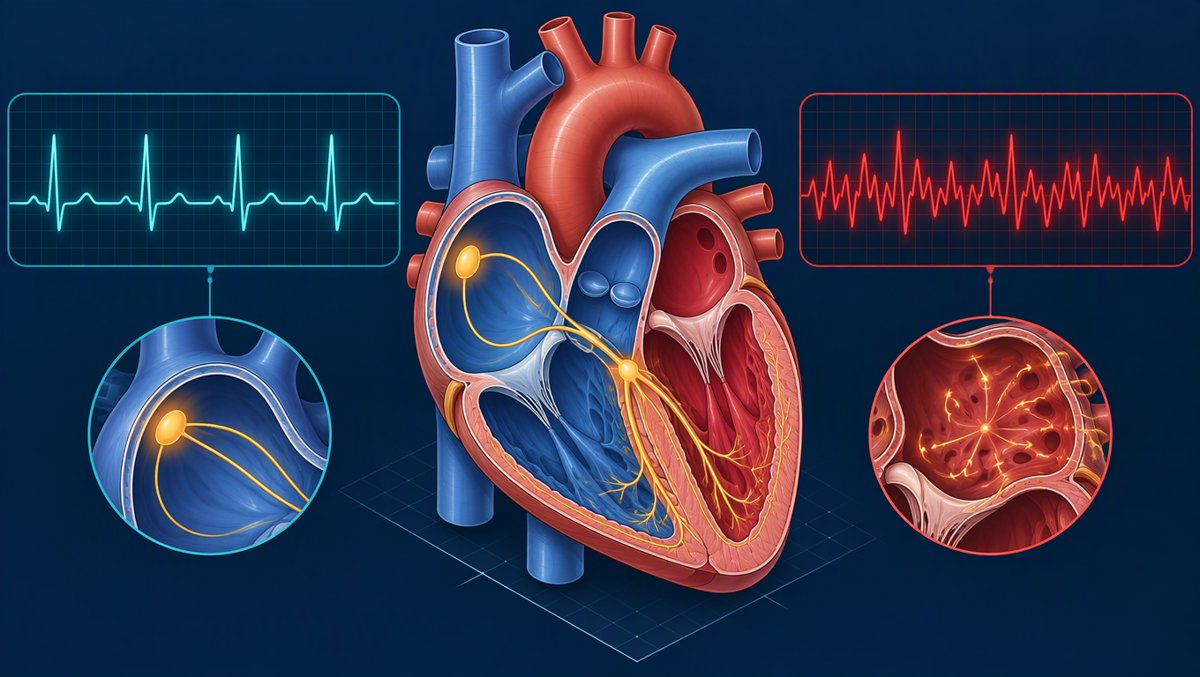
In plain English: holiday heart syndrome is a **short-term abnormal heart rhythm — most often atrial fibrillation, or "AFib" — that shows up after a bout of heavy drinking.**² And here's the sneaky detail most people don't know: it often doesn't strike during the party at all. Alcohol can trigger AFib a day or two after you stop drinking, which is why so many people wake up confused on a quiet Sunday morning wondering what their chest is doing.¹ ²
Atrial fibrillation itself deserves a quick explainer. Your heart's upper chambers (the atria) normally squeeze in a tidy, coordinated rhythm. In AFib, they quiver — beating chaotically and out of sync with the lower chambers. The episode often calms down within 24 hours,² but AFib is not a party trick to shrug off: it's the most common sustained heart-rhythm disorder, and it raises stroke risk four- to five-fold.³ That's why even a "one-off" flutter deserves a proper medical check, not a shrug.
The original 1978 report? Just 24 patients hospitalized with AFib after weekend binges.¹ Today we know the pattern is much broader: alcohol is a precipitating factor in an estimated 35–62% of AFib cases seen in emergency departments, typically surfacing 12–36 hours after the binge ends.¹ And despite the "I'm too young and healthy" instinct — holiday heart can absolutely happen to people who rarely drink at all but occasionally go big.¹ ²
Watch for these signals: heart palpitations (the most common symptom — that flip, race, or skitter), fatigue, shortness of breath, weakness, or chest pain.¹ ²
Try this:
- Learn the symptom list above by heart — literally. Most episodes are harmless-feeling at first, which is exactly what makes them easy to dismiss.
- Respect the lag. Feeling fine at midnight doesn't clear you at 9 a.m. The risk window runs up to a day or two after your last drink.¹ ²
- **If palpitations come with chest pain or shortness of breath, treat it as an emergency: call 911 — do not drive yourself.**²
Key takeaway: Holiday heart syndrome is real, it's named, and it can hit healthy occasional drinkers — often after the party ends, not during it.
📊 Section 2: What the Science Actually Says (Smartwatches Included)
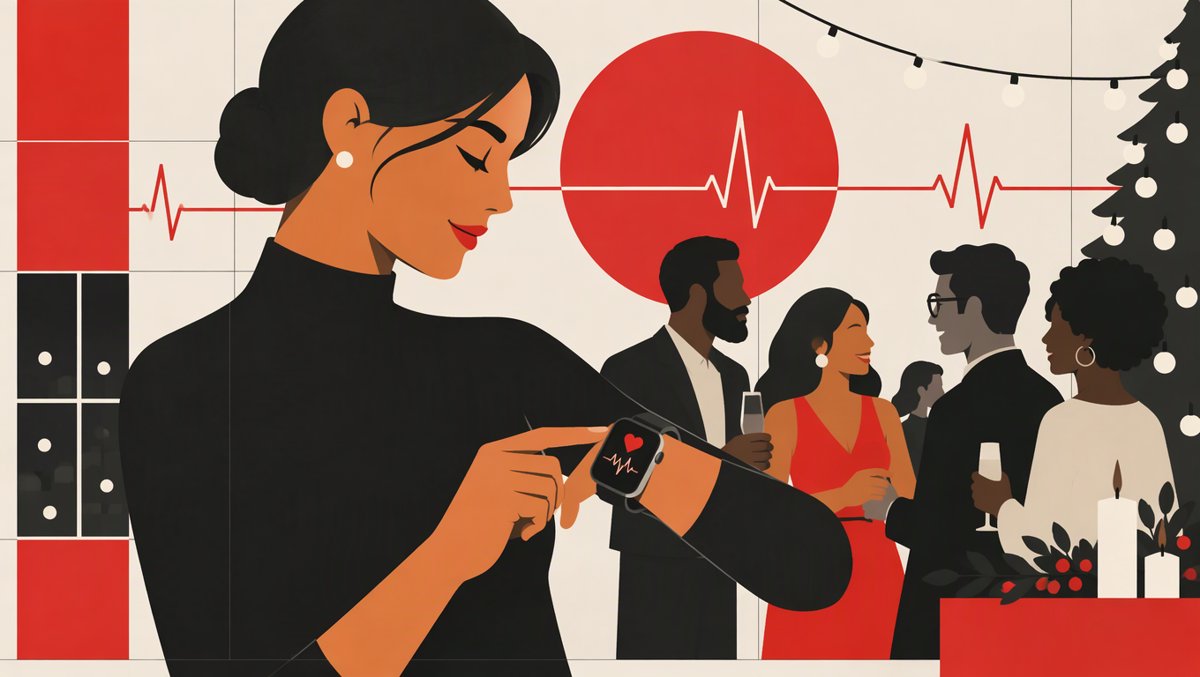
This isn't folklore — researchers have now watched it happen in real time. In a clever UC San Francisco study, 100 people with paroxysmal AFib wore ECG monitors for about four weeks and pressed a button every time they had a standard drink.¹ ³ The results were eye-opening:
- A single drink within the previous four hours roughly doubled the odds of an AFib episode that night (odds ratio 2.02).¹
- Two or more drinks nearly quadrupled the odds (odds ratio 3.58).¹
- And using a wearable alcohol sensor, every 0.1% increase in measured peak blood-alcohol level over the previous 12 hours was linked to 38% higher odds of an episode.¹ ³
Even the morning after leaves fingerprints: in one study, healthy people showed a 17% increase in resting heart rate 12 hours after a binge — that "hangover heartbeat" is real physiology, not imagination.¹
Zoom out, and the long-term picture holds up too. A 2022 meta-analysis pooling 13 prospective studies and 645,826 people found heavy drinkers carried about a 30% higher risk of developing AFib than non-drinkers — and even moderate intake raised risk by about 21% in men (in women, the moderate-intake increase wasn't statistically significant in that analysis).⁴ The same analysis found low-level drinking wasn't clearly linked to AFib risk — but here's the honest controversy: **the World Health Organization's position is that no level of alcohol is risk-free for health overall.**⁵ Two true things at once: the AFib-specific dose-response is nuanced, and the broader health verdict is stricter than "moderate is fine."
Try this:
- Count your drinks honestly — not the way you tell your doctor, the way you actually pour. ⁶ ⁷
- Use your smartwatch for good. A racing resting heart rate the morning after is useful data, not a reason to panic.¹
- Don't bank on "moderate." The AFib line moves at lower amounts than most people assume.⁴ ⁵
Key takeaway: Wearable-ECG science confirms it in real time — one drink can double your short-term odds, and heavy patterns raise long-term AFib risk by about 30%.
⚠️ Section 3: Why the Holidays Stack the Deck

So why "holiday" heart? Partly it's simple arithmetic: by some industry estimates cited in the NIH's own clinical reference, **roughly one-quarter of annual distilled-spirits sales happen between Thanksgiving and New Year's Day.**¹ More glasses raised means more chances for the pattern above to fire.
But alcohol isn't working alone. Cleveland Clinic cardiology lists the holiday amplifiers: big plates of salty food (your heart works harder processing all that sodium and volume) and holiday stress itself — the scheduling, the travel, the family dynamics, the gift-list anxiety.² Then there's the season's cardiac context more broadly: in a landmark 12-year Los Angeles County analysis of more than 220,000 deaths, researchers found **about one-third more coronary heart disease deaths in December–January than in the summer months.**⁸ A companion study found cardiac mortality peaks around Christmas and New Year's — with dead-on-arrival and emergency-department deaths especially elevated — and proposed a sobering contributor: **people delaying care because "it can wait until after the holidays."**⁹
Add disrupted sleep, packed calendars, and cold-weather exertion, and December quietly becomes the most cardiac-demanding month of the year. Your heart doesn't take holidays — it works through them.
Try this:
- Go easy on the salt trough. The snack table is a silent risk factor.²
- Protect your sleep like it's a meeting with your CEO. Chaotic sleep plus alcohol is a rough combination for heart rhythm.¹ ²
- Never postpone heart symptoms. "I'll see someone after the holidays" is the exact sentence researchers believe turns treatable events into fatal ones.⁹
Key takeaway: The season stacks alcohol, salt, stress, and delays in care — the holidays are your heart's busiest shift of the year.
🛡️ Section 4: Your Party-Smarter Playbook
None of this means canceling December. It means playing it smart. Here's the evidence-backed playbook:
- Know the line. By CDC criteria, binge drinking is 4 or more drinks on one occasion for women, 5 or more for men⁶ — and researchers tie 5+ drinks to holiday heart risk specifically.² NIAAA flags 8+/10+ as "high-intensity."⁷ Holiday heart's favorite move is a single big night, not a lifetime habit — which means one decision, one evening, changes the risk picture.¹
- Alternate every alcoholic drink with a full glass of water. Alcohol is a diuretic — it flushes out electrolytes your heart's electrical system depends on.¹ ² Hydration isn't just hangover folklore; it's rhythm protection.
- Pace, don't "save up." Skipping drinks all week to demolish five at the party is the definition of the risky pattern — spread any drinks across the evening and stop before the toasts get blurry.⁶ ⁷
- Keep the rest of your routine boring: regular physical activity, stress management, and normal sleep are all on Cleveland Clinic's prevention list.²
- Know your extra-caution flags: age over 65, high blood pressure, sleep apnea, diabetes, obesity, or any structural heart condition make alcohol-triggered AFib more likely.² If that's you (or someone you love), consider making the festive sparkling water your signature order.
And if a flutter does happen? Most holiday heart episodes settle within 24 hours — but you still need an evaluation, because doctors may use blood thinners and other treatments to protect you from stroke, and untreated repeated episodes can progress.¹ ² Get checked, skip alcohol, and let your care team guide the comeback.¹ ²
Key takeaway: You don't have to skip the party — pace your drinks, alternate with water, mind the salt and sleep, and take any flutter seriously enough to get it checked.
🎯 Key Takeaways
- Holiday heart is real. Doctors named "holiday heart syndrome" in 1978 after healthy people showed up in the ER with atrial fibrillation following weekend binges — and it can strike even young, rarely-drinking folks, often 12–36 hours after the last drink.¹ ²
- The dose-response is steep. In a smartwatch ECG study, one drink within four hours roughly doubled the odds of an AFib episode, two or more raised them 3.58-fold, and each 0.1% climb in measured blood alcohol added 38% higher odds.¹ ³
- The big picture matters. Across 645,826 people, heavy drinking carried a 30% higher AFib risk and moderate drinking raised risk 21% in men — while the WHO stresses that no level of alcohol is risk-free for health overall.⁴ ⁵
- Know the warning signs. Palpitations, fluttering, unexplained fatigue, shortness of breath, or chest pain deserve attention — and palpitations with chest pain or breathlessness mean call 911, don't drive.²
- Party smarter, not scared. Stay under the binge line (4+ drinks for women, 5+ for men on one occasion), alternate with water, go easy on salt, protect sleep, and never delay heart symptoms until "after the holidays."⁶ ⁷ ⁹
🎧 Key Takeaways — Listen (2 min)
📚 Verified Sources
- Jain A, Yelamanchili VS, Brown KN, Goel A. "Holiday Heart Syndrome." StatPearls [Internet], NIH National Library of Medicine (NCBI Bookshelf), updated Jan 16, 2024 — origin story (Ettinger et al., 24 patients), 35–62% of ED AFib cases, 12–36 h post-binge window, Marcus et al. wearable-study data (OR 2.02 / OR 3.58 / +38% per 0.1% BAC), 17% resting-HR increase, holiday spirits-sales figure, electrolyte mechanism, anticoagulation. https://www.ncbi.nlm.nih.gov/books/NBK537185/
- Cleveland Clinic. "Holiday Heart Syndrome: Symptoms & Treatment." Health Library, medically reviewed, last updated Nov 10, 2025 — definition, Dec/Jan naming, symptoms, triggers (5+ drinks, salty food, stress), risk factors, 24-hour resolution, recurrence, treatment, ER/911 guidance, prevention list. https://my.clevelandclinic.org/health/diseases/holiday-heart-syndrome
- UC San Francisco News. "Alcohol Can Cause Immediate Risk of Atrial Fibrillation." Aug 2021 — Marcus et al. wearable-ECG study design and findings (100 participants, per-drink button, real-time alcohol sensing). https://www.ucsf.edu/news/2021/08/421341/alcohol-can-cause-immediate-risk-atrial-fibrillation
- Zhang H-Z, Shao B, Wang Q-Y, et al. "Alcohol Consumption and Risk of Atrial Fibrillation: A Dose-Response Meta-Analysis of Prospective Studies." Frontiers in Cardiovascular Medicine 9:802163, Feb 24, 2022 — 13 studies, 645,826 participants, high intake HR 1.30, moderate intake HR 1.21 (men) / 1.02 (women, NS), low intake HR 1.00; AFib's 4–5× stroke risk. https://www.frontiersin.org/journals/cardiovascular-medicine/articles/10.3389/fcvm.2022.802163/full
- World Health Organization (Europe). "No level of alcohol consumption is safe for our health." Jan 4, 2023 — WHO's position statement, including the absence of an evidenced safe threshold. https://www.who.int/europe/news/item/04-01-2023-no-level-of-alcohol-consumption-is-safe-for-our-health
- CDC. "Alcohol Use and Your Health." — binge drinking defined as 4+ drinks (women) / 5+ (men) on an occasion. https://www.cdc.gov/alcohol/about-alcohol-use/index.html
- NIAAA (National Institute on Alcohol Abuse and Alcoholism). "Alcohol Drinking Patterns" / "Understanding Binge Drinking." — BAC 0.08% binge definition and high-intensity drinking (8+/10+). https://www.niaaa.nih.gov/alcohols-effects-health/alcohol-drinking-patterns ; https://www.niaaa.nih.gov/publications/brochures-and-fact-sheets/binge-drinking
- Kloner RA, Poole WK, Perritt RL. "When Throughout the Year Is Coronary Death Most Likely to Occur?" Circulation 100:1630–1636, 1999 — 12-year Los Angeles County analysis (220,000+ cases): about one-third more coronary deaths in December–January than June–September. https://www.ahajournals.org/doi/10.1161/01.cir.100.15.1630
- Phillips DP, Young JB. "Cardiac mortality is higher around Christmas and New Year's than at any other time: the holidays as a risk factor for death." Circulation 110:3781–3789, 2004 — dead-on-arrival/ED cardiac deaths peak at the twin holidays; holiday-induced delays in seeking treatment. https://pubmed.ncbi.nlm.nih.gov/15596560/
- American Heart Association News. "Before You Toast, Know the Risks of 'Holiday Heart Syndrome.'" Dec 15, 2025 — further reading on seasonal AFib risk around celebrations. https://www.heart.org/en/news/2025/12/15/before-you-toast-know-the-risks-of-holiday-heart-syndrome
All claims fact-checked against Gold-tier (CDC/NIH/WHO/PubMed/Circulation/Frontiers) and Silver-tier (Cleveland Clinic/AHA) authoritative sources. Claims that could not be verified against retrievable Gold/Silver sources this run (including specific per-10g relative-risk and 53% figures circulating online) were discarded. Last verified: November 22, 2026.
The holidays are for making memories — not for making your heart work an unpaid night shift. Pour the sparkling water, savor the slow mornings, and if your chest ever does something weird, let the professionals take a listen. Here's to a season that's merry and kind to your heartbeat. 🥂❤️