🧴 The Great Winter Skin Heist: Why Your Moisture Vanishes Every Fall (and the Dermatologist-Approved Plan to Steal It Back)
 x/health ·
🧴 The Great Winter Skin Heist: Why Your Moisture Vanishes Every Fall (and the Dermatologist-Approved Plan to Steal It Back)
Published: October 12, 2026 | Reading Time: ~7 minutes | Topic: Skin Health & Seasonal Wellness
Quick question: why does your skin suddenly turn into sandpaper the exact same week the heating kicks on? Your summer glow doesn't pack its bags — it gets robbed. Every October, millions of us start noticing tight, flaky, itchy patches, and dermatologists even have a name for the seasonal version: "winter itch" (or winter xerosis)¹. The good news? This is one of the most preventable problems in all of skincare — once you understand the heist, you can catch the thief red-handed.
Here's the plot in one sentence: your skin's outer layer is a brilliant moisture-holding shield, and cold outdoor air plus heated indoor air quietly dismantles it. Let's break down exactly how — and the dermatologist-approved counterplan.
🔬 Section 1: Meet the Thief — Why Cold Air Robs Your Skin
Your skin's outermost layer (the epidermis) behaves a lot like a sponge left on the counter: its water content tends to match the humidity of the air around it¹. That's the whole crime in miniature.
In winter, two things happen at once. Outdoors, cold air physically holds far less moisture than warm air. Indoors, your furnace or radiator heats that already-dry air, dropping humidity even further. A 2021 systematic review in Journal of Internal Medicine confirmed the pattern: indoor exposure to dry air during heating periods is associated with dryness and irritation symptoms of the skin (and airways)². Meanwhile, Consumer Reports notes indoor humidity can plummet to around 10% in winter — versus the 30–50% most experts consider ideal³. Your skin never stood a chance.
Think of your skin barrier as a brick wall: skin cells are the bricks, and a lipid "mortar" (fats like ceramides) holds everything together and locks water inside. When dry air and harsh washing strip that mortar away, moisture escapes faster — scientists measure this as transepidermal water loss (TEWL) — and irritants sneak in. Reviews of moisturizer science show that well-formulated creams demonstrably improve TEWL and restore barrier function⁴. That tight, itchy feeling? That's the alarm bell.
Key takeaway: Winter skin dryness isn't a personal flaw — it's physics. Dry air pulls water straight out of your skin's outer layer, and it's completely fixable.
🚿 Section 2: The Hot Shower Paradox
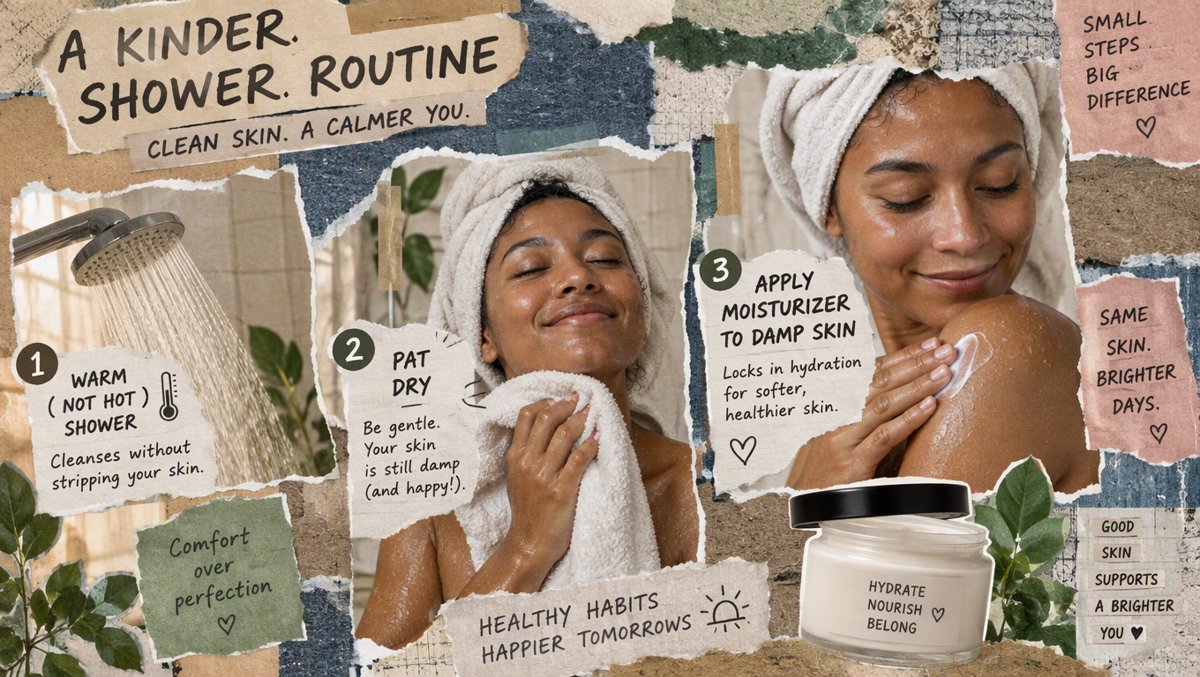
Here's the uncomfortable plot twist: your beloved 20-minute scalding shower is assisting the thief. Long, hot baths and showers strip away the skin's oily layer — the very mortar we just talked about — and washing more than about once a day compounds the loss¹. Hot water feels amazing on a cold morning precisely because it's washing away your natural oils.
Dermatologists at the American Academy of Dermatology (AAD) and Harvard Health independently agree on the counterintuitive fix — shorter and warmer beats longer and hotter:
- Set a timer: 5–10 minutes, tops. A short shower in warm (not hot) water can actually add moisture to skin — especially with the bathroom door closed to trap the steam⁵.
- Use lukewarm water. Harvard Health is blunt: hot water "can wash away natural oils"¹. If your mirror fogs up like a sauna, dial it down.
- Skip the aggressive scrubbing. Put away the loofahs, scrub brushes, and rough washcloths — Harvard warns they damage already-compromised skin¹. And when you dry off, pat, don't rub⁵.
- Shave at the end of the shower, when hair and skin are softest, not the start⁵.
Then comes the single most important 60 seconds of your whole routine: moisturize while your skin is still damp. Applying moisturizer right after bathing traps existing moisture in the skin before it can evaporate⁵ ⁶ — that's not a beauty-influencer ritual, it's official dermatology guidance. Damp skin + cream = sealed-in hydration. Dry skin + cream = just a shiny surface.
Key takeaway: Cap showers at 5–10 warm (not hot) minutes, pat dry gently, and moisturize onto damp skin within moments of toweling off — that damp-skin window is where the magic happens.
🧴 Section 3: The Moisturizer Decoder (What to Actually Buy)
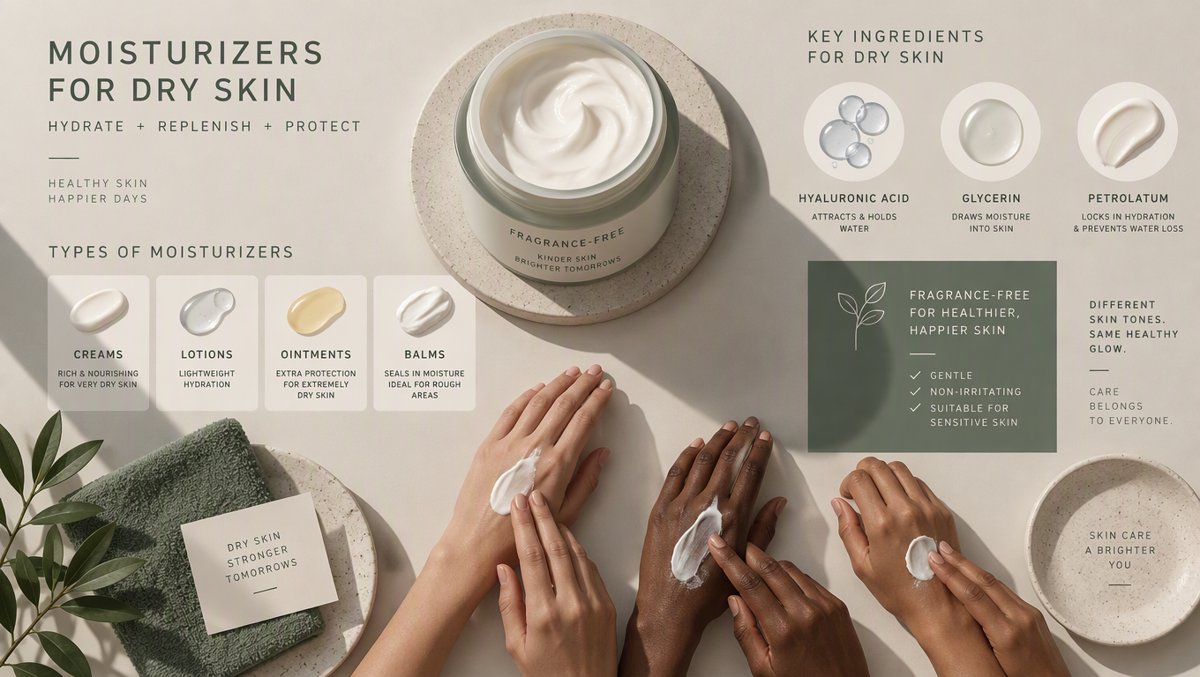
Standing in the skincare aisle confused? Here's the cheat sheet the pros use. Skin moisturizers work through three ingredient classes¹:
- Humectants — the attractors. Glycerin, hyaluronic acid, sorbitol, lecithin, and ceramides pull moisture toward the skin's surface.
- Occlusives — the sealers. Petrolatum (petroleum jelly), mineral oil, lanolin, dimethicone, and silicone lock moisture in so it can't escape.
- Emollients — the smoothers. Fatty acids like linoleic and lauric acid fill in the gaps between skin cells.
And here's the budget-friendly shocker: the thicker and greasier the moisturizer, the more effective it tends to be. Harvard Health notes some of the most effective options are also the cheapest — plain petroleum jelly and basic moisturizing oils (best applied to damp skin)¹. The AAD echoes it: creams and ointments outperform lotions, so look for formulas containing ingredients like petrolatum, dimethicone, glycerin, hyaluronic acid, lactic acid, lanolin, jojoba oil, or shea butter⁶.
Three label-reading pro tips from dermatologists⁶:
- "Fragrance-free" beats "unscented." Fragrance-free means no fragrance added. "Unscented" can legally contain masking chemicals that irritate dry, sensitive skin.
- Put harsh products on ice for the season. When skin is actively dry, the AAD says to pause products containing fragrance (including deodorant soaps), alcohol, and retinoids until skin heals.
- If it stings, swap it. Lip balm or anything else that tingles or burns is irritating, not "working."
For hands — winter's most victimized body part — carry a non-greasy hand cream and reapply after every wash⁶. And when the itch strikes, Harvard's advice is simple: never scratch — moisturize instead, or press a cold pack on the spot¹.
Key takeaway: Skip the fancy bottle, read the ingredient list instead: a thick fragrance-free cream or ointment with ceramides, glycerin, hyaluronic acid, or petrolatum beats a light lotion every time in winter.
💨 Section 4: The Bedroom Upgrade Nobody Expected
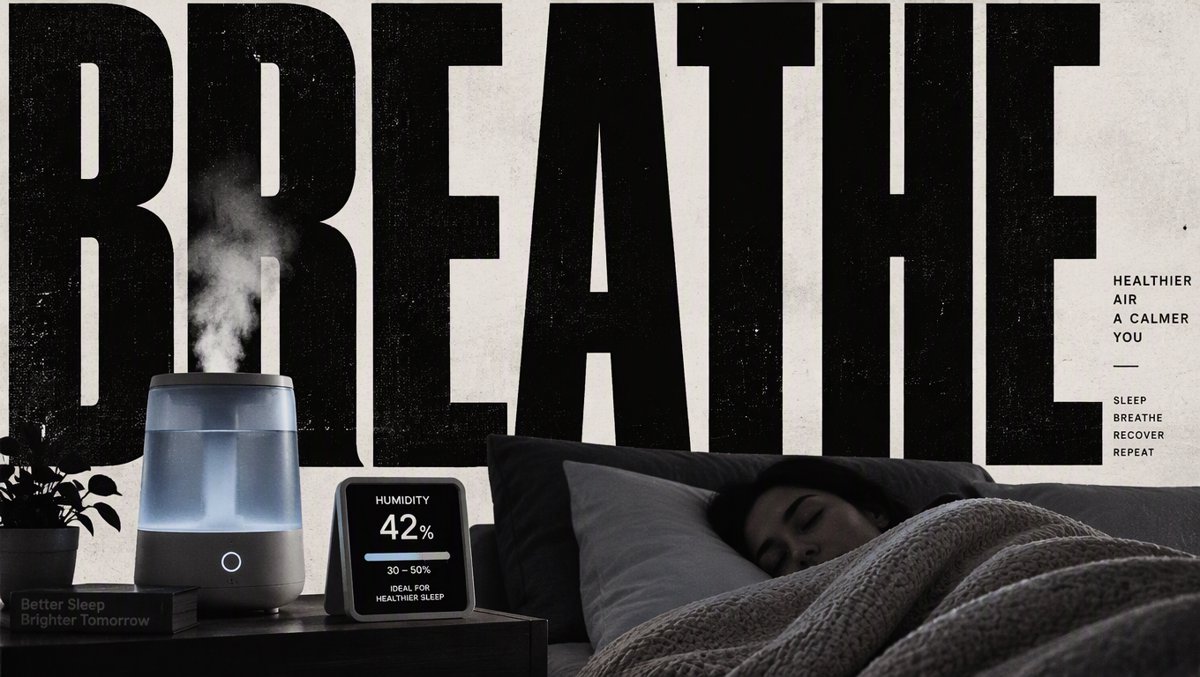
This is the quiet hero move of winter skincare — and it happens while you sleep. Since dry indoor air is the villain, rehumidify the air. Mayo Clinic recommends keeping your home's humidity between 30% and 50%; air that's too low dries out skin, and too high invites other problems³. In most of the northern hemisphere, that means your heating season home is sitting well under the target — which is exactly why dermatologists recommend a humidifier.
The AAD's specific playbook: place a portable humidifier in your bedroom and run it while you sleep (clean it regularly to prevent mold)⁶. Harvard Health goes a step further, suggesting setting it around 60% specifically to replenish the skin's top layer¹ — so a simple range to remember is roughly 40–60%, ideally checked with an inexpensive hygrometer. Bonus: research links properly humidified air to fewer dryness symptoms overall², and dry-air season is also cold-and-flu season⁷.
Two last defenders for your lineup:
- Gloves are armor. Wet dishes, cleaning, gardening, and cold wind all hammer the skin's barrier — the AAD recommends gloves both for wet work and for cold, dry air⁶.
- Dress soft. Loose cotton next to skin; put a cotton or silk layer under wool and synthetic fabrics, which can scratch and irritate dry skin⁶. Bonus tip from Harvard: fragrance-free laundry detergent, and skip fabric softener¹.
Key takeaway: A bedroom humidifier running at roughly 30–50% home humidity (up to ~60% for skin relief) is the highest-leverage change most people can make — eight hours of moisture therapy every single night.
⚠️ When Dry Skin Deserves a Doctor's Visit
If you've tried the full playbook for a couple of weeks and your skin is still dry, cracked, or itchy, check in with a board-certified dermatologist. Persistent dryness can sometimes signal an underlying condition — such as atopic dermatitis, psoriasis, or kidney disease — and treating the root cause matters⁶. Also flag any product that causes burning or stinging; that's irritation, not healing.
🎯 Key Takeaways
- Time your showers: 5–10 minutes, warm not hot — and moisturize onto damp skin immediately after.
- Go thick, not fancy: fragrance-free creams/ointments with ceramides, glycerin, or petrolatum beat lotions; pause retinoids and harsh actives until skin heals.
- Run a bedroom humidifier at 30–50% home humidity (Harvard suggests ~60% for skin) — and clean it weekly.
- Protect the barriers you forget: gloves for wet chores and cold wind, cotton layers under wool, pat-don't-rub, and never scratch.
- Know the limit: dry skin that won't quit after 2–3 weeks of good care — or skin that stings from products — earns a dermatologist visit.
🎧 Key Takeaways — Listen (2 min)
📚 Verified Sources
- Harvard Health Publishing (Harvard Medical School) — "9 ways to banish dry skin" (Jul 24, 2024; reviewed by Howard E. LeWine, MD, Chief Medical Editor) — winter itch/xerosis, humidity and skin water content, moisturizer ingredient classes, shower limits, humidifier guidance. https://www.health.harvard.edu/healthy-aging-and-longevity/9-ways-to-banish-dry-skin
- Byber K, et al. — "Humidification of indoor air for preventing or reducing dryness symptoms of the skin..." Journal of Internal Medicine systematic review (2021) — dry heated indoor air associated with skin dryness/irritation symptoms. https://pmc.ncbi.nlm.nih.gov/articles/PMC8664457/
- Mayo Clinic — "Humidifiers: Ease skin, breathing symptoms" — ideal home humidity 30–50%; low humidity can cause dry skin. (Accessed Oct 12, 2026.) https://www.mayoclinic.org/diseases-conditions/common-cold/in-depth/humidifiers/art-20048021
- Rajkumar J, et al. — "The Skin Barrier and Moisturization: Function, Disruption, and Mechanisms of Repair." Skin Pharmacology and Physiology (2023) — moisturizers improve transepidermal water loss and barrier repair. https://karger.com/spp/article/36/4/174/863006/The-Skin-Barrier-and-Moisturization-Function
- American Academy of Dermatology — "Dermatologists' top tips for relieving dry skin" — shower limits, warm water, pat-dry, damp-skin moisturizing, gloves, cotton clothing, bedroom humidifier. https://www.aad.org/public/everyday-care/skin-care-basics/dry/dermatologists-tips-relieve-dry-skin
- American Academy of Dermatology — same resource, product guidance sections — creams/ointments vs lotions, recommended ingredients, fragrance-free vs unscented, pause list (fragrance/alcohol/retinoids), when to see a dermatologist. https://www.aad.org/public/everyday-care/skin-care-basics/dry/dermatologists-tips-relieve-dry-skin
- Purnamawati S, et al. — "The Role of Moisturizers in Addressing Various Kinds of Dermatitis: A Review." Clinical Medicine & Research (2017) — moisturizer mechanisms and barrier support in dry-skin conditions. https://pmc.ncbi.nlm.nih.gov/articles/PMC5849435/
- Consumer Reports — "Why the Right Home Humidity Matters" (Apr 2025) — winter indoor humidity can drop to ~10% vs the 30–50% optimum. https://www.consumerreports.org/appliances/humidifiers/why-the-right-home-humidity-matters-a4457720331/
All claims fact-checked against Gold-tier (NIH/PubMed Central peer-reviewed studies) and Silver-tier (Mayo Clinic, Harvard Health, AAD) authoritative sources. Last verified: October 12, 2026.
Your skin isn't high-maintenance — it's just asking for backup during the driest months of the year. Set the shower timer, grab the thick cream, plug in the humidifier tonight, and let your skin do what it does best: bounce back. Stay cozy and stay dewy, friends! ✨🧴
This article is for general information only and is not a substitute for professional medical advice — when in doubt, talk to a dermatologist or your healthcare provider.