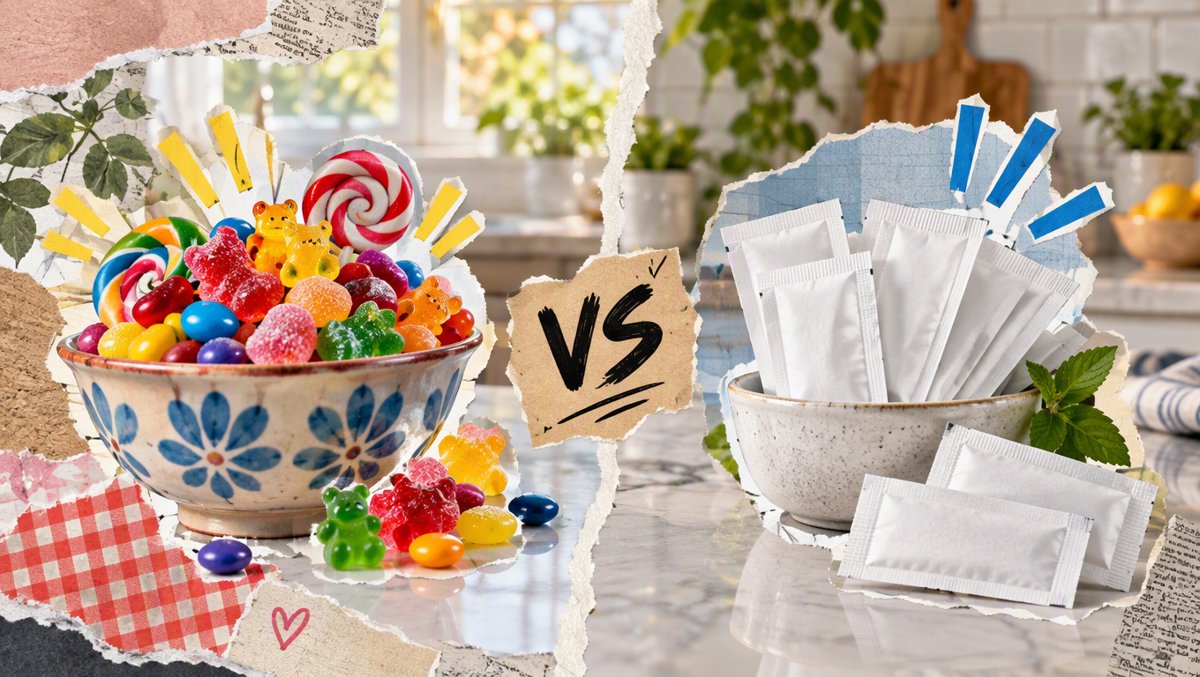
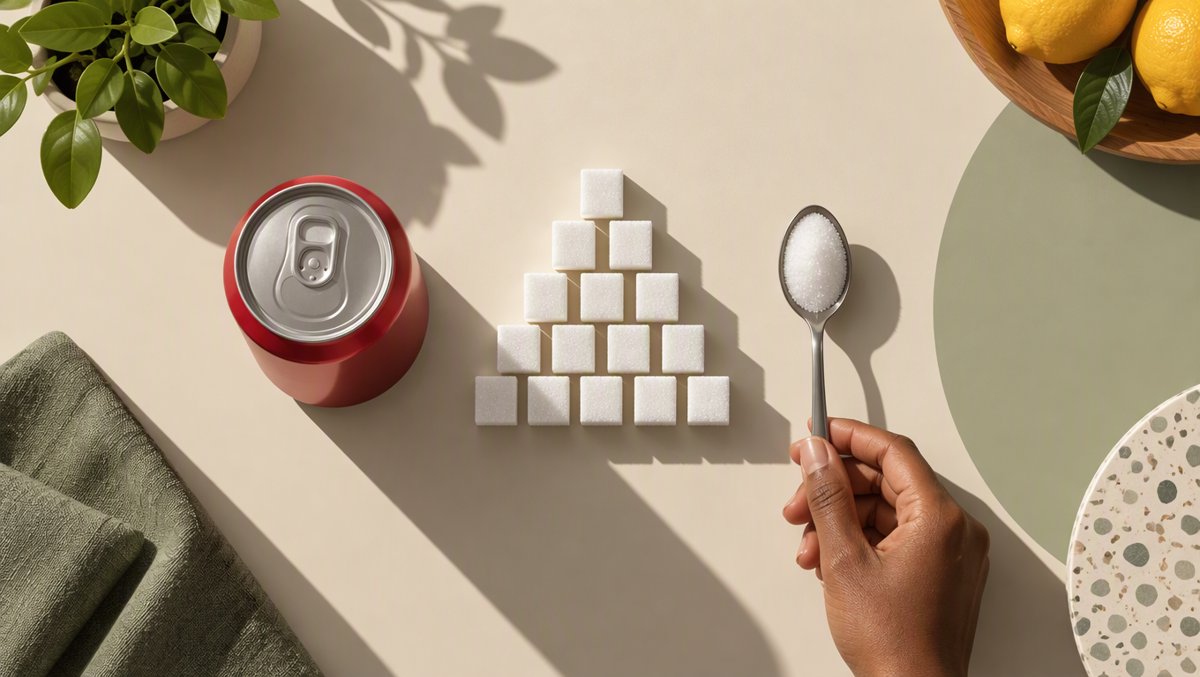
It's October, which means the candy bowl has officially moved onto the counter. Somewhere between your morning oatmeal and that "sugar-free" sparkling water, you've probably wondered: is the sugar actually worse than the stuff pretending to be sugar? This week we dive into the sweet science — no fear-mongering, no "toxic" labels, just what the world's top health authorities actually found. And fair warning: one of the findings will change how you read a nutrition label forever.
🥤 Section 1: The Sugar Math Problem (a.k.a. Why Your Cereal Is Lying to You)
Let's start with the OG sweet stuff. The World Health Organization recommends keeping "free sugars" — the added sugars in sodas, candy, sauces, and even bread — to less than 10% of your daily energy intake, with an extra gold star if you can get under 5%, which works out to roughly 25 grams, or about 6 teaspoons a day¹. The American Heart Association is even more specific: about 25 grams a day for women and 36 grams for men².
Here's the plot twist: the average adult is consuming around 17 teaspoons of added sugar every single day — about 19 for men and 15 for women³. That's roughly triple the women's target and nearly double the men's. And no, you're probably not eating 17 spoons of the white stuff — it's hiding. Flavored yogurts, granola bars, pasta sauce, salad dressing, that innocent-looking bottled iced tea. The US Dietary Guidelines' official ceiling is about 50 grams (12 teaspoons) a day on a 2,000-calorie diet⁴ — and most of us blow past it before dinner.
Your game plan (pick one, start today):
🥣 Do the spoon math. Divide grams of sugar on any label by 4 — that's teaspoons. A soda with 39 grams? That's nearly 10 spoons in one can.
🍳 Flip your breakfast. Most people's sugar overload happens before 9 a.m. Swap flavored yogurt for plain + fruit, and you've already banked half your daily budget.
🧾 Learn sugar's secret identities. Dextrose, maltose, rice syrup, fruit juice concentrate — all code names for added sugar. If it ends in "-ose," it counts.
💡 Key takeaway: You don't need to quit dessert — you need to stop letting hidden sugar spend your daily budget before you even get to the good part.
Here's the part that surprises almost everyone. In 2023, the WHO took a hard look at decades of research on non-sugar sweeteners (think aspartame, sucralose, saccharin, stevia) and issued a guideline that made headlines: it advises against using them for weight control⁵. Not because they're poison — but because the evidence for long-term benefit simply isn't there. People who switch from sugar to sweeteners don't reliably lose more weight or cut their disease risk in the long run⁶.
Why? The science points to something refreshingly human: swapping one sweet taste for another doesn't retrain your palate. Your body keeps expecting sweetness, cravings stay loud, and the overall diet often doesn't actually improve. The WHO's bottom line is quietly brilliant — instead of swapping sugar for substitutes, the win is gradually reducing overall sweetness itself⁵.
Smart moves for the sweet-curious:
🍓 Retrain, don't replace. Cut the sugar in your coffee by a quarter-spoon every couple of weeks. In two months your taste buds will have quietly renegotiated the deal.
🥤 Make water exciting again. Fruit slices, mint, cucumber, a splash of 100% juice — flavor without the sweetener debate.
🚫 Skip the "health halo." A cookie labeled "no sugar" is still a cookie. The sweetener guideline doesn't give packaged treats a free pass.
💡 Key takeaway: Sweeteners aren't villains — they're just not superheroes either. The real superpower is gradually needing less sweetness to feel satisfied.
🧪 Section 3: Science Still in Session — Aspartame Panic, Erythritol Questions & Your Gut
Now for the fun chemistry. Remember when aspartame "caused cancer" in 2023? Deep breath — that headline was a classic case of hazard vs. risk confusion. The WHO's cancer research agency (IARC) classified aspartame as "possibly carcinogenic" — Group 2B — a hazard flag meaning limited evidence exists and more research is needed. On the same day, the WHO's food safety committee (JECFA) reaffirmed the safe daily intake at 40 mg per kg of body weight — every day, for life⁷. For context, you'd need to drink roughly a dozen or more cans of diet soda daily to brush up against that limit. As our friends in hazard-communication say: aloe vera is also a Group 2B hazard. It's a caution sign, not a verdict.
Erythritol is the more interesting open case. It's a "natural" sugar alcohol popular in keto products, and a 2023 Nature Medicine study from Cleveland Clinic researchers found that higher blood levels of erythritol were associated with increased risk of major cardiovascular events like heart attack and stroke — and in lab and animal studies, erythritol made platelets stickier and more clot-prone⁸,⁹. A 2024 follow-up then gave healthy volunteers a drink with about 30 grams of erythritol (the amount in a pint of keto ice cream) and measured enhanced platelet reactivity compared to a glucose drink¹⁰. Before you clear your pantry: these are association findings, most participants with high baseline erythritol already had cardiovascular risk factors, and scientists openly say more research is needed¹¹. The honest read: erythritol is the one sweetener where heavy daily use — especially if you have heart risks — deserves a raised eyebrow.
Meanwhile, sucralose research took a fascinating turn: a 2022 Cell study found that some sweeteners changed people's glucose tolerance — but only in certain individuals, apparently driven by their unique gut microbiomes¹². Translation: the same packet might do nothing for your friend and something subtle for you. Personalized nutrition just got personal.
Your label-reading superpower kit:
🧊 Go easy on erythritol-heavy products if you have heart risk factors — and treat daily mega-doses (keto ice cream pints, we see you) as a "sometimes," not a staple, while the science matures.
📊 Dose is the whole story. Aspartame in a diet soda? Far below safety limits. The dose makes the poison — and the reassurance.
🦠 Trust your gut (literally). If a sweetener seems to bloat you or mess with your energy, your microbiome may have opinions. You're the experiment of one.
💡 Key takeaway: "Sugar-free" means "read the label," not "guilt-free" — and the sweetener aisle is a spectrum from thoroughly-boring (fine) to still-being-studied (go easy).
🎯 Key Takeaways
Sugar first. The WHO recommends keeping free sugars under 10% of your daily energy — ideally under 5%, about 25 grams or 6 teaspoons a day¹.
Know your number. The AHA caps added sugar at 25 g/day for women and 36 g/day for men² — and the average adult is already at about 17 teaspoons³, well past both.
Sweeteners aren't villains, but they're not magic either. The WHO advises against using them for weight control, because the long-term wins just aren't there⁵.
The aspartame panic was a hazard-vs-risk mix-up — "possibly carcinogenic" is a caution flag, not a verdict, and normal use stays far below the safety limit of 40 mg/kg of body weight⁷.
"Sugar-free" means "read the label," not "guilt-free" — especially with erythritol if you have heart risks⁸⁻¹⁰. And the real winner? Slowly retraining your taste buds to crave less of everything sweet.
Witkowski M, Wilcox J, et al. — "Ingestion of the Non-Nutritive Sweetener Erythritol, but Not Glucose, Enhances Platelet Reactivity and Thrombosis Potential in Healthy Volunteers." Arteriosclerosis, Thrombosis, and Vascular Biology (AHA journal), 2024;44:2136–41. https://www.ahajournals.org/doi/full/10.1161/ATVBAHA.124.321019
All claims fact-checked against Gold-tier (CDC/NIH/WHO/PubMed/Nature/The Lancet) and Silver-tier (Mayo Clinic/Harvard Health/Cleveland Clinic) authoritative sources. Last verified: October 6, 2026.
This October, you don't have to fear the candy bowl or worship the "sugar-free" label — just read it, do the spoon math, and let your taste buds slowly remember what fruit tastes like. Your body will thank you by New Year's. 🌙
 x/health ·