🤧 The Great Fall Sneeze Season: Why Ragweed Owns September (and How to Outsmart It)
Published: September 21, 2026 | Reading Time: ~6 minutes | Topic: Seasonal Allergies & Immune Health
Picture this: it's a gorgeous September morning — crisp air, golden light, pumpkin-spice everything. You throw open the windows, take a big refreshing breath of "fresh fall air"... and thirty minutes later you're a sneezing, itchy-eyed mess wondering if you caught a cold. Plot twist: you probably didn't. If it happens every September like clockwork, welcome to ragweed season — the most underrated misery in American health. Roughly 25.2% of U.S. adults report having a seasonal allergy — that's one in four of us — and nearly 1 in 3 adults (and more than 1 in 4 children) report some form of seasonal allergy, eczema, or food allergy.¹ ²
Here's the good news: fall allergies are incredibly well-studied, and with a little strategy, you can absolutely win this season. Let's get into it. 🍂
🔬 Section 1: Meet Ragweed — The Tiny Plant With a Billion-Grain Punch
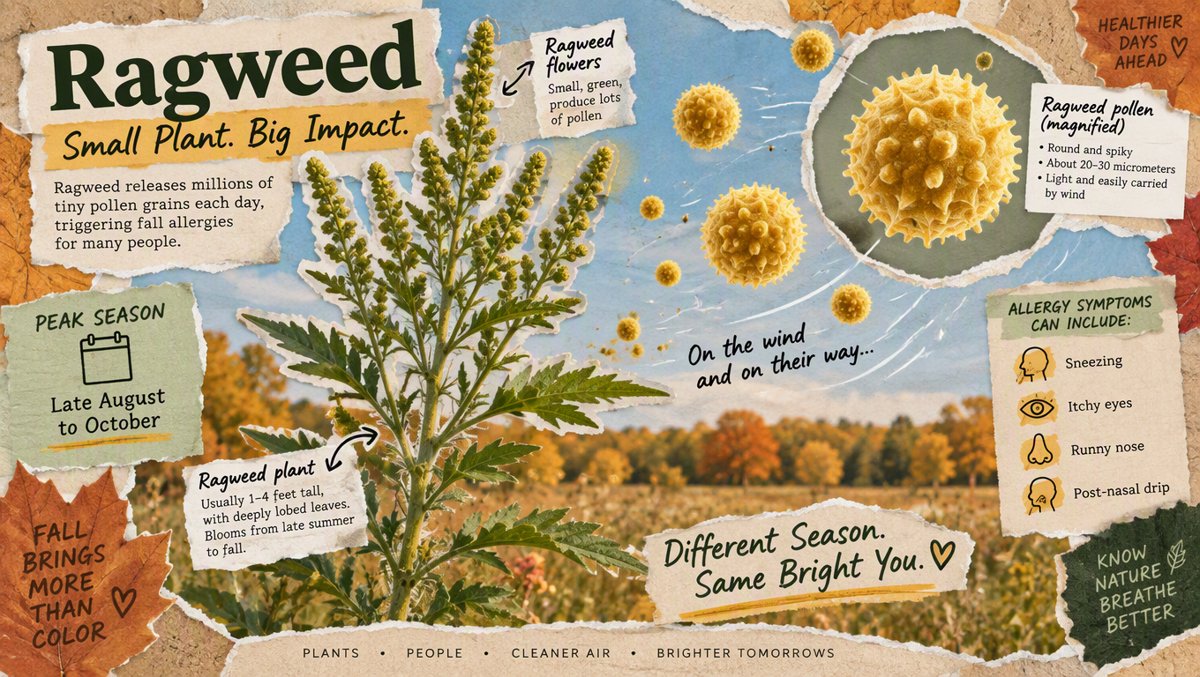
When people think "allergies," they picture spring blossoms. But fall allergy season really belongs to one plant: ragweed. It starts releasing pollen in August, peaks in mid-September, and keeps going until the first hard frost — roughly a 6-to-10-week window in most regions.³ ⁴ And ragweed doesn't mess around: a single plant can produce up to a billion grains of pollen, and that pollen has been documented traveling as far as 400 miles from where it was released.³ No wonder your nose didn't stand a chance.
Symptoms of hay fever (the nickname for allergic rhinitis) include sneezing, runny nose, congestion, itchy-watery-red eyes, coughing, and an itchy nose, roof of mouth, or throat.⁵ ⁶ One important detail: allergies don't cause fevers. If you're stuffed up but your temperature is normal, odds are good it's pollen, not a virus.⁵
And if it feels like this season keeps getting longer — you're not imagining it. The EPA has tracked ragweed pollen season across North America since 1995 and found it grew longer at 10 of the 11 locations studied, with some northern cities adding weeks to their seasons (Fargo, ND: about 21 days; Minneapolis, MN: about 18 days).⁷ ⁸ Warmer falls mean a later first frost, which means more sneezing days per year. (Fun bonus fact that explains your foggy brain: hay fever can also mess with sleep and concentration, so "allergy brain" is real.)⁵ ⁶
✅ Quick wins this week:
Track your local pollen count — check a pollen forecast app or the AAAAI's National Allergy Bureau pollen stations before planning outdoor time.
Learn your season's boundaries — ragweed peaks now and typically ends at first frost, so the finish line is real.
Do a "cold vs. allergies" gut check — no fever + itchy eyes + pattern that repeats every fall = allergies, not infection.
🔑 Key takeaway: Fall sniffles are usually ragweed, not a cold — and thanks to longer autumns, the season now runs about 6–10 weeks, so a real game plan matters.
🛡️ Section 2: Build Your Pollen Defense System (It's Hiding in Your Laundry Basket)
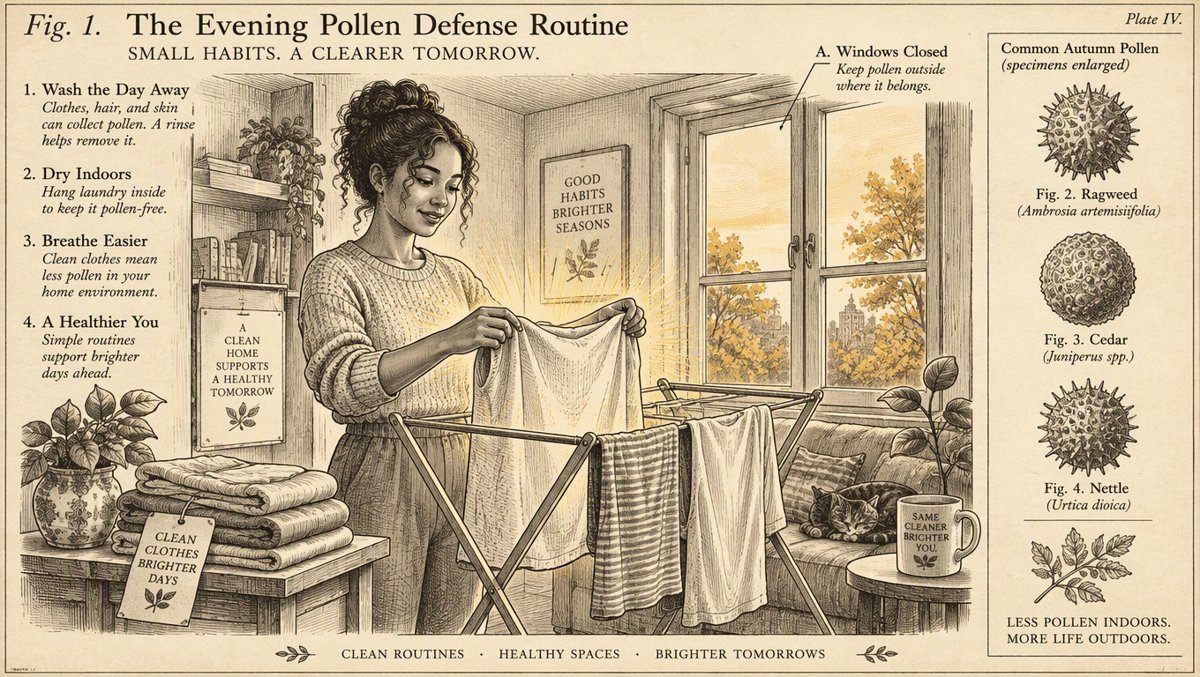
You can't avoid ragweed pollen — but you can dramatically cut how much of it rides home with you. Pollen settles on your hair, skin, and clothing while you're outside, then happily re-attacks you all evening from your own couch.³ The fix is a "decontamination" routine that takes minutes:
✅ Your pollen-defense checklist:
Shower and change clothes in the evening — wash the day's pollen off your hair and body before it gets on your pillow.
Keep windows closed on high-pollen days — that first cool fall morning is tempting, but it's also peak pollen delivery time. Run the A/C instead.
Dry laundry indoors during peak season — sheets left on the line overnight become pollen Velcro.
Wear sunglasses outdoors — a physical barrier for your itchy, watery eyes.
Wipe down pets after walks — furry family members are excellent pollen shuttles.
🔑 Key takeaway: Pollen's favorite trick is hitchhiking indoors on you, your clothes, and your pets — an evening shower, closed windows, and indoor laundry can cut your nightly exposure big-time.
💪 Section 3: Fight Back With Actual Science (Rinses, Sprays, and One Delicious Myth)
Now for the fun part — what actually works, according to the evidence:
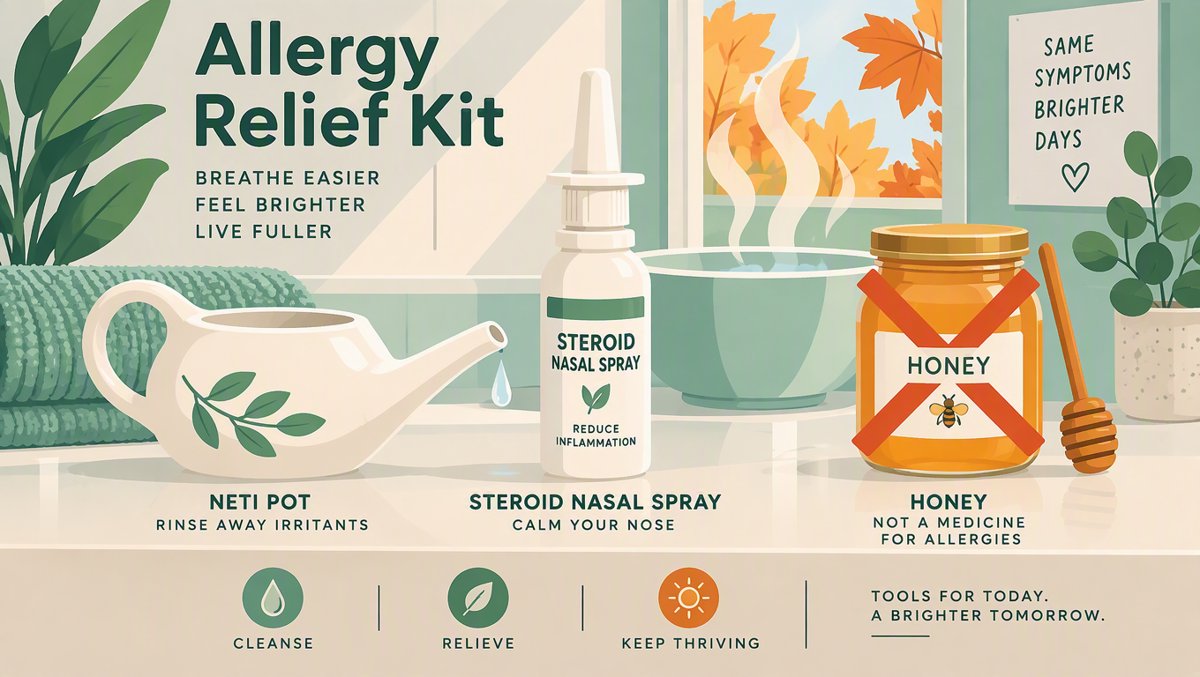
Saline rinses genuinely help. A systematic review of 46 studies found saline nasal irrigation improved nasal symptoms by 27.66% and cut allergy medication use by 62.1%.⁹ Think of it as a power-wash for the pollen party in your nose. ⚠️ One non-negotiable safety rule: use only distilled, sterile, or previously boiled water in your neti pot or rinse bottle — never straight tap water. Tap water can carry rare but serious amoebas (Naegleria fowleri and Acanthamoeba), and the CDC has linked infections to nasal rinsing with untreated tap water. If you boil tap water, keep it at a rolling boil for 1 minute (3 minutes above 6,500 ft elevation) and let it cool.¹⁰ ¹¹
Steroid nasal sprays are the heavyweight champ for stuffy noses. A landmark meta-analysis of 16 trials found intranasal corticosteroids relieved nasal blockage, discharge, and sneezing significantly better than oral antihistamines¹² — and newer research confirms it: across seasonal allergic rhinitis, intranasal steroids outperform oral antihistamine pills for total nasal symptoms.¹³ ¹⁴ The catch? They work best when you start them before the season peaks and use them consistently — Mayo Clinic allergists recommend beginning medication a couple of weeks ahead of your season rather than waiting until you're miserable.¹⁵
And the local honey myth? We love honey. Honey is delightful. But it is not allergy medicine. The American Academy of Allergy, Asthma & Immunology is blunt: there are no high-quality studies showing local honey treats allergies — and most honey contains very little of the wind-borne ragweed pollen that's actually bothering you.¹⁶ Enjoy it in your tea for other reasons. 🍯
Two last pro moves: if munching banana, melon, zucchini, or cucumber makes your mouth itchy in fall, that's likely pollen-food allergy syndrome — your immune system confusing those foods with ragweed proteins (cooking usually denatures the protein; mention it to your doctor).¹⁷ ¹⁸ And if symptoms linger despite all this, or you ever wheeze, see a board-certified allergist — uncontrolled allergies can worsen asthma, and prescription options like immunotherapy exist.⁵ ⁶
🔑 Key takeaway: Saline rinses (with distilled or boiled water only!), steroid nasal sprays started before peak season, and ignoring the honey hype form a genuinely evidence-backed fall survival kit.
🎯 Key Takeaways
Fall sniffles are mostly ragweed, not a cold — no fever + itchy eyes + an every-September pattern = allergies. It peaks in mid-September and ends at first frost.
Fight invisible pollen: evening shower + fresh clothes, windows closed on high-count days, laundry dried indoors.
Saline rinses work (27.66% symptom improvement in studies) — but only with distilled, sterile, or boiled water in your neti pot. Never raw tap water.
Steroid nasal sprays beat antihistamine pills for stuffy noses — start them before peak season and use daily through it.
Skip the local-honey myth, watch for itchy-mouth reactions to melons and bananas (pollen-food allergy syndrome), and see an allergist if symptoms won't quit.
🎧 Key Takeaways — Listen (2 min)
📚 Verified Sources
CDC, National Center for Health Statistics — FastStats: Allergies and Hay Fever — 25.2% of U.S. adults have a seasonal allergy; 31.7% any allergy. https://www.cdc.gov/nchs/fastats/allergies.htm
American College of Allergy, Asthma & Immunology — Facts and Stats — Nearly 1 in 3 U.S. adults and more than 1 in 4 U.S. children reported seasonal allergy, eczema, or food allergy (2021 NHIS data). https://acaai.org/allergies/allergies-101/facts-stats/
Asthma and Allergy Network — Asthma and Allergy Forecast — ragweed season runs late summer to first frost, peaking in September. https://allergyasthmanetwork.org/weather/
Hermelingmeier KE, et al. (2012). Annals of Allergy, Asthma & Immunology — "Nasal irrigation as an adjunctive treatment in allergic rhinitis: A systematic review and meta-analysis": 27.66% symptom improvement, 62.1% less medication use. https://pmc.ncbi.nlm.nih.gov/articles/PMC3904042/
Weiner JM, et al. (1998). BMJ — meta-analysis of 16 trials: intranasal corticosteroids superior to oral H1-antihistamines for nasal blockage, discharge, sneezing. https://pmc.ncbi.nlm.nih.gov/articles/PMC28740/
All claims fact-checked against Gold-tier (CDC/NIH/WHO/PubMed/Nature/The Lancet) and Silver-tier (Mayo Clinic/Harvard Health/Cleveland Clinic) authoritative sources. Last verified: September 21, 2026.
If your tissue box and you are inseparable every September, be gentle with yourself — and maybe start that steroid spray tonight. Here's to clear sinuses, pumpkin patches, and cozy sweaters without the sneezing soundtrack. 🍂💛
 x/health ·