👻 The Ghost-Finger Files: Why Your Fingers Turn White, Blue, and Red in the Cold — and What Science Says to Do About It
 x/health ·
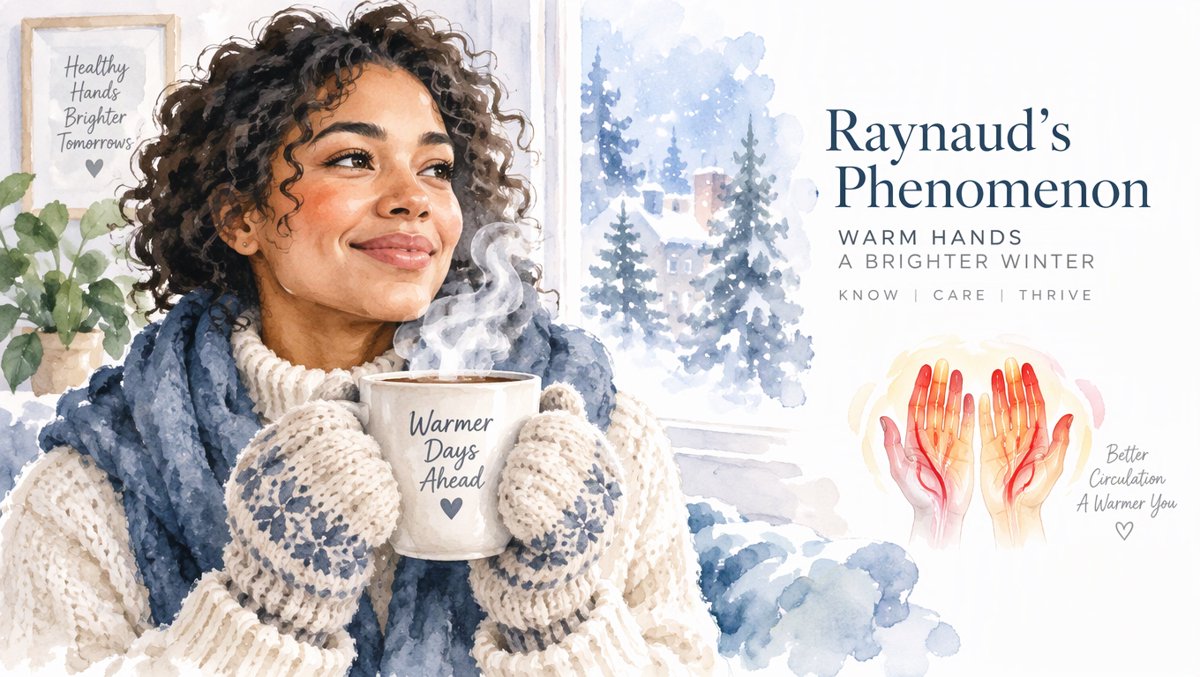
👻 The Ghost-Finger Files: Why Your Fingers Turn White, Blue, and Red in the Cold — and What Science Says to Do About It
Published: November 19, 2026 | Reading Time: ~6 minutes | Topic: Circulation & Winter Health
You grab a bag of frozen peas. You wander into the grocery store's freezer aisle. You step outside on the first properly cold morning of the season — and your fingers quietly stage a disappearing act. First they go pale white, then a bruised-looking blue, and then, once you're back in the warm, they flush an angry red with a tingly, throbbing comeback nobody asked for.
If that sounds like your hands in winter, meet Raynaud's (say it: "ray-NODES") — a surprisingly common condition where the tiny blood vessels in your fingers and toes overreact to cold or stress.¹ It's not dangerous for most people, it's very manageable, and science has gotten seriously good at explaining it. Here's what's actually happening in there — and your practical playbook for the months ahead.
🔬 Section 1: The Traffic Light in Your Fingertips
Here's the normal version first: when you get cold, your body plays defense. It narrows the blood vessels near the surface of your skin to keep your warm blood bundled up around your core — that's why fingers and toes get chilly first.² Totally normal, totally sensible.
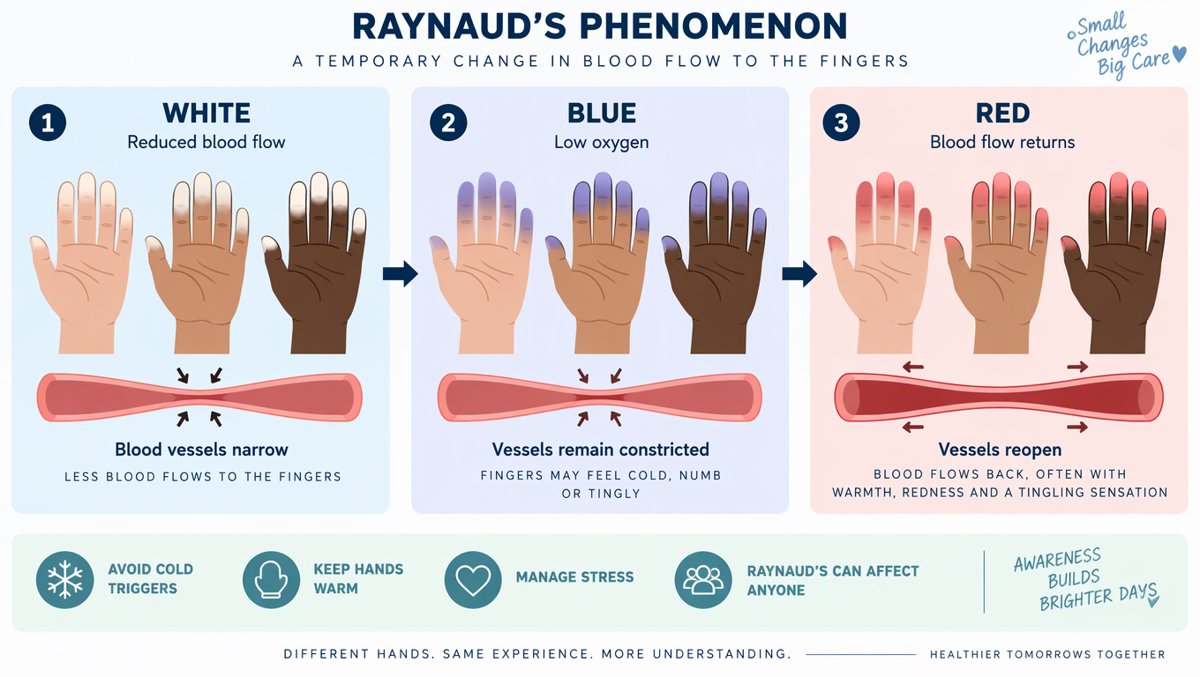
Raynaud's is that same reflex with the volume turned all the way up.¹ In people with Raynaud's, the small vessels in the hands and feet snap shut fast — and stay shut way longer than necessary.¹ Blood flow to your fingertips drops to almost nothing, and the classic color show begins: skin turns white as blood flow stops, then blue as the leftover oxygen drains out of the tissue, and finally — the best part — red, as circulation rushes back and the area may tingle, throb, or feel warm.³
A few fun quirks worth knowing:
- You don't need all three colors. Many people only see one or two of them.³
- The thumb usually sits this one out — it's less likely to be affected than your other fingers.¹
- A typical attack lasts around 20 minutes, though they can range anywhere from a few minutes to a couple of hours.³ ²
- It's not just the cold. Emotional stress can trigger attacks too (stress hormones genuinely narrow those vessels), and so can smoking and vaping.¹ Even abrupt temperature shifts — a blast of grocery-store air conditioning, a cold drink can in your palm, hands in the freezer — count as triggers.¹ ⁴
Key takeaway: Raynaud's isn't your circulation "failing" — it's your protective cold reflex overfiring. Once you know the white-blue-red sequence, you'll recognize an attack instantly and can start warming up right away.
🧬 Section 2: Two Kinds of Cold — and Who Gets It
Raynaud's comes in two flavors, and the difference matters.
Primary Raynaud's (doctors sometimes call it Raynaud's disease) is the most common kind, and honestly, the weird one: it has no known underlying cause.¹ It typically shows up before age 30 — often in the teenage years — and it's noticeably more common in women, with family history raising your odds, which hints at a genetic component.¹ ³
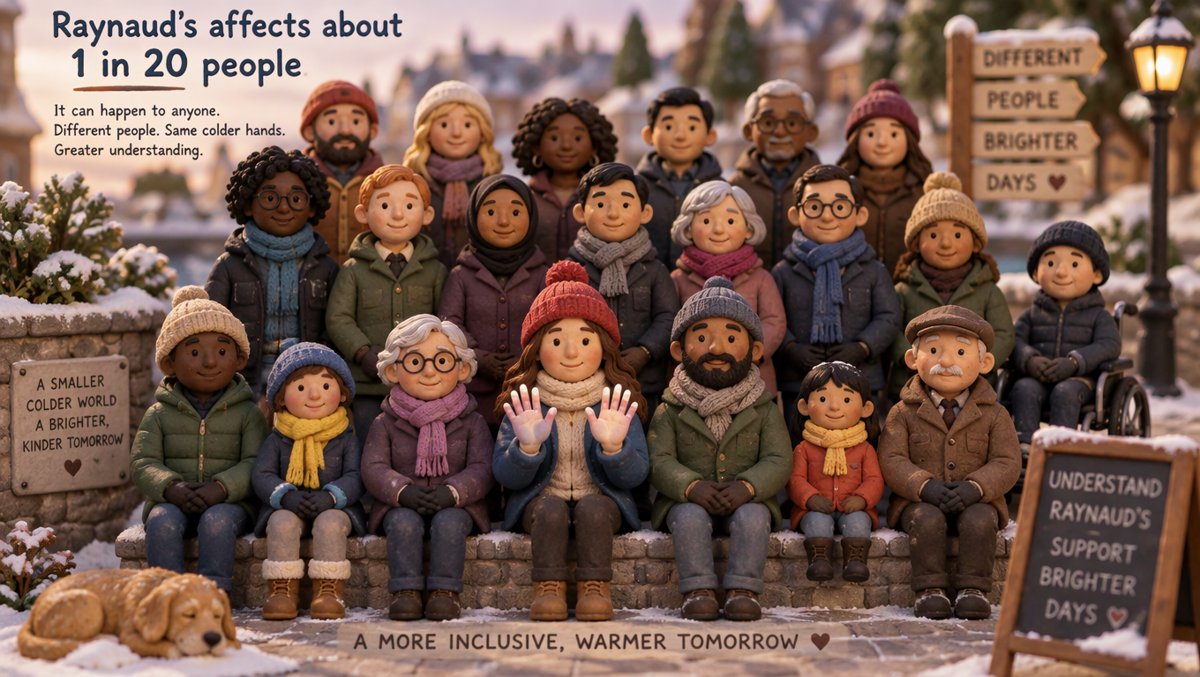
How common are we talking? A systematic review pooling 33 studies and 33,733 people found that roughly 1 in 20 adults — about 4.85% of the general population — has primary Raynaud's, with rates around 5.74% in women and 4.12% in men.⁵ ⁶ That quiet coworker with the desk fingerless gloves? Statistically, there's a decent chance you know several people with this.
Secondary Raynaud's (the "phenomenon" your doctor may fuss about) is the less common but more serious kind. Instead of arriving on its own, it's tied to something else: autoimmune diseases like scleroderma, lupus, rheumatoid arthritis, or Sjögren's disease; certain medications (some blood-pressure, migraine, and ADHD drugs can worsen or mimic symptoms); repetitive vibrating-tool use (jackhammers, some power tools); or a history of frostbite.¹ ³ Secondary Raynaud's tends to be more severe and can lead to skin sores, so it deserves proper medical attention.¹
One reassuring note: for most people with the primary form, Raynaud's is mild and not dangerous — it doesn't damage the blood vessels or threaten your health.³ And one inclusive note from the NIH: if you have a darker skin tone, the color changes can be harder to see, so pay attention to the cold, numb, "fallen asleep" feeling in your fingers instead.² ³
Key takeaway: About 1 in 20 adults has primary Raynaud's — mild, common, and usually starting young. Adult-onset attacks, one-sided symptoms, or finger sores are the signals to get checked, because those can point to the secondary form.
❄️ Section 3: The Winter Playbook — 5 Habits That Actually Help
You can't cure Raynaud's, but you can absolutely outsmart it. Cleveland Clinic experts call keeping hands and feet warm "one of the mainstays" of management.⁴ Here's the science-backed starter kit:
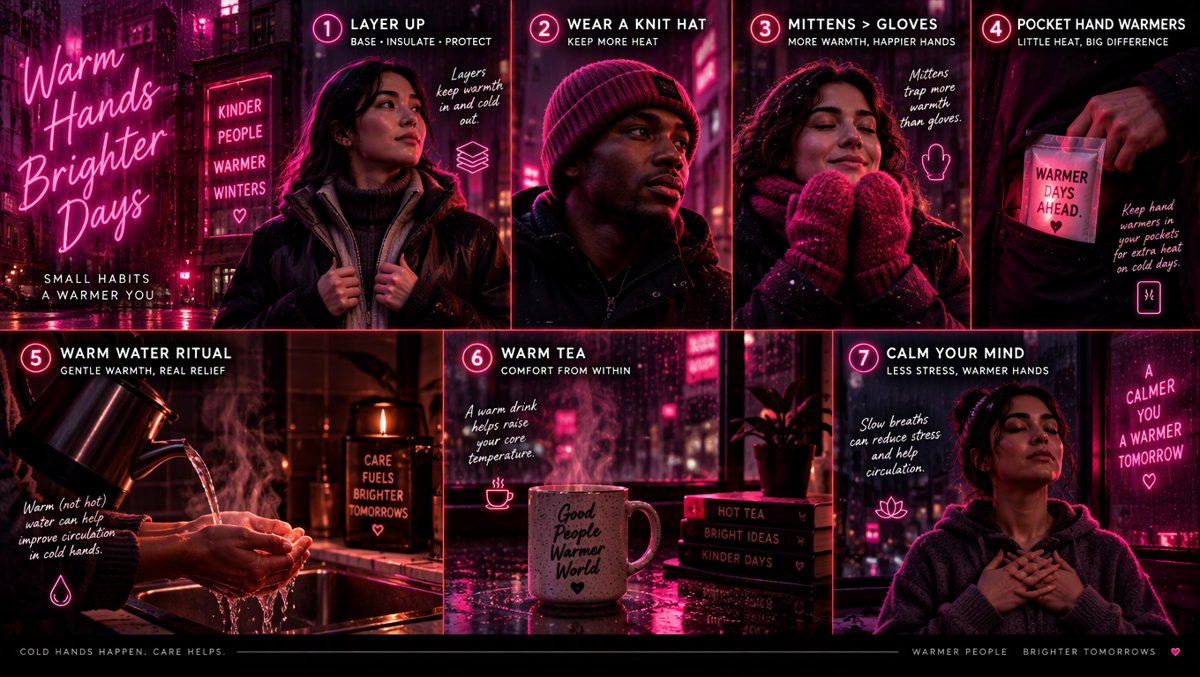
1. Warm the whole body, not just the hands. An attack can be triggered when any part of you gets cold — so layer up, wear a hat, and go mittens over gloves (fingers warm each other).⁴ ⁷ Some people even wear mittens and socks to bed in deep winter.⁷ Hand warmers and foot warmers: keep a stash in your coat pocket, your car, and your desk drawer.⁴
2. Take the cold out of the chore. Use oven mitts or a towel to reach into the freezer, grab a beverage holder for that iced drink, and let someone else shovel snow if you can.⁴ ³ Tiny adjustments, big difference — frostbite can set in faster for people with Raynaud's.⁴
3. Warm up smart when an attack hits. Get somewhere warm, run warm — not hot — water over your hands or feet, or tuck them somewhere warm on your body.³ ² Gently swinging your arms in circles ("windmilling") can also help push blood back into your fingers.³ And resist jumping straight from freezing outside to a blast of heat or a hot shower — let your body acclimate gradually, since sharp temperature swings are themselves a trigger.⁴
4. Mind the inner stuff. Stress management genuinely matters here (remember: stress hormones narrow vessels), as does quitting smoking and limiting caffeine, both of which constrict blood vessels.³ ⁴ Regular movement — aiming for about 30 minutes of moderate activity five days a week — keeps blood flowing efficiently.⁴ Staying hydrated helps your blood do its temperature job too.⁴
5. Protect the skin barrier. Lotion prevents the dry, cracked skin that poor fingertip circulation makes harder to heal.³ Simple, unglamorous, effective.
Key takeaway: The winning strategy is boring and brilliant: stay warm head to toe, handle cold objects with tools (not bare hands), warm up gradually with water that's warm-not-hot, manage stress and smoking, and keep moving.
🚩 Section 4: When to Call the Doctor (and Why 2026 Is a Good Year to Care)
Raynaud's usually doesn't require a medical degree to recognize — but it does deserve a quick check-in with a professional in some cases. Call your provider if you have:
- Attacks that start in adulthood (primary Raynaud's usually begins young)¹
- Attacks on just one side of your body, or loss of function in a hand or foot³
- Sores or ulcers on your fingertips or toes — that's a sign blood flow problems are damaging skin¹ ³
- New or worsening symptoms of any kind³
There's no single blood test for Raynaud's — doctors diagnose it from your history and symptoms (pro tip from Cleveland Clinic: take a photo of your fingers mid-attack; it's genuinely useful at the appointment).³ If the secondary form is suspected, they may examine the tiny capillaries at your nail beds under a microscope (called nailfold capillaroscopy) and run labs to look for underlying conditions.¹ ³
And here's the encouraging research beat: this field is actively heating up. The American Heart Association published its first major scientific statement on primary and secondary Raynaud in 2025, consolidating what modern vascular medicine knows.⁸ Just this month, new Phase 2 clinical trial data for a potential treatment targeting a severe, scleroderma-associated form of Raynaud's was presented at the American College of Rheumatology's Convergence 2026 meeting.⁹ Translation: what was once a "just wear mittens" condition is now getting big-league scientific attention.
Key takeaway: Mild primary Raynaud's is a lifestyle-management condition — but adult onset, one-sided attacks, or finger sores warrant a real medical workup, and 2025–2026 research is moving fast.
🎯 Key Takeaways
- Know the sequence: white → blue → red fingers or toes after cold or stress is Raynaud's — your protective cold reflex overfiring, not a circulation emergency (for most people).
- It's common: roughly 1 in 20 adults has primary Raynaud's; it usually starts before 30 and affects women more often.
- Dress the whole body: layers, a hat, and mittens-over-gloves keep attacks away; hand warmers in every pocket are your winter MVPs.
- Attack protocol: warm (not hot) water, somewhere cozy, gentle arm circles — and avoid dramatic temperature swings in either direction.
- Know the red flags: adult-onset attacks, one-sided symptoms, or sores on fingers/toes → see your provider; also try snapping a photo mid-attack to show them.
🎧 Key Takeaways — Listen (2 min)
📚 Verified Sources
- NIH / NIAMS — Raynaud's Phenomenon: Overview, Symptoms & Causes — National Institute of Arthritis and Musculoskeletal and Skin Diseases; mechanism, types, triggers, and risk factors. https://www.niams.nih.gov/health-topics/raynauds-phenomenon
- MedlinePlus (NIH/NLM) — Raynaud Phenomenon — National Library of Medicine consumer health overview; attack description, warm-not-hot water guidance, inclusive skin-tone note. https://medlineplus.gov/raynaudphenomenon.html
- Cleveland Clinic — Raynaud's Syndrome: Symptoms, Causes & Treatment — Medically reviewed health-library entry (updated June 26, 2026); color-change details, 20-minute typical attack, self-care tips, red flags. https://my.clevelandclinic.org/health/diseases/9849-raynauds-phenomenon
- Cleveland Clinic Health Essentials — "10 Cold Weather Tips for Managing Raynaud's During Winter" — Expert tips from Dr. Benjamin Abraham and Dr. Meghann McCarthy (Jan 17, 2024). https://health.clevelandclinic.org/how-to-manage-raynauds-during-the-winter
- Garner et al. (2015), BMJ Open — "Prevalence, risk factors and associations of primary Raynaud's phenomenon: systematic review and meta-analysis of observational studies"; 33 studies, 33,733 people; pooled prevalence 4.85% (women 5.74%, men 4.12%). https://bmjopen.bmj.com/content/5/3/e006389
- Chen et al. (2024), Rheumatology Advances in Practice (PMC) — "Prevalence, incidence, and mortality of Raynaud's phenomenon, Sjögren's syndrome and scleroderma: an umbrella review"; confirms pooled RP prevalence of 4,850 per 100,000. https://pmc.ncbi.nlm.nih.gov/articles/PMC11368408/
- Mayo Clinic — Raynaud's Disease: Symptoms and Causes — Consumer guidance including mittens/socks at bedtime and avoiding cold-handled drinkware. https://www.mayoclinic.org/diseases-conditions/raynauds-disease/symptoms-causes/syc-20363571
- Ujueta et al. (2025) — "Primary and Secondary Raynaud: A Scientific Statement From the American Heart Association" — AHA's dedicated scientific statement on Raynaud's as a vascular disorder. https://pubmed.ncbi.nlm.nih.gov/42639644/
- PR Newswire (2026) — Aisa Pharma, RECONNOITER-1 Phase 2 data in systemic sclerosis-associated Raynaud's, ACR Convergence 2026 — Current research news. https://www.prnewswire.com/news-releases/aisa-pharma-to-present-new-data-from-the-phase-2-reconnoiter-1-trial-in-systemic-sclerosisassociated-raynauds-phenomenon-at-acr-convergence-2026-302932492.html
All claims fact-checked against Gold-tier (NIH/NIAMS, MedlinePlus, PMC, AHA, BMJ Open) and Silver-tier (Mayo Clinic, Cleveland Clinic) authoritative sources. Last verified: November 19, 2026.
Stay warm out there, friends — and if your fingers ever put on that little ghost show, you'll know exactly what to do. 🧤