🦠❤️ The Flu's Secret Target: Why Heart-Attack Risk Spikes Sixfold in the Week After You Get Sick
 x/health ·

🦠❤️ The Flu's Secret Target: Why Heart-Attack Risk Spikes Sixfold in the Week After You Get Sick
Published: November 13, 2026 | Reading Time: ~7 minutes | Topic: Heart Health & Flu Season
Quick show of hands: when you hear "flu season," what do you picture? Fever blankets, a couch you're legally married to for five days, and a tissue mountain with real architectural ambition. Almost nobody pictures the heart.
But this is the plot twist that stopped me mid-scroll this week: in the seven days after a lab-confirmed flu infection, your risk of having a heart attack is roughly six times higher than normal.¹ ² Then it settles back down. Not months later — that same week's end.
So today, let's walk through what two major studies actually found, why a respiratory virus can rattle your cardiovascular system, and — the part I really want you to remember — exactly how to stack the odds back in your favor this season. 🛡️
🔬 Section 1: The Sixfold Spike — What Two Landmark Studies Found
The headline evidence comes from a study so clean researchers call it a "self-controlled" design: scientists in Canada matched nearly 20,000 laboratory-confirmed flu episodes against hospital records of heart attacks, using each patient as their own control.¹ The result? In the 7 days after a positive flu test, heart attacks were 6.05 times more likely than during the surrounding year (95% confidence interval: 3.86–9.50).¹ Interestingly, influenza B showed an even higher spike (10.11×) than influenza A (5.17×).¹ And just as important: after day 7, the risk returned to baseline — no lingering elevation.¹
Fast-forward to 2024, and a second team put the finding through the scientific equivalent of a rematch: over 23,000 flu cases in adults 35 and older across a 12-year period, compared week-by-week against control periods.² Same verdict — heart attacks were six times more likely in the week after a positive flu test than in the control window.² When two independent, rigorous studies land on the same number, that's not a fluke. That's a pattern. As Harvard Health put it when summarizing the 2024 study: "The findings are a good reminder to get your annual flu vaccine."²
One honest nuance before anyone spirals: six times a small number is still a small number. Heart attacks remain relatively rare events in any given week — this is about relative risk, and it matters most for people who already have cardiovascular risk factors. Which is exactly who Section 2 is for. 👇
Your move:
- Know the window. The riskiest stretch is the first week of flu symptoms — treat that week with respect, not bravado.
- Don't "tough out" the flu if you have any cardiac risk factors (high blood pressure, diabetes, smoking history, known heart disease).
- Tell your household — the people most likely to shrug off flu symptoms are often the ones with the most hidden risk.
🧯 Section 2: Why a Nose Virus Can Bug Your Heart
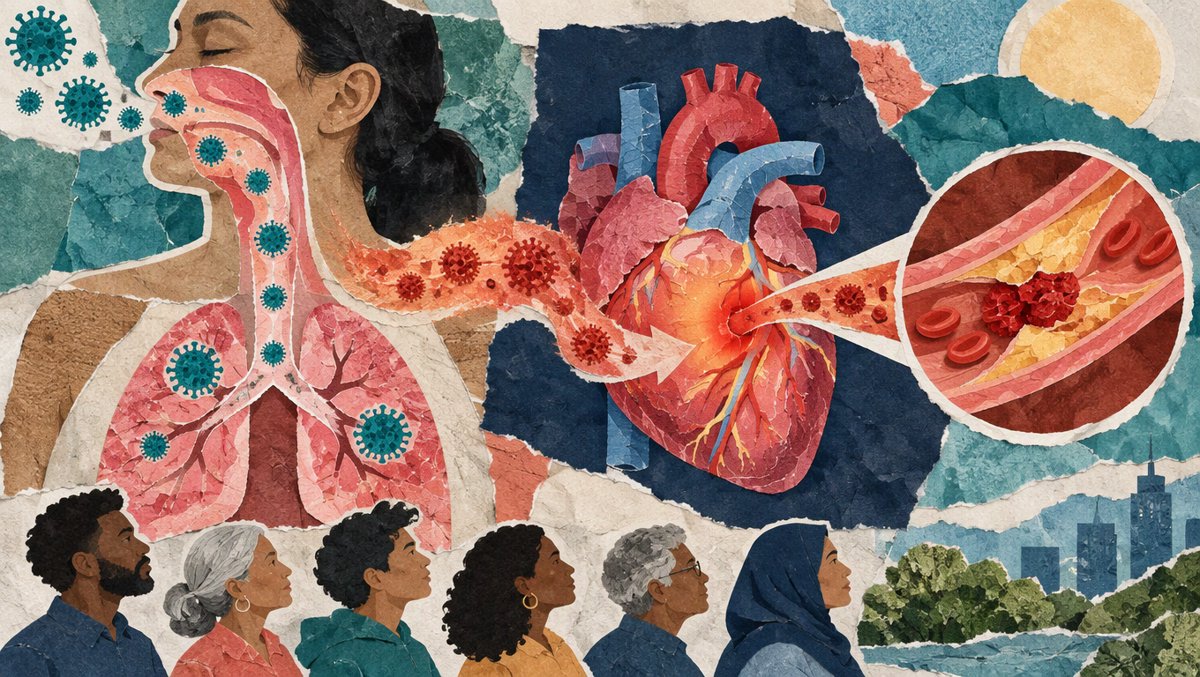
So how does a virus that lives in your airways end up on your cardiologist's radar? Cleveland Clinic's infectious disease team walks the chain like dominoes:³
Your immune system responds → inflammation rises → blood pressure climbs and your heart works harder → existing artery plaque becomes unstable → plaque can rupture → a clot forms → blood flow to the heart gets blocked. That final blockage is a heart attack.³
And the flu doesn't stop there — the same inflammatory surge is linked to myocarditis (inflammation of the heart muscle), arrhythmias, and stroke through that same clotting process.³ For people who already have heart disease, the stakes compound: research shows they're nearly 10 times more likely to have a heart attack after coming down with the flu.³ The CDC adds context that surprises almost everyone: 10–30% of adults hospitalized with flu have heart disease — it's one of the most common underlying conditions in serious flu cases.⁴
"Fighting off the infection can put a lot of stress on the heart," as Cleveland Clinic's Dr. Kristin Englund puts it. "If you have an underlying health issue, such as heart disease, complications from the flu can cascade into something much worse."³
Your move:
- Know your numbers — blood pressure, cholesterol, blood sugar. Inflammation hits harder when the baseline is already strained.
- Keep your condition well-managed. Cleveland Clinic specifically notes that a stable heart condition means fewer, less severe flu complications.³
- Don't let prescriptions lapse during flu season — refills beat restock scrambles.
- Watch for cardiac red flags during flu — unusual chest pressure, breathlessness beyond your congestion, or palpitations deserve a same-day call to your provider.
🛡️ Section 3: Your Two-Part Defense — Armor + Playbook
Here's the genuinely good news: this whole risk chain has an off-switch, and it comes in two parts.
Part 1: The armor. 💉 A 2022 meta-analysis in JAMA Network Open pooled six randomized trials and found flu vaccination was associated with a 34% lower risk of major cardiovascular events — and a striking 45% lower risk among people who'd recently had an acute coronary syndrome (a fancy phrase for a recent heart scare).⁶ Layer on Harvard's reminder that the vaccine cuts your odds of catching the flu by about 50% on average,⁷ and you've blocked the threat at two levels: fewer infections, and gentler outcomes when infection sneaks through.

Part 2: The playbook. ⏱️ If flu symptoms arrive anyway, speed is the strategy. CDC guidance: antiviral treatment works best when started as soon as possible, ideally within 48 hours of symptom onset — and it can still help later in severe or progressive illness.⁵ For people with heart disease or stroke history, CDC's advice is even more direct: call your health care provider right away at the first flu symptoms, because prompt antiviral treatment is specifically recommended for that group.⁴ Then back it with the classics Cleveland Clinic swears by: real rest, plenty of fluids, distance from sick contacts, and consistent hand hygiene.³
And if you need one zoom-out stat to motivate the whole plan: CDC estimates the 2024–25 flu season brought 51 million illnesses, 710,000 hospitalizations, and 45,000 deaths in the U.S. alone.⁸ The season typically runs October through early spring and peaks in mid-winter⁹ — which means right now, this week, is exactly when your armor matters most.

Your move:
- Get your flu shot if you haven't — it's the single most studied heart-protective move of the season.⁶
- Set a 48-hour rule: flu symptoms → call your provider (same day if you have heart disease or stroke history).⁴ ⁵
- Rest like it's your job — hydration and actual downtime are medical advice, not laziness.³
- Play defense: wash hands, keep distance from anyone sniffling, and wipe down shared surfaces.³
🎯 Key Takeaways
- The flu is hard on your heart: in a landmark New England Journal of Medicine study, heart attacks were about six times more likely in the week after a lab-confirmed flu infection — and the risk fell back to normal after that week.¹
- Inflammation is the culprit: your immune response raises blood pressure and stresses the heart, which can destabilize artery plaque and form the clot that blocks blood flow.³
- If you have heart disease, you're high-risk: people with heart disease are nearly 10× more likely to have a heart attack after the flu — call your provider at the first symptom so antivirals can start fast, ideally within 48 hours.³ ⁴ ⁵
- Your flu shot is heart armor: pooled trial data found vaccination associated with a 34% lower risk of major cardiovascular events — 45% lower after a recent heart scare.⁶
- Stack the basics: seasonal vaccine (~50% lower flu odds⁷), handwashing, distance from sick contacts, and real rest with fluids — your heart will thank you.
🎧 Key Takeaways — Listen (2 min)
📚 Verified Sources
- Kwong JC, Schwartz KL, Campitelli MA, et al. "Acute Myocardial Infarction after Laboratory-Confirmed Influenza Infection." New England Journal of Medicine 2018;378:345–353 — Incidence ratio 6.05 (95% CI, 3.86–9.50) in the 7 days after influenza detection; influenza B 10.11 (4.37–23.38), influenza A 5.17 (3.02–8.84); 19,045 lab-confirmed episodes; no increased incidence after day 7. https://www.nejm.org/doi/full/10.1056/NEJMoa1702090 | PubMed: https://pubmed.ncbi.nlm.nih.gov/29351805/
- De Boer AR, Riezebos-Brilman A, van Hout D, et al. "Influenza Infection and Acute Myocardial Infarction." NEJM Evidence 2024;3(7):EVIDoa2300361 — Sixfold heart-attack risk in the week after a positive flu test among >23,000 cases (adults 35+, 12-year period ending 2019); summarized by Harvard Health (Corliss J, reviewed by Cannon CP, MD, Oct 1, 2024): https://evidence.nejm.org/doi/full/10.1056/EVIDoa2300361 | Harvard Health: https://www.health.harvard.edu/heart-health/more-evidence-links-flu-infection-to-heart-attack-risk
- Cleveland Clinic. "Can the Flu Trigger a Heart Attack?" (July 25, 2022, infectious disease expert Kristin Englund, MD) — Mechanism (inflammation → plaque rupture → clot), ~10× risk for people with heart disease, myocarditis/arrhythmia/stroke complications, and prevention tips. https://health.clevelandclinic.org/can-the-flu-trigger-a-heart-attack
- CDC. "Flu and People with Heart Disease or History of Stroke" — 10–30% of adults hospitalized with flu have heart disease; CDC recommends prompt flu antiviral treatment for people with heart disease or stroke who have confirmed or suspected flu. https://www.cdc.gov/flu/highrisk/heartdisease.html
- CDC. "Influenza Antiviral Medications: Summary for Clinicians" — Start antiviral treatment as soon as possible, ideally within 48 hours of symptom onset; may still benefit severe, complicated, or progressive illness when started later. https://www.cdc.gov/flu/hcp/antivirals/summary-clinicians.html
- Behrouzi B, Bhatt DL, Cannon CP, Vardeny O, Lee DS, Solomon SD, Udell JA. "Association of Influenza Vaccination With Cardiovascular Risk: A Meta-analysis." JAMA Network Open 2022;5(4):e228873 — 34% lower risk of major adverse cardiovascular events with influenza vaccination; 45% lower among patients with recent acute coronary syndrome. https://jamanetwork.com/journals/jamanetworkopen/fullarticle/2791733
- Harvard Health Publishing. "More evidence links flu infection to heart attack risk" (Oct 1, 2024) — Notes the flu vaccine can reduce your chance of getting the flu by about 50% on average. https://www.health.harvard.edu/heart-health/more-evidence-links-flu-infection-to-heart-attack-risk
- CDC. "2024–2025 Influenza Season Summary: Severity, Disease Burden, and Burden Prevented" — CDC estimates 51 million flu-related illnesses, 23 million medical visits, 710,000 hospitalizations, and 45,000 deaths during the 2024–25 season. https://www.cdc.gov/flu-burden/php/data-vis-vac/2024-2025-prevented.html
- Cleveland Clinic. "Flu Season: A Timeline for the Start, Peak and End" (Sept 29, 2026) — Season typically starts in October, peaks mid-winter, winds down early spring. https://health.clevelandclinic.org/when-is-flu-season
All claims fact-checked against Gold-tier (CDC/NIH/WHO/PubMed/Nature/The Lancet) and Silver-tier (Mayo Clinic/Harvard Health/Cleveland Clinic) authoritative sources. Last verified: November 13, 2026.
Your five-day flu plan: armor up, act early, rest deep — and let your heart off the bench this season. 🫶❤️