🎄⚖️ The "Five-Pound Lie": What the Scale Actually Says After the Holidays (and the Fix That Works)
 x/health ·

🎄⚖️ The "Five-Pound Lie": What the Scale Actually Says After the Holidays (and the Fix That Works)
Published: November 21, 2026 | Reading Time: ~7 minutes | Topic: Holiday Health & Weight Science
Quick quiz, friends: how much weight does the average person gain between Thanksgiving and New Year's Day? 🤔
If you said "five pounds," you're in very good company — that number gets repeated at dinner tables, in magazine headlines, and by well-meaning relatives every single year. It's practically a holiday tradition of its own. There's just one small problem: when researchers actually put people on precise lab scales and tracked them for a full year, the famous five pounds didn't show up. 😲
What they found instead is honestly more interesting — a story about small numbers that quietly add up, a myth-busting experiment from the National Institutes of Health, and one surprisingly simple habit that, in a clinical trial, was the difference between gaining weight and actually losing it during the holidays. Grab your cocoa ☕ — let's dig in.
🔬 Section 1: The Myth Meets a Scale

Back in the late 1990s, a research team at the National Institute of Diabetes and Digestive and Kidney Diseases decided to do what rumors rarely do: measure. They recruited 195 adults and weighed them on precise lab scales four times a year — before the holidays, during them, after them, and again the following fall — so they could isolate exactly how much weight changed during the Thanksgiving-to-New-Year window.¹
Their findings, published in the New England Journal of Medicine, were a genuine plot twist:
- The average holiday-season gain was 0.37 kg — about 0.8 pounds. Not five pounds. Less than one.¹
- Weight barely budged during the weeks before the holidays (+0.18 kg, not statistically significant) or the weeks after (−0.07 kg, also not significant). The holiday window really is the special one.¹
- But here's the nuance: the average hides big differences. People with overweight or obesity gained more than others, and **14% of participants — about one in seven — actually did gain more than 2.3 kg (5 lb).**¹
So the myth isn't totally wrong — it's just wildly overstated for most people. As a companion commentary in Nutrition Reviews put it when reviewing the study: the claim that everyone gains five pounds "yet few data support this statement."² For the typical person, the holidays add a feather, not a bowling ball. 🪶
💡 Try this:
- Retire the "everyone gains five pounds" line at dinner — swap it for "some gain a little, some gain a lot, most gain less than a pound." Facts are conversation starters!
- If your jeans feel snug in January, remember 0.8 lb is normal — and fixable — before panic-mode kicks in.
- Notice whether you might be in that 14% — a once-a-week scale check tells you which group you're in.
🎯 Key Takeaway
The average holiday weight gain is about 0.8 pounds, not five — but one in seven people does gain 5+ pounds, and the only way to know your group is to know your number.
🥗 Section 2: The Catch That Turns a Feather Into a Snowball
Here's where the story gets sneaky. That sub-pound gain? **It doesn't melt away with spring.**¹
In the NIH study, participants weighed, on average, 0.48 kg (about 1 pound) more in February/March than they had the previous fall — and when 165 of them returned the following September, their weight hadn't come back down. There was no significant "rebound loss" in spring or summer at all.¹ The holiday gain essentially stuck.
Even more striking: when researchers tallied it up, that six-week holiday window **accounted for 51% — over half — of a person's entire yearly weight gain.**² That's why scientists call it a "critical period": a small gain that never leaves, repeated every winter, quietly compounds into the gradual "weight creep" many adults experience over the years.¹²¹³
And there's a fairness wrinkle worth knowing: the gain was larger among people already carrying overweight or obesity — the group with the most reason to protect their progress.¹⁴
💡 Try this:
- Pick a "return-to" number: one weight where January-you agrees to high-five December-you. Maintenance is a win — treat it like one. 🏆
- Think in winters, not weeks: one year's 0.8 lb is trivial; ten winters of it is a different story. Small hinges swing big doors.
- If you're currently working on your health, give the holidays extra attention, not less — that's exactly who the research says is most affected.
🎯 Key Takeaway
~Half of your year's weight change can happen in six holiday weeks — and since it rarely reverses on its own, maintenance really is the name of the game.
🚶 Section 3: It's Not the Couch — It's the Second Helping
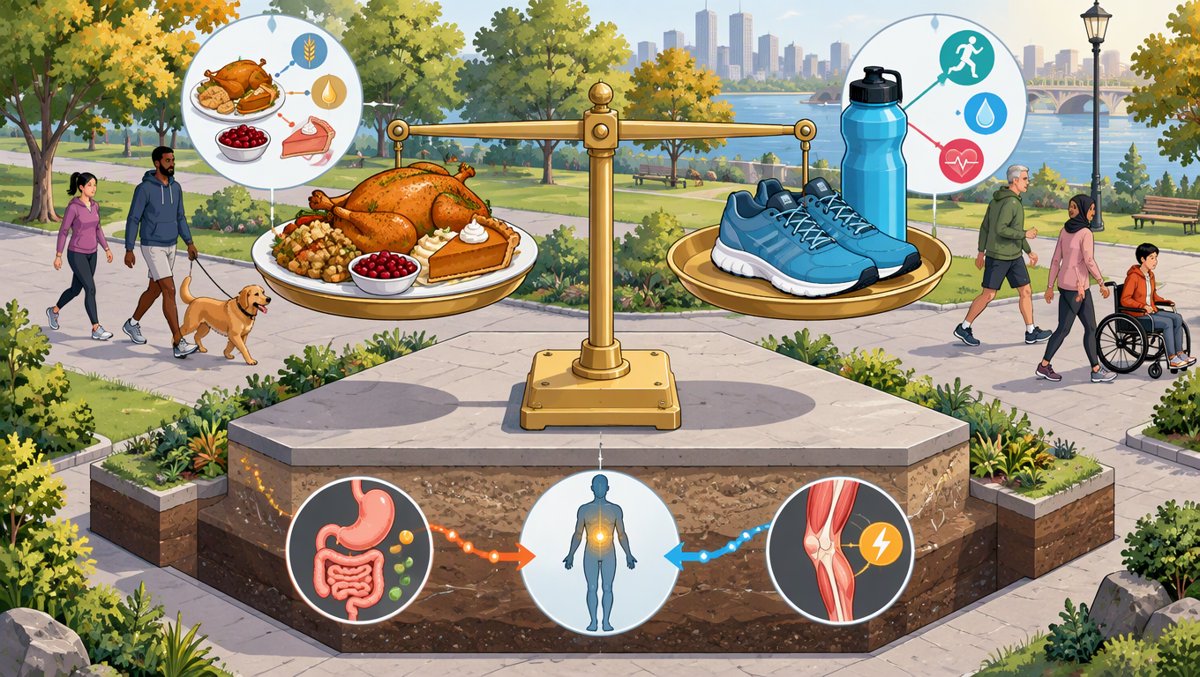
"Sure," you might say, "we gain less than we think — but it's because we skip the gym all December, right?"
Science checked that too — and the answer surprised everyone. In a 2020 study published in the International Journal of Obesity, researchers used a gold-standard technique called doubly labeled water to measure people's total energy expenditure through the holidays. The result: it didn't change. Participants were burning essentially the same amount of energy in December as before it. What shifted was on the plate side — more restaurant meals, lower satisfaction after eating, and a measured trend toward roughly +80 extra calories per day (technically not statistically significant, but pointing the same direction).³
The pattern holds in shorter windows too. In one university study, students gained about 0.5 kg during the Thanksgiving break alone — roughly 13 days — with those in the overweight/obese group gaining significantly more (1.0 kg vs. a non-significant 0.2 kg in normal-weight peers).⁴ Reviews of the broader literature find the same signature: adults consistently gain around 0.4–0.9 kg across the season.⁵
Why does this matter for you? Because it means you don't have to become a December gym warrior to win the season. The lever that actually moves is what and how much you eat — and even small, unremarkable tweaks (a plate, not a platter; water between toasts 🥂) work with the grain of the evidence instead of against it.
💡 Try this:
- Eat like it's a dinner, not a deadline: half your plate veggies first, then favorites — satisfaction is allowed, seconds are optional.
- Skip the "saving up" strategy. Arriving starving is how platters happen.
- Keep your normal movement (walks count! 🚶♀️) for your heart and mood — just don't expect it to do the scale's job alone this month. The data says intake is the driver.³
🎯 Key Takeaway
Holiday gain isn't mainly a movement problem — total energy expenditure barely changes; it's an eating-environment problem. Fix the table, not the treadmill.
📉 Section 4: The Fix That Actually Worked (It Takes 30 Seconds a Day)

Okay — so what actually prevents the creep? For a long time, advice was mostly vibes. Then a 2019 randomized controlled trial published in Obesity put one strategy to a proper test: daily self-weighing with visual feedback. One hundred eleven adults were randomized before Thanksgiving; the intervention group stepped on a Wi-Fi scale every day through the holidays, saw their weight plotted as a graph, and aimed simply to not go above their baseline.⁶
The results read like a magic trick:
- Daily weighers: −0.13 kg. They lost a little weight across the season. 📉
- Control group (no daily weighing): +2.65 kg — nearly six pounds.⁶
- Among participants with overweight/obesity, the daily-weighing group lost an average of 1.46 kg over the holidays.⁶
- Meanwhile, the control group's gain didn't vanish afterward: at the 14-week follow-up they had kept 57% of it.⁶
A systematic review of holiday-season interventions reached the same verdict: every intervention study reviewed — all of them — managed to mitigate festive weight gain, with self-weighing/self-monitoring the recurring star.⁷ And long-term registries of successful weight-losers show the same fingerprint: more self-monitoring strategies during the holidays = less gain, with daily self-weighing specifically linked to better outcomes.⁸⁹
One honest caveat 🚩: some of the best holiday data comes from the National Weight Control Registry — people who've lost 30+ pounds and kept it off — and they struggle with the holidays too (38.9% of them gained at least 1 kg in one study, more than normal-weight peers).⁸ So if the season is hard for you even when you're "doing everything right," you're in famous company. The fix isn't shame — it's a scale, a graph, and 30 seconds.
💡 Try this:
- Weekly minimum, daily ideal: step on the scale at a consistent time (morning, after the bathroom, before coffee ☕) and just observe — no judgment, just data.
- Watch the graph, not the day: one salty dinner can swing 2 lb of water. The trendline is the truth; the daily blip is noise.
- Set your one rule: "return to baseline by Jan 7." Maintenance is the win condition — the trial simply asked people not to gain, and that alone beat the control group by nearly 3 kg.⁶
🎯 Key Takeaway
In a clinical trial, a daily 30-second weigh-in was the difference between +2.65 kg and −0.13 kg over the holidays. The scale isn't the enemy — it's the early-warning system.
🎯 Key Takeaways
- 🪶 The "everyone gains five pounds" claim fails in the lab: the average holiday-season gain in the landmark NIH study of 195 adults was 0.37 kg (~0.8 lb) — though 14% of people did gain more than 5 lb.
- 📌 That small gain isn't reversed in spring or summer — and the six-week holiday window accounts for 51% of a person's total yearly weight gain. Maintenance quietly wins championships.
- 🍽️ Your activity level barely changes over the holidays — measured energy expenditure stayed flat, so the gain comes from extra eating, not skipped workouts. Enjoy the feast; keep the line in the other weeks.
- ⚖️ In a randomized trial, people who weighed themselves daily through the holidays lost 0.13 kg on average, while the group that didn't gained 2.65 kg — and kept most of it months later.
- 🚩 One honest label: roughly 1 in 7 people really does gain 5+ pounds, and even successful weight-losers find the season hard. Check in weekly, know your line, and enjoy every single celebration. 🥂
🎧 Key Takeaways — Listen (2 min)
📚 Verified Sources
- Yanovski JA, Yanovski SZ, Sovik KN, Nguyen TT, O'Neil PM, Sebring NG. "A Prospective Study of Holiday Weight Gain." New England Journal of Medicine 2000;342(12):861–867. Average holiday gain 0.37 ± 1.52 kg; 14% gained >2.3 kg; net 0.48 kg fall→spring gain not reversed by the following fall. https://doi.org/10.1056/NEJM200003233421206
- Roberts SB. "Holiday Weight Gain: Fact or Fiction?" Nutrition Reviews 2000;58(11):378–379. Confirms the 0.37 kg average, greater gains with overweight/obesity, and that the 6-week holiday season explained 51% of annual weight gain. https://doi.org/10.1111/j.1753-4887.2000.tb01839.x
- Bhutani S, Wells N, Finlayson G, Schoeller DA. "Change in eating pattern as a contributor to energy intake and weight gain during the winter holiday period in obese adults." International Journal of Obesity 2020. Doubly labeled water: total energy expenditure unchanged during holidays; intake behaviors shifted (+80 kcal/day trend, non-significant). https://doi.org/10.1038/s41366-020-0562-2
- Hull HR, Radley D, Dinger MK, Fields DA. "The effect of the Thanksgiving Holiday on weight gain." Nutrition Journal 2006;5:29. Students gained ~0.5 kg over ~13 days; 1.0 kg in the overweight/obese group. https://doi.org/10.1186/1475-2891-5-29
- Díaz-Zavala RG, et al. "Effect of the Holiday Season on Weight Gain: A Narrative Review." Journal of Obesity 2017. Consistent adult gains of 0.4–0.9 kg; self-monitoring programs appeared to prevent gain (evidence limited). https://doi.org/10.1155/2017/2085136
- Kaviani S, vanDellen M, Cooper JA. "Daily Self-Weighing to Prevent Holiday-Associated Weight Gain in Adults." Obesity 2019;27(6):908–916. RCT: DSW+feedback −0.13 kg vs control +2.65 kg (P<0.001); OW/OB subgroup −1.46 kg; control retained 57% of gain at follow-up. https://doi.org/10.1002/oby.22454
- Zorbas C, Reeve E, Naughton S, Batis C, Whelan J, Waqa G, Bell C. "The Relationship Between Feasting Periods and Weight Gain: a Systematic Scoping Review." Current Obesity Reports 2020;9(1):70–89. 70% of 23 observational studies found significant festive increases (mean 0.7 kg); all six interventions mitigated gain via self-weighing/self-monitoring. https://doi.org/10.1007/s13679-020-00370-5
- Phelan S, Wing RR, Raynor HA, Dibello J, Nedeau K, Peng W. "Holiday weight management by successful weight losers and normal weight individuals." Journal of Consulting and Clinical Psychology 2008;76(3):442–448. 38.9% of successful weight-losers gained ≥1 kg over the holidays vs 16.7% of normal-weight peers. https://doi.org/10.1037/0022-006X.76.3.442
- Olson KL, Coffino JA, Thomas JG, Wing RR. "Strategies to manage weight during the holiday season among US adults: A descriptive study from the National Weight Control Registry." Obesity Science & Practice 2021;17(3). 683 participants gained 0.66 kg on average; daily self-weighing (p=0.03) and prioritizing food choices (p=0.02) each linked to less gain. https://doi.org/10.1002/osp4.470
- Baker RC, Kirschenbaum DS. "Weight control during the holidays: Highly consistent self-monitoring as a potentially useful coping mechanism." Health Psychology 1998;17(4):367–370. Only the most-consistent self-monitoring quartile averaged any weight loss across holiday weeks. https://doi.org/10.1037/0278-6133.17.4.367
All claims fact-checked against Gold-tier (NEJM/PubMed-indexed journals incl. Obesity, Int. Journal of Obesity, Nutrition Reviews, Current Obesity Reports) and Silver-tier sources. Study figures quoted verbatim from journal records. Last verified: November 21, 2026.
This article is general health information, not personalized medical advice — if weight is a worry for you, bring it up with your own healthcare team. 💛
Here's to a season with zero math anxiety and maximum joy — weigh in, keep your line, and pass the pie. 🥧✨