The Ex-ElevenLabs CMO Bookmarked NVIDIA's Free Voice Model 3,655 Times: Inside PersonaPlex, the Full-Duplex Talker That's Actually Been Out Since January

The Ex-ElevenLabs CMO Bookmarked NVIDIA's Free Voice Model 3,655 Times: Inside PersonaPlex, the Full-Duplex Talker That's Actually Been Out Since January
On October 22, a tweet detonated across voice-AI Twitter. Liam Braus — who until recently was the CMO of ElevenLabs, the most valuable pure-play voice company on the planet — fired off a post in Spanish (naturally) declaring that "NVIDIA just eliminated the biggest friction point in voice AI." The model in question: PersonaPlex-7B, a full-duplex conversational model that "can listen and talk at the same time."
The receipts, as of this writing: roughly 166,000 impressions, 2,931 likes, and — the number that matters — 3,655 bookmarks. Bookmarks are the most honest metric on social media. Likes are applause; bookmarks are a to-do list. Three and a half thousand people are telling future-them: run this thing.
Here's the fun part, though. The tweet says NVIDIA "acaba de" — just — released it. PersonaPlex's Hugging Face card and GitHub repo are both stamped January 15, 2026. The paper (arXiv 2602.06053, accepted at ICASSP 2026) was submitted January 14. The repo has 22 commits and a GitHub issue about Apple Silicon support dating back to April. Voice-AI Twitter didn't discover a new model yesterday; it discovered a nine-month-old one, and started bookmarking like the lease is up tomorrow. (Braus, whose bio reads "powered by Claude Code and bad sleep," did not respond to our joke request for comment, because that's not how any of this works.)
So what did the ex-voice-king's marketing chief see in it? Let's dig in.
What PersonaPlex actually is
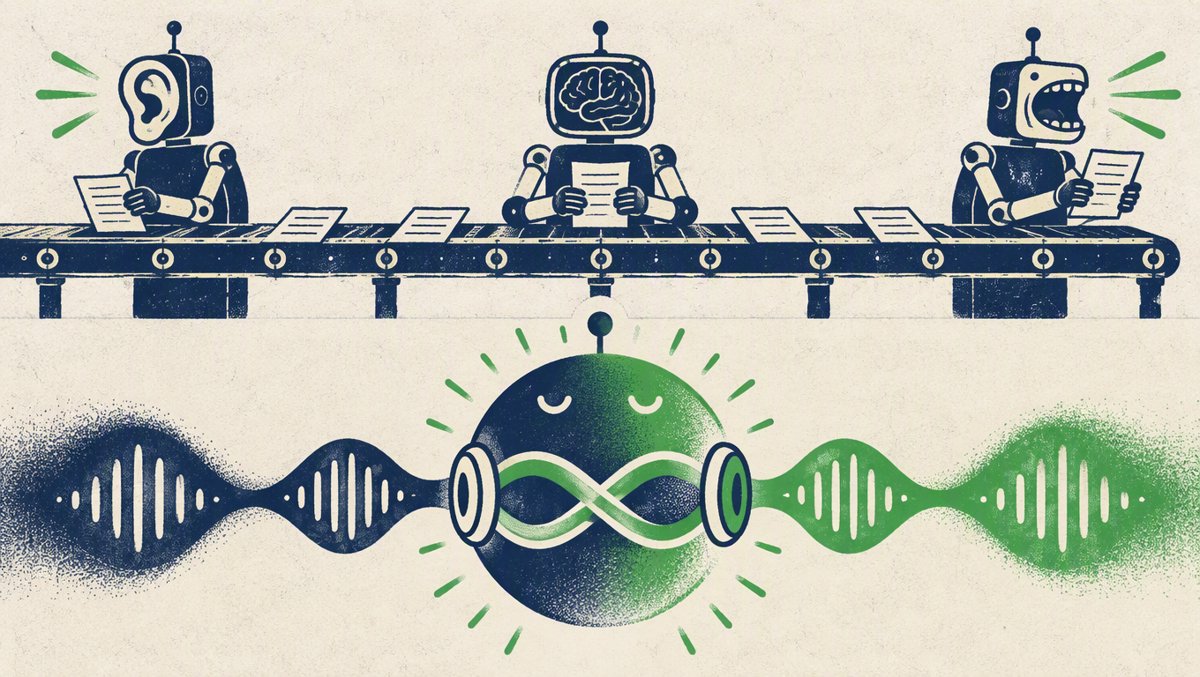
Almost every voice assistant you've ever yelled at is a cascade: speech-to-text converts your words, a language model thinks for a bit, then text-to-speech reads the answer aloud. Three models, three handoffs, and all the conversational grace of a fax machine. The pauses are wrong. It can't hear you while it's talking. It has never once said "uh-huh" at the right moment, and frankly neither have we.
Full-duplex models throw that pipeline away. PersonaPlex is a single 7-billion-parameter transformer — built on Kyutai's Moshi architecture (Moshiko weights), with Kyutai's Helium LLM as the semantic brain and the Mimi neural codec handling audio at 24kHz — that streams your speech in and its speech out simultaneously, through two parallel streams. It doesn't wait for you to finish. It learns when to pause, when to be interrupted, and when to emit a well-timed "oh okay" or "yeah, I think they do" while you ramble — the conversational grease that cascaded systems structurally cannot produce.
The paper's baseline data makes the difference vivid: original Moshi interrupts users or fails to yield 98-100% of the time on pause-handling tests (takeover rate 0.985). PersonaPlex got that down to 0.584 — still worse than Google's Gemini (0.255), a point we'll return to, because the benchmark table is more honest than the press release.
The persona trick: an audio sample plus a paragraph
PersonaPlex's actual innovation isn't duplex conversation — Moshi proved that in 2024. It's control. Previous duplex models ship like action figures: one voice, one personality, forever. Gemini and GPT-4o's realtime voices let you pick from a menu of (fixed) voices and describe a role in text, but you can't hand them an audio sample and say sound like this. PersonaPlex takes both:
- A voice prompt — a short audio embedding that captures vocal characteristics, speaking style and prosody. Zero-shot voice cloning. Ship 18 packaged voices (NATF0-NATF3, NATM0-NATM3 "natural", VARF0-4/VARM0-4 "variety") or feed it your own sample.
- A text prompt — plain language describing the role: "You work for Jerusalem Shakshuka which is a restaurant and your name is Owen Foster. Information: There are two shakshuka options: Classic (poached eggs, $9.50) and Spicy (scrambled eggs with jalapenos, $10.25)..."
Glue the two together in a "Hybrid System Prompt" — the paper temporally concatenates the segments, forces role text onto the agent's text channel while the audio channel stays silent, then plays the voice sample on the audio channel — and you get a consistent character that speaks in the cloned voice for the whole conversation. (Wonderful engineering footnote: while conditioning, the user's audio channel is fed a 440 Hz sine wave. The concert pitch A. Somebody in Santa Clara has opinions about turn-taking.)
And here's the part that made the researchers themselves raise eyebrows: the astronaut test. PersonaPlex was only trained on assistants, customer service and casual chat — but hand it "You are an astronaut on a Mars mission. Your name is Alex. You are already dealing with a reactor core meltdown..." and it improvises technical crisis vocabulary, urgency in its tone, and plausible reactor physics, none of which appeared in training. The team credits the Helium backbone's broad pretraining. The demo is on the project page and it's a genuinely good time.
How it was trained: AI teaching AI to small-talk
The training recipe is a parlor trick worth the price of admission. There's no mountain of labeled "natural duplex conversation with backchannels" data — nobody has that. So NVIDIA:
- Took 7,303 real phone conversations (1,217 hours) from the Fisher English corpus — real humans, real disfluencies — and had GPT-OSS-120B retrospectively invent a persona prompt for each speaker. ("You have lived in California for 21 years and consider San Francisco your home. You work as a teacher and have traveled a lot. You dislike meetings.")
- Generated 39,322 synthetic assistant dialogues (410 hours) and 105,410 synthetic customer-service dialogues (1,840 hours) — transcripts written by Qwen3-32B and GPT-OSS-120B, spoken aloud by Chatterbox TTS and Dia, with 26,296 voice samples from VoxCeleb, Libriheavy, LibriTTS, CommonAccent and Fisher.
The blend is the point, per the paper's own findings: synthetic data carries the task-following behavior, Fisher's real recordings carry the speech naturalness, and the shared prompt format lets the model disentangle the two. Under 5,000 hours of directed fine-tuning on top of Moshi's pretrained weights — pocket change by frontier standards.
The scoreboard: where it actually beats (and loses to) the competition
The paper's benchmark tables are refreshingly non-flattering, so let's read them like a grown-up.
Dialog naturalness (human-rated DMOS, higher is better) and voice similarity (SSIM):
| Model | Naturalness (FullDuplexBench) | Naturalness (customer-service) | Voice similarity (SSIM) |
|---|---|---|---|
| PersonaPlex | 3.90 ± 0.15 | 3.59 ± 0.12 | 0.57 |
| Gemini | 3.72 ± 0.14 | 3.22 ± 0.14 | 0.00 |
| Qwen-2.5-Omni | 3.70 ± 0.13 | 2.37 ± 0.20 | 0.07 |
| Freeze-Omni | 3.51 ± 0.18 | 2.38 ± 0.21 | 0.05 |
| Moshi | 3.11 ± 0.15 | 2.83 ± 0.13 | 0.10 |
That 0.00 for Gemini isn't an insult — it's a category error by design. Gemini has no voice cloning at all, so there's nothing to measure. The customers-service drop-off for Qwen-2.5-Omni and Freeze-Omni (3.70 → 2.37/2.38) shows what happens to role-play when a model leaves its happy place.
Conversational dynamics (FullDuplexBench; takeover rate, latency in seconds):
| Model | Pauses TOR↓ | Backchannel fit JSD↓ | Smooth turn-taking TOR↑ | Turn-taking latency↓ | Interruption handling TOR↑ | Answer quality (GPT-4o)↑ | Interruption latency↓ |
|---|---|---|---|---|---|---|---|
| PersonaPlex | 0.584 | 0.649 | 0.992 | 0.070 | 1.000 | 4.210 | 0.400 |
| Qwen-2.5-Omni | — | — | — | — | — | 4.590 | 2.740 |
| Freeze-Omni | 0.642 | 0.997 | 0.336 | 0.953 | 0.867 | 3.615 | 1.409 |
| Gemini | 0.255 | 0.896 | 0.655 | 1.301 | 0.891 | 3.376 | 1.183 |
| Moshi | 0.985 | 0.957 | 0.941 | 0.265 | 1.000 | 0.765 | 0.257 |
| dGSLM | 0.934 | 0.934 | 0.975 | 0.352 | 0.917 | 0.201 | 2.531 |
Read straight: PersonaPlex wins naturalness, turn-taking speed (0.070s vs Gemini's 1.301s — an 18x gap in not leaving people hanging), interruption handling (perfect 1.000 takeover, and it stops talking within 0.4s when you barge in), and it's the only model in the table that can both clone a voice and hold a role.
Now the honest column: Gemini beats it on pause handling (0.255 vs 0.584 — Gemini is better at knowing when you're done) and backs off more gracefully. Qwen-2.5-Omni gives better answers (4.590 vs 4.210 on GPT-4o-judged QA) but takes 2.740 seconds to shut up when interrupted — nearly 7x PersonaPlex's latency, which in a phone call feels like watching someone finish a toast at their own wedding. If your product is "brilliant answers, terrible listener," you're building a lecture, not a conversation.
One more asterisk: NVIDIA also built ServiceDuplexBench (350 customer-service questions) to prove the role-following claims, reports strong numbers on it — and then, per the model card's own "to be released soon," hasn't released it nine months later. The paper's most important benchmark is still a leap of faith. (Issue #106 on GitHub is someone politely asking. It remains politely unanswered.)
Strengths and weaknesses, no cherry-picking
Strengths
- Best-in-class conversation feel: #1 naturalness scores, near-zero turn-taking latency, perfect interruption yield — the mechanics of sounding human.
- The combo nobody else ships: role text + voice cloning + full duplex in one open model. Commercial APIs give you fixed voices; open duplex models give you one personality.
- Actually open: code is MIT; weights under the NVIDIA Open Model License, explicitly "ready for commercial use." Zero marginal cost per conversation once the GPU is yours.
- Ecosystem gravity: ~99,000 Hugging Face downloads last month, 11.6k GitHub stars, 37 community Spaces, 49 fine-tunes and 10 quantizations already exist.
- Trained on pocket change: ~3,500 directed hours, by LLM-and-TTS-generated data. The "synthetic data is slop" crowd has to square this one.
Weaknesses
- English only. English in, English out. Your Spanish-language viral tweet notwithstanding, Liam.
- The local experience is rough around the edges. The
--cpu-offloadescape hatch for sub-16GB GPUs crashes at warmup (issue #105, open since August). Community 8-bit/2-bit quantized builds "keep loading original weights" (issue #55). There's no official quantization at all. - No Mac support from NVIDIA. Apple Silicon runs the internet's enthusiasm, and all they got was a third-party Swift/MLX port — which, to be fair, hit 374 points on Hacker News in March.
- No tools, no RAG. It can't call functions, search your knowledge base, or look anything up — a customer-service agent that can't check your order status is a very empathetic brick (issues #93, #66, #65).
- Personas have a memory horizon. Users report the system prompt stops binding once a conversation outgrows the context window (issue #99); others report outright role confusion (issue #97). One r/LocalLLaMA user's review: "Starts good but gets really weird at the end."
- Benchmarks partly self-graded: ServiceDuplexBench unreleased (issue #106); test hardware was an A100 80GB, a $15k card your gaming rig is not.
Ready for local LLM?
This is the question the bookmarks are really asking, and the answer is: yes — with a loyalty card for NVIDIA and a tolerance for Sharpies-edged engineering.
The realistic setup: a Linux box, an NVIDIA GPU with 16-24GB of VRAM (RTX 3090/4090 class per community guides; NVIDIA's own card lists Ampere/Hopper data-center parts and was tested on an A100 80GB), ~15GB of weights, a Hugging Face token after clicking "I accept," and one command that serves a local web UI on port 8998 where you talk to it through the browser. That's it — no API key bills, no per-character meter running. If your GPU is an RTX 5090, you'll need the CUDA 13.0 PyTorch build; if it's NVIDIA's own DGX Spark, it runs but audio latency reportedly creeps upward mid-conversation (issue #96), which is an exquisite own-goal.
If "local" means "my MacBook," the honest answer is: not from NVIDIA — but the community Swift/MLX port exists and works, and it's the single most-discussed PersonaPlex artifact on Hacker News. If "local" means "I'll rent," any A100-class box on RunPod or Vast at $0.30-1.50/hour will do, though at that point you're sharing a data center with the cloud APIs you were escaping.
The deeper shift is the license, not the hardware. A year ago "serious voice AI" meant a per-minute invoice from OpenAI or a per-character meter from ElevenLabs. Now a 7B model you can pull in one git clone matches those systems on the conversational axis, beats several of them outright, and costs nothing per conversation. That's why 3,655 people bookmarked a nine-month-old model in a day — and why an ex-ElevenLabs CMO spent his afternoon amplifying the thing that's professionally nearest to his old employer's jugular.
The friction point wasn't really the latency. It was the invoice. And on that front, PersonaPlex — January vintage, warts and all — is the loudest shot anyone has fired yet.
Sources: NVIDIA ADLR project page; PersonaPlex paper (arXiv 2602.06053, ICASSP 2026); Hugging Face model card (nvidia/personaplex-7b-v1); NVIDIA/personaplex GitHub repo and issue tracker; @liambraus on X, Oct 22, 2026; FullDuplexBench; themenonlab.blog local setup guide; DataCamp tutorial; r/LocalLLaMA.