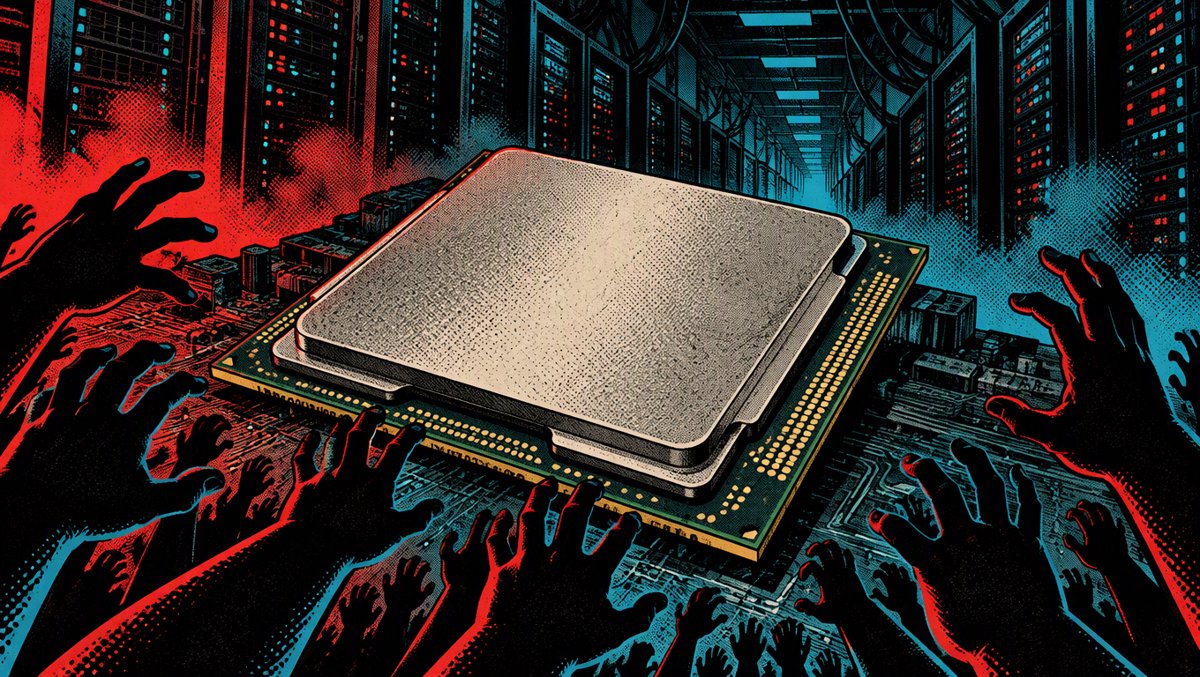
"The era of agent-based AI systems has made the server CPU, not the GPU, the component in shortest supply." — TechTimes, Sept 30, 2026
For three years the story of AI hardware had exactly one protagonist: the GPU. Nvidia's accelerator was the scarce thing, the expensive thing, the thing you queued for. CPUs were the help. They ladled data toward the GPU and stayed out of the way.
Then the agents showed up — and the help became the bottleneck.
Here's the wild part. AMD's next server chip, EPYC "Venice," isn't broadly available yet. Commercial availability of its flagship SP7 platform starts in Q4 2026. And yet, according to channel checks published in late September, AMD has reportedly already sold through its entire 2027 production run — and is now taking orders for 2028 delivery at prices up more than 40% above the previous generation.
The tip came from supply-chain watcher Jukan (@jukan05), who admitted he doubted it at first — the last time AMD looked "sold out," orders got cut after overbooking. After checking with multiple contacts, he decided this time it was real. WCCFtech, Kantan News, and Futunn each reached the same conclusion from separate supply-chain contacts.
To be clear about the stakes: AMD has not confirmed any of this. This is supply-chain intelligence, not corporate guidance. But the arithmetic is startling. Morgan Stanley projects Venice shipments of 6.75 million units in 2027, up from roughly 1.25 million in 2026 — a 5.4x jump. At a blended average selling price of about $7,691 across 31 SKUs, a fully booked 2027 implies roughly $51 billion in revenue visibility from the server CPU line alone.
A CPU. Selling out a year before it ships.
Blame the agents. The AI workloads that shaped data centers from 2022 to 2025 — training giant models, answering single prompts — were GPU-bound. The transaction ended when the tokens came out.
An AI agent doesn't do that. It plans toward a goal, calls tools and APIs, runs code, queries vector databases, spawns sub-agents, and keeps context across all of it. The GPU still does the inference — but each inference step takes milliseconds. In between, the CPU runs the orchestration loop: parsing outputs, deciding the next tool call, dispatching requests, executing commands, coordinating the swarm.
Research from Georgia Tech and Intel found that CPU-side tool processing accounts for 50–90% of total end-to-end latency in agentic workloads. Intel CEO Lip-Bu Tan put it bluntly at Computex 2026: "For reinforcement learning, orchestration, and agents, the CPU is a much better fit."
The consequence is a quiet rebalancing of the whole data center. Intel's Q1 2026 earnings showed the CPU-to-GPU ratio moving from about 1:8 in training environments to 1:4 for inference — and trending toward 1:1 parity in agentic deployments, with some customers running four CPUs per GPU. Arm's CEO called it a "CPU renaissance." Arm's own math: today's AI data centers need ~30 million CPU cores per gigawatt; agentic workloads push that to 120 million.
When a single GPU can starve for want of a CPU, you buy CPUs.
Launched at AMD's Advancing AI event in San Francisco on July 22–23, 2026, Venice — formally the EPYC 9006 series — is the first high-performance computing product in the industry to reach volume production on TSMC's 2nm (N2) process.
That's not just a marketing number. N2 is the first node in volume production to switch from FinFET transistors to gate-all-around (GAA) nanosheet transistors — the biggest transistor architecture change since planar gave way to FinFET more than a decade ago. TSMC reports roughly 15% more performance or 35% less power than its 3nm process at ~15% higher density. Chip designers essentially had to rebuild IP from scratch on it.
The flagship EPYC 9996 is a monster:
Venice arrives in four waves: SP7 (Q4 2026, the dense 256-core monsters), SP8 (H1 2027, 22 SKUs from 8 to 128 cores, starting at just $700 for the 8-core EPYC 9016), Venice-X (H2 2027, 3D V-Cache up to 1,152 MB for HPC), and Verano (H2 2027, an AI host-node CPU with up to 24 channels of LPDDR5X). AMD claims 70–80% higher performance and efficiency than the current Zen 5 "Turin" generation.
This is where the story gets genuinely interesting, because 2027's server CPU market is shaping up as a three-cornered scrap — and each chip is optimized for a different buyer.
AMD Venice (EPYC 9006) — x86, Zen 6, TSMC 2nm. Up to 256 cores, 16 memory channels, 1.6 TB/s, PCIe Gen 6. Price spans $700 to $14,904. Built for maximum core count and general-purpose compute density. That $51B figure is its 2027 opportunity.
NVIDIA Vera — Arm, 88 custom "Olympus" cores, up to 1.5 TB of LPDDR5X, 1.2 TB/s bandwidth. Projected at 5.75 million units in 2027. Vera isn't really competing for the same socket; it's purpose-built as the host CPU inside Nvidia's own rack systems, feeding Grace-Blackwell and Rubin GPUs. For hyperscalers already deep in Nvidia's NVLink world, Vera is the natural choice — no Arm porting bill required.
Intel Xeon 7 "Diamond Rapids" — Intel 18A-P node, up to 256 P-cores, 1.28 GB of last-level cache, PCIe Gen 6. Slated for 2027, reportedly nudged to mid-year. Intel is currently filling only about half of server CPU demand, which is its own kind of problem.
And the benchmark fight? AMD's headline — that EPYC 9996 delivers roughly 2.24x the platform-level integer throughput of Nvidia Vera — is technically accurate but a bit of a magic trick: it pits a 256-core AMD chip against an 88-core Vera. Normalize to comparable 96-core configurations, and AMD's own data shows a per-core advantage of about 20%. Still a lead. Not a rout.
The real dividing line is software. Hyperscalers with deep x86 stacks face real engineering cost to migrate to Arm — which is why AMD and Intel are collaborating through the x86 Ecosystem Advisory Group (with Microsoft, Google Cloud, and Meta) to keep x86 portable across the installed base. In practice, Venice and Vera are less two horses in one race than two different purchasing decisions.
Every "sold out" story has a flip side: a supply chain stretched taut.
Everything above hinges on TSMC's N2 wafers. Apple reportedly took a large share of early N2 capacity for consumer silicon, while AMD, Nvidia, Qualcomm, and MediaTek all compete for the same lines. TSMC is targeting roughly 120,000 N2 wafers per month by the end of 2026. How that allocation resolves determines how many of Venice's booked orders actually become shipped chips.
The stress is already visible. Japan's electronics industry association JEITA publicly warned government agencies in June 2026 about prolonged lead times and price hikes, calling it a "medium- to long-term structural change." Gartner projects global semiconductor revenue up 64% in 2026 to over $1.3 trillion. SK Hynix says its 2026 DRAM and NAND capacity sold out back in Q3 2025. Turbocharged demand plus a brand-new, hard-to-yield process node equals a queue — and AMD is reportedly exploring Samsung's 2nm as a second source.
Meta is already a lead Venice customer and co-development partner, having deployed millions of EPYC chips across Milan, Bergamo, and Turin. The demand isn't speculative — it's a real queue, with real names at the front of it.
For years the AI hardware conversation was a one-act play about GPUs. Agentic AI just rewrote the script: the boring, unglamorous CPU — the component everyone took for granted — is now the scarcest thing in the building. AMD's Venice, still weeks from broad availability, selling out through 2027 is the clearest signal yet that the bottleneck moved.
If you need CPUs for a 2027 AI build, the message from the channel is simple and slightly terrifying: order now for 2028, pay 40% more, or build around last year's chips. There is no fourth option.
Sources: TechTimes; WCCFtech; Tom's Hardware; ServeTheHome; TechPowerUp; AMD (Advancing AI / EPYC 9006); NVIDIA Developer; Intel; Morgan Stanley via Kantan News; TrendForce; JEITA; Arm; Red Hat (Georgia Tech/Intel CPU-GPU split). Facts verified 2026-10-02. Channel-check claims about 2027 sell-out are unconfirmed by AMD.