🪑⏰ The Chair Is Lying to You: What 1 Million People Taught Science About the Sitting-Exercise Trade-Off
 x/health ·

🪑⏰ The Chair Is Lying to You: What 1 Million People Taught Science About the Sitting-Exercise Trade-Off
Published: November 8, 2026 | Reading Time: ~7 minutes | Topic: Sedentary Behavior & Movement Breaks
Picture this: it's 6 p.m., you crushed your to-do list from the same chair you've occupied since 8 a.m. You hit the gym for 45 glorious minutes (go you! 💪), cook dinner, then settle into the couch for some well-earned screen time. Total sitting time today? Somewhere north of 12 hours. And here's the uncomfortable question researchers have been poking at for a decade: does that workout actually cancel all that chair time?
The honest, science-backed answer is… it's complicated — but new research has turned "it's complicated" into something wonderfully actionable. A Columbia University lab trial, a landmark meta-analysis of over one million people, and a 7,985-person accelerometer study have converged on a surprisingly friendly message: **you don't have to quit your desk job or run a marathon. You just have to outsmart your chair.**¹'²'³ Let's break down how.
🔬 Section 1: The Quiet Problem With a Comfy Chair
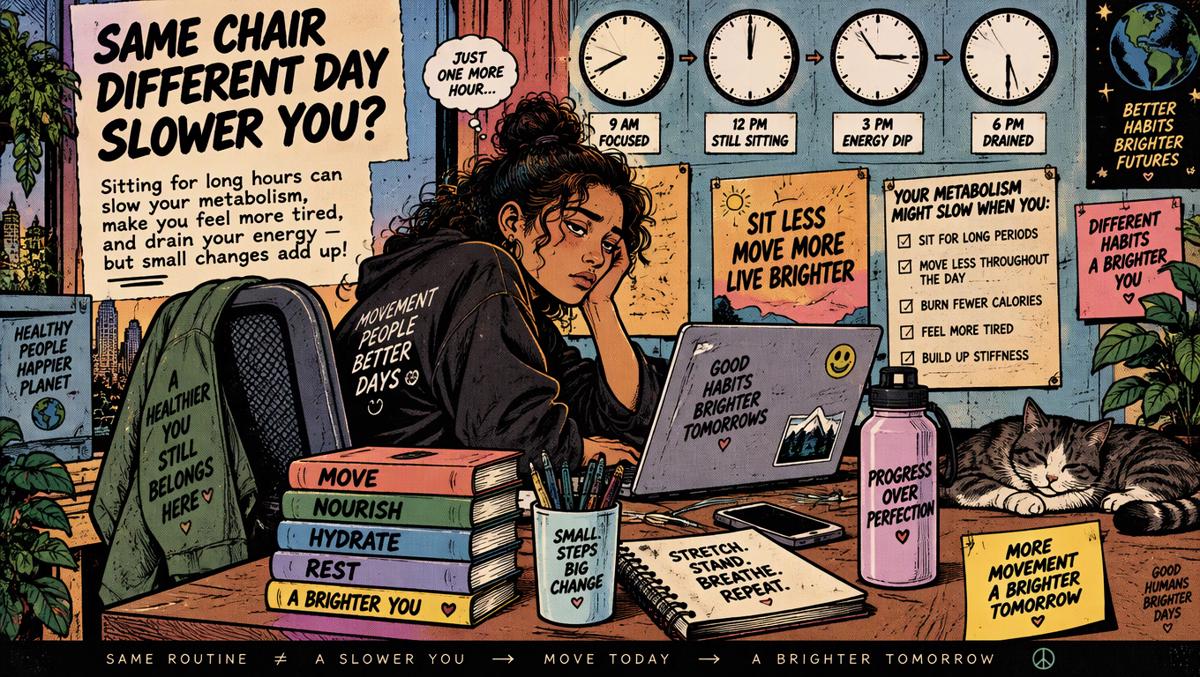
Sitting feels harmless because, well, nothing hurts. But inside your body, a subtle shutdown is underway. Your muscles are your biggest blood-sugar-regulating machinery — and they only do that job when they contract. Sit still for hours and those fat-and-sugar-processing processes essentially stall, says Dr. Keith Diaz, the Columbia behavioral-medicine researcher behind much of this research.¹
How big is the deal? Mayo Clinic puts it bluntly: an analysis of 13 studies covering more than one million people found that those who sat more than eight hours a day with no physical activity had a risk of dying similar to the risks posed by obesity and smoking.² Let that sink in for a second.
And here's the part almost nobody talks about: it's not just how long you sit — it's how. In the landmark REGARDS study, researchers strapped hip accelerometers onto 7,985 U.S. adults aged 45+ and tracked every waking minute. Result: sedentary time made up 77% of participants' waking hours — more than 12 hours a day.³ People who sat 13+ hours a day and regularly racked up uninterrupted 60-to-90-minute sitting blocks had nearly two-fold higher death risk than those who sat least and broke things up most. Meanwhile, people who kept most sitting bouts under 30 minutes had the lowest risk of all — and here's the kicker — that pattern held regardless of age, sex, race, BMI, or exercise habits.³'⁴
🔑 Key Takeaway: Long, unbroken stretches in the chair are the hidden villain. The total hours matter, but the uninterrupted hours matter most.
🚶♀️ Section 2: The 5-Minute Move That Outperformed Everything Else
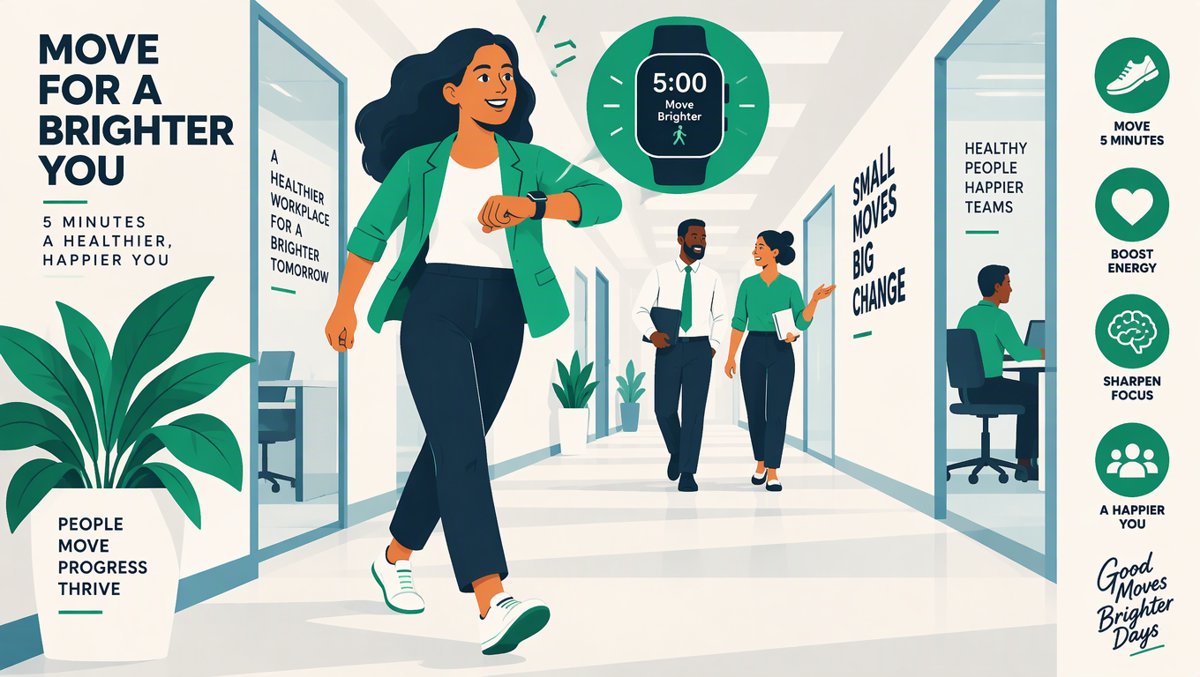
So you're thinking: "Okay Emily, how often do I need to get up — and for how long?" Great news: a Columbia lab actually tested the menu for us. In a randomized crossover trial, 11 middle-aged adults sat for 8-hour stretches on five separate days, testing different "exercise snacks": 1 minute of walking every 30 minutes, 1 minute every 60, 5 minutes every 30, 5 minutes every 60, or no walking at all — with blood sugar checked every 15 minutes and blood pressure every hour.¹
The verdict:
- 5 minutes of light walking every 30 minutes was the ONLY dose that significantly lowered BOTH blood sugar AND blood pressure compared to sitting straight through.¹
- That same regimen slashed post-meal blood-sugar spikes by a stunning 58% versus uninterrupted sitting.¹
- Every walking dose — even a single minute per hour — dropped blood pressure by 4–5 mmHg. Dr. Diaz called that "a sizeable decrease, comparable to the reduction you would expect from exercising daily for six months."¹'⁵
- Bonus: the walking regimens (except the tiniest one) also reduced fatigue and lifted mood.¹
The blood-sugar mechanism is delightfully simple, per Dr. Diaz: muscles regulate blood sugar and cholesterol — but only when they're used and contracted. Frequent short walks keep those metabolic machines switched on all day instead of letting them idle for eight hours.¹
🔑 Key Takeaway: Think of a 5-minute stroll every half hour as the "full dose," and a 1-minute walk per hour as the budget version — both beat sitting still, and the numbers are bigger than most people expect.
🎯 Section 3: Can Your Workout Cancel the Chair? (The Honest Answer)

Here's where the science gets genuinely interesting — and where two big studies paint two halves of the same picture. A Lancet meta-analysis pooling data from 1,005,791 people found that people who logged 60–75 minutes of moderate-intensity activity a day (think brisk walking or cycling) had sitting-related death risk that essentially disappeared — even for those sitting 8+ hours daily.² That's the optimist's headline.
But the Diaz cohort study adds the sober footnote: death risk climbed with sitting time and long bouts even after accounting for exercise habits.³ Translation: your 6 a.m. run is medicine — real, potent medicine — but it doesn't grant immunity to a 4-hour, motionless spreadsheet session.
The resolution researchers themselves offer: do both. Move a lot (the WHO recommends 150–300 minutes of moderate activity per week for adults⁶), and interrupt the chair time. As the Annals study authors put it, guidelines should target reducing and interrupting sedentary time.³'⁴
A few honest caveats so you don't fall for the marketing:
- Standing desks alone aren't proven protection. Mayo Clinic notes it's not clear whether standing by itself lowers the risk.²'⁷ Sit-stand alternating plus walking breaks is the evidence-backed combo.
- The couch counts too. In the Lancet data, TV time was even harder to offset than desk time — 5+ hours daily was linked to higher death risk even among the most active folks.⁸ (Probably because couch-sitting rarely comes with breaks… and often comes with snacks. 🍿)
- Fun fact for your next trivia night: this whole field traces back to a 1953 Lancet paper comparing London bus drivers (seated all day) with conductors (constantly on the move) — the drivers had more heart disease.⁹ Science has been side-eyeing the chair for 70+ years.
🔑 Key Takeaway: Big daily movement raises your ceiling, but breaking up sitting raises your floor. You want both — and the walking-break version is the one you can actually do during work.
🛠️ Your Chair-Proof Day: 5 Actionable Tips
- Set a 30-minute movement timer. Phone, watch, whatever nudges you. When it pings: stand, stretch, or do one lap. That's the dose the lab data loves.¹
- Bottle-cue yourself. Keep a water bottle at your desk; every refill is a built-in walk. Hydration + movement in one habit. 💧
- Walk your calls. Meetings without screens? Take them on foot. Phone catch-ups with mom? Stroll the hallway or block.
- Make the 5 minutes delightful. A favorite playlist, a window lap, a quick stair loop — the study found these breaks boost mood, so engineer ones you'll actually enjoy.¹
- Stretch your streaks, not just your legs. Aim to keep any single sitting stretch under ~30 minutes most of the day — that was the pattern tied to the lowest mortality risk.³
🎯 Key Takeaways
- Sitting 8+ hours a day with little movement carries a death-risk profile similar to smoking or obesity — and your workout doesn't fully cancel long chair stretches.²'³
- The full fix is big: about 60–75 minutes of moderate movement a day (brisk walking counts!) appears to erase sitting's extra mortality risk. Worth chasing when life allows.²
- The desk-friendly MVP: a 5-minute light walk every 30 minutes — the only tested dose that cut both blood sugar and blood pressure, trimming post-meal glucose spikes by 58%.¹
- Every walking-break dose dropped blood pressure 4–5 mmHg — comparable to six months of daily exercise — so even a 1-minute hourly stroll is worth it.¹'⁵
- Standing desks alone aren't proven protection, and couch time counts against you too. Break up chair stretches, keep them under ~30 minutes, and move on your calls.²'³'⁷
🎧 Key Takeaways — Listen (2 min)
📚 Verified Sources
- Duran AT, et al. "Breaking Up Prolonged Sitting to Improve Cardiometabolic Risk: Dose–Response Analysis of a Randomized Crossover Trial." Medicine & Science in Sports & Exercise (2023). Columbia University trial testing five walking-break doses over 8-hour sitting sessions; 5-min-every-30-min was the only dose to significantly lower both glucose and blood pressure, cutting post-meal glucose spikes 58%. https://pubmed.ncbi.nlm.nih.gov/36728338/
- Mayo Clinic. "Sitting risks: How harmful is too much sitting?" (Expert Answer, updated Mar 25, 2025). Cites the 13-study, 1-million-person analysis: 8+ hours daily sitting with no activity = death risk similar to obesity and smoking; 60–75 min/day moderate activity offsets it; standing-alone benefits unproven. https://www.mayoclinic.org/healthy-lifestyle/adult-health/expert-answers/sitting/faq-20058005
- Diaz KM, et al. "Patterns of Sedentary Behavior and Mortality in U.S. Middle-Aged and Older Adults: A National Cohort Study." Annals of Internal Medicine (2017). 7,985 adults tracked by accelerometer; sedentary time = 77% of waking hours (~12+ hrs); 13+ hrs/day with 60–90-min bouts ≈ two-fold mortality risk; sub-30-minute bouts = lowest risk. https://pubmed.ncbi.nlm.nih.gov/28892811/
- Columbia University Irving Medical Center / EurekAlert. "Long sitting periods may be just as harmful as daily total." (Sep 11, 2017). Official study release with Dr. Diaz's guidance: "take a movement break every half hour," and independent-of-exercise-habit findings. https://www.eurekalert.org/pub_releases/2017-09/cumc-lsp090817.php
- Popular Science. "Mini walk breaks every 30 minutes can boost your health." Coverage of the Duran/Diaz trial with co-author quotes: all walking doses cut BP 4–5 mmHg ("comparable to… exercising daily for six months"); practical desk tips. https://www.popsci.com/health/exercise-sitting-work
- World Health Organization. "Physical Activity" Fact Sheet. WHO guidance: adults should limit sedentary time and get 150–300 minutes of moderate-intensity activity weekly. https://www.who.int/news-room/fact-sheets/detail/physical-activity
- Mayo Clinic News Network. "Mayo Clinic Q and A: Active work stations because sitting all day is bad for your health." (Mar 20, 2025). Expert discussion of active workstations and sedentary-risk reduction. https://newsnetwork.mayoclinic.org/discussion/mayo-clinic-q-and-a-active-work-stations-because-sitting-all-day-is-bad-for-your-health/
- MedPage Today (with The Lancet). "Doing 60 to 75 minutes of moderately intense physical activity a day can help reverse the detrimental effects of a sedentary lifestyle." Coverage of Ekelund 2016 meta-analysis incl. TV-viewing findings (HR 1.16 for 5+ hrs/day TV in the most active). https://www.medpagetoday.com/primarycare/exercisefitness/59360
- The Lancet. Ekelund U, et al. "Does physical activity attenuate, or even eliminate, the detrimental association of sitting time with mortality? A harmonised meta-analysis of data from more than 1 million men and women." (2016). The primary Gold-tier source: 60–75 min/day moderate activity seems to eliminate the sitting-mortality association. https://www.thelancet.com/journals/lancet/article/PIIS0140-6736(16)30370-1/abstract
All claims fact-checked against Gold-tier (CDC/NIH/WHO/PubMed/Nature/The Lancet) and Silver-tier (Mayo Clinic/Harvard Health/Cleveland Clinic) authoritative sources. Last verified: November 8, 2026.
Your chair is furniture — your body is the adventure. Stand up, take the lap, and let your muscles clock back in. I'll be right here cheering (from a standing desk). 🚶♀️✨